


More news on this day
Germany’s three key Emirates gateways of Frankfurt, Munich and Düsseldorf are set to lose the airline’s flagship Airbus A380 for part of the 2026 summer schedule, as the Dubai carrier temporarily switches to smaller Boeing 777 and Airbus A350 aircraft amid a broader reshuffle of its superjumbo network.
Get the latest news straight to your inbox!
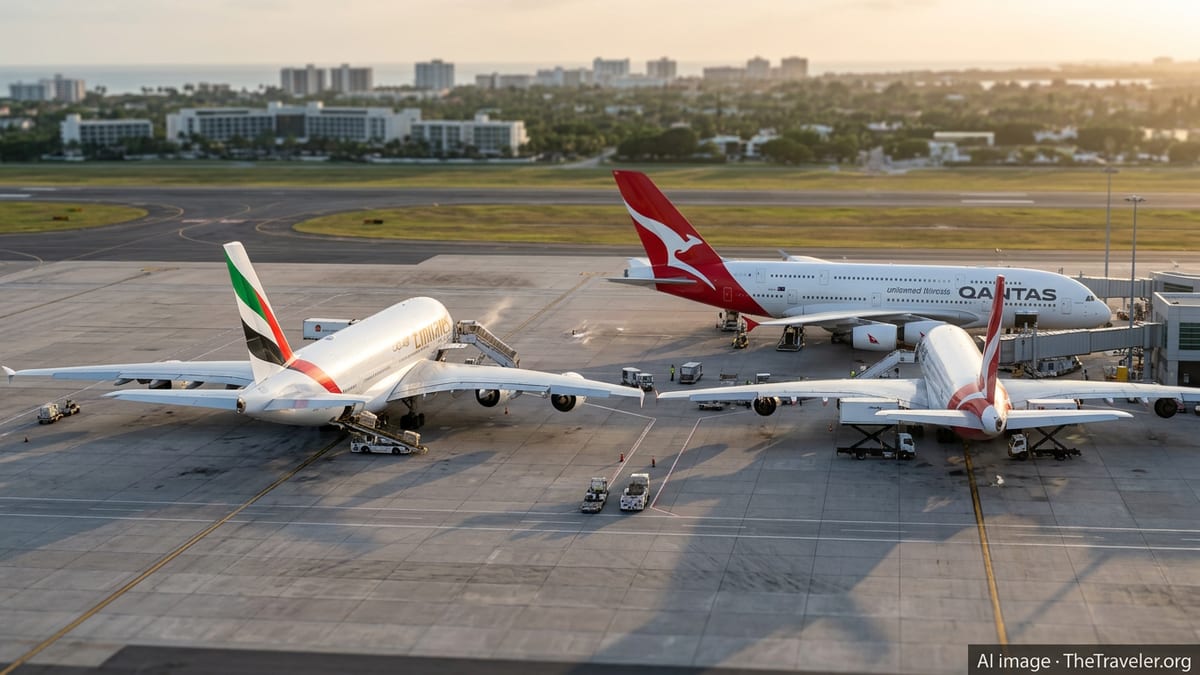
Schedule Filings Show A380 Gap Across German Gateways
Published schedule data and specialist route reports indicate that Emirates will pause A380 operations to all three of its German destinations for several weeks in June and July 2026. Frankfurt, Munich and Düsseldorf, which have all been regular fixtures on the airline’s superjumbo roster in recent years, are instead slated to see Boeing 777-300ER and, on selected rotations, the new Airbus A350-900.
Aviation-focused outlets tracking timetable changes report that the adjustment appears in filings updated in early June, covering the first half of the peak European summer period. For now, the underlying Dubai to Germany frequencies largely remain, but with capacity trimmed as the double decker is swapped for smaller widebodies. The pattern mirrors moves on other Emirates A380 routes in Europe and North America where the aircraft has been temporarily removed.
German-language industry coverage notes that Emirates has already circulated revised equipment plans to distribution channels for Frankfurt and Munich, with the A380 absent from booking displays for several weeks. Düsseldorf, which had seen a more limited A380 presence, is understood to follow a similar pattern, aligning the three German gateways under a common summer equipment strategy.
Maintenance, Retrofits and Network Pressures Drive Fleet Shuffle
The pause in German A380 services comes as Emirates continues a multi-billion-dollar retrofit program for its superjumbo fleet, introducing a refreshed cabin design and an expanded Premium Economy product. Recent coverage of the retrofit effort highlights that each A380 requires several weeks of downtime for interior work, constraining the number of aircraft available for frontline routes at any one time.
At the same time, the carrier is still adjusting to wider operational pressures. Over recent months, Emirates has repeatedly trimmed A380 flying on a number of long haul routes, particularly in response to evolving airspace restrictions and higher operating costs on some sectors. Analysts point out that concentrating the available A380s on a smaller set of high-yield destinations, while backfilling others with 777 and A350 capacity, allows the airline to protect premium revenue while keeping schedules broadly intact.
Germany’s role as a strong premium and corporate market means that the country is unlikely to be sidelined for long. However, the current combination of cabin retrofits, network disruptions and seasonal planning appears to have tipped the balance toward a temporary downgrade in gauge rather than outright frequency cuts. The resulting aircraft mix is intended to preserve connectivity between Dubai and Germany while freeing A380 frames for refurbishment or deployment elsewhere.
Boeing 777 and Airbus A350 Step In to Cover Summer Demand
In place of the A380, Emirates is planning to rely primarily on the Boeing 777-300ER, the backbone of its long haul fleet, for Germany during the affected period. The type offers a smaller seat count than the A380 but remains competitive on cargo capacity and range, making it a logical substitute where schedule integrity is a priority.
More notably, some rotations to Germany are expected to feature the airline’s new Airbus A350-900, which is progressively joining the fleet. Publicly available fleet information shows that Emirates is integrating the A350 on medium to long haul routes where fuel efficiency and operating economics are particularly important. Deploying the A350 alongside the 777 allows the carrier to fine-tune capacity while showcasing its latest cabin product to German passengers.
Travel agents and booking data indicate that, for most passengers, the change will manifest as an equipment swap rather than a cancelled flight. Timings between Dubai and the three German airports remain broadly similar in current schedules. However, travelers who had specifically chosen the A380 for its spacious cabins, onboard bar area or upper deck experience will find those features absent on the 777 and A350, even if service standards remain aligned with the wider Emirates brand.
Impact on Passengers and Competitive Landscape in Germany
The short term withdrawal of the A380 from Germany is expected to have several knock-on effects for travelers and competitors. With smaller aircraft operating in place of the superjumbo, total seat capacity between Dubai and Germany will fall for the duration of the pause. This could translate into higher load factors and, in some cases, firmer fares during peak travel weeks if demand remains strong.
For Germany’s airports, the absence of the A380 briefly alters the mix of very large aircraft movements. Frankfurt and Munich, which already handle significant A380 activity from other carriers, are unlikely to face major operational disruption. Düsseldorf, where A380 appearances have been less frequent, will instead see a more conventional widebody profile in its summer schedule.
From a competitive standpoint, the move may create a modest opening for rival airlines offering connections between Germany and Asia, Africa or Australasia via their own hubs. However, Emirates’ established brand recognition, along with its decision to keep German frequencies largely intact using alternative widebodies, suggests that the airline intends to defend its position in the market even without the visual draw of the A380 for a few weeks.
Temporary Pause Fits Into Longer Term A380 Strategy
Industry observers interpret the German changes as a tactical adjustment, not a signal that Emirates is withdrawing the A380 from the country on a permanent basis. The airline has repeatedly emphasized in public statements and interviews that it plans to operate the type well into the next decade, supported by ongoing cabin upgrades and engine maintenance agreements.
Recent analysis of Emirates’ broader network underscores that the carrier continues to reintroduce the A380 on a mix of trunk routes and high volume leisure markets as conditions allow, even while trimming the aircraft from others. Rotational pauses like the one now affecting Germany are increasingly seen as a feature of this flexible deployment strategy, reflecting the realities of retrofit slots, maintenance cycles and shifting demand patterns.
For passengers planning trips between Germany and Dubai this summer, the most immediate advice from travel industry guidance is to monitor booking references and seat maps closely, as aircraft assignments may continue to evolve closer to departure. While the A380 will briefly disappear from Frankfurt, Munich and Düsseldorf, the underlying connection between Germany and Emirates’ Dubai hub remains intact, supported by a mix of Boeing 777 and Airbus A350 services designed to bridge the gap until the superjumbo’s planned return.