


More news on this day
Germany is moving to strengthen passenger safety across its rail network with the introduction of BODE’s BMU-3 intelligent sensor system, a smart train door technology designed to reduce accidents at the platform–train interface while keeping services running on time.
Get the latest news straight to your inbox!
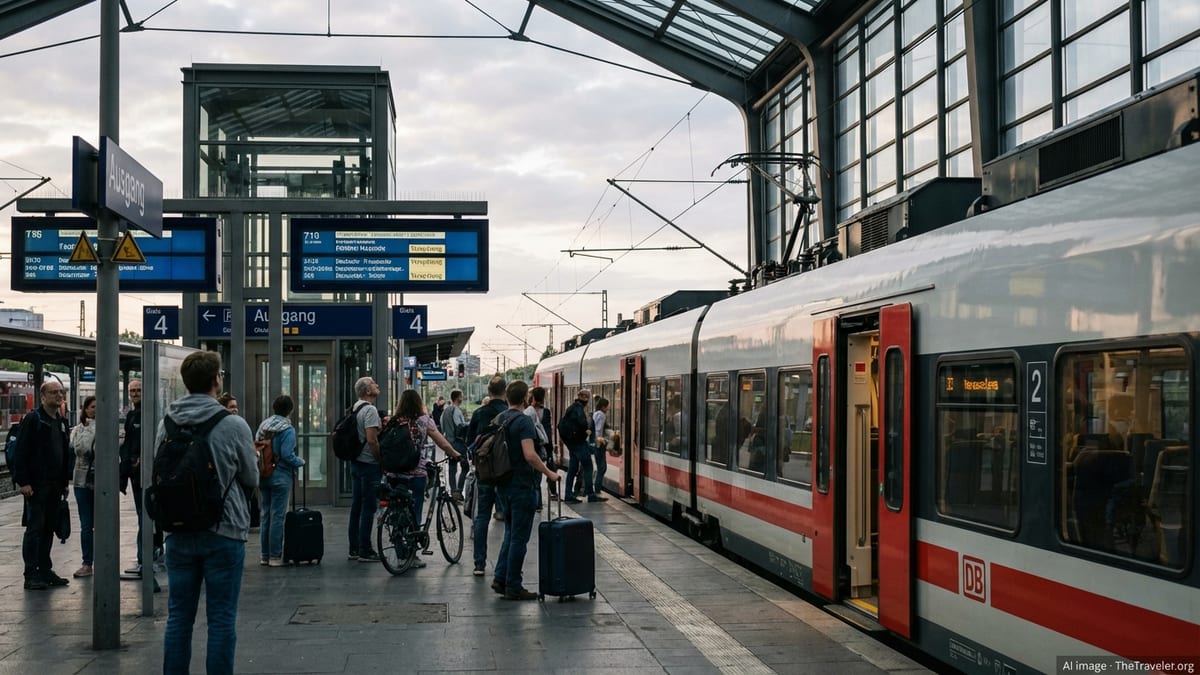
New Sensor-Based Door Systems Target Known Safety Risks
The deployment of the BMU-3 system comes against a backdrop of long-standing concerns about accidents involving closing train doors, including trap-and-drag incidents in which passengers or luggage become caught as trains depart. Publicly available safety investigations in Europe have repeatedly highlighted these risks, particularly on busy commuter and metro services where high passenger volumes and short dwell times put pressure on door operations.
The BMU-3 system, developed within the BODE group of companies in Germany, is presented by the manufacturer as a central “boarding management unit” for rail vehicles. Company information describes it as an intelligent sensor platform that replaces multiple conventional door-side controls and safety devices with a single integrated unit. This approach is intended to simplify wiring and interfaces, and to provide more consistent monitoring of the space around train doors.
According to product documentation, the sensor field in front of each doorway can detect the presence and movement of passengers, mobility aids, bicycles and other objects while the train is at the platform. The system is designed to prevent the doors from closing when a person or obstacle is detected in the danger zone and to support more reliable confirmation that the doorway is clear before departure.
Industry coverage of smart door technologies indicates that such systems are increasingly being considered a key component in modern rolling stock procurement, as operators seek to align with national and European guidance on platform–train interface risk. Germany’s move to introduce BMU-3 technology reflects that wider trend toward using digital and optical sensing at the doors rather than relying solely on mechanical edges and basic light beams.
How the BMU-3 Intelligent Sensor System Works
Technical material released by the BODE group describes BMU-3 as a multifunction sensor that creates a monitored zone around each door opening. Instead of separate push buttons, tread plates, light curtains and obstacle detectors, the BMU-3 unit combines these functions into a single module mounted in the door environment and connected to the train’s control network.
The sensor uses scanning technology to monitor the doorway and the immediate platform area during boarding and alighting. When a train stops and doors are commanded open, the BMU-3 can support contactless activation, enabling passengers to trigger door opening via virtual buttons or proximity-based detection rather than physical switches. As boarding continues, the unit tracks movements and is configured to recognise when people are still entering or exiting, keeping the closing sequence inhibited as long as the area remains occupied.
Once the platform area is assessed as clear, the door control logic allows the closing cycle to begin. If an object or person moves back into the monitored zone during closure, the sensor is intended to either prevent the doors from closing fully or command them to reopen, reducing the risk of trapping. In parallel, the BMU-3 provides status data to the vehicle’s onboard systems, supporting remote diagnostics and integration with train control and monitoring equipment.
Promotion of the technology by the manufacturer and in specialist rail media stresses that the BMU-3 is not limited to door-edge protection. The system architecture supports additional functions such as counting passengers, wheelchairs and strollers, assisting operators in understanding crowding levels and dwell time pressures in real time. These capabilities are positioned as useful tools both for day-to-day operations and for longer-term planning of capacity and timetable changes.
Germany’s Rail Modernisation and Safety Goals
The introduction of BMU-3-based smart doors fits within a broader push to modernise Germany’s rail infrastructure and rolling stock. National rail operators and regional transport authorities have been investing in new trains, signalling upgrades and station improvements in an effort to increase capacity, improve punctuality and shift more journeys from road to rail.
Within this context, door systems are a relatively small but critical part of overall performance. Studies on urban and mainline railways in Europe have shown that incidents at the platform–train interface can lead not only to injuries, but also to extended service disruptions while investigations and rescue operations take place. Reducing the likelihood of such incidents is seen as a way to protect passengers and avoid knock-on delays across dense networks.
Public guidance published in recent years by safety bodies in the United Kingdom and elsewhere has highlighted cases in which older trains without sensitive door edges or advanced anti-drag protections were involved in passenger accidents. These reports have contributed to a growing consensus that next-generation fleets should incorporate more sophisticated door and platform interface technology. Observers note that Germany’s adoption of BMU-3 sensors on new and refurbished trains appears aligned with these emerging expectations.
Germany is also under pressure to maximise accessibility and convenience for passengers with reduced mobility. Smart door systems that can coordinate with retractable steps, gap fillers and platform screens are seen as contributors to a more inclusive network, where boarding and alighting are smoother for all users, including wheelchair users and travellers with prams or heavy luggage.
Implications for Train Operations and Passenger Experience
Rail industry analyses point out that intelligent door systems can influence both safety statistics and operational performance. By providing a clearer view of the doorway environment and automating parts of the decision process, BMU-3-type sensors can support more predictable dwell times, especially at heavily used stations where staff cannot easily monitor every door simultaneously.
With the BMU-3’s ability to capture data about passenger movements, operators may gain new insight into where and when trains experience the greatest boarding pressure. Over time, this information could be used to adjust staffing, change train formations or refine timetables to better match demand. For regular passengers, the benefits are expected to appear as fewer abrupt door closures, less time spent waiting for manual checks and a smoother flow on and off trains.
Specialist coverage of BODE’s sensor portfolio highlights that smart doors can also support hygiene-focused measures such as touch-free activation, which became a focus for some transport systems in the wake of public health concerns. Germany’s decision to deploy a sensor platform capable of supporting such features indicates an interest in future-proofing rolling stock for evolving expectations around comfort and cleanliness.
However, rail commentators caution that technology on its own does not eliminate risk. Effective use of systems like BMU-3 depends on appropriate configuration, maintenance and staff training, as well as clear passenger information. German operators introducing the new door systems are expected to integrate them with existing rules for dispatch and platform safety, rather than relying solely on automation.
Germany’s Role in Exporting Smart Door Technology
Beyond domestic deployments, the BODE group is positioning its BMU-3 and related systems as export products for international rail projects. Company profiles describe the business as a specialist in mobile transportation technology within the wider Schaltbau Group, with door systems already in use on rail and bus fleets in multiple countries.
As demand grows worldwide for safer and more accessible public transport, Germany’s experience with smart door sensors is likely to be closely watched by other railways considering upgrades. Trade fair materials and rail technology features indicate that BODE has been presenting BMU-based solutions to operators and vehicle manufacturers across Europe, Asia and the Americas, marketing the combination of safety, digital connectivity and modular design.
Analysts suggest that if Germany’s rollout of BMU-3-equipped rolling stock demonstrates measurable reductions in door-related incidents and service disruptions, the technology could become a reference point for future standards. This would reinforce Germany’s status as a significant exporter of rail safety and control technology, complementing its established presence in rolling stock, signalling and electrification markets.
For travellers, the shift may be most visible in subtle ways: doors that respond more intuitively, trains that depart promptly even in crowded conditions and networks that experience fewer unexpected stoppages linked to platform–train incidents. As the BMU-3 system moves from technical specification sheets into daily service, Germany’s rail passengers will be among the first to test whether smarter doors can deliver a safer and more reliable journey.