


Many visitors arrive in Skaftafell with a very specific picture in mind: that they will strap on crampons and step directly onto Skaftafellsjökull, the photogenic glacier tongue visible from the popular S1 hiking trail. In practice, however, most guided glacier hikes and ice cave tours sold “from Skaftafell” take place on nearby outlet glaciers such as Falljökull and Virkisjökull, reached by short shuttle drives from the national park’s main parking area. This article unpacks why that is, what kinds of tours currently operate from Skaftafell, and how to match your expectations with the on-the-ground reality.
Get the latest updates straight to your inbox!
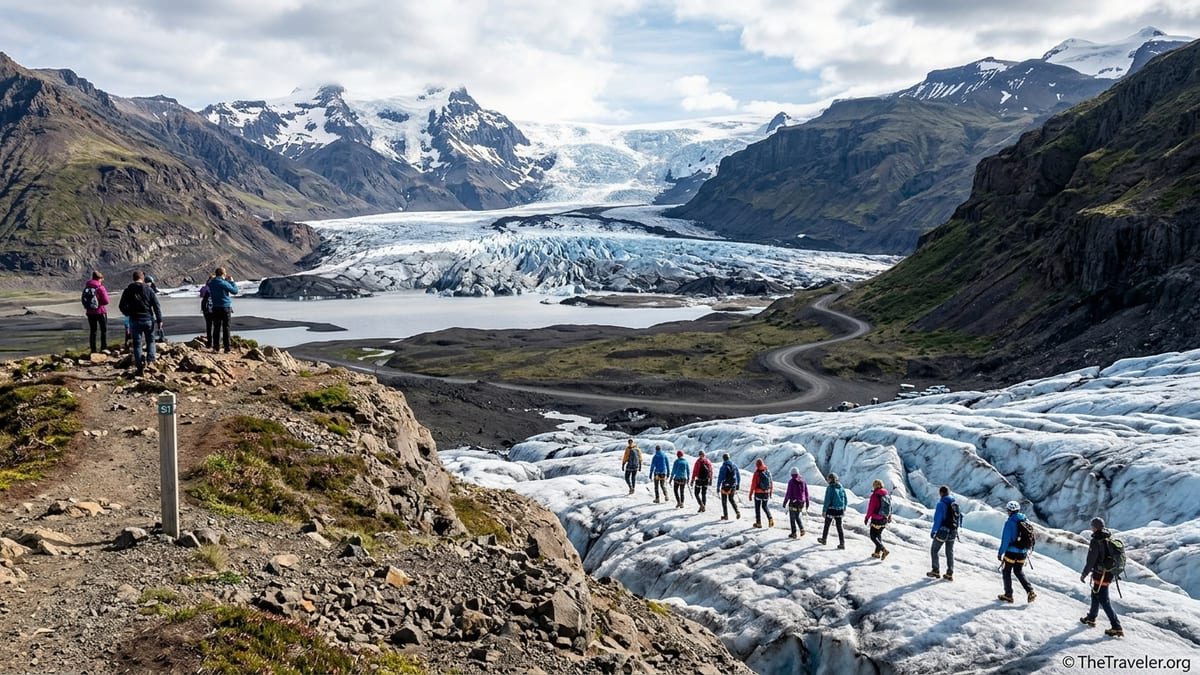
Skaftafell as a Hub within Vatnajökull National Park
Skaftafell is one of the main visitor hubs inside Vatnajökull National Park in Southeast Iceland. The visitor area sits just off the Ring Road, with a large parking lot, campground, service buildings and a network of marked hiking trails, including the easy S1 route to a viewpoint over Skaftafellsjökull. From here, visitors see one of several glacier tongues that descend from the Vatnajökull ice cap toward the coastal plain.
Commercial glacier activities from Skaftafell are organized on specific outlet glaciers rather than on every glacier visible from the trails. Current tour descriptions by major operators state that their guided glacier walks and combined hike plus ice cave trips from Skaftafell operate on nearby outlets such as Falljökull and, in some formats, the adjacent Virkisjökull. Operators highlight these outlets as offering accessible ice, crevasse fields and scenic views within a relatively short driving and hiking approach from the Skaftafell base.
As of November 2026, a review of representative tour offerings and park concession information indicates that standard commercial glacier hikes are not routinely advertised as taking place on Skaftafellsjökull itself. Independent information from glacier specialists notes that companies previously worked on several tongues in the area but have concentrated on Falljökull and neighboring outlets in recent years. If any operator begins promoting a dedicated Skaftafellsjökull walk in the future, travelers should read the detailed description carefully, as product names and meeting points can be similar.
The national park manages an annual licensing system for companies offering glacier hikes and ice cave trips on specific outlet glaciers inside the protected area. These concession agreements define which businesses can guide on named glacier sectors and for what period, and they are renewed on a time bound basis rather than being permanent rights. Current contracts reference areas including Falljökull and Virkisjökull, along with other outlets farther east, with validity periods typically stated by season or year.
Why Guided Tours Rarely Walk on Skaftafellsjökull
The fact that most tours do not step onto Skaftafellsjökull itself is not an oversight but reflects a mix of terrain, safety and operational considerations. Accessibility plays a key role. The viewpoint reached by the S1 trail looks across a proglacial lagoon and steep, broken ice. That scenic setup makes Skaftafellsjökull excellent for photographs and for understanding how the glacier has retreated, but it also means that safely reaching stable ice would require more time and more complex route finding than many short commercial tours can accommodate.
By contrast, Falljökull and Virkisjökull provide relatively direct access from vehicle parking on approved tracks to suitable ice surfaces. Operators describe a pattern where their minibuses make a short transfer, followed by a guided walk across rocky moraine, before guests step onto the glacier itself. The ice here typically offers rolling gradients, crevasse fields and serac formations that are dramatic but still manageable for groups using basic crampon technique under a certified guide.
There are also safety and regulatory reasons not to treat every glacier tongue the same way. Glacier tongues change constantly due to melting, crevassing and rockfall from surrounding mountains. Some nearby outlets that once hosted popular hikes have been withdrawn from regular commercial use after updated risk assessments. While specific hazard reports are often internal, public commentary notes that concern about unstable slopes and potential landslides has influenced guiding patterns on certain glaciers in the region.
Finally, tour logistics favor concentration on a smaller number of high quality, relatively predictable outlets. Vans and guiding teams can move efficiently between Skaftafell base camp and the same glacier access points throughout the day, supporting multiple departures with consistent terrain. Skaftafellsjökull, in practice, fits better into the park’s network of hiking viewpoints than into this intensive guiding model, even though it remains one of the visual icons of Skaftafell.
Where Skaftafell Glacier Hikes Actually Take Place
To understand where you will actually walk on ice, it is essential to read not only the tour title but also the detailed description. Several major operators currently offering glacier hikes from Skaftafell specify that the walk takes place on an outlet of Vatnajökull reached by vehicle transfer. Descriptions commonly name Falljökull, and in some cases reference the Falljökull and Virkisjökull area, as the primary terrain for standard blue ice hikes departing from the Skaftafell parking area.
Typical “from Skaftafell” glacier hikes include short introductions of roughly 2.5 to 3 hours total, products marketed as more extensive half day hikes of around 4 to 5 hours, and seasonal winter options that combine a glacier walk with time inside a natural blue ice cave. These are framed in booking systems as Skaftafell based departures, but the ice underfoot is usually on one of the nearby tongues accessible by approved tracks, not on Skaftafellsjökull itself.
Some regional products sold through third party platforms list a meeting point a few minutes’ drive from Skaftafell, such as a service station or private base camp, while still using the Skaftafell area as shorthand. In practice, these also target Falljökull or a neighboring outlet and may specify that guests must arrive at the designated base rather than drive onto unpaved access roads independently. Where operators use super jeeps rather than standard minibuses, the approach can be longer but follows the same principle: Skaftafell is the hub, the glacier tongue itself is a specific, often named, destination reached by company vehicles.
Independent informational sites that map glacier tours in Southeast Iceland reflect this reality, listing the Skaftafell car park as a meeting point for several companies while clearly labelling the actual glacier terrain as Falljökull or other outlets. Combined with the park’s own trail mapping, the picture that emerges is that Skaftafellsjökull is the scenic backdrop for walkers on the S1 trail, whereas guided crampon walks are concentrated on the more guide friendly tongues to the east.
Types of Glacier Tours from Skaftafell Today
Glacier tours from Skaftafell generally fall into three broad formats, with variations by operator and season. The first are introductory blue ice walks of around 2 to 3 hours in total, marketed to first time glacier visitors and families. These usually include approximately one hour on the ice itself, framed by a short bus ride from Skaftafell and a hike across moraine. Fitness requirements are described as moderate: guests should be comfortable walking on uneven ground for a couple of hours but do not need prior technical experience. Minimum ages on these shorter tours are often set around 8 years, though exact limits vary and some companies set higher thresholds.
A second category comprises longer hikes of roughly 4 to 5 hours, sometimes billed as “adventurous” or “extended” glacier hikes. These trips aim to reach higher elevations and more complex ice features, such as deeper crevasses and icefalls, and often involve more time practicing crampon technique. Advertised fitness expectations are higher, with operators advising that participants should be able to walk for several hours at a steady pace and manage steeper sections of ice. Minimum ages may rise into the early teens, and these hikes are less likely to be recommended for very young children or travelers with limited mobility.
The third major category is seasonal ice cave tours, typically offered from roughly late autumn through early spring when colder temperatures help stabilize natural caves and tunnels within the glacier. Some of these tours from Skaftafell are primarily glacier walks with a short visit to a cave at the high point, while others place more emphasis on time inside an ice chamber. Operators caution that availability, cave location and accessibility change from year to year, and they adjust itineraries accordingly. Publication season tables for 2026 to 2027, for example, differentiate between caves near Skaftafell and larger, separate cave systems accessed from the Jökulsárlón area.
Across all categories, tour descriptions explain which equipment is included. Standard packages from Skaftafell generally provide crampons, a helmet and an ice axe for use on the glacier. Many operators also include a climbing harness, particularly on tours that venture into more crevassed terrain or into caves where roped travel may be required. Sturdy hiking boots that fit crampons are essential; some companies offer boot rental at extra cost for guests who do not have appropriate footwear, while others stipulate that participants must bring their own boots and will be turned away if their shoes are not suitable.
Logistics: Meeting Points, Shuttles and Self Driving Rules
Transport logistics are an important and sometimes overlooked part of planning a Skaftafell glacier hike. For most mainstream products, guests are instructed to meet at Skaftafell base camp or a clearly identified nearby service point at a fixed check in time. There, they complete registration, collect any rental equipment and receive a safety briefing. Only after this do groups board company vehicles to travel to the actual glacier access point.
Current tour notes emphasize that guests should not attempt to drive themselves to the glacier trailheads used by guiding companies. The approach tracks are often rough, unsigned and subject to park access rules that differentiate between licensed operators and the general public. Minibuses and super jeeps operated by licensed companies follow designated routes and parking arrangements agreed with the park, allowing them to drop groups close to the glacier margin without creating unmanaged traffic or safety issues on narrow gravel tracks.
Travelers planning a packed Ring Road itinerary need to account for this structure when timing their day. A three hour tour block from Skaftafell does not equate to three hours of walking; it includes check in, gearing up, the vehicle transfer and a portion of time on moraine as well as on ice. Similarly, longer four to five hour departures can occupy most of a daylight half day, especially in winter, leaving limited time for additional major stops if you are attempting a multi hour drive the same day.
Joining instructions also underscore the need to arrive early. Several operators specify a recommended arrival 20 to 30 minutes before departure time to complete formalities and be ready to board the shuttle. In winter, they warn that road conditions between Reykjavík, Vík, Kirkjubæjarklaustur and Skaftafell can be variable, and that late arrival may result in missing the tour with no refund according to stated cancellation policies.
Safety, Regulations and the Role of Certified Guides
Vatnajökull National Park and Icelandic authorities strongly advise against unguided glacier hiking on Vatnajökull’s outlet glaciers, including those around Skaftafell. Glacier surfaces conceal crevasses, moulins and unstable snow bridges that can be difficult or impossible for untrained visitors to read, especially in poor weather or low contrast light. Even where tracks from previous groups are visible, conditions can change within hours as ice melts or new snow falls.
Licensed operators working from Skaftafell employ certified glacier guides trained in ropework, rescue techniques and hazard assessment. Many tours from Skaftafell are described as non technical in the sense that guests do not use ropes or climb vertical ice, but the guides still manage group spacing, route choices and exposure around crevasses. Their presence is a key safety measure, not simply an add on for commentary.
The park’s concession system and annual licenses play a regulatory role in concentrating commercial glacier traffic on defined outlets and companies. Recent documentation notes that dozens of companies hold or have held licenses for glacier hiking and ice cave operations in specific sectors, with fees per visitor and validity typically limited to a single operating year or season. This time bound framework allows the park to adjust access in response to changing glacier conditions, safety assessments and visitor volume.
From a traveler’s perspective, the practical message is straightforward. If you wish to step onto glacier ice near Skaftafell, you should do so with a reputable, licensed operator, on a product explicitly described as a glacier hike or combined hike and cave tour. Walking close to the ice margin from public trails, or attempting to climb down unsupervised toward crevasse fields, is both discouraged and potentially dangerous.
Skaftafellsjökull Viewpoints versus Glacier Hikes
The easy S1 trail from Skaftafell visitor area to the Skaftafellsjökull viewpoint is one of the most popular short walks in the region. Trail descriptions state that the route follows a well marked gravel path of roughly an hour to an hour and a half round trip, suitable for most visitors in fair weather. The reward is a raised vantage point over Skaftafellsjökull and its meltwater lagoon, with interpretive material in some resources highlighting how far the glacier front has retreated in recent decades.
Experientially, this viewpoint walk and a guided glacier hike are complementary rather than interchangeable. On S1, you remain on dry ground, often some distance above the glacier, observing the tongue as part of the wider landscape. You gain a sense of scale, of how the glacier has shaped the valley and how its retreat has exposed new terrain. On a glacier hike, by contrast, you feel the ice under your feet, hear meltwater running beneath, and see crevasse patterns and crystal structures at arm’s length.
Because these experiences serve different purposes, many visitors choose to do both. A common pattern is to hike to the Skaftafellsjökull viewpoint either before or after a booked glacier tour, time and weather permitting. Others may combine S1 with a longer trail such as the route to Svartifoss waterfall or to higher viewpoints over multiple glacier tongues on a separate day, reserving one dedicated half day for guided time on the ice.
Understanding this distinction helps manage expectations. Booking a “Skaftafell glacier hike” does not automatically mean you will stand on the specific tongue you see from the S1 viewpoint, and walking S1 does not place you on glacier ice. Framing Skaftafellsjökull primarily as a scenic highlight accessed by regular hiking trails aligns more closely with how the area is currently managed and marketed.
Choosing the Right Glacier Tour from Skaftafell
Selecting a glacier tour from Skaftafell involves balancing fitness, time, season and personal priorities. Those on tight itineraries or with limited hiking experience may gravitate toward the shorter 2 to 3 hour tours, which provide a taste of crampon walking and glacier scenery within a compact time slot. Travelers with a full day in the area and good fitness may prefer the longer half day hikes that reach more remote parts of the glacier and spend more time away from the busiest lower sections.
Season plays an equally important role. In summer and the shoulder months, the focus is on blue ice hikes, with the glacier surface generally more accessible and daylight plentiful. In winter, tours may emphasize ice caves, but weather can cancel or shorten trips, and daylight hours are short. Current season schedules published by major operators show that specific cave products open and close on different dates within the October to April window, depending on safety assessments and structural stability, so flexibility and careful reading of date ranges are essential.
Group size, guiding language and cancellation terms also vary by operator and product. Some companies promote small group formats with tighter maximum numbers, which can mean more individual attention and easier movement in complex terrain. Others run larger groups but may offer more departure times. Most operators provide guiding in English as standard, with occasional departures in other languages, but this is always subject to confirmation in the booking details rather than guaranteed across all dates.
Prices and inclusions change by operator, tour length and season, and are subject to regular updates. Prospective guests should research current price ranges directly from company booking pages and note exactly what each tour includes, from crampons and harnesses to boot rental and transportation. It is good practice for writers and readers alike to verify such details against the latest information at the time of publication; for this article, checks were made against operator listings and park resources current to November 2026, but travelers booking later should anticipate further adjustments.
So, Can You Walk on Skaftafellsjökull Itself?
Returning to the initial question, the weight of current evidence suggests that visitors planning a trip as of late 2026 should not expect to book a standard guided group hike that specifically walks on Skaftafellsjökull. Instead, most glacier walks and ice cave combinations marketed from Skaftafell base camp operate on neighboring outlet glaciers, particularly Falljökull and, in some cases, the connected Virkisjökull area. Product titles often reference Skaftafell because that is the meeting point and the recognizable destination on most itineraries, not because Skaftafellsjökull is the glacier tongue used for the hike.
This does not diminish the value of Skaftafellsjökull as an experience. The S1 viewpoint trail provides one of the clearest and most family friendly opportunities in Iceland to observe a retreating glacier tongue and its lagoon at close range without technical equipment. For many visitors, pairing that trail with a guided walk on a nearby outlet offers a richer understanding of Vatnajökull than either experience alone.
The practical takeaway is to treat “glacier hike from Skaftafell” as shorthand for “glacier hike departing from Skaftafell to a nearby outlet glacier,” and to read the detailed tour description to see exactly which glacier you will stand on, how long you will be out, and what equipment and transport are included. At the same time, consider Skaftafellsjökull itself as a must see scenic stop reached by regular hiking trails, best enjoyed as a complement to, not a substitution for, time walking on the ice.
If, in future seasons, a company begins offering a clearly advertised Skaftafellsjökull specific guided walk with appropriate permissions and safety measures, travelers can expect that development to be reflected in updated tour descriptions. Until then, anyone visiting Skaftafell who wants to step onto glacier ice should plan on booking a tour that uses one of the established outlet glaciers nearby, while reserving Skaftafellsjökull primarily as a viewpoint and a striking reminder of the power and dynamism of Vatnajökull.