


More news on this day
Air travel across the busy Northeast corridor was thrown into disarray on Monday, September 21, 2026, after a technical failure at an air traffic control facility prompted ground stops at several major airports, causing cascading delays and cancellations that were still affecting passengers into Tuesday.
Get the latest news straight to your inbox!
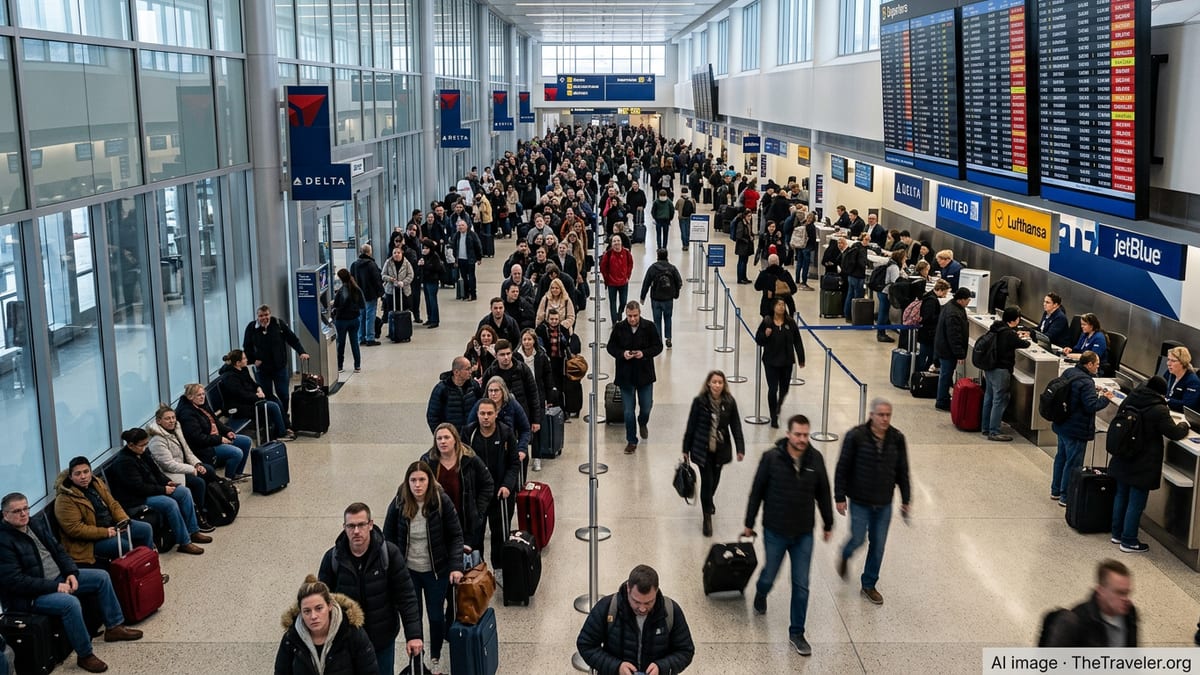
Ground stops hit New York, Philadelphia and regional hubs
According to publicly available air traffic management advisories and news coverage, the disruption began Monday afternoon when an equipment outage affected radar and communications systems serving the New York and Philadelphia areas. The problem was tied to fiber infrastructure used by an air traffic control facility in New Jersey, which handles approach control for multiple high-traffic airports.
Federal airspace status summaries and media reports indicate that departures bound for Newark Liberty International Airport, John F. Kennedy International Airport, LaGuardia Airport, Philadelphia International Airport and New Jersey’s Teterboro Airport were initially halted under ground stop orders. The measures were listed as related to an equipment outage rather than weather or congestion, an unusual classification in a region more often slowed by storms or volume.
Local coverage from New York and Philadelphia shows that the stoppages quickly translated into mounting delays. Newark alone saw hundreds of arrivals and departures affected, while extended ground delay programs at the other hubs pushed wait times well beyond scheduled departure slots. Smaller airports across New England, including Portland International Jetport in Maine and Boston Logan International Airport, reported knock-on effects as diversions and late inbound aircraft clogged gates and taxiways.
By early Monday evening, ground stops at the main Northeast hubs had been lifted and traffic was slowly resuming. However, flight-tracking data and airline status boards showed that schedules remained heavily distorted, with long queues for takeoff and significant arrival delays as carriers attempted to reposition aircraft and crews.
Equipment outage linked to damaged fiber lines
Published accounts of the incident describe a telecommunications mishap at or near a construction site in New Jersey as the root of the outage. The damage reportedly affected fiber-optic lines that connect radar and radio equipment to the air traffic control systems overseeing approaches into the New York and Philadelphia regions.
Coverage of the event notes that the disruption hit an air traffic control facility that has grown in importance in recent years, after responsibilities for handling Newark-area traffic were transferred from the New York Terminal Radar Approach Control facility to the Philadelphia approach control. That realignment was documented in federal notices that cited chronic staffing constraints and congestion in New York’s airspace as contributing factors.
The reliance on shared communications and radar infrastructure meant that a single point of failure translated rapidly into a loss of available capacity across several airports. Air traffic management summaries show that once the outage occurred, standard procedures led to ground stops for traffic headed into the affected airspace until controllers could verify safe separation with the systems still online or restored.
Repair crews restored connectivity later Monday, and subsequent public statements referenced a return to normal operations. Even with systems back up, it took several hours for traffic flows to stabilize as delayed departures, missed connections and aircraft out of position continued to reverberate through the network.
Continuing delays into Tuesday despite lifted ground stops
By early Tuesday, September 22, publicly accessible FAA status summaries no longer listed ground stops at New York or Philadelphia airports related to the equipment outage. Instead, the national airspace snapshot showed a single active ground stop at Dallas Fort Worth International Airport attributed to thunderstorms, underscoring that the Northeast disruption had moved into its recovery phase.
Travelers, however, continued to encounter the effects of Monday’s stoppages. Airline schedules on Tuesday morning in New York, Philadelphia and Boston still reflected a mix of delayed departures and scattered cancellations. Flight data showed some early-morning services cancelled outright, a common outcome when crews and aircraft are unable to reach their starting locations before duty-time limits or curfews take effect.
Reports from affected airports described long lines at check-in counters and customer service desks as passengers sought rebooking options. Some travelers whose flights were cancelled late Monday were accommodated on Tuesday departures, while others were routed through alternate hubs outside the Northeast in an effort to avoid the most congested airspace.
Travel-industry outlets noted that the timing of the outage, hitting one of the country’s densest corridors late in the afternoon, maximized its impact. The Northeast corridor links major business and leisure markets, and disruption there can quickly ripple into transatlantic operations and connections across the domestic network.
What travelers flying through the Northeast should expect
Publicly available guidance from airlines and air traffic authorities stresses that a ground stop does not mean all flights are cancelled, but it does mean that departures destined for an affected airport can be held at their origin for extended periods. Once such an order is lifted, crews must work through lengthy queues, and airport taxiways can become congested as operations ramp back up.
Travelers connecting through the Northeast over the next day are being advised, in published airline alerts and airport statements, to monitor flight status closely, use mobile apps for rebooking where possible, and arrive early at the airport in case of lingering crowding at security and boarding gates. Because aircraft rotations are scheduled tightly, a delay on a single leg can persist across multiple subsequent flights until the aircraft is pulled from service or repositioned.
Those starting trips at smaller regional airports across New England and the Mid-Atlantic may also feel indirect impacts. Even if their local airport is not under a ground stop, they can see delays when inbound aircraft are late departing from constrained hubs or when connecting banks are disrupted, forcing airlines to consolidate lightly booked flights or adjust routing.
Some travel analysts are flagging that recovery from such a widespread disruption can take more than a full operating day, particularly when the incident overlaps with peak travel periods. As Monday’s outage unfolded during an already busy afternoon, operations on Tuesday were expected to carry some residual delays, especially on heavily traveled business routes.
Broader questions about infrastructure resilience
The equipment failure has prompted fresh attention to the resilience of communications and radar systems that underpin U.S. air traffic control. Recent federal documents highlight both modernization efforts and ongoing vulnerabilities, including reliance on older infrastructure and the complexity of managing dense airspace over the Northeast corridor.
In earlier regulatory notices concerning New York area slot waivers, federal regulators pointed to chronic congestion and staffing limitations at key air traffic facilities, which can magnify the effect of any technical issue. The decision to shift some responsibilities to the Philadelphia approach control was part of an attempt to balance workloads, but Monday’s outage illustrates how new dependencies can be created when traffic is consolidated.
Industry observers note that previous nationwide disruptions, such as a temporary halt to departures linked to a flight-planning system data issue, spurred calls for faster technology upgrades and more robust backup systems. The latest Northeast ground stops are likely to renew scrutiny of how redundant fiber routes are engineered and how quickly alternate communications paths can be activated when physical infrastructure is damaged.
For travelers, the incident serves as another reminder that disruptions rooted in infrastructure can be difficult to predict or avoid, even with careful planning. Until redundancy and modernization projects fully reach the busiest corridors, those flying through major Northeast hubs may continue to face elevated risks of significant delays when technical problems arise.