


São Paulo–Guarulhos International Airport (GRU) is the main gateway to Brazil for millions of travelers each year. After a long flight, most passengers want one thing: a safe, straightforward ride to their hotel. At GRU, that usually means choosing between the official Guarucoop taxis operating inside the terminals and a confusing mix of app drivers and informal, sometimes illegal, operators outside. This safety-focused guide explains how Guarucoop works, what you can realistically expect to pay, how fixed and prepaid-style fares are handled, and the red flags to watch for so you can step into the right car with confidence, at any hour of the day or night.
Get the latest updates straight to your inbox!
Understanding Guarucoop: The Official Taxi at GRU
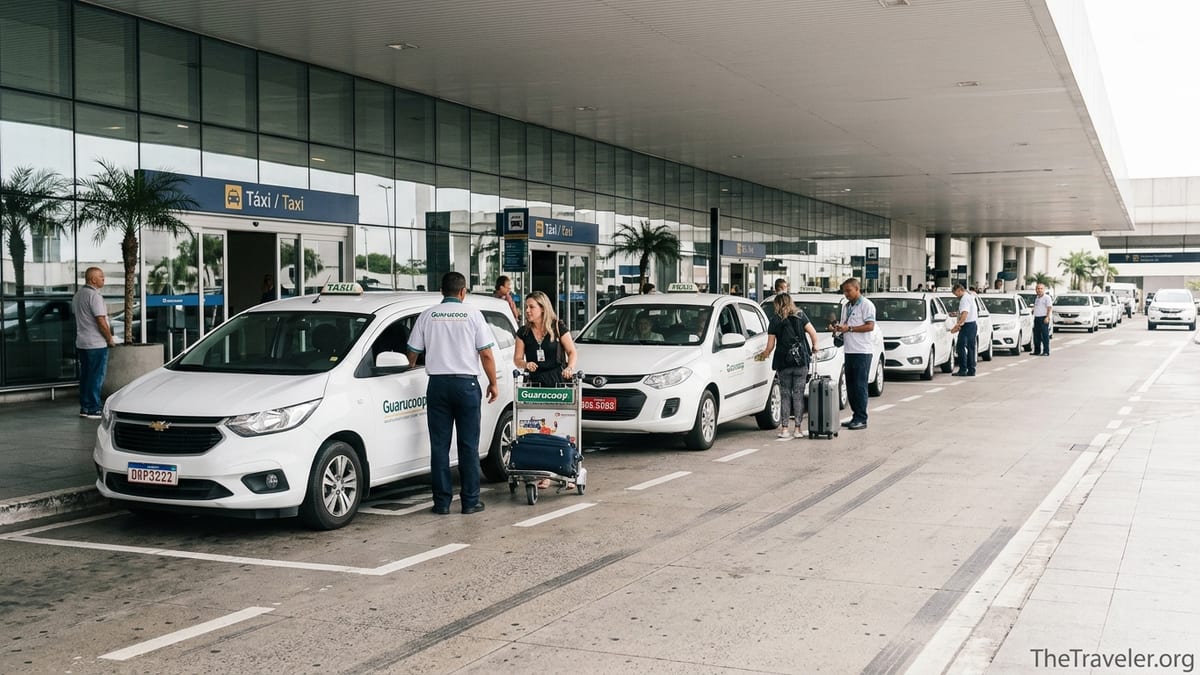
Guarucoop is the official taxi cooperative licensed by the Guarulhos city authorities to operate at São Paulo–Guarulhos International Airport. It has an exclusive concession to serve the airport’s taxi ranks, which means that when you walk out of Terminals 2 or 3 and see a line of white taxis under Guarucoop branding, you are looking at the authorized service. The cooperative has operated since the 1980s and today runs a large fleet of air-conditioned vehicles dedicated to airport traffic.
For travelers, this exclusive concession is important because it creates a clearly defined “safe zone” for taking a taxi. Inside the terminals you will see Guarucoop desks or counters and clear signage pointing to the official taxi ranks. Staff typically wear branded uniforms, and the cars display Guarucoop identification along with a city taxi license number. If you remain in this area and deal only with the counters or the organized queue, you are using the system the airport and many foreign consulates specifically recommend as the safest option for arrivals at GRU.
Guarucoop taxis operate from all three terminals, but most international passengers arrive in Terminals 2 and 3, where the cooperative’s presence is most visible. After collecting your baggage and clearing customs, you simply follow the “Táxi” signs toward the exit. Before you step outside, you will usually pass an official taxi desk where staff can quote an estimated fare, help you with destination names in Portuguese, and direct you either to a standard sedan or a larger vehicle, depending on your group size and luggage.
Because Guarucoop holds the official airport concession, its operations are regularly mentioned in travel advisories and conference logistics documents that recommend the cooperative as the preferred way to reach central São Paulo, particularly for visitors unfamiliar with Brazil or those arriving late at night. That official status does not make the service luxurious or the cheapest option in all cases, but it does mean the system is structured, regulated and visible, which adds an important layer of safety.
How Fares Work: Meters, Fixed Tables and Realistic Price Examples
Guarucoop taxis normally operate with regulated meters, but at the airport the experience often feels close to a fixed or prepaid-style fare. Staff at the counter ask for your destination, consult an official fare table or system, and provide an approximate cost before you step into the car. You then pay the driver at the end of the ride based on the meter, which usually aligns with the estimate unless traffic is unusually heavy or you request extra stops. For many travelers, hearing a clear price range in advance is reassuring and helps avoid disputes.
Real-world prices naturally vary with traffic, the exact location of your hotel and the time of day, but traveler reports and recent local coverage offer some useful benchmarks. A typical Guarucoop ride from GRU to neighborhoods along Avenida Paulista or in central São Paulo often falls in the region that many passengers describe as around double the price of a rideshare in light traffic, but with the advantage of bus-lane access and a predictable, official setup. In practice, that can mean a Guarucoop taxi costing roughly the equivalent of a mid-range dinner for two in São Paulo for a 45–60 minute journey into town, depending on exchange rates and time of day.
Some scams involving informal drivers underscore why these official fare references matter. Local media have documented cases of passengers paying roughly twice the going rate when lured into unlicensed cars; for example, travelers charged about the price of a Guarucoop ride for a distance where regular metered taxis or app cars would have cost significantly less. In contrast, the Guarucoop estimate is given in advance at a staffed counter and, if you feel uncertain, you can ask for the amount to be written on a slip or shown clearly on a display before accepting.
When comparing costs, it can help to think in ranges rather than exact numbers. A late-night Guarucoop ride from GRU to a major business hotel in bairros like Jardins, Bela Vista or Centro will usually be more expensive than a rideshare ordered once you are in the city, but cheaper than a private driver booked through a hotel car service. The price you pay reflects not only the distance but the exclusivity of airport access, the size of the cooperative’s fleet and the convenience of stepping into a car just minutes after clearing customs.
Where to Find Official Taxi Counters and How to Use Them
Locating the official Guarucoop service at GRU is straightforward if you stay alert to airport signage and avoid anyone who approaches you directly. After leaving baggage claim in Terminals 2 or 3, follow the signs marked “Táxis” or “Taxi” toward the exit. Inside the public arrivals hall, before you walk out to the curb, look for counters labeled with Guarucoop branding. These counters are usually positioned near the main exits so that you can speak to an agent while still inside the secure, well-monitored area of the terminal.
At the Guarucoop counter, the process is simple: you tell the agent your destination, ideally showing the full address on your phone or a printed reservation. The staff then check their fare system and quote an approximate price. In some cases, they may write your destination and estimated fare on a slip and hand it to you, or they may walk you to the taxi line and pass the information directly to the driver. Language is generally not a major barrier; even if the agent speaks limited English, showing your hotel name and booking confirmation usually resolves any confusion.
Once you leave the counter, you follow the directions to the official taxi rank. The Guarucoop queue is usually clearly marked, with taxis lining up in an orderly fashion and a dispatcher organizing vehicles. Cars display Guarucoop signage and an official city taxi plate. You enter the first available car unless you need a larger vehicle or an accessible option, in which case you can indicate this to the dispatcher, who will call an appropriate taxi forward. The meter is reset in front of you, and the driver confirms your destination again before pulling away.
If you do not see a counter for any reason, you can still find Guarucoop vehicles by looking for the structured line of taxis just outside the terminal doors. The key is to move directly from the exit to the official rank without stopping to talk to people who offer rides along the way. Hanging back in the arrivals hall gives informal drivers time to approach you; walking purposefully to the marked taxi queue helps you avoid those conversations altogether.
Handling Luggage, Groups and Late-Night Arrivals Safely
For many travelers, the combination of long-haul flights, heavy luggage and crowded terminals can make arrival at GRU feel overwhelming. Using the official Guarucoop taxis simplifies at least one part of that experience. Drivers are accustomed to handling large suitcases and sports equipment, as the airport serves major international routes. At the taxi rank, you can expect the driver to help load your bags into the trunk, and most sedans are spacious enough for two or three large suitcases plus carry-on bags. If you are traveling with four or more people or very bulky items, ask at the counter for a larger vehicle or two taxis.
From a safety standpoint, keeping your luggage with you and moving directly from customs to the taxi counter is important. Avoid leaving bags unattended while you check your phone or exchange money. If anyone other than a uniformed airport employee or Guarucoop staff member offers to carry your luggage or guide you to a car, politely decline and continue to the official taxi area. Inside the taxi, keep valuable items like passports, laptops and cameras in the back seat with you rather than in the trunk, and make sure the doors are locked once you depart.
Late-night and very early-morning arrivals are common at GRU due to its international flight schedule. The official Guarucoop service runs around the clock, and there is normally a steady flow of taxis even after midnight. For solo travelers, especially those unfamiliar with São Paulo, this 24-hour official presence is a significant advantage. Walking out of the terminal at 01:30 and finding a staffed taxi counter and a well-lit queue of licensed cars is far safer than negotiating with informal drivers or waiting in a dark corner of a parking structure for an unknown vehicle.
If your flight is heavily delayed and you arrive in the middle of the night, take your time through immigration and customs, then head straight to the Guarucoop counter. If you feel uncomfortable for any reason, such as an unusually empty terminal or people persistently offering unauthorized rides, step back inside the building near other passengers or security staff and only proceed when you can go directly to the counter or rank. Many business travelers and international organizations explicitly recommend this approach for women traveling alone or visitors carrying expensive equipment.
Informal Drivers and Common Scams: What to Avoid
The most persistent safety issue at GRU involves informal or illegal drivers who operate outside the official taxi and rideshare systems. These individuals often position themselves in or just outside the arrivals hall, approaching travelers with offers of “taxi,” “Uber” or “transfer” in multiple languages. Some carry clipboards or wear generic vests to appear more official than they are. The basic pattern is always similar: they intercept you before you reach the Guarucoop counter or the designated pickup areas for rideshare apps and try to redirect you to an unregulated car.
Local news outlets have documented a range of scams linked to these informal drivers, from simply overcharging to more aggressive tactics. One common scenario involves a driver quoting a price that sounds similar to what you might expect for a trip into the city, only to demand a much higher amount on arrival, often claiming that “tolls,” “traffic” or “extra distance” have increased the cost. In other cases, passengers are taken on needlessly long routes, dramatically inflating the fare. Reports from São Paulo note that some travelers have paid roughly double the going rate for standard routes after accepting rides from unlicensed operators.
More worrying accounts describe drivers diverting passengers to ATMs, insisting on cash payment and pressuring them to withdraw larger amounts than originally agreed. Others mention passengers being intimidated into paying inflated fares at the destination, especially if they are arriving late at night or carrying large amounts of luggage. Police operations in recent years have periodically targeted these illegal drivers around GRU, but enforcement ebbs and flows, and travelers still report being approached frequently in the terminals.
The simplest way to avoid these risks is to adopt one hard rule: never accept unsolicited offers of transport at GRU. If someone walks up to you saying “Taxi?” or “Uber?” or waving a sign, assume they are not part of the official system. Politely say no, keep walking and head directly either to the Guarucoop counter inside the terminal or to the clearly signed pick-up areas for app-based rides. If a person persists, move toward a visible airport security officer or information desk and do not engage further. Staying within well-lit, crowded, camera-monitored areas at all times significantly reduces your exposure to scams.
Comparing Guarucoop to Rideshare Apps and Other Transport Options
For many visitors, the decision at GRU is not between a taxi and an unknown informal driver, but between the official Guarucoop taxis and popular rideshare apps such as Uber, 99 or local competitors. In general, app-based rides from GRU to central São Paulo can be cheaper than Guarucoop, especially during non-peak hours. However, using an app requires extra steps: you must have mobile data or Wi-Fi, the app installed and updated, and a clear understanding of where the official pickup zones are located. You also need to be able to identify your driver correctly to avoid the risk of following someone who falsely claims to be your ride.
Guarucoop’s main advantages compared with rideshare apps are simplicity and immediate availability inside the terminal. You do not need a local SIM card or roaming data, you are directed to the taxi rank by staff, and you get into a car within a few minutes. Moreover, Guarucoop taxis often benefit from using bus corridors and airport access lanes that can reduce travel time during heavy traffic. Some travelers who routinely use rideshare apps in the city still choose Guarucoop for the airport leg, particularly when they are tired, carrying a lot of luggage or arriving very late at night.
On the other hand, travelers staying for longer periods in São Paulo sometimes prefer to use a rideshare app once they are more comfortable with the city’s layout. After the initial journey from GRU, rideshare services can be a cost-effective way to move between neighborhoods. Mixed strategies are common: for example, taking Guarucoop from the airport to a hotel in Avenida Paulista on arrival, then using rideshare apps for outings over the following days, and perhaps returning to the airport by app at the end of the trip.
There are also other transport options at GRU, such as the Airport Bus Service and the rail link connecting the airport to the city’s train and metro system. These can be good choices for budget-conscious travelers during daytime hours, especially those familiar with São Paulo or comfortable navigating public transport with luggage. However, buses and trains may be less appealing late at night or for first-time visitors concerned about security and wayfinding. In those situations, an official Guarucoop taxi remains one of the most straightforward and safety-focused options.
Step-by-Step: A Safe Taxi Journey From GRU to Your Hotel
Consider the experience of a first-time visitor arriving from Europe on a late-evening flight. After passing immigration and collecting luggage in Terminal 3, the passenger follows the overhead signs toward “Exit” and “Taxi.” In the public arrivals hall, they spot a Guarucoop counter with staff in uniform. The traveler approaches, shows the hotel booking on a phone screen and asks in simple English for a taxi to the address. The agent checks the fare system, gives an approximate price, writes the hotel name on a slip and points the traveler toward the nearest exit leading to the taxi rank.
Outside, the visitor joins the clearly marked Guarucoop queue. A dispatcher signals the next taxi forward, helps load the suitcase and confirms the destination in Portuguese, repeating the street name to ensure understanding. The driver resets the meter, locks the doors and heads out along the airport access road. The passenger keeps their passport and electronics in a small bag on the seat beside them and watches the route on an offline map, noting that traffic is relatively light at this hour. About 45 minutes later, they arrive at the hotel, pay the fare shown on the meter, receive a printed or handwritten receipt on request and step directly into the lobby.
Now imagine a contrasting scenario involving an informal driver. The same passenger exits customs and hesitates in the arrivals hall to check messages. Within seconds, a man with a generic lanyard approaches and offers a “taxi,” naming a price that sounds reasonable. He insists his car is “faster” and “cheaper than official taxi,” urging the traveler to follow him before they have time to think. They walk through a side door and cross a parking lot to a car with no clear taxi markings. The journey into town takes longer than expected, the driver claims extra charges for “tolls and traffic,” and at the destination he demands a significantly higher amount than originally quoted. Feeling tired and uncertain, the traveler ends up paying simply to end the situation.
The difference between these two experiences largely comes down to one decision at the airport: whether to walk directly to the official Guarucoop area or to engage with unsolicited offers. By planning ahead, knowing what the Guarucoop counter and taxi rank look like, and being prepared to politely refuse anyone who approaches you, you dramatically improve your chances of having a smooth, uneventful ride from GRU to your hotel.
The Takeaway
Guarulhos International Airport can feel intense, especially after a long-haul flight, but your onward journey does not have to be complicated or risky. The official Guarucoop taxi cooperative, with its exclusive concession at GRU, provides a simple and generally safe way to reach São Paulo’s main neighborhoods at any time of day or night. Using the visible taxi counters and organized ranks inside the terminal keeps you within a regulated system that many airlines, hotels and international organizations recommend to their guests and delegates.
Fares with Guarucoop are not the cheapest option in every situation, and app-based rides can sometimes offer lower prices. However, the combination of clear estimates, professional staff, airport-specific experience and 24-hour operation makes Guarucoop a strong choice for newly arrived visitors, solo travelers, families with children and anyone carrying valuable equipment. If you prioritize safety and predictability over shaving a few reais off the fare, the official taxi queue is usually the right place to be.
The main threats at GRU come from informal drivers who approach passengers inside or just outside the terminals. These operators may overcharge, take longer routes or pressure you into paying more than agreed. You can avoid nearly all of these problems by refusing unsolicited offers, staying in well-lit public areas and going directly either to the Guarucoop service or to the signed pickup areas for rideshare apps. With a few simple precautions and a clear plan, stepping into a legitimate taxi at Guarulhos becomes just another smooth part of your journey, not a source of stress.
FAQ
Q1. Where exactly can I find the official Guarucoop taxis at Guarulhos Airport?
Inside Terminals 2 and 3, follow the taxi signs to the arrivals exit and look for Guarucoop counters just before the doors, then proceed to the marked taxi rank directly outside.
Q2. Are Guarucoop taxis available 24 hours a day at GRU?
Yes. Guarucoop operates around the clock, with taxis serving arriving flights throughout the night and early morning, although queues may be shorter during off-peak hours.
Q3. How much does a Guarucoop taxi from GRU to central São Paulo usually cost?
Prices vary with traffic and exact destination, but travelers typically pay a mid-range fare comparable to an official airport taxi in other major cities for a 45–60 minute ride.
Q4. Can I pay for a Guarucoop taxi by card, or do I need cash?
Many Guarucoop taxis accept major bank cards, but card functionality can occasionally fail, so carrying some local currency as a backup is wise, especially late at night.
Q5. Is it safer to take Guarucoop or a rideshare app like Uber from GRU?
Both can be safe when used correctly, but Guarucoop has the advantage of clearly marked counters and ranks inside the terminal, which many first-time visitors find more reassuring.
Q6. How can I recognize informal or illegal drivers at Guarulhos Airport?
Informal drivers typically approach you directly in the arrivals hall or outside, offering “taxi” or “Uber” without being at a counter or in the official taxi or app pickup areas.
Q7. Are Guarucoop taxis metered or fixed-price?
They are metered, but at the airport you usually receive an approximate fare quote in advance based on an official table, so the experience feels similar to a fixed or prepaid-style fare.
Q8. What should I do if a driver at GRU insists on a much higher fare than agreed?
Use only official taxis or app rides with clear pricing. If a driver demands more, stay in public, well-lit areas, seek help from hotel staff or airport security and do not get into arguments in isolated spots.
Q9. Is it safe to arrive at GRU after midnight and still take a taxi?
Yes, many passengers arrive late at night. As long as you stick to the official Guarucoop counters and ranks or clearly signed app pickup areas, late-night taxi use is a common and practical option.
Q10. Do Guarucoop taxis charge extra for luggage?
Standard luggage for air travel is normally included in the fare. If you have unusually bulky items or a very large group, mention this at the counter so they can allocate an appropriate vehicle.