


Landing at São Paulo/Guarulhos International Airport and trying to understand how the city’s trains work can feel overwhelming, especially after a long-haul flight. CPTM’s Line 13-Jade is the backbone of the rail connection between GRU Airport and São Paulo, and used correctly it can save you money and time compared with taxis or ride-hailing. This guide explains step by step how to use the Guarulhos airport train, from finding the station and shuttle to making the right connections at Engenheiro Goulart, Brás, Tatuapé and Luz, buying tickets, and managing luggage.
Get the latest updates straight to your inbox!
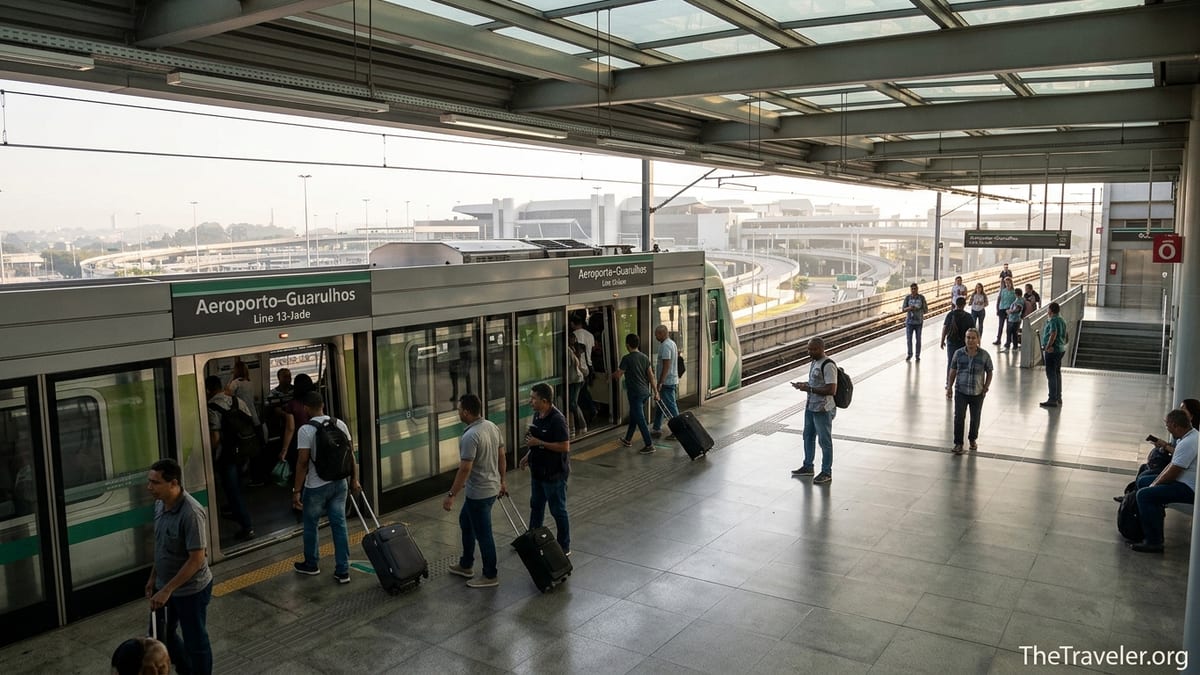
Overview: How Line 13-Jade Connects GRU Airport and São Paulo
Line 13-Jade is part of São Paulo’s metropolitan rail network, operated by CPTM, and it links São Paulo/Guarulhos International Airport (GRU) with the eastern side of the city. The airport stop is called Aeroporto–Guarulhos and sits near GRU’s Terminal 1, connecting by a short internal shuttle or people mover to Terminals 2 and 3. From the airport station, most travelers change at Engenheiro Goulart to join Line 12-Safira, which continues toward major interchange hubs like Tatuapé and Brás, where you can then transfer to the São Paulo Metro and other CPTM lines.
In practice, the journey from the airport to central São Paulo usually involves two or three trains. A typical route for a visitor staying near Avenida Paulista might be: GRU Airport → Line 13-Jade to Engenheiro Goulart → Line 12-Safira to Brás → Metro Line 3-Red to Sé → Metro Line 1-Blue to Consolação/Paulista. This sounds complicated on paper but is easier on the ground thanks to clear signage and integrated platforms. The total travel time can range from about 50 to 80 minutes depending on waiting times and time of day.
Line 13-Jade offers both regular stopping services and an “Airport Express” that links the airport to central stations with fewer stops. Schedules and frequencies can vary by time of day and day of the week, so it is wise to check posted timetables inside the stations. Regardless of which service you choose, the fare structure is integrated with the metro, which means most travelers will pay a single base fare for each entry to the rail system, with free transfers between CPTM and Metro lines once inside the paid area.
For many visitors the main tension is between cost and convenience. A licensed airport taxi to Avenida Paulista can easily cost several times the price of the train. By contrast, the train plus metro combination usually costs close to the standard urban rail fare per entry, making Line 13-Jade a very economical way to reach the city, particularly if your destination is already near a metro station.
Finding the Airport–Guarulhos CPTM Station and Shuttle
Guarulhos Airport has three passenger terminals. The CPTM station Aeroporto–Guarulhos does not sit directly underneath these buildings like in some European airports. Instead, it is located near Terminal 1, slightly apart from the main complex. To bridge that distance, the airport operates an internal shuttle connection between the station and Terminals 1, 2 and 3. Depending on the time of day and current infrastructure, this can be a shuttle bus service or a people mover system, but functionally it plays the same role: linking arriving passengers with the rail network.
If you arrive on an international flight, you will most likely land at Terminal 3. After immigration and customs, follow the signs for “Trains” or “CPTM.” At Terminal 3 you first exit into the public arrivals area, then look for wayfinding indicating the internal transfer to Terminal 1 / Train station. In practice, many travelers simply follow signs for the free airport shuttle or ask any uniformed airport staff member for “trem CPTM aeroporto” and they will point you toward the boarding area.
The shuttle route typically loops in the following order: Terminal 3 → Terminal 2 → Terminal 1 → CPTM station → Terminal 1 → Terminal 2 → Terminal 3, and so on. If you board at Terminal 3 right after landing, expect roughly 10–20 minutes to reach the CPTM station depending on traffic on the service road and intermediate stops. At quieter times, the journey can be closer to 10 minutes; during busier peaks, allow extra buffer, especially if you have a fixed time you want to reach the city.
From Terminal 1, the walk to Aeroporto–Guarulhos station is short and well signed, with ramps and elevators that accommodate luggage trolleys. The station itself has a modern, airy design with ticket machines, staffed ticket counters during main operating hours, and wide gates that can handle passengers with suitcases. If you are coming from the city toward the airport, trains will terminate at Aeroporto–Guarulhos and you simply exit, follow the signs to the airport shuttle or people mover, and ride it to your terminal.
Services on Line 13-Jade: Regular Trains and Airport Express
Line 13-Jade offers a regular all-day service that runs between Aeroporto–Guarulhos and Engenheiro Goulart, with stops including Guarulhos-CECAP. Trains generally operate from early morning until late evening, but visitors should be aware that first and last train times can vary, and nighttime headways may be longer. During daytime peaks, intervals can be relatively short, making the service comfortable for airport employees and frequent travelers who rely on it daily.
In addition to the stopping service, there is an Airport Express train that connects the airport with central stations such as Luz, sometimes also serving Brás on one leg of the journey. This express is designed primarily for passengers wanting a more direct ride into central São Paulo without multiple transfers. It operates on a fixed timetable with fewer departures than the regular service, often focused on daytime and early evening periods when demand is higher. Because of its limited schedule, travelers arriving very early in the morning or late at night typically depend on the regular trains plus a transfer at Engenheiro Goulart.
For example, a daytime passenger landing at GRU around 13:00 who wants to reach the historical center near Praça da Sé might check the current Airport Express timetable in advance and plan to catch a departure from Aeroporto–Guarulhos directly to Luz. From Luz, it is just one quick metro ride on Line 1-Blue to Sé. On the other hand, someone arriving at 23:30 may find that the most convenient option at that hour is to use the regular Line 13-Jade service to Engenheiro Goulart, change to Line 12-Safira, and then connect to the metro, or consider a taxi or ride-hailing if train frequencies are already low.
Because operating plans can change over time, visiting travelers should use the timetable posters that CPTM displays inside Aeroporto–Guarulhos station and at Engenheiro Goulart. These show the latest programmed intervals and the specific departure times for any express services. Staff at the station can also indicate whether the next train is a stopping service or an Airport Express and which station it will serve in the city center, helping you decide the best option for your luggage and timing.
Key Connections: Engenheiro Goulart, Tatuapé, Brás and Luz
Engenheiro Goulart is the main connecting station between Line 13-Jade and Line 12-Safira. When you arrive from the airport on a regular Line 13 train, you normally disembark here and cross to the appropriate platform for Line 12 towards the city center. The transfer is within the paid area, which means you do not pass through gates or pay another fare. Signage clearly distinguishes the direction toward stations like Tatuapé and Brás from the outbound direction toward eastern suburbs.
Continuing on Line 12-Safira from Engenheiro Goulart, the first major interchange most visitors meet is Tatuapé. Here, you can transfer to Metro Line 3-Red via covered walkways, giving access to neighborhoods along the east–west axis, including Ponte Preta, Anhangabaú and Barra Funda. Tatuapé is particularly convenient if you are staying in the eastern part of the city or near a Line 3 station. Many airport passengers heading for hotels in the República or Sé areas prefer to stay on Line 12 a few more stops and change at Brás instead.
Brás is one of São Paulo’s biggest and busiest interchange hubs. From Brás you can connect not only to Metro Line 3-Red but also to other CPTM lines, making it a flexible gateway for a wide range of destinations. For instance, a traveler headed to a hotel near Luz station might remain on the train until Brás and then either ride Metro Line 3 one stop to Sé and transfer to Line 1-Blue for Luz, or stay on CPTM if an appropriate service is running. Brás can be crowded in rush hour, but signage and platform staff help direct flows of passengers between lines.
Luz station itself is both an architectural landmark and a strategic transit node. Some Airport Express services run directly between Aeroporto–Guarulhos and Luz, which is ideal if your accommodation is in the historic center, near Praça da República, or close to Luz or São Bento metro stations. From Luz, you can connect to Line 1-Blue of the Metro and other CPTM routes. Many tourists also take the opportunity to admire the preserved 19th-century station building before continuing their journey. If you are carrying large suitcases, note that Luz has stairs, escalators and elevators, although certain connections may require short walks through busy passageways.
Tickets, Fares and Payment Options
The good news for visitors is that Line 13-Jade uses the same fare structure as the rest of São Paulo’s metro and CPTM rail system. When you pass through the gates at Aeroporto–Guarulhos, you pay the regular urban rail fare. Transfers between CPTM lines and São Paulo Metro lines inside the system are free, so you can ride Line 13-Jade, change at Engenheiro Goulart, Tatuapé or Brás, and then transfer to the Metro without paying extra, as long as you remain within the paid area. If you exit through the gates and re-enter at another station, a new fare is charged.
There are several ways to pay. Occasional users and tourists often buy single-use tickets or paper/QR-code passes from machines or staffed ticket offices inside the station. These are simple: you pay the flat fare, pass through the gate once and then travel freely across CPTM and Metro until you leave the system. At Aeroporto–Guarulhos, ticket offices typically accept Brazilian currency and, in many cases, debit cards. Ticket vending machines often accept local bank cards and sometimes international cards, although acceptance can vary, so it is sensible to have some Brazilian reais with you, especially upon arrival.
Visitors staying in São Paulo for several days may consider smartcards or time-based products. The city’s Bilhete Único is the main contactless card for residents, integrating buses, CPTM and Metro. However, obtaining a personal Bilhete Único generally requires a Brazilian taxpayer ID (CPF), so it is not always practical for short-term visitors. An alternative for frequent rail use is the Cartão Fidelidade, a reusable card that offers discounted fares per trip with certain usage rules. The conditions and exact discounts can change over time, so anyone staying longer or commuting daily should check current details at a major Metro station like Sé or República.
Another increasingly common option is contactless payment at the turnstiles. Many Metro and CPTM stations accept contactless debit and credit cards directly at selected gates. This can be convenient for international travelers who prefer to pay with a bank card instead of buying paper tickets. You simply tap your card on the reader at the gate, wait for the green light and walk through. The system charges you the equivalent of the standard fare, usually converted by your bank into your home currency, often with standard foreign transaction fees. Because technology rollouts are gradual, not every single gate or station may support contactless at all times, so be prepared with a backup, such as cash for a paper ticket.
Travel Times, Frequency and When the Train Makes Sense
On paper, Line 13-Jade is a straightforward link between the airport and São Paulo. In real life, your overall travel time depends on your arrival time, luggage, and tolerance for transfers. The train itself from Aeroporto–Guarulhos to Engenheiro Goulart is relatively quick. Adding the transfer to Line 12 and the ride to Brás or Tatuapé, plus a final metro leg, most passengers reach central neighborhoods in under 70–80 minutes, including walking between platforms and a short wait for connections.
Frequency is another key factor. During weekday peaks and daytime, Line 13-Jade services operate at reasonably regular intervals, and Line 12-Safira services to the city are frequent. If you land at GRU around 10:00 on a weekday, it is realistic to walk through immigration, catch the airport shuttle to the station, buy a ticket and board a train to the city without long waits. However, late-night arrivals may coincide with longer train intervals and the approach of closing times on certain segments of the Metro, in which case you must decide whether the savings over a taxi justify potential waiting and tighter connections.
A practical example helps. Suppose you arrive at 18:00 on a weekday and are staying near República. After clearing immigration and customs in about 45–60 minutes, you catch the shuttle to the train, buy a ticket, and board a Line 13-Jade train around 19:20. You ride to Engenheiro Goulart, transfer to Line 12-Safira, stay on until Brás, then change to Metro Line 3-Red toward Barra Funda and get off at República. The full door-to-door journey might take around 70–90 minutes, depending on waiting times. A similar taxi ride at rush hour could also take an hour or more, and often at a substantially higher price than the combined train and metro fare.
On the other hand, if your flight arrives after midnight or you are heavily laden with large suitcases or traveling with small children, a door-to-door taxi or ride-hailing trip could be more comfortable, even if more expensive. The rail system, while safe and widely used, does not provide dedicated airport luggage cars or guaranteed seating, and standing with heavy bags on a crowded commuter train is not ideal after an overnight flight. Many travelers therefore choose to use Line 13-Jade for daytime and early evening arrivals, especially when traveling solo or with light luggage, and switch to road transport outside these windows.
Luggage, Station Access and Onboard Comfort
Unlike some airport rail services in Europe or Asia that are built specifically for airline passengers, Line 13-Jade is integrated into São Paulo’s regular commuter network. Trains have standard interiors with a mix of longitudinal seating along the sides and open standing space in the middle, rather than special luggage racks or extra-wide aisles. That said, most locals are used to sharing space with travelers carrying suitcases, especially on Line 13-Jade and at stations like Aeroporto–Guarulhos, Brás and Luz, where tourism and intercity travel are common.
When boarding with luggage, it helps to enter through wider doors, move slightly away from the entry area so others can pass, and position suitcases against a side wall or under a grab bar instead of leaving them in the middle of the aisle. During peaks, avoid placing bags on empty seats, as these fill quickly with commuters. If you are traveling in a group, assign one person to stay close to the bags while others hold onto poles or overhead grips. The trains are air-conditioned, and cars are well lit, which makes the ride reasonably comfortable even at busier times.
Station access at Aeroporto–Guarulhos, Engenheiro Goulart, Tatuapé, Brás and Luz is generally accessible, with elevators, escalators and ramps. Aeroporto–Guarulhos in particular was built with airport users in mind, so platforms, concourses and access routes accommodate wheeled luggage and passengers with reduced mobility. Nevertheless, expect some walking, especially at major interchange stations where lines cross at different levels. For example, transferring between CPTM and Metro at Brás or Tatuapé involves using escalators or elevators and following overhead signs through covered walkways.
For added peace of mind, treat your luggage as you would in any large city. Keep valuables close, do not leave bags unattended on platforms, and be mindful of your surroundings when trains are crowded. Many visitors choose to place backpacks on their front in busy carriages and keep passports and electronics in interior pockets or money belts. These are standard big-city precautions rather than responses to a particular risk, but they help ensure a smooth introduction to São Paulo’s transit system.
Comparing the Train to Buses, Taxis and Ride-Hailing
When deciding whether to use Line 13-Jade or another option, it helps to compare real-world scenarios. Consider a traveler landing at GRU around lunchtime, heading to a hotel near Avenida Paulista. If they choose a licensed airport taxi from the official taxi stand, the fare is often significantly higher than the combined cost of train and metro, even though the taxi is door-to-door and avoids transfers. During midday, however, traffic on the main highway into São Paulo can be heavy, so a taxi might not be much faster than the rail route once congestion is factored in.
Premium airport buses and shuttle vans also connect GRU with destinations such as Avenida Paulista, República and the Tietê bus terminal. These services can be more comfortable for those with multiple suitcases or limited mobility, with guaranteed seating and luggage storage. Their fares typically sit between those of the train and a taxi. For example, a shuttle bus from GRU to central districts might cost many times a single rail fare but still less than a private taxi, with travel times comparable to a car in moderate traffic.
Ride-hailing apps are another popular choice among locals and travelers. Pick-up points at GRU are usually clearly marked for authorized services, and app-based rides can sometimes be cheaper than official airport taxis, especially in off-peak periods. However, dynamic pricing can make rides expensive during peak hours or bad weather, and traveling by car exposes you to the same road congestion as taxis and buses. In contrast, the train and metro network are not affected by surface traffic and maintain fairly consistent journey times.
A balanced approach is to evaluate time of arrival, amount of luggage, budget, and comfort preferences. Solo travelers or couples with backpacks or small suitcases, arriving during daytime, often find Line 13-Jade plus the metro to be a cost-effective and reliable option, with the added advantage of dropping them close to many central hotels. Families with young children, elderly travelers, or those arriving late at night may reasonably prioritize comfort and simplicity over cost and choose taxis or shuttle services. Knowing that Line 13-Jade exists and understanding how it connects gives you flexibility to choose the right option for each trip.
The Takeaway
CPTM’s Line 13-Jade offers a practical and budget-friendly way to link São Paulo/Guarulhos International Airport with the city’s vast metro and rail network. Although it is not a dedicated premium airport train, its integration with Line 12-Safira and key hubs like Tatuapé, Brás and Luz allows you to reach major business and tourist districts with just one or two transfers, often in under 80 minutes from the time you board at Aeroporto–Guarulhos station.
Using the service involves a few basic steps: finding the airport shuttle to the station, buying a ticket or using an accepted payment card, changing at Engenheiro Goulart for Line 12, and then choosing the right interchange at Tatuapé, Brás or Luz to connect to the metro or other CPTM lines. Once you have done it once, the process becomes straightforward, and for many repeat visitors it becomes the default choice for airport transfers.
Ultimately, the decision to ride Line 13-Jade depends on your arrival time, luggage, group size and budget. For travelers who value savings and are comfortable with urban rail systems, it is one of the most efficient ways to move between GRU Airport and São Paulo. Even if you opt for a taxi or shuttle on your first visit, understanding how the line works gives you more options for future trips, and opens up the possibility of combining train, metro and bus to explore Brazil’s largest city with confidence.
FAQ
Q1. How do I get from Guarulhos Airport terminals to the Line 13-Jade station?
The Aeroporto–Guarulhos station is linked to all three terminals by an internal shuttle connection that stops at Terminals 1, 2 and 3, then the train station.
Q2. Do I pay extra to use Line 13-Jade from the airport?
No. You pay the standard urban rail fare when you enter at Aeroporto–Guarulhos. Transfers to other CPTM and Metro lines inside the system are included without extra charge.
Q3. How long does the trip from the airport to central São Paulo take by train?
From Aeroporto–Guarulhos to central areas like Sé or República, most travelers take around 60 to 80 minutes, including transfers and short waits between trains.
Q4. Is it easy to travel with luggage on Line 13-Jade?
Yes, but trains are standard commuter trains with no special luggage cars. Use elevators and escalators where available and keep bags close to you, especially at busy times.
Q5. Where should I change trains to reach Avenida Paulista?
A common route is to ride Line 13-Jade to Engenheiro Goulart, change to Line 12-Safira to Brás, then switch to Metro Line 3-Red and finally Line 1-Blue or Line 2-Green toward Paulista stations.
Q6. Does the Airport Express train run all day?
No. Airport Express services operate on a limited timetable, mainly during daytime and early evening. Outside those times, use the regular Line 13-Jade service plus connections.
Q7. Can tourists buy and use a Bilhete Único for the airport train?
In most cases Bilhete Único requires a Brazilian taxpayer ID, which many tourists do not have. Visitors typically use single tickets, QR codes or contactless bank cards instead.
Q8. Is taking the train from Guarulhos Airport safe?
The airport rail connection is widely used by airport workers and passengers and is generally considered safe. As in any big city, keep normal awareness of your belongings.
Q9. What if my flight arrives very late at night?
Late at night train frequencies are lower and some metro segments approach closing time. In that case, many travelers choose taxis or ride-hailing for convenience and speed.
Q10. Are there toilets and shops at the airport train station?
Aeroporto–Guarulhos station offers basic facilities such as restrooms and ticket offices, while the main terminals have a wide range of shops, cafés and services for passengers.