


Guayama appears often in Puerto Rico trip research as a tempting detour: a historic southern town with elegant architecture, mangrove-fringed coastline, and a stretch of seafood shacks at the edge of Jobos Bay. On paper it looks easy, with tourism sites describing Guayama as about an hour from San Juan. In practice, the question most visitors need to answer is more specific: is Guayama worth devoting an entire day of your Puerto Rico itinerary, and what can you realistically see without turning the trip into an exhausting blur of highway and closed doors?
Get the latest updates straight to your inbox!
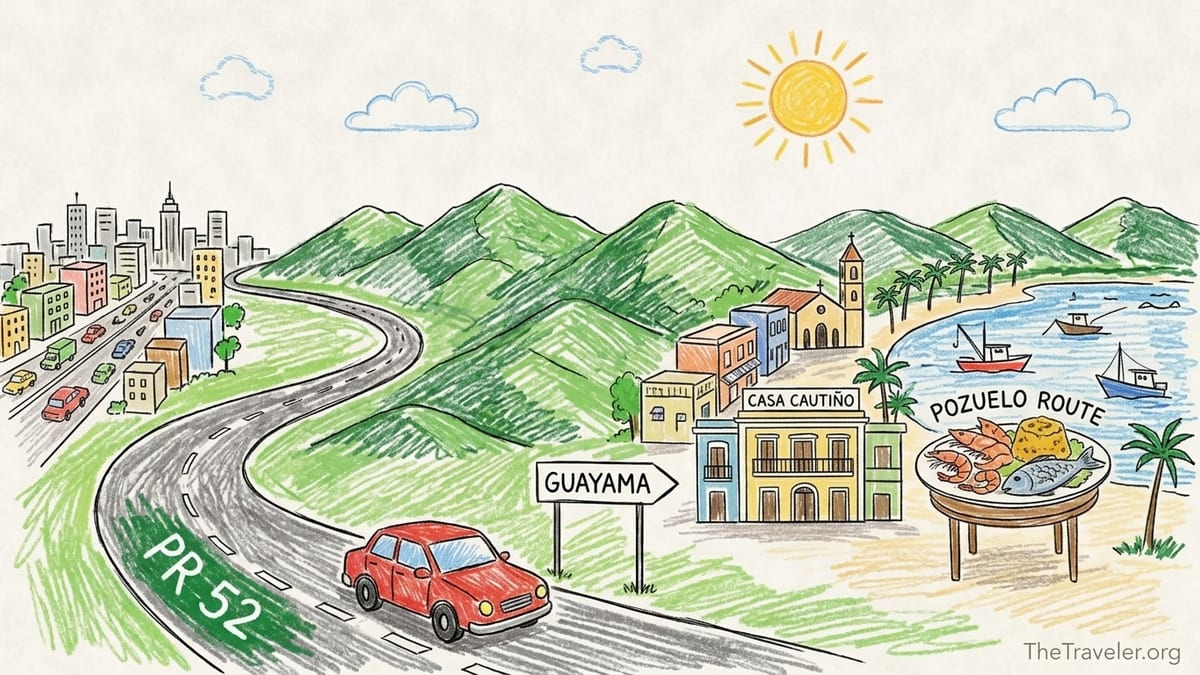
How Far Is Guayama Really, And What Does The Drive Feel Like?
From central San Juan to the historic center of Guayama, you will likely drive around 55 to 65 miles each way, mostly on toll highway PR 52, the island’s main north–south route. With light traffic and no stops, navigation apps often estimate the drive at about 1 hour and 10 minutes. In real conditions, especially if you are starting from Condado, Isla Verde or Old San Juan, you should plan on 1 hour 30 minutes each way once you factor in city traffic, merging onto PR 18 and PR 52, and brief rest or fuel stops.
PR 52 is a divided, limited-access toll road built to high standards, and the route south takes you through the Cordillera Central before descending toward the drier southern coast. The drive itself can be scenic, but it also demands attention. You will encounter fast-moving traffic, occasional aggressive lane changes, and some steep grades and curves as you cross the mountains. Many local drivers advise avoiding long return legs on PR 52 late at night if you are not familiar with Puerto Rico’s driving style and road signage.
For a Guayama day trip, a realistic schedule assumes 3 hours of total round-trip driving. That means if you leave San Juan at 8 a.m. and return around 7 p.m., nearly half the day is lost to the road once you add in time spent navigating city streets at both ends. Travelers who already feel tense about driving in a new country should weigh whether this is how they want to spend one of only a few days on the island.
Tolls are collected electronically on PR 52, so if you rent a car, confirm in advance whether your rental includes an electronic toll pass and how fees are charged. It is common for rental agencies to charge a small daily fee plus the actual tolls. You will not pay in cash at toll booths, so driving PR 52 without a pass can lead to added administrative charges later.
What Kind Of Traveler Will Get The Most Value From Guayama?
Guayama is not a beach-resort destination or a compact “everything in one plaza” colonial showpiece. It is a working southern town with a handsome historic center, a fishing community at Pozuelo, and access to low-lying coastal ecosystems like Jobos Bay and the Aguirre State Forest. You will get the most value from a dedicated Guayama day if you are already planning to go beyond San Juan and want to experience smaller Puerto Rican towns, local seafood culture, and coastal ecology rather than lounging at a single beach club.
Architecture and history enthusiasts will appreciate Guayama’s main square, stately parish church and the neoclassical Casa Cautiño, the 19th-century residence of a wealthy sugar family that later became a museum. Even if you are not an expert, walking the streets around the plaza gives a concrete sense of how sugar wealth and civic pride shaped southern towns, very different from tourist-heavy Old San Juan. Photographers interested in balconies, carved doors and pastel facades will find plenty to capture on a slow stroll.
Food-focused travelers who like to seek out where locals actually eat will be drawn to the “Ruta Gastronómica de la Costa” around the fishing community of Pozuelo. Here, small and mid-sized seafood restaurants line Road 7710 beside Jobos Bay, with menus built around fresh catch from local boats. Restaurants such as El Arcoiris Restaurante in Barrio Pozuelo, which has been operating since the 1970s and currently opens Thursday through Sunday from late morning to evening, are known across the south coast for their seafood-focused Puerto Rican cuisine and water views.
Nature-minded visitors who prefer mangroves, lagoons and birdlife over big-wave beaches can use Guayama as part of a day that also touches the Jobos Bay National Estuarine Research Reserve or the nearby Aguirre State Forest. Jobos Bay is the second-largest estuarine area in Puerto Rico and forms a protected landscape of mangrove islands, seagrass beds and shallow water between Guayama and Salinas. That said, this is not a traditional beach park, and access focuses more on interpretive trails, research, and low-impact recreation than on umbrellas and facilities.
How To Build A Realistic “Town & Pozuelo Food Route” Day Trip
The most straightforward Guayama day trip from San Juan combines two compatible zones: the historic center and the Pozuelo gastronomic route. This pairing works because both areas lie relatively close to each other, you avoid complicated mountain detours, and you can keep driving segments short once you reach town.
Assuming you are staying in San Juan proper, a practical schedule starts with an 8 a.m. departure. This allows you to clear much of the worst morning traffic while still reaching Guayama before late morning. If you arrive between 9:30 and 10 a.m., you can park near the main plaza and walk to see the Iglesia San Antonio de Padua, the central square, and the exterior of Casa Cautiño before the midday heat gets intense. Build in at least 90 minutes to wander, photograph and sit for a coffee or light snack at a café facing the plaza.
Visiting Casa Cautiño itself requires a bit more planning. The house has historically operated as a regional museum, but hours can be limited or change with staffing and maintenance. Some recent visitors have reported irregular opening times, and reliable, frequently updated digital information is scarce. Before committing your day, call or check with the Puerto Rico Institute of Culture or Guayama’s municipal offices to confirm whether the museum is currently open to the public and on what schedule. If Casa Cautiño is closed, you can still enjoy the architecture from the outside and redirect your cultural stop to the church and plaza.
Around noon or shortly after, you can drive 10 to 15 minutes to Pozuelo along Road 7710 for lunch on the coastal route. Restaurants such as El Arcoiris and Villa Pesquera Punta Pozuelo typically start lunch service around 11 a.m. and continue through the afternoon. At El Arcoiris, for example, current posted hours list opening from 11 a.m. to 9 p.m. Thursday through Sunday. This timing lines up well with a mid-day meal featuring fresh fish, jumbo shrimp, mofongo, or seafood-stuffed tostones while looking out toward Jobos Bay and small fishing boats.
After a long lunch and perhaps a short walk along the waterfront to watch local fishermen unload their catch or check out the modest marina at the end of Road 7710, start your return to San Juan by about 3:30 or 4 p.m. You will likely be back at your hotel by early evening, even with a fuel stop or brief detour. This structure gives you a taste of a real southern town and an authentic seafood corridor without overloading the day or leaving most of your exploration for the hottest or darkest hours.
Designing A “Town & Jobos Bay Nature” Day Without Overreaching
If you are more drawn to coastal ecology than to seafood lunches, you can replace the Pozuelo focus with a nature-oriented segment connected to Jobos Bay and the Aguirre area. The Jobos Bay National Estuarine Research Reserve protects nearly 3,000 acres of estuary and mangrove habitat between Guayama and Salinas, with a visitor center installed in a historic building that once served a sugar refinery’s social club. From there, a network of interpretive trails allows visitors to see dry forest, mangroves, lagoons and views over the bay, and the reserve supports environmental education programs and coastal research.
However, Jobos Bay is not a conventional “drive in anytime” attraction. Trails are open to the public, but the visitor center and formal programs may have specific hours, staffing limitations, or require advance arrangements for guided activities. Official information from Puerto Rico’s Department of Natural and Environmental Resources, which manages the reserve, emphasizes regulations to protect the ecosystem and highlights that the site is first a research and conservation area rather than a mass-tourism facility. Before building a day around Jobos Bay, call the reserve or check recent local reports to confirm visitor center hours, trail access, and any temporary closures due to restoration work or storm impacts.
In practice, a town-and-nature day might look like this: depart San Juan at 7:30 or 8 a.m., arrive in Guayama mid-morning for a quick plaza and church visit, then continue to the Jobos Bay reserve or Aguirre State Forest around late morning or early afternoon. Plan to spend two to three hours walking short trails, birdwatching, or joining any available educational activity. Pack water, sun protection, and snacks, since services on site are limited compared with a full-service beach resort. After your visit, you can stop in Pozuelo or along PR 3 for an early dinner before beginning the drive back north by late afternoon.
If you find on arrival that the visitor center is closed or conditions are not ideal, have a backup plan. You might shift emphasis to Pozuelo’s seafood restaurants and short waterfront strolls, or explore more of the town center and nearby Aguirre neighborhood by car and on foot. The key is mental flexibility: Guayama and Jobos Bay reward people who are happy with low-key, unscripted experiences, but may frustrate travelers expecting a tightly programmed schedule of timed tours and ticketed attractions.
Why Trying To “Do It All” In One Day Backfires
With a rental car, it is tempting to imagine a huge loop: depart San Juan, stop at Carite State Forest in the central mountains, descend to Guayama’s town center, tour Casa Cautiño, detour to a golf course, have a long seafood lunch in Pozuelo, then continue along the south coast for a beach stop before finally driving back to San Juan after sunset. On a map this looks ambitious but possible. On the ground, it is usually a recipe for fatigue, rushed visits, and night driving on unfamiliar roads.
Carite State Forest alone can easily absorb half a day, with its cool, foggy uplands, trails to rivers and waterfalls, and narrow access roads that require cautious driving. Reaching Guayama from Carite often involves slower secondary roads rather than just dropping directly onto PR 52. If you try to include both Carite and a full Guayama program, you will spend your morning navigating mountainous terrain, your midday racing between town sights, and your afternoon watching the clock while choking down an otherwise excellent lunch on the coast.
Adding golf, such as a full 18-hole round at a course in the wider south coast region, pushes the schedule beyond reasonable limits. A typical round with check-in, warm-up and play can easily take four hours or more. Even if a course is located relatively close to Guayama, combining that with cultural visits, a serious coastal meal and nature stops forces you into early pre-dawn departures and late-night highway returns that many drivers unfamiliar with Puerto Rico will want to avoid.
A more subtle pitfall is trying to tag multiple coastal excursions together. The stretch from Guayama through Salinas and Santa Isabel to Ponce contains several appealing seaside spots, from marinas to smaller beach towns. Each merits lingering. Stringing too many of them onto a Guayama day strip-mines their charm, turning what should be relaxed pauses into quick photo stops timed around the closing hours of Casa Cautiño or restaurant kitchens. The result is that you see a lot, but experience very little with depth.
Timing, Museum Hours, Daylight And Driving Fatigue
The practicalities of opening hours and daylight shape whether a Guayama day feels smooth or stressful. Many smaller museums and cultural centers across Puerto Rico keep limited schedules, closing on Mondays and sometimes Tuesdays, or shortening hours outside local peak visitation periods. Casa Cautiño has historically mirrored this pattern, and in recent years on-the-ground reports suggest that staffing levels and maintenance can lead to temporary closures or reduced opening days. That means a traveler who arrives on a random weekday without checking first may find only the exterior accessible.
Restaurants on the Pozuelo route, by contrast, often concentrate their operations from Thursday through Sunday. For example, El Arcoiris in Barrio Pozuelo currently lists hours from 11 a.m. to 9 p.m. on those four days, while remaining closed Monday through Wednesday. Other seafood spots along Road 7710 may keep similar “long weekend” schedules, opening for lunch and dinner when locals are most likely to drive out for a meal. If you are thinking about a Guayama day trip primarily for the food, planning that day between Thursday and Sunday greatly increases your options.
Daylight is another limiting factor, especially for visitors unaccustomed to driving PR 52 and local roads after dark. In winter months, sunset in southern Puerto Rico can be around 6 p.m., while in summer it extends closer to 7 p.m. or slightly later. To avoid long nighttime drives, time your departure from Guayama so that most of your return leg occurs in daylight or early dusk. Leaving around 4 p.m. usually strikes a good balance, allowing a relaxed lunch and a short afternoon walk without an after-dark mountain crossing.
Driving fatigue is real on this route. A round trip of roughly 120 to 140 miles, much of it at highway speeds with sections of winding mountain roadway, can feel draining after a full day in the sun. Build in short breaks for water and rest at service plazas along PR 52, and avoid stacking an intense night-before in San Juan’s nightlife onto a dawn departure. If you find on the day that you are more tired than expected, consider cutting short the afternoon portion of your Guayama visit and heading back earlier, rather than pushing yourself into a stressful return.
What To Do If Something Is Closed Or The Weather Changes
Because Guayama’s main attractions rely on small staffs, weather-sensitive coastlines and outdoor walking, flexibility is crucial. One realistic scenario: you arrive in town to find Casa Cautiño closed despite older information suggesting it would be open. In that case, shift immediately to exploring the historic center on foot. Focus on exterior architecture, public art, side streets radiating from the plaza, and any open café or bakery where you can talk with locals about the town’s history. The experience may end up richer than a rushed museum walkthrough.
If your plan centered on Jobos Bay and you encounter a temporary trail closure or heavy afternoon thunderstorms, revert to a cultural and culinary focus. Drive back into Guayama for an extended café stop, or head to Pozuelo earlier than planned to linger over a long lunch indoors while watching the changing weather over the bay. Many coastal restaurants here sit only a few steps from the water, so you can observe how local fishermen and boat owners adapt to sudden squalls and shifting sea conditions.
Occasionally, you may find that a particular restaurant you wanted to visit, such as Villa Pesquera Punta Pozuelo or a specific seafood spot mentioned by friends, is unexpectedly closed for a private event or rest day. Because Barrio Pozuelo and the 7710 corridor support an active fishing and restaurant scene, with multiple independent operators, it is usually possible to slide one or two doors down to another establishment serving similar dishes based on the day’s catch. Asking a local where they would eat that day is often the most reliable backup plan.
On very rare occasions, regional events, roadworks or severe weather can disrupt parts of PR 52 or coastal routes. In such cases, shifting your plan to an alternate southern town like Ponce or Salinas, or returning directly to San Juan and reallocating the day to city museums or beaches, may be wiser. The lesson is that Guayama works best for travelers who treat it as a flexible canvas rather than a checklist of must-do items locked into fixed times.
When Guayama Fits Better Into A Longer South Coast Road Trip
For many visitors, Guayama makes even more sense as one chapter in a broader south coast journey rather than as a stand-alone out-and-back excursion. If you are already planning to drive from San Juan to Ponce, Cabo Rojo, or the southwest, routing yourself along PR 52 and incorporating a Guayama stop becomes far more efficient. In that context, you are not doubling back; the hours you spend on the highway carry you progressively across the island rather than shuttling you out and back in a single push.
On a multi-day itinerary, you might leave San Juan in the morning, stop in Guayama for lunch in Pozuelo and a short walk in the historic center, then continue toward Ponce or another southern base for the night. The next day, you could explore Ponce’s museums or the beaches of Guanica and La Parguera without needing to repeat the same mountain crossing. This approach also gives you slack to deal with an unexpected closure of Casa Cautiño or a stormy afternoon at Jobos Bay, because Guayama is just one of several stops rather than the focal point of your only free day.
Another sensible scenario is for travelers spending several nights in the south who want a lower-key day after busy excursions elsewhere. From Ponce or Salinas, Guayama lies close enough to allow a relaxed drive to the town center, a leisurely afternoon seafood feast on the Ruta Gastronómica, and a return to your base well before dark. In that case, the question is no longer “is Guayama worth a whole day from San Juan?” but rather “how do we best use a spare afternoon nearby?” The calculation shifts strongly in Guayama’s favor.
If your entire time in Puerto Rico is limited to three or four days centered on San Juan, Guayama becomes harder to justify compared with options closer to the capital, like the beaches and kiosks of Piñones, the rainforest of El Yunque, or the caves and karst country in the north. Travelers with a strong personal interest in architecture, seafood or estuaries may still find Guayama compelling, but should enter the planning process aware that it is a deeper cut, not a mainstream highlight for first-time visitors on tight schedules.
The Takeaway
Guayama can absolutely be worth a full day from San Juan, but only for certain travelers and only with honest expectations about distance, pace and what you will actually see. The town rewards those who want to go beyond postcard Puerto Rico to encounter a real southern municipality, with its plaza, historic homes, fishing community and coastal ecosystems. It is far less ideal for visitors seeking a fast, beach-heavy day or a long list of polished, ticketed attractions that open on predictable schedules.
The most realistic Guayama day trips from San Juan focus on two zones: either the historic center plus the Pozuelo coastal food route, or the town plus a nature component around Jobos Bay and Aguirre. Trying to bolt on Carite Forest, a full round of golf, and multiple extended coastal stops almost always results in frustration and fatigue, not enrichment. Limited museum hours, the need to respect daylight for the return drive, and the potential for closures or weather shifts all argue for simplicity and flexibility.
If you have a week or more in Puerto Rico and a genuine interest in architecture, southern food and coastal habitats, Guayama can be a satisfying, under-the-radar day that deepens your sense of the island beyond San Juan. If your time is short or your priorities are beaches and nightlife, you may be better served by destinations closer to your base. Framing the choice in terms of your own energy, curiosity and tolerance for driving will help you decide if Guayama belongs on this trip, or on your list for the next one.
FAQ
Q1. How long does it really take to drive from San Juan to Guayama?
In normal daytime conditions, most drivers should plan on about 1 hour 30 minutes each way from central San Juan to Guayama’s historic center, allowing for city traffic, merging onto PR 52 and at least one brief stop.
Q2. Is Guayama a good choice for a first-time short visit to Puerto Rico?
For a first visit of only three or four days centered in San Juan, Guayama is usually not the most efficient day trip compared with closer options like El Yunque or Piñones. It works better for travelers with at least a week on the island or a strong interest in small towns, seafood and coastal ecology.
Q3. Can I visit Casa Cautiño without a reservation?
Historically, Casa Cautiño has operated on a regular schedule without reservations, but recent years have seen limited or irregular opening hours depending on staffing and maintenance. It is wise to call the relevant cultural authorities or Guayama’s municipal offices shortly before your trip to confirm current access.
Q4. What days are best for the Pozuelo seafood route?
The coastal restaurants in Barrio Pozuelo are most active from Thursday through Sunday. Many well-known places, including El Arcoiris, currently open for lunch and dinner on those days and may remain closed earlier in the week, so align your Guayama seafood day with the long weekend if possible.
Q5. Is there beach swimming in Guayama suitable for a full beach day?
Guayama’s coastline around Pozuelo and Jobos Bay is more about mangroves, fishing activity and shallow estuarine water than about long, wide swimming beaches with extensive facilities. If your main goal is a classic beach day with services, you may be happier in other coastal areas.
Q6. Do I need a car to visit Guayama from San Juan?
Yes. Public transportation between San Juan and Guayama is limited and not geared to day-tripping visitors. A rental car or private driver is the practical way to make the trip, especially if you want to combine the town center with Pozuelo or nature areas.
Q7. Is it safe to drive PR 52 to Guayama?
PR 52 is a major toll highway built to high standards and widely used by locals and visitors. The main considerations are adjusting to local driving habits, respecting speed limits on mountain curves, and avoiding very late-night drives if you are not comfortable on unfamiliar roads after dark.
Q8. How much time should I plan in Guayama itself on a day trip?
On a balanced day, expect to spend about three to five hours in the Guayama area, split between the town center and either Pozuelo or a nature stop. The rest of the day will be taken up by driving between San Juan and the south coast.
Q9. Can I combine Guayama with Carite Forest or Ponce in a single day from San Juan?
It is technically possible, but usually not enjoyable. Adding Carite or Ponce means more mountain or coastal driving and far less time actually experiencing each place. For most travelers, Guayama plus one additional zone is the upper limit for a comfortable day trip from San Juan.
Q10. When does it make more sense to see Guayama as part of a longer road trip?
If you are already planning to drive from San Juan to Ponce, Cabo Rojo or the southwest, stopping in Guayama along the way for lunch or a short town visit is very efficient. In that context, Guayama becomes a natural waypoint on a multi-day south coast route rather than a long out-and-back commitment.