


More news on this day
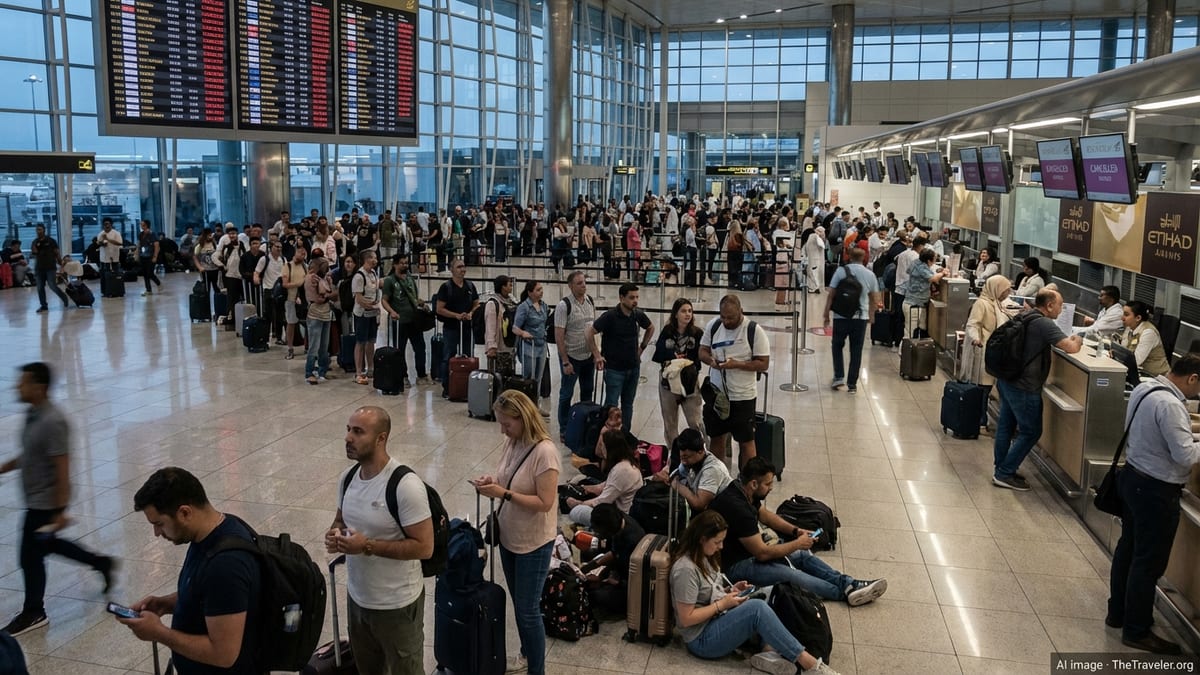
Air travel across the Gulf faced a sharp wave of disruption on September 19, 2026, with flight-tracking tallies showing 1,585 delays and 40 cancellations across major Middle East hubs, as schedule pressure, route adjustments, and knock-on aircraft positioning issues piled up through the region’s tightly connected networks.
Get the latest news straight to your inbox!
Where the disruption concentrated and why it spread so quickly
The most acute congestion appeared to cluster around Saudi Arabia and the United Arab Emirates, where hub airports process dense banks of arrivals and departures that are timed for quick connections. When early rotations slip, later departures often inherit the delay, especially on narrow-body regional services that feed long-haul waves.
Published coverage tied the spike to a combination of short-notice regional operating adjustments and airspace route realignments, which can add flying time and compress turnaround windows. Even when airports remain open, longer routings and tactical changes to flight paths can disrupt aircraft and crew sequencing across multiple cities in a single day.
Security risk in the wider region has also been a continuing backdrop for airline planning in 2026, with operators balancing schedule integrity against rapidly changing operational constraints. In practical terms, that can mean more conservative fuel planning, altered alternates, and re-timed departures to match available routings, all of which can erode on-time performance once a network starts running late.
Airport-by-airport snapshot: Riyadh, Jeddah, Dubai and other hubs
Publicly posted disruption summaries for September 19 showed Riyadh’s King Khalid International Airport leading the region by volume, with 357 delays and eight cancellations. Jeddah’s King Abdulaziz International Airport followed with 272 delays and four cancellations, a particularly sensitive pinch point given the airport’s role in international traffic and pilgrimage flows.
In the UAE, Dubai International Airport posted 186 delays and nine cancellations, while Abu Dhabi’s Zayed International Airport recorded 119 delays and two cancellations. Sharjah International Airport, a key base for low-cost operations, saw 68 delays and three cancellations, reflecting how quickly hub delays can spill into high-frequency short-haul flying.
Other Gulf gateways also registered notable impacts in the same reporting, including Doha’s Hamad International Airport, Muscat International Airport, and Kuwait International Airport, where smaller absolute numbers can still translate into missed connections when flights are tightly banked. The same day’s disruption picture underscored the region’s role as a global crossroads, where a late inbound can ripple into onward departures bound for Europe, South Asia, East Asia, and North America.
Airlines most affected: network knock-on effects and crew limits
Carrier-level tallies associated with the September 19 spike pointed to heavy disruption for Saudi operators. Saudia was listed with 232 delayed flights and eight cancellations, while low-cost carrier flynas was listed with 137 delays and two cancellations, illustrating how domestic and regional frequency can amplify the raw number of affected flights during irregular operations.
In the UAE’s budget segment, the same reporting highlighted disruption at flydubai and Air Arabia, consistent with the operational reality that high-utilization fleets have less slack to recover once rotations run behind. Network carriers can sometimes protect long-haul departures by delaying or consolidating short-haul legs, but that often shifts pain onto regional travelers and connection itineraries.
Duty-time limits for crews and minimum rest requirements can turn a late afternoon delay into an evening cancellation if an aircraft arrives too late to legally operate its next segment. That dynamic can be especially pronounced when added route time or holding patterns push multiple flights beyond their planned blocks.
Airspace risk management remains in focus
Beyond day-to-day operational bottlenecks, airlines and regulators have continued to monitor conflict-zone risk around Gulf overwater airspace. A European Union Aviation Safety Agency conflict-zone bulletin updated on August 31, 2026, extended guidance through September 30, 2026, recommending that operators avoid operating at all altitudes over the waters of the Persian Gulf within the Bahrain, Kuwait, Doha, and Emirates flight information regions, except as necessary for arrivals and departures.
The same EASA guidance also addressed overwater airspace in the Gulf of Oman west of a specified longitude and highlighted risks tied to missile and drone activity, interception operations, and potential falling debris. While such bulletins are aimed at operator risk assessment rather than consumer itineraries, they help explain why routings and schedules can change quickly, and why airlines may add buffer time or reroute flights that would otherwise take more direct tracks.
Separately, published coverage in recent months has tracked rolling airline-by-airline adjustments on certain Gulf routes, including temporary suspensions, reinstatements, and day-by-day cancellations as conditions evolve. For travelers, that pattern can look like inconsistent service, but operationally it reflects a shifting mix of demand, routing availability, and risk planning.
What travelers should do now: practical steps for connections and rebooking
For passengers traveling through Gulf hubs in the next several days, the key risk is not only a delayed departure but the domino effect on onward connections, especially itineraries that rely on short layovers. When a hub experiences widespread delay, re-accommodation can be slow because many flights depart near full and later flights may already be impacted by aircraft and crew displacement.
Publicly available airline and airport tools can provide the fastest reality check before leaving for the terminal. Travelers can reduce surprises by verifying their flight number status on the operating carrier’s website and reviewing airport departure boards, then arriving with extra time if security and check-in queues are likely to surge during irregular operations.
When disruption hits mid-journey, travelers generally have better odds of protecting their trip by proactively asking for rebooking options that preserve the long-haul segment first, then rebuilding the short-haul legs around it. For those with separate tickets, the risk is higher because missed connections are often treated as independent trips, making same-day disruption across multiple Gulf airports more consequential than a single delayed flight.