


More news on this day
Travel advice for Kuwait and Bahrain has been sharply tightened by Australia, the United Kingdom, Canada and New Zealand, as governments move to reflect a deteriorating security picture across the Gulf and mounting disruption to air links through the region.
Get the latest news straight to your inbox!
Four governments move Kuwait and Bahrain into highest-risk category
Recent updates to official guidance in Australia, the United Kingdom, Canada and New Zealand show a clear shift toward treating Kuwait and Bahrain as among the riskiest destinations in the Middle East for leisure and non-essential business travel.
Australia’s Smartraveller service now lists both Bahrain and Kuwait at its highest advisory level, “do not travel,” following a review of Middle East travel settings dated 24 July 2026 that cites a deteriorating regional security climate and the potential for further escalation in coming days.
Canada’s travel advisory system has also been revised, with Bahrain and Kuwait both reclassified to “avoid all travel,” the strongest warning in Ottawa’s four-tier scale, in an update published on 23 July 2026 that highlights heightened tensions and the risk of sudden changes to the security environment.
New Zealand’s public travel information notes that its government currently advises against travel to Bahrain and Kuwait because of the wider conflict in the Middle East, while the United Kingdom’s Foreign, Commonwealth and Development Office continues to caution against all but essential travel to parts of the Gulf and to warn its citizens about the possibility of missile or drone activity affecting Bahrain and Kuwait.
Security concerns linked to regional conflict and missile threats
Across the updated advisories, officials point to the impact of a widening regional conflict, including missile and drone strikes and related reprisal actions that have targeted or threatened key infrastructure around the Gulf.
Australia’s revised guidance for Bahrain notes an intensifying cycle of military operations in the broader region and explicitly raises the possibility of attacks on civilian infrastructure, urging travelers to consider how they would respond if local warning systems signalled an imminent strike and to identify enclosed shelter options before any trip.
Canada’s updates on Bahrain and Kuwait reference security alerts issued by diplomatic missions in Manama about potential Iranian plans to strike targets in central Bahrain, and underline that escalation elsewhere in the Middle East could have direct spillover effects on these small but strategically important Gulf states.
New Zealand’s SafeTravel bulletins fold Bahrain and Kuwait into wider warnings about conflict-related risks across the Middle East, including reduced fuel supplies, higher prices and pressure on key maritime routes, while UK public information reminds travelers that previous missile incidents prompted calls for British nationals in Bahrain and Kuwait to shelter indoors and avoid all movements until the immediate threat had passed.
Flight cancellations, airspace closures and transit disruption
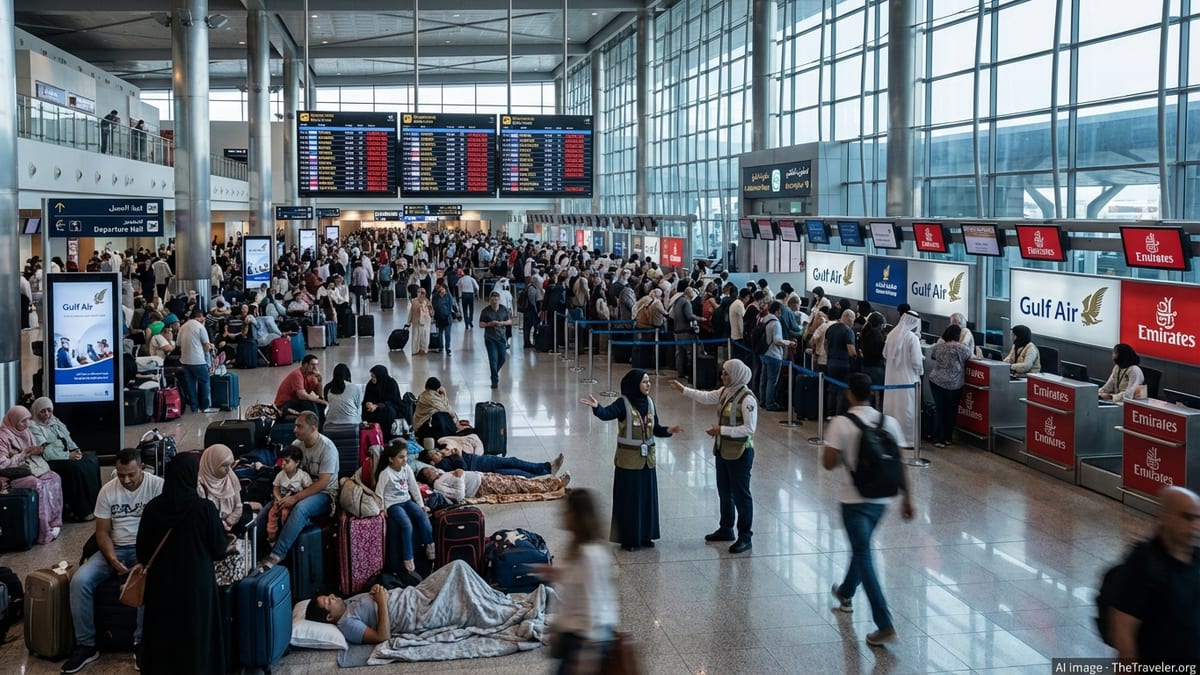
The tightening of government advice is being reinforced by practical disruption in the air, with a series of flight cancellations and route changes affecting Kuwait and Bahrain over recent months as airlines react to shifting risk assessments and temporary airspace restrictions.
Reports from airline passengers and regional travel forums in July indicate that carriers including Emirates, Etihad Airways and Air Arabia have periodically suspended or rerouted services to Kuwait and Bahrain as regional tensions have spiked, while some travelers connecting through Kuwait International Airport or Bahrain International Airport have received short-notice cancellation notices and rebooking offers.
Earlier in the year, specialist aviation and travel industry briefings described partial or complete closures of airspace over several Gulf states, including Bahrain and Kuwait, as military operations intensified, forcing carriers to adopt longer routings around the Gulf and prompting some to temporarily withdraw scheduled services.
Travelers who rely on Kuwait or Bahrain as transit hubs are being advised in public forums and by travel agents to build additional flexibility into itineraries, check bookings frequently in the days before departure and ensure that any insurance policies cover disruption stemming from government advisories or security-related airspace closures.
Insurance, consular support and practical implications for travelers
The shift to near-blanket warnings has important knock-on effects for insurance coverage and the level of support travelers can expect if they choose to visit Kuwait or Bahrain against official advice.
In the United Kingdom and several other European markets, travel insurers commonly exclude cover for trips taken to destinations where government guidance advises against all or all but essential travel. Commentators on Bahrain-focused travel forums report that some UK-based policies are now explicitly declining claims connected to non-essential travel into Bahrain, citing current Foreign Office wording.
Australian and Canadian advisories also stress that government capacity to provide consular assistance in high-risk environments can be limited, particularly where embassy operations are constrained by security conditions or where emergency evacuations would depend on commercial transport links that might be suspended at short notice.
Travelers who still decide to proceed are being urged by publicly available guidance to register with their home country’s traveler databases where available, maintain close contact with family and friends, and review whether their insurance extends to conflict-related incidents, medical evacuation and last-minute cancellations triggered by changes in official advice.
Planning alternatives and monitoring a fast-moving situation
For many tourists and business travelers, the latest moves by Australia, the UK, Canada and New Zealand are prompting a reassessment of near-term plans involving Kuwait and Bahrain, including cruise itineraries, stopover packages and corporate travel through Gulf hubs.
Some regional tourism specialists suggest that travelers who had intended to spend time in Kuwait City or Manama are now looking at alternative stopovers in destinations not subject to the highest-level advisories, or opting to delay Gulf trips until there is clearer evidence that the security situation is stabilizing and air services have normalised.
Official guidance across all four governments emphasises that the security outlook in the Middle East remains highly fluid, and that risk levels could change with little warning. Advisories urge citizens to monitor updates closely in the days and hours before departure and to remain prepared for sudden alterations to flight schedules, airport operations or local movement restrictions.
For now, the alignment of tighter language from Australia, the United Kingdom, Canada and New Zealand underlines the extent to which Kuwait and Bahrain have moved into a higher-risk category for international travel, placing a greater onus on would-be visitors to scrutinise plans, understand the limits of insurance and consular support, and decide whether their journeys are truly essential.