


Most travelers arrive in Chianti with a clear plan: follow the Strada del Vino, hit a few marquee cellars, photograph the vineyards and move on to the next Tuscan postcard. It is a reliable recipe for good wine and good photos, but it misses the quieter, more surprising side of this region. Away from the famous tasting rooms, Chianti is a lived-in landscape of stone hamlets, contemporary art in oak forests, Romanesque abbeys, olive mills and weekly markets where prices are written in chalk and no one is in a hurry. This is where the region stops being a brand and becomes a place again.
Get the latest updates straight to your inbox!
Chianti’s Overlooked Hill Villages
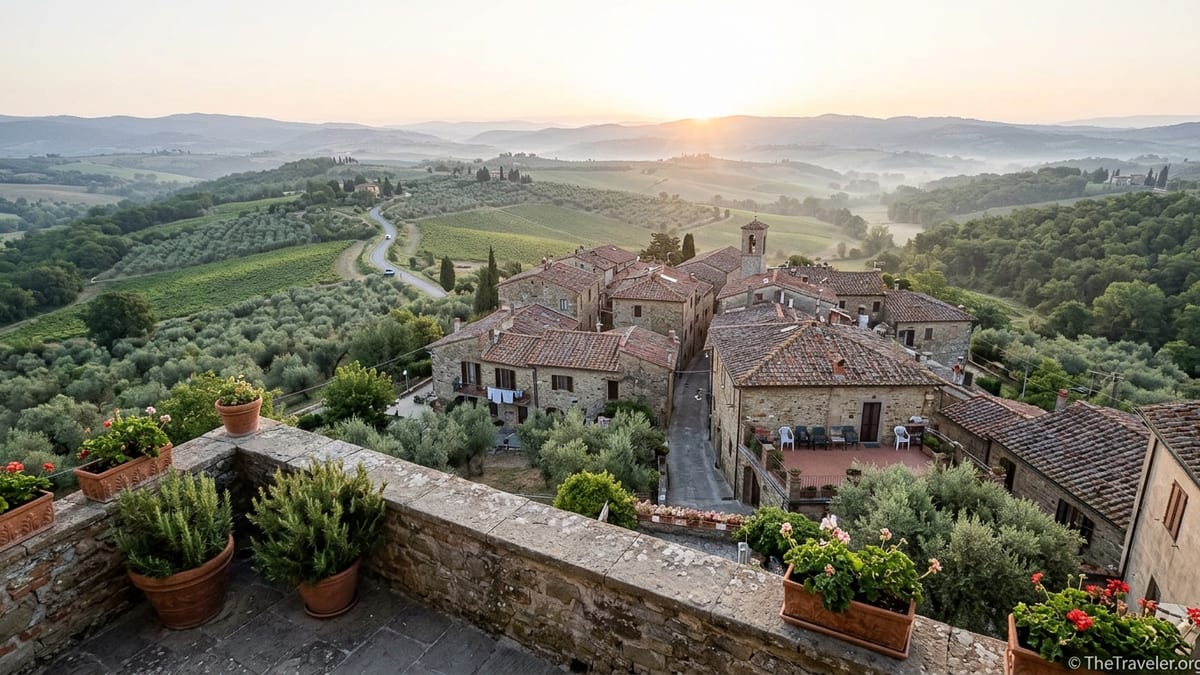
If you base yourself in Greve or Castellina and only visit headline estates, you will miss Chianti’s most atmospheric corners: the small, lived-in hill villages that rarely feature in glossy brochures. Radda in Chianti, for example, sits near the geographical heart of the Chianti Classico zone and has only around 1,600 residents, which gives its stone lanes and central piazza a quietly residential feel even in peak season. It is compact enough to walk in under an hour yet rich enough in wine bars, small groceries and views over terraced vineyards to easily fill a day.
From Radda, a narrow country road winds up to Volpaia, a medieval hamlet encircled by vineyards more than 600 meters above sea level. The entire village is effectively a tiny wine community, but what most visitors miss is the rhythm of daily life here: children weaving between delivery vans on the stone alleyways, church bells echoing across the valley, local residents stopping at a small alimentari for bread and cheese while tourists hurry past toward tastings. Arriving in late afternoon rather than at lunchtime lets you see Volpaia when the day-tripping groups have left and the village exhales.
Another place that rewards slow exploration is Montefioralle, perched on a hill above Greve. It is officially classified among the most beautiful hamlets in Italy and feels almost like a stone ring set above the valley. Many travelers stop for a quick photo from the car park below and move on to a winery booking. If you instead walk the circular lane inside the walls, peek into the tiny oratory and sit for an espresso in the village bar, you will start to understand how farm families once lived here year round, long before Chianti was a global wine destination.
Practical details matter. In most of these villages you can still park for a few euros for several hours in municipal lots just outside the historic center. Espresso at a local bar typically costs around 1.20 to 1.50 euro at the counter, and a glass of basic Chianti in an unpretentious enoteca might be 5 to 7 euro. These are modest sums, but they buy something many visitors never experience: time to watch village life rather than rushing from one appointment to the next.
Monasteries, Abbeys and the Soul of the Landscape
Chianti’s hills are dotted with monasteries and abbeys that once organized much of the agricultural life of the region. Today they are often treated as quick photo stops between wineries, yet a slower visit can be one of the most memorable experiences you have in the area. Badia a Coltibuono, for example, is a former Vallombrosan monastery whose history stretches back nearly a thousand years. The complex now hosts a working organic estate, a restaurant and guest rooms, but its cloister, frescoed halls and geometric Italian garden still tell the story of monastic agriculture and hospitality.
Many travelers book only a tasting at places like this, then leave as soon as the final glass is poured. It is worth paying slightly extra for a guided visit that includes the historic abbey rooms and gardens, not only the cellars. You might walk through a cool stone refectory where monks once dined, see centuries-old olive jars lining vaulted rooms and learn how monastic communities laid out terraced vineyards and chestnut groves. These details make later drives through Chianti’s hills more meaningful, because you start to recognize the patterns in the landscape.
Even smaller parish churches, often signed as "pieve" on road signs, can offer a quiet counterpoint to the busy tasting room. Many stand on sites that were spiritual centers for the countryside long before wine estates existed in their current form. Stepping into a dim Romanesque nave on a hot afternoon, you might find a single candle, a fresco softened by time and a handwritten sign announcing the next village festa. Stopping for five minutes here, even without perfect historical knowledge, connects you to Chianti as a place where faith, seasons and farming were always intertwined.
A practical tip: dress modestly for these visits, carry a light scarf if you are traveling in summer, and check for visiting hours posted on parish doors or municipal tourism boards. Many of these sites are free to enter but rely on small donations, so having a few coins ready for the offertory box is a simple way to support local custodians.
Art in the Forest: Chianti’s Contemporary Side
When people picture Chianti, they rarely imagine contemporary art. Yet in the oak and chestnut woods near Pievasciata, a small village north of Siena, the Chianti Sculpture Park has quietly grown into one of the region’s most distinctive cultural experiences. Here, dozens of site-specific sculptures are scattered along a forest trail, each created by artists from different parts of the world and designed in dialogue with the terrain: glass columns rising from the undergrowth, stone forms echoing dry-stone walls, metal installations that catch the light between branches.
Most wine-focused travelers never make it here, partly because the park requires a small detour from the main Chiantigiana road and a dedicated time slot. Yet the practicalities are straightforward. Entry tickets are typically priced in the range of a modest museum visit in a major city, and children receive reduced fares, making it a family-friendly stop. You park near the entrance, follow a signposted loop trail through the forest and can spend from one to two hours, depending on how long you linger at each piece.
An additional surprise waits outside the park: Pievasciata itself is gradually being transformed into an open-air art village, with sculptures and installations appearing in gardens, small squares and by the roadside. While tour buses queue outside well-known wineries, you might find yourself standing alone in front of a striking contemporary work set against olive groves and stone houses. It is a different way to understand Chianti, not as a timeless postcard but as a living region where new creative projects emerge alongside ancient vineyards.
To make the most of a visit, wear walking shoes suitable for uneven woodland paths and bring water, especially in summer when temperatures can climb quickly away from the forest shade. If you are traveling with children, the park provides a playful break from adult-oriented activities like long tastings, while still anchoring them in the local landscape. Many visitors report that conversations about which sculpture best "fits" the forest continue over dinner, long after leaving the park.
Everyday Chianti: Markets, Bakeries and Olive Oil Mills
One of the biggest mistakes short-stay visitors make is scheduling only winery appointments and restaurant reservations, without leaving margin for everyday places where locals shop and socialize. In market towns such as Greve in Chianti, the main piazza has hosted stalls for centuries, and weekly markets still fill the square with vendors selling seasonal fruit and vegetables, cured meats, cheeses, kitchenware and work clothes. Prices for local produce are often surprisingly reasonable: a kilo of tomatoes in late summer might cost 2 to 3 euro, while a wedge of aged pecorino could be 6 to 8 euro depending on quality.
Arriving early, before 10 am, lets you watch residents shop with canvas bags and exchange news with stallholders. Simple gestures, like buying a few peaches or a bag of almonds, open up small interactions that you will never have in a tasting room. Many markets also have a van serving porchetta panini or rotisserie chicken. Eating a warm sandwich on a stone bench for a few euros while you watch the life of the piazza unfold is a very different experience from a structured four-course lunch paired with reserve wines.
Beyond markets, small family bakeries and alimentari scattered through the villages are where Chianti’s food culture really lives. A typical bakery window in a town such as Castellina or Panzano might display crusty loaves baked on stone, schiacciata drizzled with olive oil and seasonal pastries. For a few coins you can put together an impromptu picnic: a half loaf, a small piece of salami, a tomato and a local soft cheese, then take them to a public viewpoint or rest area overlooking vineyards.
Olive oil mills offer another overlooked dimension. Many estates produce both wine and oil, but a handful of small frantoi focus largely on olives and welcome visitors informally in the harvest season. Instead of a full tasting flight, you might stand at a counter and sample a spoonful of bright green new oil on a piece of bread, while the mill owner explains how rainfall and olive fly pressure shaped that year’s yield. Bottles of high-quality extra virgin from such places can be comparable in price to a mid-range bottle of Chianti Classico, yet they bring the flavor of the region to every meal once you are home.
Walking, Not Just Driving, Through the Vineyards
Classic Chianti itineraries are usually described in terms of roads: the SR222 between Florence and Siena, the scenic switchbacks above Radda, the winding drives linking Gaiole, Greve and Castellina. While these routes are undeniably beautiful, they are still experienced through a windshield. What most visitors miss is that the region is dense with walking paths and farm tracks that thread between vineyards, oak woods and streams, many of them starting directly from village centers.
From Radda, for example, waymarked trails lead out toward nearby hamlets and estates, passing stone farmhouses, small chapels and shaded valleys. A modest loop of 6 to 8 kilometers can be completed in half a day by travelers with average fitness and rewards you with perspectives on the vineyards that are impossible to grasp from the road. You may pass workers pruning vines in winter or tying shoots in spring, hear the hum of machinery during harvest or simply enjoy the layered scents of wild herbs, soil and wood smoke.
These walks do not require specialized gear, but a few practical precautions make them more enjoyable. Sturdy shoes with good grip are advisable, especially after rain when clay paths can be slick. Carry water and a light snack, and in summer plan to be on the trail early in the morning or later in the afternoon to avoid the strongest heat. Maps from local tourism offices or digital navigation apps with offline topographic layers can help you stay oriented, as waymarking varies from excellent to minimal depending on the municipality.
Walking also changes the way you relate to wine itself. Arriving at a small estate on foot, a little dusty and sun-warmed, makes a simple tasting on a terrace feel like a natural extension of your journey rather than another appointment on a schedule. When you later open a bottle from that producer at home, you may remember a particular bend in the path, a distant bell or a field of sunflowers more vividly than the technical tasting notes.
Staying in Agriturismi and Rural Homes
Accommodation choices strongly shape how you experience Chianti. Many visitors opt for hotels in larger towns or polished wine resorts with spas and panoramic pools, which can be comfortable but sometimes insulate you from local rhythms. Agriturismi and small rural guesthouses, by contrast, place you directly in the working countryside. These are farm-based accommodations that must, by regulation, be connected to an agricultural activity, whether vineyards, olive groves, livestock or mixed crops.
A typical agriturismo stay might include a restored stone farmhouse apartment with a kitchenette, simple but solid furniture, and a terrace overlooking fields. Breakfast could feature bread baked on site, jams from the farm’s own fruit trees and eggs from their hens. Some properties host communal dinners a few evenings a week where guests, neighbors and extended family gather around long tables to share seasonal dishes. Prices vary widely depending on amenities and proximity to major routes, but many mid-range options in Chianti offer double rooms in the range of a modest urban hotel, especially outside the peak of July and August.
Choosing this type of accommodation also changes your daily patterns. Instead of driving into town for every meal, you might shop at a local market in the morning, then prepare a simple lunch in your kitchen and spend the afternoon reading under fig trees or walking nearby lanes. Conversations with hosts are often a rich source of local recommendations, from little-known viewpoints to small artisans and family-run trattorie that do not appear in international guides.
When evaluating agriturismi, look carefully at recent guest feedback to understand whether the property leans more toward quiet farmstay or polished resort. Both can be enjoyable, but expectations matter. If your goal is to connect with the land and everyday life in Chianti, a smaller place where you occasionally see tractors passing the window and hear roosters at dawn may be exactly what you are looking for.
The Takeaway
Chianti’s global fame as a wine region can make it feel, at first glance, like a finished product: vineyards framed for photographs, tasting rooms calibrated for international visitors, itineraries laid out along well-trodden roads. Yet beyond this polished surface lies a quieter Chianti that most travelers overlook, not because it is hidden, but because it does not advertise itself loudly. It lives in hilltop hamlets where the grocery store knows every resident, in centuries-old abbeys where vines still wrap around cloisters, in forest art trails and weekday markets.
Experiencing this side of Chianti does not require special access, only a modest shift in priorities. Leave space in your schedule between tastings. Choose to walk a little more and drive a little less. Step into churches, bakeries and olive mills with the same curiosity you bring to wine cellars. Stay where the night sky is dark and mornings begin with birds and farm sounds rather than traffic. In doing so, you will discover that the region’s most lasting flavors are not only in the glass, but in the unhurried hours you spend inhabiting its villages, paths and everyday rituals.
FAQ
Q1. When is the best time of year to explore Chianti beyond the wineries?
Spring and autumn are ideal for slower travel in Chianti. From late April to early June and again from September into October, temperatures are generally mild, walking paths are comfortable, and villages are lively without the peak summer crowds.
Q2. Do I need a car to visit lesser-known villages and art sites in Chianti?
A car gives you the most flexibility for reaching small hamlets, abbeys and the Chianti Sculpture Park, as public transport between villages is limited. However, you can combine regional buses or trains to larger towns with local taxi services and organized excursions if you prefer not to drive.
Q3. Are smaller villages like Volpaia and Montefioralle suitable for families?
Yes, these compact hill villages can be very family friendly, as traffic is limited and distances are short. Children often enjoy exploring narrow lanes and walls, though parents should be prepared for some uphill walking and bring suitable footwear and sun protection.
Q4. How expensive are local markets and everyday food compared with winery restaurants?
Buying food at village markets, bakeries and small groceries is usually more economical than eating all meals in winery restaurants. Simple items like fresh bread, fruit, cheese and salami can be combined into generous picnics for the price of a single course at a more formal venue.
Q5. Can I visit abbeys and parish churches without joining a guided tour?
In many cases you can, as parish churches and some abbey grounds are open during posted hours and welcome respectful individual visitors. For more in-depth access to historic rooms, cloisters or private chapels, it is often worth booking a guided visit through the site or a local tourism office.
Q6. How should I dress for visiting religious sites in Chianti?
Modest, comfortable clothing is recommended. Shoulders and knees should be covered when entering churches or abbeys, and a light scarf can be useful. Footwear suitable for stone floors and uneven paths around old buildings will make visits more comfortable.
Q7. Are there marked walking trails, or will I be crossing private vineyard land?
Chianti has a mix of official walking routes, farm tracks and small roads. Many paths are clearly marked, while others require a map or navigation app. It is important to respect private property, follow existing tracks and close any gates you pass through.
Q8. What is an agriturismo, and how is it different from a regular hotel?
An agriturismo is an accommodation linked to an active farm, such as a vineyard or olive grove. Stays here often feel more informal and rural than in conventional hotels, with opportunities to experience local products, seasonal meals and closer contact with hosts.
Q9. Do I need to book everything in advance, or can I be spontaneous?
For high season, advance reservations are advisable for accommodation and popular winery tastings. However, many of the experiences described, such as markets, village walks and casual visits to parish churches, can be enjoyed spontaneously if you leave some unscheduled time in your days.
Q10. Is it possible to enjoy Chianti if I am not a wine drinker?
Yes. While wine is central to the region’s identity, non-drinkers can focus on hill villages, art parks, abbeys, walking routes, food traditions and landscape photography. Many wineries and agriturismi also offer excellent meals, olive oil tastings and cultural activities that do not require drinking wine.