


Landing at Ho Chi Minh City’s Tan Son Nhat International Airport can feel overwhelming, especially after a long-haul flight. Between taxi touts, ride-hailing apps and private shuttles, it is easy to overpay for the short trip into town. For budget minded travelers heading to District 1, the Airport Bus 109 offers one of the simplest, cheapest and most reliable options, dropping you close to Ben Thanh Market, Pham Ngu Lao and 23 September Park for a fraction of a taxi fare.
Get the latest updates straight to your inbox!
What Is Airport Bus 109 and Why Travelers Use It
Airport Bus 109 is a dedicated airport route linking Tan Son Nhat International Airport with central Ho Chi Minh City, including the backpacker area around Pham Ngu Lao Street and the green corridor of 23 September Park in District 1. Operated as an airport focused service with modern, air conditioned buses, it is designed with visitors in mind, with clear route displays and space for luggage. For many independent travelers, it is the default choice when they want to avoid taxi negotiations but still keep transport costs low.
The route runs between the airport and the District 1 bus hubs around Ben Thanh and 23 September Park, passing key downtown streets such as Nam Ky Khoi Nghia, Cach Mang Thang Tam, Le Lai and Pham Ngu Lao. In practical terms, that means you can step off your long haul flight, get on a single bus, and step off again within walking distance of most budget and mid range hotels in central Saigon. For example, a guesthouse on Bui Vien Street is usually a five to ten minute walk from the final stop at 23 September Park.
Compared with regular city buses, the interior of Bus 109 tends to be slightly more comfortable, with better air conditioning and wider aisles. You will still be riding with a mix of locals and travelers, which makes it feel like part of the city rather than a tourist shuttle, but it is noticeably easier to manage with luggage than typical urban routes. Tickets are sold on board by a uniformed conductor, and you simply pay in cash and keep the small paper ticket as proof of purchase.
For solo travelers and couples, especially those arriving in the daytime, the value of Bus 109 is clear. A typical taxi to District 1 can run around 120,000 to 200,000 dong depending on traffic and route, while the bus usually costs around 15,000 to 20,000 dong per person for the full trip. Over the course of a multi city trip in Vietnam, using the bus instead of taxis can easily save enough for several extra meals or an upgraded room.
Route, Stops and Where to Get Off in District 1
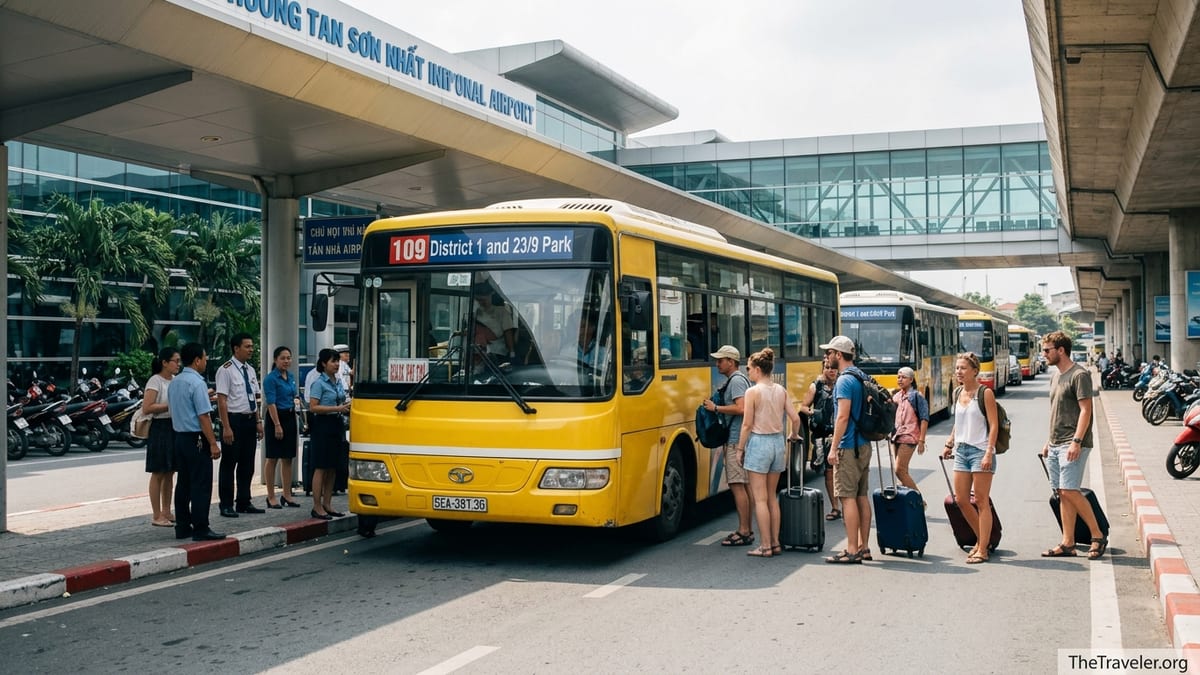
From Tan Son Nhat Airport, Bus 109 serves both the international and domestic terminals. After exiting arrivals, you follow signs toward the public transport area and look for the yellow airport buses parked along the curb. The bus will typically be marked with the number 109 and a route description referencing 23/9 Park or the city center. If in doubt, you can show the driver or conductor “23/9 Park” written on your phone or on a piece of paper and ask for confirmation before boarding.
The route leaves the airport along Truong Son Street, loops past the domestic terminal, and then joins the main arteries of the city such as Hoang Van Thu and Nguyen Van Troi before running down Nam Ky Khoi Nghia into the downtown grid. In the city center, it passes near Ben Thanh Market and continues along Le Lai and Pham Ngu Lao, making several convenient stops for travelers staying in District 1. One of the most useful landmarks is the stretch of 23 September Park that borders Pham Ngu Lao Street, which functions as a de facto bus and backpacker hub.
If your hotel is near Ben Thanh Market, you can get off at the Ben Thanh bus station stop, which is a short walk from the market’s clock tower and many nearby hotels such as Liberty Central Saigon Centre or budget guesthouses on Le Thanh Ton. Travelers staying on or near Bui Vien, De Tham or Pham Ngu Lao Streets will usually ride the bus until the 23 September Park area, where the bus terminates or pauses at a small bus loop. From there it is a few minutes on foot to most hostels and guesthouses clustered around the park.
In the opposite direction, when you are leaving Ho Chi Minh City for your flight, you can board Bus 109 from stops along Pham Ngu Lao or from the 23 September Park bus area. Many travelers simply head to the park, find the bus stands along the park’s edge and look for the 109 signage. Even if you are staying closer to the river near Nguyen Hue or Dong Khoi, it is often a short and inexpensive taxi or a 15 minute walk to connect with Bus 109 at Ben Thanh or 23 September Park.
Operating Hours, Frequency and Journey Time
Bus 109 operates from early morning into the late night, which covers the majority of international and regional arrivals at Tan Son Nhat. Current schedules indicate a start time around 5:30 to 5:45 in the morning from both the airport and 23 September Park, with service continuing until roughly 23:30 to 1:30 in the early hours, depending on direction and day. In practice, that means most daytime and evening arrivals will find the bus still running, while those landing in the very early hours of the morning may need to resort to a taxi or ride hailing service.
Frequency varies with traffic and time of day, but you can expect a bus roughly every 20 to 30 minutes during most of the day. In peak hours, service can be more frequent, while late at night gaps may be slightly longer. For example, a traveler arriving at 14:00 will usually clear immigration and customs by around 15:00 and typically be on a bus by 15:20 or 15:30. Someone arriving on a late evening flight around 23:00 may still catch the last or second to last departure, but it is wise to move promptly to the bus stands rather than stopping for a long meal in the terminal.
The journey time between the airport and District 1 depends heavily on traffic. In light traffic, particularly early in the morning or late at night, the bus can cover the distance in about 30 minutes. During rush hours, especially on weekday evenings when commuters crowd the main approach roads, the trip can stretch to 50 minutes or more. Travelers arriving around 17:00 to 19:00 should budget at least an extra 20 minutes compared with off peak times.
As a real world example, a visitor landing from Singapore at 10:30 on a weekday might clear the airport by 11:15, board a 109 bus shortly afterward, and reach the 23 September Park area by 11:50. Another traveler with a 07:30 domestic flight departure the next day might leave their Pham Ngu Lao hostel at 05:30, catch an early 109 near the park, and arrive at the airport domestic terminal by around 06:00, leaving enough time for check in and security.
Ticket Price, Paying on Board and Luggage Rules
Bus 109 is priced to be accessible to both locals and visitors. Recent information from city transport providers and travel guides indicates a fare in the region of 15,000 to 20,000 Vietnamese dong for the full route between the airport and 23 September Park, which is usually less than one US dollar per person. Some sources mention slightly lower fares for short hops of under five kilometers, but most arrival passengers will simply pay the standard city center price. Given how inexpensive the fare is, many travelers do not worry about the exact tariff and simply pay what the conductor requests for the airport to District 1 journey.
You buy your ticket on board. After you step onto the bus and take a seat, a conductor will walk down the aisle asking where you are going. You can say “Ben Thanh” or “Pham Ngu Lao” or show your hotel address on your phone. The conductor will quote the price, accept cash and hand you a small paper ticket. Payment is almost always in Vietnamese dong; while staff sometimes accept small US dollar notes, it is safer to withdraw or exchange a bit of local currency at the airport first. Card payments are not common on board.
Luggage policies on Bus 109 are generally lenient, as the service is known as an airport route. Buses are fitted with racks and open standing areas where you can place suitcases and backpacks. In practice, travelers routinely carry one checked suitcase and one cabin bag without issue. Some operators mention a possibility of an additional small charge for very heavy or oversized luggage, but this is usually a modest amount and will be explained by the conductor if it applies. As long as your bags can fit through the bus door and are not obstructing the aisle, staff are usually accommodating.
For example, a couple arriving from Europe with two 23 kilogram checked cases and two carry on backpacks will typically be allowed on board without any special procedure. They might take seats near the middle of the bus and stand their suitcases in the open floor space nearby, keeping them under control during the ride. In contrast, a traveler carrying large sports equipment such as a full size surfboard or bicycle box may find the bus impractical and would be better off booking a taxi or van, both for convenience and out of consideration for other passengers.
How to Find Bus 109 at Tan Son Nhat Airport
After clearing immigration, baggage claim and customs at the international terminal, you emerge into the arrivals hall filled with currency exchanges, SIM card kiosks and pickup drivers. To reach Bus 109, you exit the terminal building onto the outer curb and turn toward the area signed for public buses and taxis. The bus bays are typically located to the right when you walk out of the main door, although signage can change with renovations, so it is wise to follow airport signs indicating “bus” or ask a security guard for “bus 109” if you are unsure.
The Airport Bus 109 vehicles are usually painted in a bright yellow scheme and carry clear route numbers on the front and sides. Other airport buses and city routes may also be present, including different route numbers and colors, so check the electronic or printed sign on the windshield that mentions “109” and “23/9 Park” or similar wording. If several buses are lined up, you can show your destination on your phone and staff will point you to the right vehicle.
Passengers arriving at the domestic terminal can also board Bus 109 without returning to the international side. The bus normally serves both terminals on its loop, stopping at marked bus bays outside each arrival area. If you are connecting from a domestic flight to a city hotel, simply follow signs from baggage claim to the arrivals forecourt, then walk along the curb until you see the bus stops and numbered stands. In both terminals, the stands are shared with other routes, so it is worth waiting until the correct bus arrives rather than jumping onto the first vehicle that pulls in.
One common real world strategy is to split tasks if you are traveling with a friend or partner. While one person buys a local SIM card and withdraws cash from an ATM, the other can walk out to confirm the bus stop location and check the next departure time, then signal back via messaging apps once everything is ready. This helps you avoid rushing and reduces the chance of missing a bus by a few minutes while still sorting your essentials.
When Bus 109 Is Better Than a Taxi or Grab
Even in a city where taxis and ride hailing services are relatively affordable, Bus 109 holds a clear edge in several situations. The most obvious is cost. For a solo backpacker landing at mid day and staying near Bui Vien, spending under 20,000 dong for a direct ride to 23 September Park is far cheaper than paying around 150,000 dong for a metered taxi to the same area. Over the course of a month long trip that might include multiple flights in and out of Ho Chi Minh City, those savings add up.
The bus can also be faster in practice when compared with waiting for ride hailing pick ups during peak arrival times. At busy periods, many passengers request cars through popular apps at once, which can lead to long waits or confusion about pickup points. With Bus 109, you simply walk to the bus bay and board the next departure. Particularly for travelers without mobile data immediately on arrival, avoiding the need to coordinate a pickup through an app can remove a layer of stress.
Another advantage is predictability. With meter based taxis, there is always a small risk of an inexperienced or opportunistic driver choosing a longer route, especially if the passenger is visibly unfamiliar with the city. While reputable brands and ride hailing apps reduce this risk, some visitors still feel uncertain after reading about scams. Bus 109 has a fixed route and fixed pricing, and staff are accustomed to working with tourists. You pay once, receive a ticket, and get off where everyone else does, which often feels more straightforward to first time visitors.
Bus 109 is also a good choice for those who enjoy easing into a new city rather than rushing straight to a private vehicle. The bus windows give you a preview of local neighborhoods, shopfronts and motorbike flows as you approach District 1. Many travelers mention that this short ride helped them adjust to Ho Chi Minh City’s pace and layout, spotting landmarks like the Saigon River or the Saigon Central Post Office towers in the middle distance as they approach downtown.
When You Should Skip the Bus and Take a Car
Despite its strengths, Bus 109 is not ideal for every situation. Travelers arriving very late at night or in the small hours of the morning, outside the operating window of the bus, will realistically need to arrange a taxi, pre booked car or ride hailing service. If your international flight lands at 02:30, by the time you clear formalities the buses will not be running, and waiting several hours for the morning service is not practical after a long journey.
Time pressure is another critical factor. If you are connecting through Ho Chi Minh City on separate tickets, landing at Tan Son Nhat and catching a domestic flight from the same airport within a tight connection window, a taxi will give you more control over journey time and allow for last minute changes of route if traffic is unusually heavy. The bus, while generally reliable, is still subject to traffic lights and multiple stops that may add precious minutes.
Large groups and families with substantial luggage may also be better served by private vehicles. A family of five with several large suitcases and young children might find the confined space and occasional standing room on the bus more challenging than a private van or two regular taxis. In such cases, the cost per person difference between the bus and a shared taxi becomes less significant, especially when weighed against convenience and comfort.
Travelers staying outside District 1, for example in Thao Dien in District 2 or in a residential neighborhood of District 7, will need a second mode of transport after getting off the bus at 23 September Park or Ben Thanh. While many still choose this combination to save money, those arriving in heavy rain or extreme heat might opt for a direct car to their final address instead of juggling bus transfers and local taxis with luggage in hand.
23 September Park: The Key Landmark for Bus Travelers
September 23rd Park, commonly written as 23/9 Park, is a long, narrow green space running along the edge of District 1 near Pham Ngu Lao Street. For visitors using Bus 109, it serves as both a practical transport hub and an easy visual landmark. Buses pull in at the park’s edge, where several routes start and finish, and passengers fan out into the surrounding streets of budget guesthouses, cafes and tour agencies.
The park itself sits above what was once the Saigon railway station yard and is now earmarked for future metro infrastructure. For current travelers, it is a pleasant strip of trees, benches and walking paths where locals practice morning exercises, teenagers gather in the evenings, and street vendors sell snacks and drinks. Many hotels list their location relative to 23 September Park, such as “two minutes’ walk from 23/9 Park,” knowing that it is a reference point every taxi driver and bus rider recognizes.
For bus passengers arriving from the airport, the park is usually the last or near last stop on the route. When the conductor calls out “Cong vien hai ba thang chin” or gestures toward the final stop, you can confidently get off and orient yourself. If your accommodation is in the backpacker cluster, you may already see street signs for Bui Vien and De Tham from the bus window as you pull in. Many travelers choose to grab an iced coffee from a nearby cart, sit on a bench in the park, and check into their hotel once the midday traffic has cooled slightly.
When leaving the city, return to the same side of 23 September Park where buses line up, watching for the 109 signs. Even if you misjudge your stop and walk a little too far along the park, the area is compact enough that you can double back within a few minutes. Using the park as your anchor point dramatically simplifies navigating between your hotel, the bus stop and the wider city.
The Takeaway
For budget conscious travelers arriving at or departing from Ho Chi Minh City, Airport Bus 109 offers a practical blend of low cost, reasonable comfort and straightforward logistics. It connects both terminals of Tan Son Nhat Airport directly to the heart of District 1, including Ben Thanh Market and the 23 September Park area, for a fare that is a small fraction of the cost of a taxi or ride hailing car.
The bus is particularly well suited to solo travelers and couples with light to moderate luggage, arriving during daytime or evening hours and staying in or near the central districts. It is easy to board, easy to pay for with cash on board, and simple to navigate thanks to clear route markings and the prominent landmark of 23 September Park at the city end. For many, it provides their first glimpse into the rhythms of Saigon life.
At the same time, it is important to recognize when a taxi or private transfer is a better choice: late night arrivals, tight flight connections, heavy luggage or accommodation far from the bus route can all tip the balance in favor of door to door service. By weighing cost, time, comfort and your destination, you can decide on each trip whether Bus 109 or a car best fits your plans.
Armed with a basic understanding of Bus 109’s route, schedule, fares and practicalities, you can step out of Tan Son Nhat Airport with confidence, walk past the taxi touts, and hop on a yellow bus that will carry you straight into the city for the price of a coffee. For many travelers, that quiet, air conditioned ride into District 1 is the moment Ho Chi Minh City begins to feel not just like a busy arrival hall, but a place they can navigate on their own terms.
FAQ
Q1. Where exactly do I catch Bus 109 at Ho Chi Minh City airport?
After leaving the arrivals hall at either the international or domestic terminal, walk out to the main curb and follow signs for public buses. Look for the yellow buses marked with the number 109 at the shared bus bays near the taxi area, and confirm with staff that the bus is going to 23 September Park or the city center.
Q2. How much does Bus 109 cost from the airport to District 1?
The fare for the full journey between Tan Son Nhat Airport and the District 1 area around Ben Thanh and 23 September Park is typically in the range of 15,000 to 20,000 Vietnamese dong per person, payable in cash on board to the conductor.
Q3. How long does the trip from the airport to 23 September Park take?
In light traffic, the ride usually takes around 30 minutes. During rush hours or heavy rain, expect the journey time to increase to 40 to 50 minutes, so always allow some buffer if you have time sensitive plans.
Q4. What are the operating hours of Bus 109?
Bus 109 generally starts running around 5:30 to 5:45 in the morning and continues until late at night, with last departures close to midnight or shortly after. Exact times can vary slightly, so travelers with very late or very early flights should be prepared to use a taxi if the bus is not operating.
Q5. Can I bring large luggage on Bus 109?
Yes, Bus 109 is designed as an airport route and can accommodate typical checked suitcases and carry on bags. Most travelers with one large suitcase and one smaller bag per person ride without problems, although extremely bulky items like surfboards or bicycle boxes may be impractical.
Q6. Is Bus 109 safe for solo travelers arriving alone?
For most visitors, Bus 109 is considered a safe and straightforward option. It is used by a mix of locals and tourists, there is a uniformed conductor on board, and it follows a fixed, well known route into the city, which tends to feel more predictable than negotiating with unfamiliar taxi drivers.
Q7. How often does Bus 109 run during the day?
During most of the day you can expect a Bus 109 departure roughly every 20 to 30 minutes in each direction. Frequencies can be higher at peak times and a bit lower late at night, so moderate waiting times are normal.
Q8. When is it better to choose a taxi instead of Bus 109?
A taxi or ride hailing car is usually a better choice if you arrive after the last bus, are traveling with a lot of luggage or small children, have a very tight connection, or are staying far from District 1 and want direct door to door service.
Q9. Which stop should I use if my hotel is near Bui Vien or Pham Ngu Lao?
If you are staying near the backpacker streets of Bui Vien, De Tham or Pham Ngu Lao, remain on Bus 109 until it reaches the 23 September Park area in District 1. Get off there and walk a few minutes to your accommodation using the park as your reference point.
Q10. Do I need to buy a ticket in advance for Bus 109?
No advance ticket is required. You simply board the bus when it arrives, take a seat, and pay the conductor in cash once on board. Keep the small paper ticket you receive until you leave the bus.