


Ho Chi Minh City’s Tan Son Nhat International Airport can feel hectic the moment you clear customs, especially if you are trying to figure out where to meet your Grab driver while taxi touts circle around you. This guide walks you step by step through using Grab at both the international and domestic terminals, explains typical app prices into the city, and compares Grab with licensed airport taxis so you can choose the easiest option for your flight, budget, and luggage.
Get the latest updates straight to your inbox!
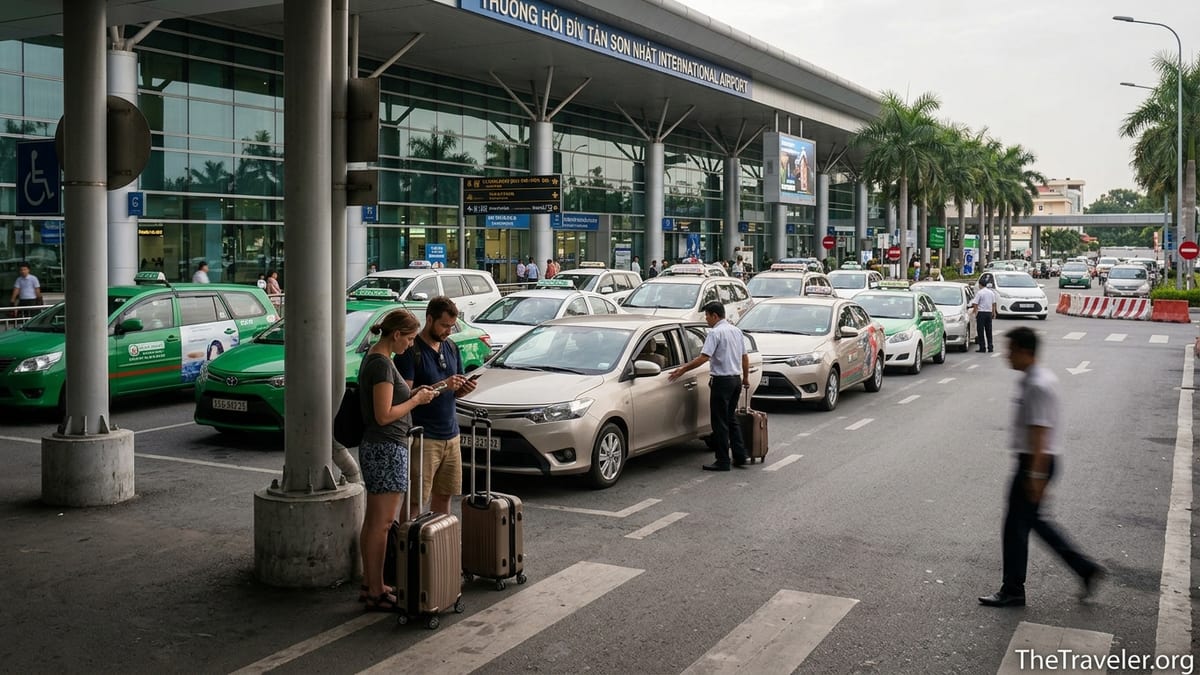
Understanding Tan Son Nhat Airport Layout and Terminals
Tan Son Nhat International Airport, usually shown as SGN, sits only about 6 to 8 kilometers from central District 1, but the airport layout and traffic around it can make that short distance confusing for first-time visitors. The airport currently operates two main terminals: Terminal 2 for international flights and Terminal 1 for domestic services within Vietnam, while a new Terminal 3 dedicated to domestic traffic is being phased in. When you open your Grab app on arrival, it will usually label pickup locations by terminal and by specific zones in the adjacent parking area, so knowing where you are standing is the first step.
International arrivals use Terminal 2. After immigration and baggage claim, you exit directly onto a busy curb packed with relatives, hotel drivers, and taxi representatives. This curb is not the main Grab pickup point; most Grab cars wait in the parking lot across the access road or at marked ride-hailing lanes near the domestic terminal. Domestic arrivals use Terminal 1, which sits a short walk away along the same access road. For many riders, especially when terminals are busy, it is actually faster to walk from international arrivals over to the domestic terminal side to meet their Grab driver in a more organized pickup area.
Traffic patterns at Tan Son Nhat are another factor. Main access is via Truong Son Street, which often backs up at evening rush hour and during peak holiday periods such as Tet. Because Grab uses dynamic pricing, heavy traffic and high demand around the airport can push up fares for short distances at those times. Licensed taxis queue in dedicated lanes at both terminals, so travelers arriving in the middle of a downpour at 6 pm on a Friday may discover that the practical difference between Grab and a metered taxi is more about wait time than price.
For transit passengers connecting from an international flight to a domestic flight the same day, there is also a free airside shuttle between terminals that keeps you inside the secure area, but Grab pickup always takes place landside after you have cleared customs and walked out of the building. If you have a tight onward connection, it rarely makes sense to leave the airport complex by Grab; instead, focus on reaching your domestic check-in counter inside the airport as quickly as possible.
Where to Meet Your Grab at the International Terminal
At Terminal 2, the biggest confusion for new arrivals is that Grab cars cannot usually stop directly outside the main exit doors for long. Security officers keep this section of curb moving, and only licensed airport taxis and prearranged vehicles are officially allowed to linger. To meet your Grab smoothly, the simplest method is to exit the terminal, cross the first access road, and walk into the open parking lot or multi-level parking area directly ahead. Your app will typically show the official pickup point as the parking lot area opposite international arrivals, and local drivers are very used to collecting foreign passengers there.
In practice, after you collect your luggage and step out through customs, look for the ground-floor doors leading straight outside. Once you are in the open air, ignore anyone offering “Grab,” “taxi,” or “car” verbally. Instead, keep your phone in hand, open the Grab app, and request a car only once you are close to the parking lot. Many travelers simply follow the crowd heading left toward the domestic terminal and then cross into the car park. Drivers often message in the app with a brief description of their car color and the parking row. Because there can be many similar silver sedans, always double-check the license plate in the app before you get in.
One common real-world scenario: a couple arriving from Europe around 9 pm books a GrabCar to District 1 while still standing inside baggage claim. By the time they walk out, their driver has already circled the airport once and is being pushed away by security, which can trigger cancellation or a driver no-show fee. To avoid this, wait until you are physically in the pickup area or at least on the sidewalk outside before you tap “Book.” At normal evening demand, cars usually arrive within 5 to 10 minutes. In high season or after multiple delayed flights, it may stretch closer to 15 minutes, in which case you should stay in touch with the driver via the app chat.
Signage at the international terminal does exist for parking and car parks, but it is not always clear about Grab specifically. Think of the rule of thumb: terminal curb for taxis, parking lot for Grab. If you feel turned around, you can send your live location from the app to your driver, or ask them which “column” or “lane” they are in. Many drivers will reply in basic English or send a photo of a nearby pillar number, which you can match on the spot.
Grab Pickup at the Domestic Terminal and the Terminal 3 Shift
For domestic arrivals at Terminal 1, Grab pickup tends to be more straightforward because ride-hailing platforms have long used clearly designated lanes near the terminal and the adjacent parking structure. After collecting your baggage, you exit to the arrivals curb and can usually see directional signs for ride-hailing zones leading towards the parking building. In recent years, travellers and local residents have reported that Grab cars commonly wait in a specific band of the ground-floor parking area, marked with pillars and lane labels that drivers reference in the app chat, such as “lane D1 near pillar 5.”
If your flight has landed in Ho Chi Minh City from another Vietnamese city and you are heading directly into town, you can open the Grab app while still in the baggage area to check prices, but again it is best to confirm the ride only once you are close to the designated pickup zone. Domestic passengers often travel lighter and move faster, so drivers expect quick boarding. On a typical weekday morning, a GrabCar Economy from Terminal 1 to a hotel near Ben Thanh Market might cost the rough equivalent of 4 to 7 US dollars in Vietnamese dong, with the exact amount varying based on demand and any promotional vouchers that Grab is running that week.
As Terminal 3 transitions into full operation for some domestic flights, ride-hailing rules continue to evolve. Reports from regular flyers indicate that restrictions sometimes prevent Grab from stopping at the most convenient curbside locations at new or refurbished terminals, forcing pickup into specific ride-hailing lots or lanes slightly farther from the main doors. If your domestic ticket lists Terminal 3, check the terminal code in the Grab app when setting your pickup point and follow any in-app instructions carefully. The app typically updates available pickup spots in near real time, so the location shown there is more reliable than directions found in older blog posts or printed maps.
Because the domestic and international terminals are walkable in about 5 to 10 minutes for most travelers without heavy bags, some people landing at Terminal 2 still choose to walk over to Terminal 1 to meet their Grab, especially when they see that domestic pickup is better organized at that particular moment. This can work well if you only have a carry-on backpack and arrive during cooler evening hours. However, if you are hauling two large suitcases in mid-day heat and humidity, the short distance can feel much longer, and in that situation a licensed taxi directly outside your door may be the more comfortable option.
Typical Grab Prices, Surge Pricing and Payment Options
Grab pricing at Tan Son Nhat is variable, but some broad patterns hold. For a standard GrabCar Economy to central District 1, many travelers report paying roughly between 90,000 and 200,000 Vietnamese dong in normal daytime conditions, which usually equates to something in the 4 to 9 US dollar range. The lower end of that band tends to appear in off-peak hours, such as mid-morning or mid-afternoon on weekdays. During those times, it is not unusual to see app quotes just below 100,000 dong for the 25-to-40-minute trip into the city, depending on traffic.
Surge pricing can push fares significantly higher when demand spikes. For example, if you land on a Saturday night at 10 pm, just as several other international flights arrive and a sudden downpour slows traffic on the main access road, you might see standard GrabCar quotes soar to 250,000 or even 300,000 dong for the same trip. Some visitors in early 2026 have shared examples of late-night rides from the airport to downtown costing the rough equivalent of 20 to 25 US dollars in the app when rain and heavy demand collided, which is two or three times the usual rate. In those moments, it may be cheaper to walk out to the official taxi rank and take a licensed metered cab instead.
Payment flexibility is one of Grab’s key advantages. You can generally pay by cash in Vietnamese dong, by a foreign credit or debit card saved in the app, or by local e-wallets if you have set them up. For travelers arriving from North America or Europe, adding a Visa or Mastercard to the app before landing is often the most convenient approach, removing the need to negotiate cash with a driver after a long flight. However, it is still smart to withdraw a small amount of dong at an airport ATM before leaving the building, both for cash emergencies and because some drivers are more comfortable if they know you have cash available in case the card payment fails due to connectivity issues.
Grab also regularly runs promotional discounts and tourist bundles. Around 2025 and 2026, visitors have reported receiving introductory “tourist packs” in the Grab app that include percentage-off vouchers for airport rides. In one common scenario, a new user might pay full fare on the app, but then see a 20 or 25 percent discount applied at the end of the trip, effectively refunding part of the cost. These offers change frequently, but they can make Grab substantially cheaper than taxis for budget-conscious travelers. Just remember that at times of very high surge pricing, even a discount voucher may not fully offset the jump in base fare.
How Much Luggage Can You Take and Which Grab Option to Choose
When you order a Grab at Tan Son Nhat, you will see several ride categories, though availability can vary by time of day. For most visitors heading into the city, GrabCar Economy or similar options are the default. These are typically compact or mid-size sedans that comfortably seat three passengers in the back and one in the front, with room for approximately two medium checked suitcases plus a couple of small backpacks in the trunk. If your party consists of two people with one checked bag each and carry-ons, this is usually sufficient.
If you are traveling as a family of four with several large suitcases, or as a group carrying bulky sports equipment, it is worth considering a larger category if it appears in the app, such as GrabCar Plus or any label indicating a larger MPV or SUV-style vehicle. These vehicles can usually handle three or four full-size checked bags along with smaller items more comfortably. When booking, count both people and bags; drivers have the right to decline if your luggage clearly exceeds the safe capacity of their vehicle, and in that case you may be charged a small cancellation fee and need to request a larger car.
GrabBike, the motorbike option, is popular among local residents and very light-pack travelers but is generally not a realistic choice for most airport passengers. Ride rules usually restrict GrabBike to travelers with only a small backpack or carry-on that can be safely worn by the passenger without unbalancing the bike. If you are a solo traveler with a daypack landing in off-peak hours, a GrabBike from the airport might be the cheapest and fastest way into areas like Phu Nhuan or nearby parts of District 3, with fares roughly half or a third of a car ride. However, you will not be able to balance a rigid suitcase or heavy duffel on a motorbike safely, and drivers may cancel if they see you with more luggage than they can handle.
Regardless of category, always think about the combination of heat, humidity, and travel fatigue. Wrestling large suitcases through the parking lot and into the back of a compact car after a 14-hour flight can be much more tiring than it looks on paper. If your budget allows, stepping up one category for more space is often worth the small difference in cost, especially if you are carrying fragile items or traveling with children who may need space to stretch out during the ride into the city.
When a Licensed Taxi Might Be Easier Than Grab
Although Grab is often cheaper than a traditional taxi, there are several realistic scenarios at Tan Son Nhat where a licensed airport taxi is the more practical choice. The first is when you are arriving at a very busy time with heavy luggage and just want to get to your hotel with minimal walking. Official taxi counters and taxi queues sit directly outside both terminals, typically with clear branding for reputable companies such as Vinasun and Mai Linh. You collect your bag, walk out the door, and follow the signs to the taxi line, where attendants direct you to the next car in the queue.
In that situation, the main advantage of a taxi is immediacy. If Grab prices are surging because of rain or peak traffic, the meter in a licensed cab may give you a similar or even lower fare than the dynamic Grab quote. For example, when the Grab app displays 250,000 dong for a rush-hour ride to District 1, a metered Vinasun taxi making the same journey in similar traffic might come out nearer 150,000 to 200,000 dong by the end of the ride. Some frequent visitors to Ho Chi Minh City report preferring these two companies specifically at the airport because they have built a reputation for relatively reliable meter use and fewer disputes.
Taxis can also be simpler when technology or connectivity fail. If your phone battery is low, your SIM card has not yet activated, or you are having trouble logging into the Grab app, trying to arrange a ride through the parking lot may only add stress. In those cases, heading straight to the taxi queue and taking the first official cab is often the safest move. It is still wise to have your hotel name and address written down or saved in Vietnamese on your phone so you can show it clearly to the driver.
There are, however, important caveats. Outside the official taxi ranks, you may encounter individuals posing as drivers from either Grab or reputable taxi companies, often holding out laminated cards or offering “fixed price” rides in cash. These offers almost always exceed the typical meter or app-based price, sometimes significantly. To protect yourself, only accept taxis from the signed queue or cars that match the details in your Grab app. If someone approaches you with a printed sign bearing a taxi logo and a flat rate that seems vague or high, politely decline and keep walking toward the official line or your designated Grab pickup point.
Safety, Scams and How to Avoid Common Pitfalls
Like many busy airports in Southeast Asia, Tan Son Nhat has its share of opportunistic scams, though most travelers complete their journey into the city without any serious problems. The most common issues involve overcharging and informal drivers. One scenario often described by visitors is a person in a taxi-like uniform or holding a smartphone who approaches just outside the baggage hall saying “Grab, Grab” and offers to walk you to a car. Once you are inside, there is no app booking, and the driver may quote a price two or three times higher than a normal Grab ride, often insisting on cash payment at the end.
The simplest defense against this is to keep the entire transaction inside the Grab app or the official taxi system. Do not share your phone or your app with strangers; do not accept rides where the driver claims the app is “not working” and asks to go offline. At the curb, ignore verbal offers and instead walk calmly to your chosen pickup area. When using Grab, always match the license plate number, car model, and driver photo in the app with the actual vehicle before you get in. If anything feels wrong, you can cancel the ride and rebook, or move to an area with more people around.
Another occasional problem is drivers taking unnecessarily long routes to inflate the fare, especially in cash taxis with meters. While Grab’s fixed upfront pricing limits this risk, you should still keep an eye on the route in your app’s map view. On a normal evening, a ride into central District 1 should generally take between 25 and 45 minutes, depending on traffic. If you notice the driver traveling in the opposite direction from the city center for no apparent reason, politely ask about the route or use translation apps to say you prefer the shortest way. Most legitimate drivers, whether Grab or taxi, are used to customers watching the map and do not mind.
Finally, think about personal safety in the same way you would in any large city. Sit in the back seat if you are traveling alone, keep valuable items like passports and laptops out of sight, and avoid counting large amounts of cash in full view. At night, if you are very tired or disoriented, it can be worth paying slightly more for a ride type with a better-rated driver or larger vehicle rather than chasing the absolute cheapest option. The goal is not only to save money but to arrive at your accommodation feeling calm and secure.
Step-by-Step: Booking a Smooth Grab Ride from SGN
To make the process as seamless as possible, it helps to think through your steps before you land. Ideally, you install the Grab app and add a payment method while still in your home country, then test that the app opens and loads maps for Vietnam. When your plane lands at Tan Son Nhat, wait until you have collected your luggage and are approaching the terminal exit before opening the app to check estimated prices and journey times. If you are arriving at Terminal 2 and plan to use Grab, mentally note that your pickup is likely in the parking area across the road, not directly at the curb.
Once you are outside, walk toward the known pickup zone. At international arrivals, this usually means crossing the access road and entering the open parking area; at domestic arrivals, it may mean following signs into the ground floor of the parking structure or a clearly marked ride-hailing lane. Only when you are near that area should you set your pickup pin in the app and press “Book.” Choose the car category that matches your group size and luggage, then wait for confirmation of your driver’s name, vehicle, and plate number.
While you wait, use the in-app chat to send a simple message such as “At international car park near column 5” or the Vietnamese equivalent if you are comfortable with basic phrases. Some drivers may call to confirm your location; if you do not share a common language, you can reply in the chat using short words or even send a photo of a nearby sign or pillar. When the car approaches, visually confirm the plate number and vehicle model from the app before getting in. Only then should you close the app screen or put your phone away.
At the end of the ride, the app will summarize your fare. If you paid by card, there is nothing else to do unless you wish to add an optional tip through the app. If you are paying cash, confirm the amount on the app with the driver before handing over bills. Many drivers carry limited change, so try to have a mix of smaller notes; handing over a very large note for a small fare can cause delays while the driver searches for change. Once you are settled in your hotel, you can check your trip history in the Grab app to review the exact route and cost, which is useful if you are tracking expenses or comparing options for your return journey.
The Takeaway
For most travelers landing in Ho Chi Minh City, using Grab from Tan Son Nhat Airport is a straightforward, budget-friendly way to reach the city center, provided you know where to meet your driver and what a reasonable fare looks like. International arrivals should remember that the main Grab pickup point is usually in the parking area across from Terminal 2 rather than at the immediate curb, while domestic passengers at Terminal 1 enjoy more clearly defined ride-hailing lanes. Taking a moment to walk to the correct zone before booking saves time and avoids driver cancellations.
At the same time, licensed taxis from well-known brands like Vinasun and Mai Linh remain a solid alternative, especially during peak demand, bad weather, or when you simply do not want to haul heavy luggage through the car park. Comparing the live Grab quote with a rough expectation of a metered taxi fare can help you decide in real time which option is better for that particular arrival. By combining a basic understanding of the airport layout, common price ranges, and safety best practices, you can step out of the terminal into Vietnam’s largest city with confidence instead of confusion.
FAQ
Q1. Where exactly is the Grab pickup point at Ho Chi Minh’s international terminal?
At Terminal 2, most Grab pickups take place in the parking area opposite the arrivals hall rather than at the curb. Exit customs, walk outside, cross the access road and head into the car park, then request your ride and follow your driver’s instructions in the app.
Q2. How much does a Grab from Tan Son Nhat Airport to District 1 usually cost?
In normal daytime conditions, many travelers pay roughly 90,000 to 200,000 Vietnamese dong for a standard GrabCar Economy ride to central District 1, with higher prices during peak traffic, bad weather or late-night surges.
Q3. Is Grab cheaper than a taxi from Ho Chi Minh airport?
Often it is, especially in off-peak hours and when you use app discounts, but during heavy demand or rain, Grab’s dynamic pricing can exceed the final meter fare of a reputable taxi company such as Vinasun or Mai Linh.
Q4. Can I pay for my Grab ride from the airport with a foreign credit card?
Yes, most visitors add a Visa or Mastercard to the Grab app and pay automatically, although it is wise to carry some Vietnamese dong in case of connectivity problems or if you later choose a metered taxi instead.
Q5. How many suitcases will a standard GrabCar from the airport hold?
A typical GrabCar Economy can usually handle around two medium checked suitcases plus small backpacks or carry-ons. For three or four large cases or bulky items, choose a larger vehicle category if available.
Q6. Is it safe to take Grab late at night from Tan Son Nhat?
Generally yes, as long as you book only through the official app, confirm the license plate and driver details before boarding, sit in the back seat, and keep valuables out of sight, just as you would in any major city.
Q7. Should I walk from the international terminal to the domestic terminal to get a Grab?
Some travelers do, because domestic pickup zones can feel more organized, and the walk is about 5 to 10 minutes. However, if you have heavy luggage or arrive in intense heat or rain, it may be easier to request Grab directly from the international-side parking lot or take a licensed taxi instead.
Q8. What should I do if someone in the arrivals hall offers me a “Grab” ride in cash?
Politely decline and keep walking. Genuine Grab rides are arranged only through the app, with a confirmed driver profile and fixed price. Cash-only offers made verbally are usually informal or overpriced and are best avoided.
Q9. How long does the ride from the airport to downtown Ho Chi Minh City take?
Depending on traffic, a Grab or taxi ride to central District 1 typically takes about 25 to 45 minutes. During rush hour or heavy rain, it can take longer even though the distance is only around 6 to 8 kilometers.
Q10. Is GrabBike a good option from Tan Son Nhat Airport?
GrabBike is practical only for solo travelers with a light backpack or small carry-on and who are comfortable on a motorbike. If you have any checked luggage or are unfamiliar with local riding conditions, a car or taxi is a safer and more comfortable choice.