


Landing in Ho Chi Minh City and getting mobile data sorted in the first 20 minutes can make the rest of your trip dramatically easier. Tan Son Nhat International Airport (SGN) has plenty of SIM card stalls, but prices, quality and registration practices vary. At the same time, Vietnam now has excellent eSIM options that many frequent travelers prefer. This guide walks you through how to get connected on arrival, what to expect at the airport counters, the pros and cons of physical SIMs versus eSIMs, and whether you might be better off waiting until you reach the city.
Get the latest updates straight to your inbox!
Understanding Tan Son Nhat Airport Layout and Where SIM Counters Are
Ho Chi Minh City is served by Tan Son Nhat International Airport, which has a dedicated international terminal (often referred to as T2) and a separate domestic terminal. Almost all visiting travelers will arrive into the international terminal. After you clear immigration and customs and walk out through the green or red channel, you enter the arrivals hall. This is where you will see the bulk of the mobile counters and travel desks clustered together.
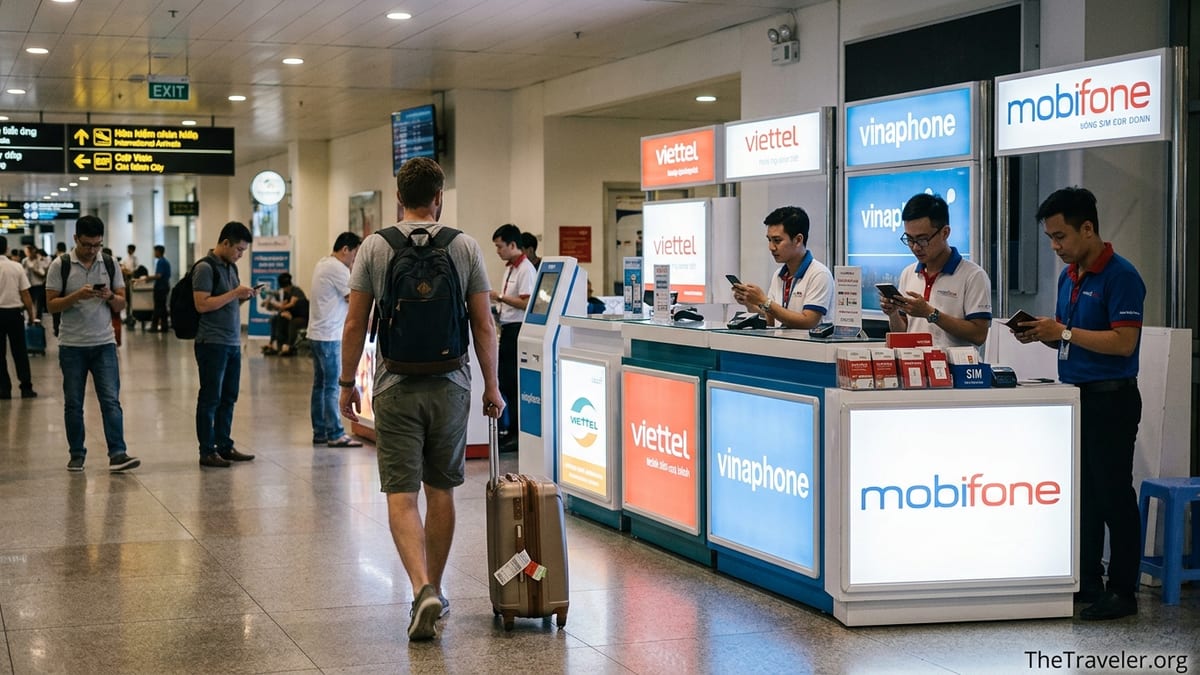
Most SIM card vendors are located just beyond the sliding doors of the customs exit on the public side of the arrivals hall. You will typically see several brightly lit kiosks one after another, with branding that prominently features Viettel, Vinaphone or Mobifone alongside generic “4G/5G SIM” or “Tourist SIM” signs. A few counters are combined with money exchange or travel service desks, selling SIMs as an add-on to airport transfers or city tours.
Counters generally operate long hours to match international flight schedules, and many travelers report that at least some booths remain open overnight. That is helpful if you land on a late flight from Europe or North America and want to get connected before taking a taxi or ride-hail into the city. You do not need to leave the building or cross any roads to find a SIM counter, so you can sort your mobile access before even looking for an ATM or taxi queue.
It is important to understand that many of these kiosks inside the arrivals hall are run by third-party resellers rather than by the networks themselves. Staff usually wear uniforms with Viettel, Vinaphone or Mobifone logos, but they are often independent agents who buy bulk SIMs and packages and then add their own markup. This explains why two counters next to each other, both selling “Viettel 7-day 4G SIM,” might quote different prices when you ask.
What to Expect When Buying a SIM at the Airport
The purchase process at Tan Son Nhat is usually quick. Staff at the kiosks are used to dealing with newly arrived tourists who are jet-lagged and carrying luggage, so they try to complete the sale and activation in under 10 minutes. You will almost always be asked for your passport. Vietnam requires prepaid SIMs to be registered with valid ID, and the airport kiosks typically photograph the passport photo page and sometimes your face, then enter those details into their system while activating the SIM.
In practice, a typical interaction looks like this: you approach a counter, say you want data for a week or a month, and the staff member suggests a tourist package. As of mid 2026, common offers are in the range of 200,000 to 350,000 Vietnamese dong for 7 to 30 days of data, often advertised as “unlimited” but with a daily high-speed allowance. You hand over your phone, the staff insert the physical SIM, run a few activation codes, take a photo of your passport, and then show you that data is working before you pay. Payment is almost always in cash, though some kiosks accept cards for larger purchases.
Quality of registration can vary. Some travelers report that airport SIMs later show up in the carrier’s app as being registered to someone else, or receive messages in Vietnamese telling them to update registration within a deadline. That suggests that certain stalls still use pre-registered SIMs that technically belong to a different person. The service will often work fine for short visits, but it may cause problems if you stay longer, need to extend the number, or use it for more formal purposes such as banking or government apps. It is one of the main reasons some long-stay visitors avoid buying SIMs at the airport and instead go straight to an official store in town.
On the positive side, airport staff usually know how to troubleshoot basic issues. If your iPhone is still locked to a foreign carrier, they will tell you immediately that the SIM will not work. If mobile data does not start instantly, they can manually set the APN or restart your phone. That level of support at 1 a.m. with no Vietnamese language skills can be worth paying a premium, especially if you are traveling with children or need to coordinate a hotel pick-up online.
Viettel, Vinaphone and Mobifone: How the Big Three Compare
Vietnam’s mobile market is dominated by three major operators: Viettel, Vinaphone and Mobifone. All three run 4G networks nationwide and have been rolling out 5G in major cities, although coverage and speeds differ by area. For most visitors staying in Ho Chi Minh City, any of the three will feel fast and reliable for maps, ride-hailing, messaging and social media. The differences become more noticeable if you plan to travel into rural areas, mountains or islands.
Viettel has the broadest national coverage, including remote areas such as the northern mountains and parts of the Mekong Delta. Travelers heading to Ha Giang, Sapa or small Mekong islands often find that only Viettel maintains a usable signal in the more isolated pockets. If your Vietnam itinerary includes motorbike loops, countryside homestays or trekking in less developed regions, a Viettel SIM or Viettel-backed eSIM is usually the safest bet.
Vinaphone tends to perform very well in urban environments and along major transport corridors. In Ho Chi Minh City, Hanoi, Da Nang and coastal hubs such as Nha Trang and Da Nang–Hoi An, Vinaphone speeds are generally comparable to or slightly better than Viettel on average, especially for 4G. Some international eSIM providers partner primarily with Vinaphone for the Vietnam portion of their plans because of that strong city coverage. If you plan to focus on cities, beaches and well-trodden tourist routes, a Vinaphone-backed option will feel perfectly adequate.
Mobifone is often positioned as a budget-friendly alternative, with competitive prices and plenty of data-focused bundles marketed to younger users. In practice, Mobifone coverage in big cities like Ho Chi Minh City is solid, but the network can feel thinner in remote areas compared to Viettel. A Mobifone SIM or eSIM can be an excellent choice for a short stay concentrated in Saigon and nearby destinations like Vung Tau or the Mekong towns commonly visited on tours. For a cross-country backpacking trip, many travelers still lean toward Viettel.
Prices, Packages and Real-World Examples
Prices for tourist SIMs at Tan Son Nhat change frequently, but by mid 2026 the broad range for a straightforward tourist data SIM at the airport is usually between 250,000 and 400,000 dong, depending on duration and whether voice minutes are included. For example, it is common to see a 7 to 10 day package with around 3 to 5 GB per day of high-speed data, plus some local call allowance, priced in the 250,000 to 300,000 dong bracket at airport kiosks. Staff often label these bundles generically as “unlimited data” because speeds are throttled after you hit the daily high-speed cap rather than charging overage.
In the city, official Viettel, Vinaphone or Mobifone stores typically sell very similar packages for noticeably less. A visitor going to a central Viettel store in District 1, for instance, might pay around 150,000 to 220,000 dong for a monthly data-heavy plan with a generous 4G allowance and local call credit. Some long-stay travelers report paying roughly 200,000 dong for a 30-day plan with enough data to stream video regularly and tether a laptop for occasional work. The discrepancy is the markup that airport resellers charge for their location, English-language assistance and off-hours availability.
Top-ups are cheap once you have a local SIM fully registered in your own name. Many students and digital nomads in Vietnam run on plans in the 70,000 to 100,000 dong per month range for ongoing data bundles. For a practical example, a common Viettel package around this price point offers a set daily quota of high-speed data, adding up to around 15 to 30 GB per month, which is plenty for maps, messaging, and social media. You can activate these bundles via SMS codes provided at the store or through the carrier’s official app once your SIM is registered correctly.
Tourists considering the airport convenience premium should think about their total spend in context. If you are in Vietnam for 5 days and will spend thousands of dong each day on food, transport and attractions, paying an extra 100,000 to 150,000 dong at the airport to have working data immediately is relatively small. For longer stays or budget-focused backpackers, saving that amount by visiting an in-town store can feel more worthwhile, especially when combined with better peace of mind about proper registration.
eSIM Options: Local vs International Providers
eSIM has changed how many visitors approach connectivity in Vietnam. If your phone supports eSIM, you can often land with data already active on your device, or scan a QR code shortly after arrival without visiting a physical counter. There are two broad categories: global or regional eSIM brands that cover multiple countries in Southeast Asia, and local Vietnam-focused eSIMs powered directly by Viettel, Vinaphone or Mobifone.
International eSIM companies typically sell data-only plans that work on one of the major Vietnamese networks in the background, often Vinaphone or Viettel. You buy the plan online before your trip, receive a QR code by email, install it on your phone and set it as your data line. A common example would be a 10 or 15 day Vietnam plan with a fixed data allowance, say 10 or 20 GB total, costing the equivalent of 15 to 30 US dollars. These eSIMs are very convenient and are sufficient for most tourists, but they usually do not include a Vietnamese phone number, so making local voice calls may rely on internet calling apps instead.
Local Vietnam eSIM offers are growing quickly. Some providers now sell eSIMs that are effectively local SIMs embedded in a QR code, complete with a Vietnamese phone number and access to local data bundles. For instance, there are Mobifone-backed travel eSIMs marketed toward international visitors that provide a local number plus a daily high-speed data allowance for a fixed period. These can be purchased through official or partner websites and then activated once you land by following simple on-screen instructions. Travelers who need to receive SMS codes from local services, or who plan to use ride-hailing and food delivery apps that sometimes prefer local numbers, often appreciate this kind of product.
The main advantage of eSIM is that you avoid physical SIM swapping, which is especially useful if your existing SIM is tied to banking apps or two-factor authentication at home. You can keep your home number active for SMS on the physical SIM while using a Vietnam eSIM solely for data and local calls. For families, each adult can arrive with an eSIM already installed, so there is no need to find an open counter if flights are delayed late into the night.
Passport Registration, ID Rules and Potential Pitfalls
Vietnamese regulations require all mobile SIMs, including prepaid tourist ones, to be registered to a real identity, usually with a passport for foreigners. When you buy a SIM at the airport, staff will typically scan or photograph your passport photo page. Some outlets also take a quick headshot to match to the ID as part of compliance with more recent verification rules. This can feel intrusive, but it has become a standard step designed to reduce fraud and anonymous phone numbers used for scams.
Problems arise when the SIM you are sold has already been pre-registered under a different identity. This has historically been common with some resellers, who activate blocks of numbers under one person or business and then simply assign them to tourists. The phone will appear to work normally for calls and data, but messages from the carrier may warn that registration needs updating, or the number may later be deactivated if the authorities detect mismatched information. Short-stay travelers might never notice, but someone staying for a semester of study or a months-long work project could suddenly find their number cut off.
If your visit is longer than a few weeks or you plan to open local bank accounts, sign a lease or use Vietnamese government-linked apps, make sure your SIM is properly registered in your own name. The safest approach is to go to an official Viettel, Vinaphone or Mobifone store in the city with your passport and allow staff to create or update your registration in their system. They will take both a passport scan and a live photo and then confirm that the number is tied directly to your details. This process usually takes 10 to 20 minutes and can prevent bigger headaches later.
For most holidaymakers on a 2 to 3 week trip, using an airport SIM that may not be perfectly registered is unlikely to cause immediate problems, especially if it is clearly marketed as a short-term tourist package that expires by the time you leave. Still, it is wise to watch out for SMS notifications from the carrier urging you to update your information. If you receive one, you can decide either to ignore it for a very short trip or to visit a proper store in town if you will be in Vietnam long enough that a disconnection would be inconvenient.
Should You Buy at the Airport or Wait Until the City?
Whether to buy a SIM at Tan Son Nhat or wait until you reach the city comes down to how you balance convenience, cost and registration quality. Buying at the airport is clearly the easiest option if you arrive at an odd hour, are unfamiliar with Vietnam and want working data before booking a ride or contacting your accommodation. You pay more, but you walk out of the terminal able to open a maps app, message friends and translate basic Vietnamese phrases immediately.
Waiting to buy in the city is usually cheaper and more transparent, especially if you go to an official carrier store. In central Ho Chi Minh City, District 1 alone has multiple Viettel, Vinaphone and Mobifone shops where staff can properly register your SIM, help you choose an appropriate monthly plan and explain top-up codes. Prices here tend to reflect the standard domestic market rather than the airport premium, which can mean saving the equivalent of several US dollars per line. For digital nomads, exchange students or long-stay visitors, this option makes sense and also provides clearer paperwork if you later need to prove number ownership.
A hybrid approach works well for many visitors. One option is to buy or activate an eSIM before you fly so that you land with functional data in Vietnam, then take your time in the following days to visit a carrier store in the city for a properly registered physical SIM or long-term eSIM with a local number. Another is to accept a slightly overpriced short-duration SIM at the airport for the first week, then replace it later with a cheaper, correctly registered SIM in town if you extend your stay.
Also consider your onward travel needs. If Tan Son Nhat is just a transit point and you are flying on to another Vietnamese city within a few hours, you might prefer to wait and buy in your final destination, especially if your onward airport is smaller and less hectic. On the other hand, if you are heading straight into Ho Chi Minh City traffic and need ride-hailing apps to avoid taxi scams, having data before you step out of the terminal can be a meaningful safety and comfort upgrade.
Practical Tips for a Smooth Experience
A few practical steps can make your airport SIM or eSIM experience at Tan Son Nhat smoother. Before you fly, check if your phone is unlocked and supports local 4G and 5G bands used in Vietnam. Locked phones from certain carriers in the United States or Japan, for example, may refuse foreign SIMs even if hardware is compatible. Confirm also that your device supports eSIM if you intend to use one. Newer iPhones and many recent Android flagships do, but older or budget models might still be physical-SIM only.
Carry some local currency or be prepared to withdraw cash at an airport ATM before buying a SIM. While some kiosks accept international cards, having cash in hand simplifies the interaction and avoids potential card terminal issues. When you are offered a plan at the counter, ask clearly what you are getting: how many days, how much high-speed data per day or in total, whether local calls or SMS are included, and whether tethering is allowed. Have the staff show you your remaining data in the carrier’s app or via a balance check code if possible, so you understand what you have purchased.
For eSIM users, it is wise to install the eSIM profile over Wi-Fi before you leave home or at a hotel with reliable internet, because airport Wi-Fi can be busy or unreliable. Many providers allow you to purchase and install the eSIM days in advance and then start the validity period only when you first connect in Vietnam. That way, you can arrive with everything configured and your phone will simply pick up a Vietnam network once you are off airplane mode.
If you are concerned about registration quality but still want the convenience of an airport SIM, you can later take your SIM and passport to an official store in Ho Chi Minh City and ask staff to check and update your information. They can usually re-register an existing number to your passport as long as you can show control of the SIM by receiving verification codes. This simple follow-up step can give you both immediate connectivity from the airport and longer-term peace of mind during an extended stay.
The Takeaway
Ho Chi Minh City’s Tan Son Nhat Airport makes it relatively easy to get connected within minutes of landing, with multiple SIM counters in the international arrivals hall and growing support for eSIM-based travel plans. The big three networks Viettel, Vinaphone and Mobifone all offer fast 4G in the city and expanding 5G, with Viettel favored for remote coverage, Vinaphone strong in cities and Mobifone appealing on price. Airport SIMs are generally more expensive and sometimes less cleanly registered than those from official city stores, but they deliver immediate, low-friction connectivity at any hour.
If you value convenience above all, buying a short-term SIM at the airport or arriving with a pre-purchased eSIM will serve you well for a typical holiday. Budget-minded or longer-stay travelers can save money and gain better control over registration by visiting an official carrier shop in town. Whichever route you choose, having a plan before you land, keeping your passport handy for registration and understanding the basic trade-offs between airport counters, city stores and eSIMs will help you stay connected smoothly from touchdown to your last bowl of pho.
FAQ
Q1. Can I buy a SIM card at Ho Chi Minh City’s Tan Son Nhat Airport late at night?
Yes. Several SIM kiosks in the international arrivals hall typically stay open to match late-night and early-morning flights, so you can usually buy a SIM even after midnight.
Q2. Which network is best for most travelers to Vietnam: Viettel, Vinaphone or Mobifone?
For national coverage, especially in remote areas, Viettel is generally the safest choice. For city-focused trips, Vinaphone and Mobifone also provide fast and reliable service at similar price levels.
Q3. Do I really need to show my passport to buy a SIM at the airport?
Yes. Vietnam requires SIMs to be registered to an identity, and airport staff will almost always ask to scan or photograph your passport before activating a new number.
Q4. Are airport SIM cards more expensive than those in the city?
Usually. The same type of tourist data package might cost roughly 250,000 to 400,000 dong at the airport, while similar bundles from official city stores can be noticeably cheaper.
Q5. Will an airport SIM work for online banking or long-term use in Vietnam?
It will work for basic calls and data, but some airport SIMs are not perfectly registered to your own name. For long-term stays or banking, it is better to confirm or redo registration at an official store.
Q6. Is an eSIM better than a physical SIM for visitors to Ho Chi Minh City?
If your phone supports it, an eSIM is very convenient because you can set it up before you fly and avoid swapping cards. However, many eSIMs are data-only, so you may not get a local phone number.
Q7. Can I get a Vietnamese phone number with an eSIM?
Yes, some Vietnam-focused eSIM products are backed directly by local operators and include a Vietnamese number, which is useful for ride-hailing, delivery apps and receiving SMS codes.
Q8. What should I do if I receive messages saying my SIM registration is incomplete?
If you will be in Vietnam for more than a short visit, take your SIM and passport to an official Viettel, Vinaphone or Mobifone store and ask staff to check and update your registration details.
Q9. Is it safe to rely only on airport Wi-Fi instead of buying a SIM or eSIM?
Airport Wi-Fi can work for quick messages or ride-booking, but coverage in the city varies. A local SIM or eSIM provides more reliable connectivity for navigation, translation and safety.
Q10. Should I wait to buy a SIM in the city if I am staying in Ho Chi Minh City for a month?
If you can manage the first trip into town without mobile data, waiting and buying from an official carrier store in the city will usually give you better prices and cleaner long-term registration.