


For budget travelers landing at Ho Chi Minh City’s Tan Son Nhat International Airport, Bus 152 remains one of the cheapest ways to reach the city center around Ben Thanh Market. It is a true local bus, not a tourist shuttle, which means you can save money but also need to be prepared for cash-only fares, basic comfort and a bit of confusion if it is your first time in Vietnam. This guide explains exactly how to find and use Bus 152 in 2026, what it costs, how much luggage you can realistically bring, and when it makes sense for visitors to choose this ultra-cheap option over the more comfortable airport Bus 109 or a Grab car.
Get the latest updates straight to your inbox!
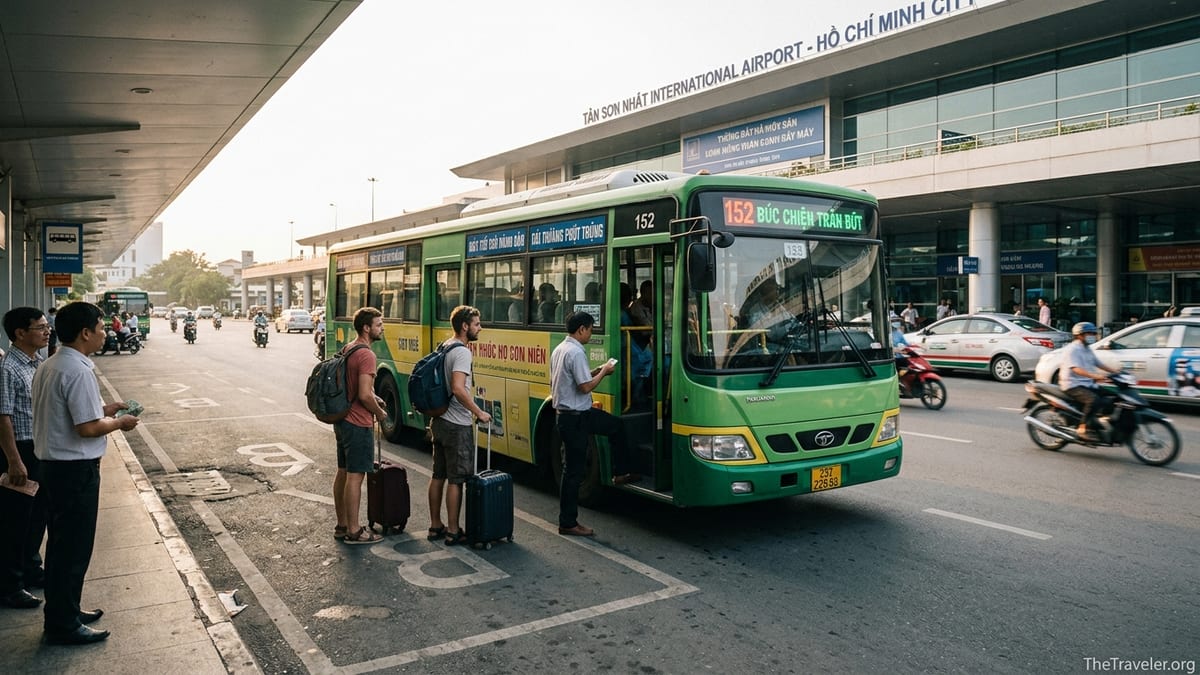
What Bus 152 Is and Why It Matters for Budget Travelers
Bus 152 is a public city bus operated by Ho Chi Minh City’s municipal system, running between Tan Son Nhat International Airport and the central Ben Thanh area in District 1. Unlike the yellow airport shuttle buses that used to target tourists, 152 is a standard green local bus used by commuters, students and airport workers. For independent travelers used to public transport, it is an easy way to cut arrival costs to almost nothing while getting a first look at the city from ground level.
In 2026, Bus 152 continues to serve the airport alongside the more tourist-friendly orange Bus 109, which also runs between Tan Son Nhat and the Ben Thanh / Pham Ngu Lao backpacker area. Bus 109 typically costs several times more than 152 but offers more space for luggage and clearer signage for visitors. Current airport transport guides aimed at tourists consistently list 152 as the cheapest option into District 1, with fares as low as a fraction of a US dollar per ride, while 109 is framed as the affordable but more comfortable alternative.
If you are arriving in the middle of the day, have light baggage and feel comfortable dealing with basic English or gestures, Bus 152 can get you to within a short walk of Ben Thanh Market for the price of a local coffee. For travelers landing late at night, carrying large suitcases or traveling with small children, the slightly higher fare of Bus 109 or the convenience of a Grab ride is usually worth the extra cost.
Route Overview: From Tan Son Nhat to Ben Thanh
Bus 152 links Tan Son Nhat Airport with central District 1, terminating near the Ben Thanh area, which is the heart of tourist Ho Chi Minh City. Ben Thanh itself is surrounded by major streets like Le Loi, Ham Nghi and Pham Ngu Lao, where many hotels and guesthouses cluster, so reaching this hub puts you within a short walk or quick taxi hop of most popular accommodations.
From the airport, 152 first leaves the terminal area and joins the busy city streets, passing through neighborhoods in Tan Binh District before heading toward District 1. Along the way it uses major avenues where office workers and students get on and off. For visitors, the key part of the route is the final stretch as the bus approaches the Ben Thanh area near Quach Thi Trang Square, where multiple city bus lines converge and where the future Ben Thanh Metro Station is under construction. Many current transport resources describe 152 as a direct cheap option toward the Ben Thanh / Ham Nghi corridor rather than a scenic tour route.
In practice, most tourists either ride all the way until the bus reaches the cluster of stops around Ben Thanh or ask the conductor to alert them when it is time to get off for “Ben Thanh Market.” Hotel staff in District 1 are used to guests arriving by 152 and can usually tell you which stop is closest to your specific address, for example on Le Thanh Ton, Bui Vien or Nguyen Hue.
Schedule, Frequency and Operating Hours
According to recent public transport information and airline travel guides, Bus 152 typically runs from early morning to late evening, roughly around 5:30 or 6:00 in the morning until about 7:00 in the evening. Exact times can shift slightly with schedule adjustments made by the city’s transport authority, and local notices have in the past shortened airport boarding times when overlapping routes were introduced. Because of this, travelers arriving on late evening flights should not rely on finding Bus 152 waiting outside after dark.
During the day, the bus generally operates with intervals of about 15 to 20 minutes, depending on traffic and demand. In peak traffic hours, such as 7:30 to 9:00 in the morning or late afternoon around 4:30 to 6:00, travel time from the airport to Ben Thanh can stretch to around 60 to 70 minutes. In lighter traffic, some guides and recent traveler reports suggest that the journey may be closer to 45 to 55 minutes.
Because Ho Chi Minh City’s traffic is unpredictable, you should avoid using Bus 152 when you are on a tight schedule, such as when you are heading back to the airport for an international departure and have less than a couple of hours to spare. For airport-bound trips with a strict check-in time, many travelers use Grab or a metered taxi from District 1, reserving Bus 152 for their arrival when timing is more flexible.
Fares, How to Pay and Why Small Cash Matters
Bus 152 is inexpensive even by Vietnamese standards. Recent airport guides and 2026 transport comparison articles typically describe fares in the range of about 5,000 to 10,000 Vietnamese dong per person, which is roughly the cost of a street-side iced tea. Some references still quote around 5,000 dong for a passenger ticket and an additional similar charge if you bring a large suitcase, although details can vary slightly with each round of local fare updates.
Payment is cash-only on board. You pay the conductor after the bus departs, usually when they walk down the aisle collecting fares and issuing simple paper tickets. The system is not set up for large bills, so having small notes is important. If you hand over a 500,000 dong bill for a fare of a few thousand dong, the conductor may struggle to make change, especially at the beginning of the route. Travelers who changed money before departure or at the airport often make a point of asking the currency exchange or a cafe to break one large note into several 20,000 and 10,000 dong notes before heading to the bus stop.
A realistic example for a solo traveler in 2026 might be paying around 7,000 dong in total for themselves and a mid-size carry-on backpack. Even if the fare is at the upper end of current estimates around 10,000 dong, that still comes to less than half a US dollar. In comparison, Bus 109 from the same airport usually costs in the range of 10,000 to 20,000 dong one way, and a Grab car from the airport to a hotel near Ben Thanh might run between roughly 80,000 and 150,000 dong depending on the time of day and traffic.
Finding Bus 152 at the Airport: Step-by-Step
Tan Son Nhat Airport now has multiple terminals, but for arriving passengers the principle is the same: you need to clear immigration and customs, step outside to the arrivals forecourt and then walk toward the public bus area where several city routes, including Bus 152, pick up passengers. The bus stop is not inside the terminal building itself. You exit, pass the line of private cars and taxis, and look for the marked bus bays where green city buses pull in.
Travelers arriving at the international terminal usually find the bus zone on the roadway directly opposite or slightly to one side of the main arrivals exit, where local passengers queue for city buses. Aircraft operators and travel companies describe Bus 152 departing from the airport side and heading toward the city center, while another stop on the opposite side of the road serves buses back to the airport. Drivers display the route number in large digits at the front of the bus, so you should look specifically for “152” on a green vehicle, not the orange 109 or other lines that go to different parts of the city.
One practical example: if you land mid-morning, collect your bag and step out of the terminal around 10:30, you might see a 109 leave just as you arrive. Instead of waiting for the next 109, you could cross to the bus bay for ordinary city routes, spot a 152 with passengers boarding, and hop on. In under an hour and for a fraction of the fare, you would be stepping off near Ben Thanh, with only a short walk to a hotel on Le Loi or a guesthouse in the backpacker streets.
Luggage Limits and Comfort: What You Can Realistically Bring
Official city bus policies for routes like 152 generally allow personal bags and modest suitcases but discourage large, bulky cargo that blocks aisles or doors. Past traveler reports and airport guides often mention a small extra fee for bigger pieces of luggage, such as a full-size suitcase, though in reality enforcement can be flexible. The key is whether your bags can be tucked under your seat or in front of your knees without spilling into the walkway.
For a typical visitor with a 40-liter backpack and a small daypack, Bus 152 is perfectly workable. You can sit in a double seat and keep your main bag on your lap or at your feet. If you travel with one medium wheeled suitcase and a backpack, you will probably be allowed onboard but you should be prepared to pay a little more than the bare minimum fare and to maneuver your bag quickly so that you do not block other passengers at the door.
By contrast, travelers with two or three large checked bags, sports equipment or bulky musical instruments are better off using Bus 109 or a ride-hailing car. Bus 109 vehicles are designed as airport shuttles, with more open space at the front and luggage racks. Several 2026 transport comparisons describe 109 as costing roughly twice as much as 152 but still being the cheapest way to get “high standard” airport transport to District 1 when you consider luggage and comfort.
Comfort levels on 152 are basic. The bus is usually air-conditioned but not icy, seating is standard plastic or padded benches, and at busy times you may need to stand for part of the journey. There is no guaranteed luggage shelf and no onboard English-language announcements, though some drivers or conductors will call out “Ben Thanh” near the central stops if they see foreign passengers clearly watching for the city center.
What to Expect on the Ride: Crowds, Safety and Local Experience
Riding Bus 152 is closer to commuting with local residents than taking a dedicated airport coach. At mid-morning on a weekday you might find a mix of airport staff heading home after an early shift, students with backpacks, office workers checking their phones and a handful of travelers with small suitcases. The atmosphere is generally low-key and practical rather than touristy. You will likely hear Vietnamese conversations, phone calls and the hum of traffic from outside as the bus moves between districts.
Safety on the route is comparable to other urban buses in major Southeast Asian cities. Petty theft can occur in crowded conditions, so you should keep your phone and wallet secure, as you would on a metro in Bangkok or a bus in Manila. Use a money belt or an inner pocket for passports and keep backpacks zipped and close to your body. City transport officials and travel advisories regularly remind visitors to be alert around any busy transport hub, and Bus 152 is no exception.
On a typical ride, you will see the city change from the low, functional airport buildings and surrounding residential streets to the denser, more commercial environment of central District 1. You might pass small cafes brewing iced coffee, shops selling spare phone chargers and street vendors carrying baskets of fruit near intersections. For many travelers, the bus offers a relaxed first glimpse of everyday Saigon life before they dive into the rush of Ben Thanh Market and Nguyen Hue Walking Street.
If you are unsure when to get off, you can show “Ben Thanh Market” written on your phone or a piece of paper to the conductor when you board. Even if they do not speak much English, they will normally nod and either point to the ticket price or tap your shoulder near the correct stop. This informal assistance is a common part of using local buses in Vietnam and often works better than trying to match every street name to an offline map.
Should Tourists Use Bus 152 or Choose Another Option?
Whether Bus 152 is right for you depends on a few practical questions: what time you land, how much luggage you carry, how tight your schedule is, and how comfortable you feel in local public transport environments. Budget backpackers arriving mid-day with one pack and no hotel pickup almost always benefit from Bus 152. It saves money, is relatively straightforward to use with a bit of preparation and drops you in the very area where most budget accommodation is located.
On the other hand, first-time visitors arriving late in the evening, older travelers with mobility issues or families managing young children and multiple suitcases may find that Bus 109 or a Grab car is a more sensible choice. The fare difference between 152 and 109 is significant only if your budget is extremely tight. In real terms, paying the equivalent of one or two extra coffees for a simpler ride with better luggage space is a good trade-off for many travelers navigating a new city after a long-haul flight.
A realistic scenario might help. Imagine a couple landing at 3:00 in the afternoon with one shared suitcase and two small backpacks. They clear immigration quickly, step out to the curb and see both 152 and 109 in the bus area. If they want to minimize costs and are not tired, they might choose 152, paying a tiny fare, sitting with their luggage at their feet and arriving at Ben Thanh just in time for a late lunch. If their flight had been delayed to 8:30 in the evening, with darkness and fatigue setting in, the same couple might reasonably skip 152 and book a Grab for the door-to-door convenience, especially if they are carrying electronics or valuables they prefer not to juggle in a crowded local bus.
As a rule of thumb, use Bus 152 when cost savings and a bit of local flavor are your priorities and when your arrival time is within normal daytime operating hours. Opt for 109 or a taxi when comfort, clarity and timing matter more than shaving the last few thousand dong off your transport budget.
The Takeaway
Bus 152 from Tan Son Nhat Airport to Ben Thanh is one of the cheapest airport-to-city routes in Southeast Asia, offering an authentic and budget-friendly way into Ho Chi Minh City’s center. For the price of a local drink, you can travel from the terminal gates to the heart of District 1, arriving within walking distance of many hotels, hostels and street-food hotspots.
To make the most of it, arrive during daytime hours, have small cash ready, travel with manageable luggage and give yourself enough time to ride without worrying about tight deadlines. Look for the green bus marked 152 in the public bus area outside the terminal, pay the conductor on board and keep an eye on a map or ask to be alerted at Ben Thanh Market.
Bus 152 is not for everyone: it is a working city bus rather than a dedicated tourist service, with basic comfort levels and limited space for big bags. Yet for independent travelers comfortable with a bit of uncertainty, it remains an excellent way to stretch a travel budget and see a slice of everyday Saigon life before checking into a hotel or heading out to explore Nguyen Hue, Pham Ngu Lao and the city’s growing cafe scene.
FAQ
Q1. How much does Bus 152 from Tan Son Nhat to Ben Thanh cost in 2026?
The fare is typically in the low thousands of Vietnamese dong per person, often quoted in the range of about 5,000 to 10,000 dong, with a small extra charge possible for a large suitcase. Exact amounts can vary slightly with local fare adjustments, but it remains one of the cheapest ways to reach District 1.
Q2. Where exactly do I catch Bus 152 at Tan Son Nhat Airport?
After you clear immigration and customs, exit to the arrivals curb and walk to the public bus area, where several green city buses stop. Look for the bus with the route number 152 displayed at the front. It usually boards from the roadway opposite or slightly to one side of the main arrivals exit, not from inside the terminal building.
Q3. What are Bus 152 operating hours and how often does it run?
Recent information suggests Bus 152 generally runs from early morning, around 5:30 or 6:00, until early evening, roughly around 7:00. Buses often come every 15 to 20 minutes in daytime, though traffic and minor schedule changes can affect this. Travelers arriving late at night should not rely on this route and should instead plan for Bus 109 or a taxi.
Q4. Can I bring large luggage on Bus 152 from the airport?
You can usually bring a medium suitcase and a backpack, but space is limited and you may pay a small extra fee for big bags. The key rule is that luggage should not block the aisle or doors. If you have multiple large checked bags or bulky items, Bus 109 or a ride-hailing car is more comfortable and practical.
Q5. Do I need exact change to pay for Bus 152?
You do not need exact change, but payment is cash-only and the conductor may have difficulty changing very large notes. It is best to carry several 10,000 and 20,000 dong bills. Many travelers break a 500,000 dong note at an airport cafe or currency exchange before heading to the bus stop.
Q6. How long does the ride from Tan Son Nhat to Ben Thanh usually take on Bus 152?
Typical travel time ranges from about 45 to 70 minutes, depending on traffic. In lighter conditions it can be under an hour, while during rush hour or rain it may be longer. If you have a tight schedule, especially when returning to the airport for a flight, consider extra buffer time or choose a faster option like a taxi.
Q7. Is Bus 152 safe for solo travelers and first-time visitors?
Bus 152 is widely used by local residents and is generally considered safe in the same way as other big-city buses. As with any crowded public transport, you should keep valuables secure, close bags and be aware of your surroundings. Solo travelers who are comfortable using buses in other countries usually have no problem with route 152.
Q8. Will people on Bus 152 speak English and tell me where to get off?
Some conductors or younger passengers speak basic English, but you should not rely on it. A practical approach is to have “Ben Thanh Market” or your street name written down to show the conductor when you board. Many will nod and tap your shoulder or call out when you reach the closest stop in District 1.
Q9. Should I choose Bus 152 or Bus 109 from Tan Son Nhat?
Choose Bus 152 if you want the absolute lowest cost, are arriving in daytime, and have light luggage. Choose Bus 109 if you have larger bags, prefer a more straightforward tourist-oriented service and do not mind paying several times the 152 fare, which is still inexpensive compared with taxis or private transfers.
Q10. What if Bus 152 is too crowded or not running when I arrive?
If you reach the bus area and find 152 overcrowded or not operating, you can switch to Bus 109, which also goes toward the Ben Thanh and backpacker area, or order a Grab car or metered taxi from the arrival zone. Having a backup option in mind ensures you are not stuck at the terminal even if local bus conditions are not ideal when you land.