


Ho Chi Minh City’s Tan Son Nhat Airport (SGN) is Vietnam’s busiest hub and a common first stop for international visitors continuing on to domestic destinations such as Da Nang, Phu Quoc or Hanoi. With three passenger terminals now in play, plus immigration, baggage reclaim and security to deal with, international to domestic connections can feel confusing, especially on a tight schedule. This guide walks you through every stage in clear, practical steps, using recent, real-world examples to help you decide how much time you really need.
Get the latest updates straight to your inbox!
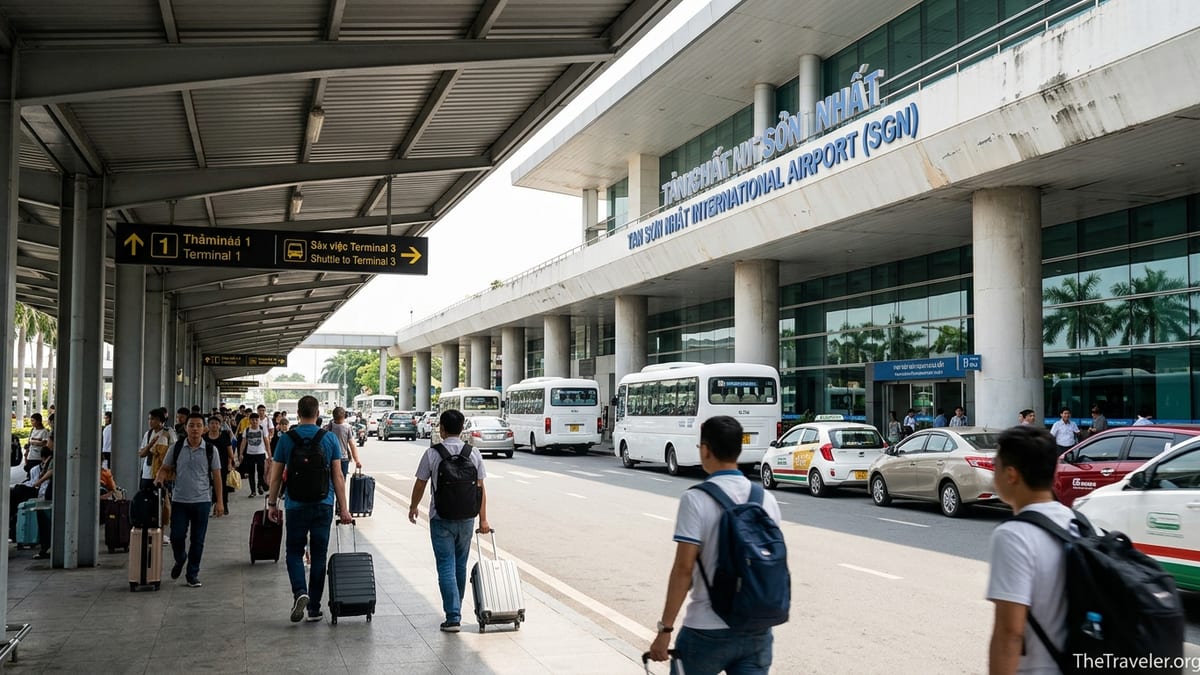
Understanding the layout: T2, T1 and the new T3
Tan Son Nhat is compact by global standards, but its layout can still surprise first-time visitors. International flights use Terminal 2 (often shown as T2 or "International Terminal" on boarding passes and airport signs). Traditional domestic flights have long used Terminal 1 (T1), positioned next door on the same frontage road. On top of that, a new domestic Terminal 3 (T3) has opened on a separate loop road on the opposite side of the airfield, connected by landside shuttle buses and road access rather than an indoor walkway.
In practice, this means that if you arrive from overseas into T2 and continue to a domestic destination, you will either walk across to T1 or take a shuttle from T2 to T3, depending on which airline you fly. Vietnam Airlines has moved most domestic operations to T3, while many Vietjet domestic flights still check in and depart from T1. Budget carriers and regional airlines typically use T1, although airlines can adjust terminal assignments, so always confirm on your ticket or with your airline before travel.
The walk between T2 and T1 is short: once you exit customs at T2, you step outside, turn right, and follow the pavement along a covered walkway for roughly 5 to 10 minutes. By contrast, moving from T2 to T3 involves leaving the terminal, walking to the clearly signed shuttle stop on the roadway, and riding a free bus that typically takes around 10 to 20 minutes depending on traffic and intermediate stops. Travellers report that overall T2 to T3 transfers, including waiting for the shuttle, usually take 20 to 30 minutes door to door during normal conditions.
Because the three terminals are not fully linked airside in the way you might see at a mega-hub like Singapore Changi, you should plan for all international to domestic connections at SGN to involve entering Vietnam through immigration, collecting checked bags, moving between terminals landside, and then re-checking in for your onward domestic flight followed by security screening again.
Step-by-step: from international arrival to immigration and baggage
After your international aircraft parks at T2, you disembark and follow the "Arrivals" and "Immigration" signs along the corridor. You first pass health or document checks if required, then reach the immigration hall. There are separate lines for Vietnamese citizens and foreign passport holders. If you have arranged a visa-on-arrival approval letter or an e-visa, follow the posted instructions, as procedures can differ slightly depending on your nationality and visa type.
Queue times at immigration vary widely. Early morning arrivals, banked waves of long-haul flights from Europe or North Asia, and peak holiday periods like Tet can see long lines that stretch to 45 minutes or more. At quieter times, travellers have reported clearing immigration in 10 to 20 minutes. Services that offer fast-track immigration exist and can be helpful if your connection is tight, but they must be arranged in advance and always comply with official rules.
Once your passport is stamped, you descend to the baggage reclaim hall, where carousels are clearly numbered. Flight information screens show which belt your bags will appear on. Checked luggage typically appears within 15 to 30 minutes after landing, although occasional delays are possible if several wide-body aircraft arrive at once or if ground handling is stretched. Oversized or special baggage, such as sports equipment, may appear on a separate counter, so keep an eye on signage.
After collecting your bags, you proceed through the customs area. In most cases, travellers simply walk through the green channel unless they have items to declare. Customs officers may ask to scan or open selected bags for inspection. This stage usually takes only a few minutes, but you should still allow a small buffer, especially if you are carrying high-value electronics or large quantities of goods that could attract questions.
Moving from T2 to domestic terminals T1 and T3
Immediately after customs, you step into the public arrivals hall of T2. From here, your next task is to reach the correct domestic terminal for your onward flight. If your domestic flight operates from T1, the process is straightforward: after exiting the sliding doors, turn right and follow the exterior sidewalk. You pass a row of cafés, ATMs and ride-hailing pickup points before reaching T1. The walk is modest but the area can be crowded with families, hotel drivers and taxi touts, so allow 10 to 15 minutes, especially if you have heavy luggage or children.
If your domestic flight leaves from the new T3, you cannot walk there directly from T2. Instead, look for signs directing you to the free airport shuttle. Major airlines and the airport operator run a loop bus that connects T2, T1 and T3, typically stopping near a marked pole in the roadway outside the arrivals area. Expect typical wait times of 5 to 15 minutes, although at busy times this can stretch, so build that uncertainty into your connection plan. The ride itself often takes 10 to 20 minutes, depending on traffic around the terminal complex.
For example, a traveller arriving on a Japan Airlines international flight into T2 at around 06:00 and connecting to a mid-morning Vietnam Airlines domestic departure from T3 might spend 20 minutes clearing immigration, 20 minutes waiting for and reclaiming luggage, and 25 minutes in total to find, wait for and ride the shuttle to T3. They would arrive at T3 approximately 65 minutes after landing, which is acceptable for a longer layover but too tight if the onward domestic check-in closes 40 minutes before departure.
While taxis and ride-hailing cars such as Grab technically can move you from T2 to T3, using them inside the airport loop is rarely faster than the shuttle once congestion and vehicle waiting time are factored in. Several travellers have reported overpaying local taxis for short terminal-to-terminal rides, so unless you have mobility issues or an unusual situation, the dedicated shuttle or the T2 to T1 walkway will be the simplest option.
Check-in, baggage re-check and security for your domestic flight
Once you arrive at T1 or T3, you must complete domestic check-in and pass through security. Unless your international and domestic legs are booked on a single ticket with through-checking confirmed, you should always expect to check in again for your domestic flight. This applies especially when mixing airlines, such as an international leg on a foreign carrier and a domestic leg on Vietjet or Bamboo Airways.
At T1, airline check-in counters are grouped by carrier. Vietjet, for example, uses designated sections of Hall A in T1, with rows of self-service kiosks and staffed counters. Travellers on purely domestic itineraries typically need to complete check-in at least 40 to 50 minutes before departure, while those connecting from an international flight should consider arriving earlier in case queues are long. At T3, Vietnam Airlines and its partners run larger check-in areas designed to handle higher densities of passengers, but morning waves to major cities like Hanoi and Da Nang can still be busy.
After check-in and baggage drop, you proceed to domestic security. Here, your boarding pass and ID or passport are checked, followed by standard x-ray scanning of cabin baggage and metal detectors for passengers. Domestic security at Tan Son Nhat is usually faster than immigration, but lines can still build at peak hours. Many travellers report clearing domestic security within 10 to 20 minutes outside holiday periods; however, you should assume it might occasionally take 30 minutes or more if multiple flights are closing within the same time window.
Inside the domestic departure area, gate changes are not uncommon, so watch the departure boards. Boarding often begins 25 to 40 minutes before departure for narrow-body aircraft such as Airbus A321s and Boeing 737s. This means that for a flight scheduled at 10:00, you may be expected at the gate by around 09:20. When you plan your connection, focus not only on the departure time printed on your ticket but also on these earlier cut-offs for check-in closure, baggage acceptance and boarding.
Minimum connection times and how much time to allow
Official minimum connecting time, often abbreviated as MCT, for protected connections on a single ticket is typically shorter than what most independent travellers should risk. Full-service airlines operating both your international and domestic legs, such as Vietnam Airlines and some of its partners, may offer valid itineraries with connections under 3 hours at Tan Son Nhat, and sometimes closer to 2 hours in off-peak windows. When you book such a ticket directly with the airline, the carrier is generally responsible for rebooking you if delays make you miss your onward flight.
If you book separate tickets or mix carriers, you carry the full risk of delay. In those cases, a much more conservative buffer is wise. Many frequent travellers through Ho Chi Minh City recommend a minimum of 3 hours for an international to domestic connection when you must clear immigration, collect bags, walk or shuttle between terminals, re-check in and clear security again. That 3-hour guideline assumes no major disruption, average queue lengths and on-time arrival; under storm conditions, holiday surges or unexpected immigration delays, even 3 hours can feel tight.
For example, consider an international arrival scheduled at 06:00 into T2 and a separately booked domestic departure at 08:00 from T1. On paper, this 2-hour window looks tempting. In reality, if immigration takes 30 minutes, baggage reclaim 25 minutes, the walk to T1 10 minutes, and domestic check-in closes 40 minutes before departure, you would have only around 15 minutes of slack for any delay, misdirected bag or crowded check-in area. Many travellers in this situation have reported sprinting to the counter and being refused baggage check because the cut-off has passed, even though the plane is still at the gate.
For risk-averse travellers or those with families, large amounts of luggage or complex visas, a 4-hour buffer is far more comfortable, especially if your domestic flight departs from T3 and you must rely on the shuttle. This longer layover also gives you time to withdraw cash, buy a local SIM, grab a coffee in the landside cafés between T2 and T1, or simply recover from a long-haul flight before boarding another leg. If you must overnight in Ho Chi Minh City, many hotels near the airport offer short transfers and flexible check-in for early morning or late-night arrivals.
Special cases: through-checked bags, codeshares and low-cost carriers
Your experience changes significantly if your bags are tagged through to your final domestic destination and you have boarding passes for both segments on arrival. This more seamless scenario often occurs when you fly a full-service airline or alliance partner all the way through, such as a European or Japanese airline connecting onto Vietnam Airlines on a single ticket. In some of these cases, ground staff may arrange for baggage transfer without requiring you to re-check in at the domestic terminal, although you will almost always still clear immigration at T2 as your first point of entry into Vietnam.
However, foreigners should not assume through-checking will work when combining a foreign airline with a low-cost domestic carrier on separate tickets. Vietjet, for instance, runs its own connection products on specific routes, but those generally apply only when all segments are operated by Vietjet as a single itinerary. If you arrive on a different airline and then fly Vietjet domestically, you will normally need to clear immigration, reclaim your bags at T2, walk to T1, and check in as if starting a fresh journey.
Codeshare flights can add another layer of complexity. A ticket sold by a partner airline might list a flight number from that partner, but the operating carrier at SGN could be Vietnam Airlines. In these cases, your terminal assignment will usually follow the operating airline’s pattern: a codeshare domestic sector operated by Vietnam Airlines will typically use T3, even if your booking reference was issued by another carrier. The safest approach is to verify the operating airline and terminal ahead of time using your booking confirmation or by contacting the airline directly.
Low-cost carriers also tend to enforce check-in and bag-drop deadlines strictly. For instance, if a low-cost domestic flight closes check-in 40 minutes before departure, arriving at the counter 35 minutes before scheduled take-off with heavy luggage is likely to result in denial of boarding, even if you can see the aircraft still at the stand. Travellers who have tried to push these limits at Vietnamese airports often report having to buy a new ticket for a later flight at same-day prices.
The takeaway
Transferring from an international arrival to a domestic flight at Ho Chi Minh City’s Tan Son Nhat Airport is manageable once you understand the basic pattern: you land at T2, pass through immigration and customs, collect your bags, move to either T1 or T3, then check in and clear security for your domestic leg. The airport is busy but not excessively large, and walking distances between T2 and T1 are modest. The main variables are immigration queues, baggage delivery times, shuttle waits to T3 and how strictly your airline enforces check-in cut-offs.
For itineraries on one ticket with a full-service airline, trusting the airline’s official minimum connection standards is usually reasonable, though allowing a little extra time never hurts. For separate tickets, mixed carriers or low-cost domestic segments, aiming for at least 3 hours between scheduled international arrival and domestic departure is a pragmatic balance of efficiency and safety, with 4 hours or more recommended for families, first-time visitors or travel during peak Vietnamese holidays.
Above all, build margin into your plans and stay flexible. If you can, choose domestic flights that give breathing room after long-haul arrivals, keep important items in your carry-on in case your checked bag is delayed, and be ready to ask airport staff for help if queues threaten your connection. With a realistic timeline and clear expectations, your connection at Ho Chi Minh City can be a smooth bridge rather than a stress point on your journey through Vietnam.
FAQ
Q1. Is 2 hours enough to connect from an international flight to a domestic flight at Ho Chi Minh City?
For most travellers, 2 hours is risky. You must clear immigration, collect bags, move terminals and re-check in, so 3 hours is a safer minimum, especially on separate tickets.
Q2. Do I have to go through immigration when transferring from international to domestic at Tan Son Nhat?
Yes. Ho Chi Minh City is your first point of entry into Vietnam, so you must pass immigration and customs at Terminal 2 before continuing to any domestic flight.
Q3. How long does it take to walk from the international terminal (T2) to the domestic terminal (T1)?
The walk from T2 to T1 usually takes about 5 to 10 minutes at a normal pace, but you should allow up to 15 minutes if the area is crowded or you have heavy luggage.
Q4. How do I get from Terminal 2 to Terminal 3 for my domestic flight?
After customs at T2, follow signs to the free airport shuttle outside the arrivals hall. The bus ride to T3 typically takes 10 to 20 minutes plus waiting time at the stop.
Q5. If both flights are on Vietnam Airlines, will my bags be checked through automatically?
Often they will be, especially on a single ticket, but it is not guaranteed on every routing. Confirm at your origin airport check-in whether your baggage is tagged to your final domestic destination.
Q6. What happens if my international flight is delayed and I miss my domestic connection?
If both flights are on one ticket, the operating airline will normally rebook you on the next available flight. On separate tickets, you may have to buy a new domestic ticket yourself.
Q7. How early should I arrive at the domestic terminal before my flight from Ho Chi Minh City?
Plan to be at the domestic terminal at least 1.5 to 2 hours before departure, which allows time for check-in, baggage drop and security, particularly at busy times of day.
Q8. Are there fast-track services to speed up immigration at Tan Son Nhat?
Yes, some airlines and third-party providers offer fast-track or assistance services, but they must be booked in advance and availability can vary by flight and time of day.
Q9. Can I leave the airport between my international arrival and domestic departure?
You can exit the airport once you clear immigration and customs, provided you meet Vietnam’s entry requirements. Just ensure you return to the correct terminal with enough time for check-in and security.
Q10. Is it safe to use taxis or ride-hailing apps between terminals instead of the shuttle?
It is generally safe, but often slower and more expensive than the official shuttle for short terminal transfers. If you do use a taxi or ride-hailing app, confirm the fare and destination carefully.