


Walk along Hoboken’s riverfront on any clear evening and you will see the same ritual play out again and again: visitors line up at Pier A and the waterfront walkway, phones pointed east, capturing the Manhattan skyline glowing across the Hudson. The view deserves the attention. Yet for all the photos snapped of New York’s towers, most travelers never turn around and walk a few blocks inland, where Hoboken’s best streets quietly tell a far more intimate story. For curious visitors, those blocks are where the city really comes into focus.
Get the latest updates straight to your inbox!
From Postcard Skyline to Lived‑In City
Hoboken’s waterfront is a magnet for anyone arriving by PATH train or ferry. Within minutes of stepping out of Hoboken Terminal, you can be on Pier A Park’s lawns or strolling the Hudson River Waterfront Walkway with the World Trade Center and Midtown skyscrapers filling your frame. On warm weekends, you will see engagement shoots, graduation portraits, and travelers dragging rolling suitcases straight from Newark Airport just to get that skyline shot before heading back to Manhattan. It is easy to assume that the view is the whole story.
Spend a little time watching the flow of people and a pattern emerges. Many visitors walk a quick loop from the terminal to Pier A, maybe as far as Sinatra Park or the approach to Pier C, then turn around. Some duck into the first bar or chain café near the station and call it a day. They leave with dozens of photos of New York and almost none of Hoboken itself. The city becomes a foreground blur beneath a famous backdrop.
Yet just two or three blocks inland, the mood changes. Traffic thins, skyline chatter fades, and the scale drops to something distinctly human. Blocks of brick and brownstone row houses, corner delis, century‑old bakeries and tiny parks reveal a place that has evolved from a waterfront factory town to one of New Jersey’s most walkable small cities. For travelers willing to explore beyond the river’s edge, streets like Washington, Court, Garden, Bloomfield and Park offer the kind of everyday detail that makes a short visit feel unexpectedly rich.
Seeing Hoboken this way means shifting your camera away from the skyline, at least for a little while, and pointing it toward stoops, storefronts and side streets. It is less about chasing a single iconic shot and more about collecting small, grounded impressions: a family carrying a sheet‑pan pizza home along Garden Street, a late‑night crowd outside a neighborhood bar on First Street, or a solitary commuter walking under the brick arches of Court Street at dawn.
Washington Street: More Than a Path to the Waterfront
Most visitors meet Washington Street without realizing how central it is to Hoboken’s identity. Stretching roughly from Observer Highway in the south up to 15th Street in the north, it forms the backbone of the city’s historic district. Planning organizations have highlighted Washington Street for its near‑continuous run of historic storefronts pressed right up to wide brick sidewalks, with occasional cross streets opening glimpses of the Hudson and the skyline beyond. Cafés, bars, independent boutiques and old‑school delis sit door‑to‑door in compact, walkable blocks.
In practical terms, Washington Street is where a short visit to Hoboken can turn into an afternoon you did not plan for. You might arrive thinking you will grab a quick slice and head back to Manhattan, then find yourself hopping from a family‑run Italian deli with house‑made mozzarella to a Cuban café serving strong coffee and pressed sandwiches. A simple stroll between about 1st and 8th Streets might include a breakfast stop at a corner bagel shop, a peek into a vintage clothing store, and dessert picked up at a century‑old bakery location that gained worldwide fame through reality television.
Prices are typical for a New York–area downtown but can be more forgiving than across the river. Expect an espresso or cappuccino at a sit‑down café to cost around 4 to 6 dollars, a loaded breakfast sandwich from a no‑frills counter to land in the 6 to 9 dollar range, and a sit‑down pasta dinner on a popular block to start around the mid‑teens. Even if you are traveling on a tight budget, it is easy to build a food “crawl” up and down Washington: share an Italian sub from a deli known locally for its fresh mozzarella, split a personal pizza at an artisanal pizzeria, and finish with a shared box of pastries from Carlo’s Bakery’s original Hoboken shopfront at 95 Washington Street.
Washington Street is also where Hoboken’s personality comes out at street level. On weekday mornings, you will see parents pushing strollers to school drop‑off between 7th and 10th Streets, office workers cutting across town with commuter coffee in hand, and delivery trucks threading narrow gaps. On Friday nights, sidewalk patios fill quickly near the midtown blocks, particularly around bars that screen sports or host trivia nights. If you want photos that show Hoboken as a lived‑in place rather than just a viewing platform for Manhattan, this is the street to wander slowly and watch life unfold.
Garden, Bloomfield & Park: Brownstone Blocks Made for Wandering
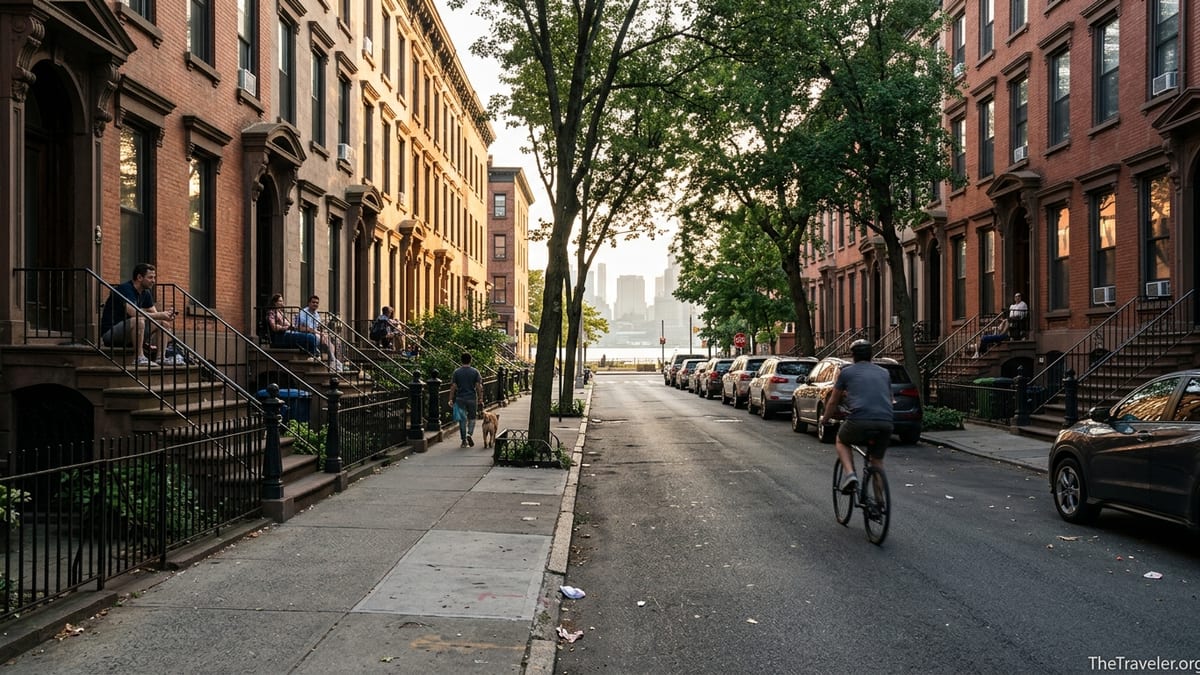
Step one block west of Washington and you enter a different Hoboken. Garden Street, Bloomfield Street and Park Avenue run roughly parallel from downtown toward the north end of town, lined with 19th‑ and early‑20th‑century row houses. Many are brownstones or brick townhomes with stoops, cast‑iron railings, bay windows, and shaded front yards that soften the urban grid. Recent architectural surveys identify these blocks as the core of the Hoboken Historic District, noting details like raised garden‑level basements and uniform cornice lines that give entire streets a consistent, almost theatrical backdrop.
Photographically, this is where you trade wide skyline panoramas for intimate, layered frames. On a late afternoon in summer, the light filters through mature street trees along Garden Street, throwing dappled shadows across the brownstone facades. Residents sit on stoops with a book or a glass of wine. On some blocks, children chalk hopscotch patterns onto the sidewalk or ride scooters along the curb. For visiting photographers, a 35 mm lens on a full‑frame camera captures the rhythm of doors, windows and stoops without flattening the perspective too much. Smartphones excel here as well, especially if you get close to architectural details like carved lintels or ornate ironwork.
Between 2nd and 8th Streets on Garden and Bloomfield, you will find some of Hoboken’s most photogenic residential stretches. Around 2nd or 3rd Street, a typical scene might include a string of three‑story brownstones, a small tree pit repurposed as a micro‑garden, and a resident walking a dog past a vintage‑looking lamppost. By the time you reach about 10th Street, the blocks feel slightly quieter, with fewer bars and more family‑oriented buildings. Real estate listings for condos along Garden Street often highlight the “tree‑lined brownstone block” as a selling point, and walking there for even ten minutes makes it clear why.
For visitors, these streets are not attractions in the conventional sense; they are lived‑in neighborhoods. That calls for a bit of etiquette. If you are taking photos, avoid shooting directly into people’s windows, and keep a respectful distance from stoops where residents are sitting. Early mornings on weekends are often the most peaceful time to wander, with soft light and little traffic. Even then, a quiet “good morning” goes a long way toward signaling that you are an appreciative guest passing through, not simply treating the street as a backdrop.
Court Street: Cobblestones and Industrial Echoes
If Washington and Garden Streets tell the story of Hoboken’s commercial and residential life, Court Street offers a glimpse of its industrial past. Running roughly parallel to Washington but tucked between it and Hudson Street, Court Street is narrower, with stretches of old cobblestones and brick walls that once backed factories and warehouses. Architectural surveys of the Hoboken Historic District mention these utilitarian structures and alleys as rare survivors of an earlier waterfront economy, when the city’s piers handled freight and workers poured off ferries in large numbers each day.
Today, walking the length of Court Street feels almost like slipping into a service corridor between two versions of Hoboken. On one side of the block, Washington Street hums with cafés, brunch crowds and retail signs. On the other, the waterfront parks host joggers and skyline photographers. In between, Court Street remains relatively quiet, with older brick facades, loading docks, and the occasional garage or backyard glimpsed through open gates. Uneven paving stones add texture underfoot, especially after a light rain when puddles reflect the walls on either side.
For photographers and curious walkers, Court Street is an ideal place to experiment with leading lines and depth. Use a slightly longer focal length, around 50 to 85 mm, to compress the perspective and emphasize the receding row of cobblestones and brick. A low vantage point at knee height captures the rough surface of the street in the foreground, drawing the eye toward a figure or doorway framed far down the block. Because the street sees less foot traffic than Washington, patient visitors can often wait for a single subject to walk through the frame, creating atmospheric images that feel almost cinematic yet grounded in real life.
As with Hoboken’s residential streets, discretion matters here. While Court Street can feel like a forgotten lane, it still runs behind homes and businesses. Avoid blocking driveways or standing in the middle of the street for long stretches, especially on weekday mornings when service vehicles might be using it. A quick glance over your shoulder before you crouch down for a shot is usually all it takes to stay safely out of the way.
First to Fifth Streets: Everyday Life Between Terminal and Brownstones
Many visitors experience Hoboken mainly as a north‑south journey: from the PATH station and waterfront parks up along Washington Street. It is easy to overlook how much of the city’s character lies in the east‑west cross streets, particularly between about 1st and 5th Streets. These are the blocks where you feel the constant negotiation between old and new, commerce and quiet, waterfront glamour and everyday life.
Start at 1st Street just west of the waterfront and you might pass a cluster of small bars, pizzerias and takeout spots serving late‑night crowds. Head a block or two inland and you will hit corners with long‑standing delis, small laundromats and low‑rise apartment buildings that predate the recent wave of upscale development. On 2nd and 3rd Streets, small playgrounds and pocket parks appear between the buildings, offering a quick breath of green for residents who do not live directly near the riverfront.
Economically, these cross streets show Hoboken’s range. A craft cocktail bar just off Washington may charge 14 to 17 dollars for a well‑made drink, while a no‑nonsense tavern on a side street pours a domestic beer for half that price. A boutique fitness studio near 4th Street might have weekend drop‑in classes that appeal to short‑term visitors, while a modest corner bakery sells coffee and a pastry for under 6 dollars total. If you are visiting for a day, letting yourself drift along one of these cross streets is a useful way to find more down‑to‑earth options than the waterfront or the busiest stretch of Washington alone might suggest.
Between 1st and 5th Streets, you will also cross several of the brownstone blocks that define Hoboken’s visual identity. For instance, walking west on 4th Street from the river takes you from open skyline views across Sinatra Drive, past Washington’s storefronts, and into quieter residential stretches on Garden and Bloomfield within a five‑minute span. That short walk encapsulates Hoboken’s compactness: a continuous transition from grand landscapes to human‑scale streetscapes without ever needing a cab or subway ride.
How to See Hoboken Like a Local, Not a Day‑Trip Checklist
Experiencing Hoboken’s best streets means approaching the city with a different rhythm than many quick visitors bring. Instead of racing from one “must see” spot to the next, treat the Mile Square City as a neighborhood you are temporarily borrowing. Plan just one or two firm stops, then leave the rest of your time unstructured for wandering. A realistic half‑day itinerary might be: skyline views at Pier A or the open sections of the waterfront walkway, coffee on Washington Street, and a slow loop through Garden, Bloomfield and Court Streets before heading back to the PATH.
Transportation is straightforward. From Lower Manhattan, the PATH train from the World Trade Center to Hoboken typically takes around 15 to 20 minutes. From Midtown, the 33rd Street PATH line connects to Hoboken with a transfer at Journal Square or direct service at certain times. New York Waterway ferries link Midtown and downtown Manhattan to Hoboken Terminal in roughly 8 to 15 minutes depending on the route. Once you arrive, walking is the most enjoyable way to move around; the entire city is only about a mile square, and most streets mentioned here are within a 10‑ to 15‑minute walk of the terminal.
To explore comfortably, wear shoes that handle uneven surfaces, especially if you plan to walk Court Street’s cobblestones or detour onto older sidewalks. In cooler months, waterfront winds can be noticeably harsher than conditions just a few blocks inland, so pack an extra layer even on seemingly mild days. On humid summer afternoons, it often feels several degrees cooler by the water; many locals time their walks so they move inland for shaded brownstone blocks during the hottest hours and return to the riverfront closer to sunset.
Above all, build in small pauses. Instead of photographing every block, choose a stoop‑lined street and sit for a few minutes on a park bench or low wall, watching how residents use the space. You might see a neighborly chat stretch across two windows, a delivery cyclist zig‑zag past double‑parked cars on Washington, or kids weaving around tree pits with scooters. These unplanned moments are what separate a generic “I saw the Hoboken skyline” visit from a deeper, more textured memory of the city.
The Takeaway
Hoboken’s skyline views are as compelling as any along the Hudson, and they rightly draw photographers and day‑trippers year‑round. Yet the city’s true personality unfolds not on the river’s edge but a few blocks inland, where brownstone stoops, cobbled service lanes and cross‑street corner stores reveal a densely layered, lived‑in place. Washington Street connects it all, but it is the quieter runs of Garden, Bloomfield, Park and Court Streets, along with the east‑west blocks between them, that give the Mile Square City its depth.
For travelers, the invitation is simple: by all means, capture the skyline from Pier A or the open stretches of the Waterfront Walkway. Then, instead of boarding the next PATH train back to Manhattan, turn your back on the towers for an hour and follow the grid inland. Let your feet choose between a brownstone block, a cobblestone lane or a café‑lined thoroughfare. The resulting photos might not be the ones that dominate social media feeds, but they will be the ones that remind you Hoboken is not just a backdrop to New York, but a city with streets worth savoring on their own.
FAQ
Q1. How long do I need to explore Hoboken’s best streets beyond the waterfront?
Most visitors can see the main waterfront views plus a good stretch of Washington, Garden and Court Streets in about three to four hours on foot.
Q2. Is Hoboken walkable for first‑time visitors unfamiliar with the area?
Yes. Hoboken is only about a mile square, sidewalks are continuous, and most of the streets mentioned are within a 10‑ to 15‑minute walk of the PATH station.
Q3. Which streets are best for photographing Hoboken’s brownstones and stoops?
Garden Street and Bloomfield Street between roughly 2nd and 10th Streets offer some of the most photogenic brownstone and brick row‑house blocks.
Q4. Where can I find the liveliest mix of cafés, bars and shops?
Washington Street, especially between about 1st and 8th Streets, concentrates many of Hoboken’s independent cafés, restaurants, bars and small boutiques.
Q5. What is special about Court Street for visitors?
Court Street is a narrow cobblestone lane running behind Washington Street, with historic brick walls and a quieter, more industrial character ideal for atmospheric photos.
Q6. Are Hoboken’s side streets safe to walk during the day?
Generally yes. The residential blocks off Washington Street are regularly used by families, commuters and dog walkers, though normal big‑city awareness is still wise.
Q7. How do I get from Manhattan to Hoboken without a car?
You can reach Hoboken easily by PATH train from the World Trade Center or Midtown, or by New York Waterway ferry services to Hoboken Terminal on the river.
Q8. Can I combine waterfront views and neighborhood streets in a short visit?
Absolutely. A simple loop from Hoboken Terminal to Pier A, then up Washington and across to Garden or Bloomfield, covers both skyline views and residential charm.
Q9. When is the best time of day for photographing Hoboken’s streets?
Early morning offers softer light and quiet residential blocks, while late afternoon and early evening bring warm light and more activity on Washington Street.
Q10. Are there good food options away from the waterfront itself?
Yes. Washington Street and the nearby cross streets are lined with delis, bakeries, pizzerias and cafés, many of which are more affordable than riverfront venues.