


Across the Hudson River from Midtown and Lower Manhattan, Hoboken, New Jersey, manages a rare balancing act. It feels like a compact, walkable small city where you quickly recognize corner cafes and regulars at the local bar, yet its waterfront parks deliver some of the most sweeping, cinematic views of New York City anywhere in the region. For travelers who want the Manhattan skyline without Manhattan intensity, Hoboken is an easy side trip that often ends up being a highlight of the whole visit.
Get the latest updates straight to your inbox!
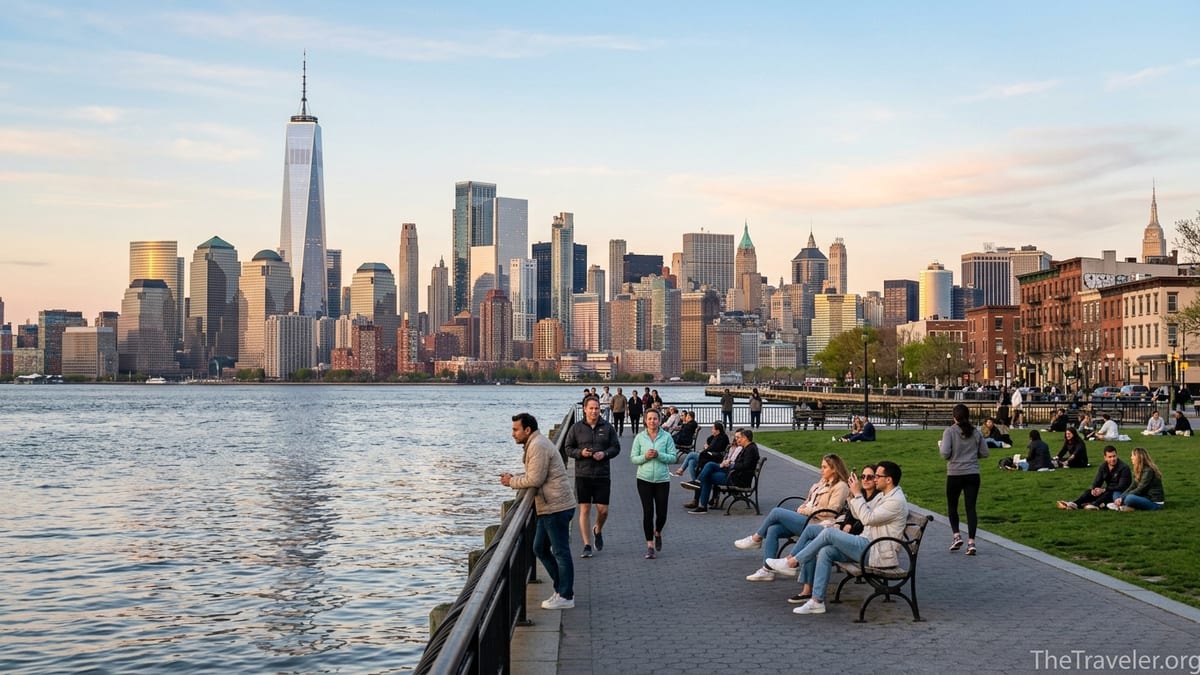
Why Hoboken Feels Like a Small City Next to the Giant
Hoboken is often called the Mile Square City, and that nickname is surprisingly accurate. The core of town is barely more than a square mile, and you can walk from the western residential streets to the riverfront in around 10 to 15 minutes. That scale gives Hoboken an immediately legible feel. Instead of a maze of avenues and expressways, visitors find a simple grid, low-rise brick buildings, and a tight-knit commercial spine along Washington Street. The result is a place where you can arrive with no plan and comfortably wander without worrying about long subway transfers or getting stranded.
Despite sitting directly across from both Midtown and Lower Manhattan, Hoboken projects a gentler energy. You notice it in the way people queue outside neighborhood coffee shops on weekend mornings, in the joggers who loop the riverfront, and in the easy spill of strollers and dogs out of brownstone stoops. Real estate agents and hotel brands love to highlight this combination of small-town charm and big-city access, and in Hoboken it is not just marketing language. You can admire the Empire State Building from a park bench, then be back on a quiet, tree-lined side street five minutes later.
Visitors arriving from New York are often struck by how quickly the mood shifts. One moment you are in the crush of the World Trade Center concourse or Midtown’s Penn Station area; fifteen minutes later you are emerging from the PATH station into a compact downtown where the loudest sound might be delivery trucks and bar music instead of sirens. That sense of psychological distance is part of what makes Hoboken so appealing as a half-day escape from a Manhattan-heavy itinerary.
Hoboken’s population also contributes to the small-city impression. While it has grown steadily with young professionals and families, it is still far smaller than a New York borough, and the community feels highly local. Many restaurants and bars on Washington Street are independent, long-running businesses, and regulars are on a first-name basis with staff. As a visitor, you are stepping into a functioning hometown that just happens to sit directly opposite the world’s most famous skyline.
Waterfront Parks With Some of the Best Manhattan Views Anywhere
The main reason many travelers detour to Hoboken is its riverfront. Standing along the Hudson here, the view of Manhattan is almost panoramic, stretching from the Freedom Tower in the south up past the Empire State Building and midtown towers. It feels like you have stepped back from a massive painting to appreciate it as a whole. Because Hoboken’s waterfront is mostly parkland, there are many places to stop, sit, and really absorb the skyline rather than just snapping a quick photo from a lookout.
Pier A Park, just north of the historic Hoboken Terminal, is usually the first stop. A long pier refashioned into a green lawn with tree-lined paths, it extends into the Hudson far enough that you feel surrounded by water. On clear days, you can spread out a blanket and see everything from Governors Island and the Statue of Liberty’s silhouette to the office towers at Brookfield Place and the glass shards of Lower Manhattan. Locals come here for after-work picnics, free summer movie nights, and weekend soccer games, but visitors simply strolling the paths will find dozens of effortless vantage points for skyline photos.
Walk a bit farther north along the Hudson River Waterfront Walkway and you reach Pier C Park, a smaller, modern park set on its own little island. Accessible by a curved footbridge, it has play areas for children, a fishing pier, and benches oriented toward Midtown. As the afternoon light shifts, the glass facades of Manhattan’s towers reflect shades of gold and pink, and the contrast between Hoboken’s modest mid-rise buildings and the skyscrapers across the river is striking. It is one of the best spots in the region to appreciate just how close New York is geographically, even as Hoboken keeps its own quieter rhythm.
Farther north, the waterfront path continues past residential towers and smaller green spaces. From here, you get a slightly more angled view toward Midtown and the newer Hudson Yards complex. Cyclists cruise by, locals walk dogs, and runners use the path as a daily training route. For visitors, it is an easy, level stroll with constant water views. If you time your walk for sunset, you can watch the lights flicker on across Manhattan while the sky fades behind it, all without the crowds associated with Manhattan’s own waterfront promenades.
Getting to Hoboken: PATH, Ferries, and Easy Connections
Hoboken is one of the simplest New Jersey cities to reach from Manhattan without a car. The most straightforward option for most travelers is the PATH train, a rapid-transit system connecting Manhattan with several New Jersey hubs. From the World Trade Center station in Lower Manhattan, trains run directly to Hoboken, and the ride typically takes around 10 minutes. From Midtown, you can catch PATH from 33rd Street; you will usually transfer at either Journal Square or Hoboken depending on the schedule, but total travel time is still typically under 25 minutes end to end.
As of mid-2026, a standard one-way PATH fare sits in the low single digits, and riders can pay with contactless bank cards or stored-value transit cards used around the region. Because PATH is separate from the New York City subway system, you will generally pay a separate fare when you transfer from subway to PATH, which is worth factoring into your budget if you are making multiple round trips. For a day trip focused on Hoboken, though, the cost is manageable and the simplicity of the route more than compensates.
Another scenic and popular option is the NY Waterway ferries that operate between Manhattan and Hoboken. Boats connect the Hoboken / NJ Transit Terminal area to Lower Manhattan terminals such as Brookfield Place, with crossing times typically under 10 minutes. One-way fares are higher than the PATH, but riders get a built-in harbor cruise: you stand on open decks as the skyline glides past, passing close to the piers and occasionally sharing the water with sailboats and commuter craft. For many visitors, the extra cost is justified by the photo opportunities alone, especially if you travel at golden hour or after dark when the city is lit up.
If you are staying elsewhere in New Jersey, Hoboken doubles as a transport nexus. NJ Transit commuter trains terminate at Hoboken Terminal from towns across northern New Jersey, and local buses and the Hudson-Bergen Light Rail connect Hoboken with Jersey City, Bayonne, and other waterfront communities. That makes it easy to combine a Hudson County itinerary: you might spend the afternoon exploring Liberty State Park and Jersey City’s street art, then ride the light rail north and finish your day with sunset over Manhattan from Hoboken’s piers.
Washington Street: Hoboken’s Main Street Energy
While the waterfront delivers the signature skyline views, Washington Street provides the small-city backbone. Running the length of town a few blocks inland from the river, it is lined with brick walkups, fire escapes, and an ever-changing mix of cafes, bakeries, boutiques, and bars. Wide sidewalks and relatively modest traffic give it an approachable scale. As you stroll, you pass everything from old-school Italian-American restaurants to sleek cocktail bars and independent clothing stores.
Food is one of Washington Street’s main draws. Longstanding spots like classic Italian dining rooms and taverns sit beside newer arrivals serving contemporary American menus, ramen, or vegetarian-friendly fare. On a typical evening you might see a line outside a busy slice joint, couples heading into a dimly lit wine bar, and families sharing big plates of pasta a few doors down. For travelers, the key is to follow your nose and the local crowds: many of the most satisfying meals are in places that look like neighborhood fixtures rather than destination restaurants.
Washington Street also hosts much of Hoboken’s nightlife. Young professionals spill out of sports bars during big games, and low-key cocktail lounges draw an after-dinner crowd. Because the city is so compact, bar-hopping is simple; you can try a craft beer bar, a live-music venue, and a classic corner pub without ever needing a cab. For those who prefer a quieter evening, there are bakeries and gelato shops where you can grab dessert and then walk toward the river to finish the night with views of the Empire State Building and Midtown lights.
Daytime, the same street feels different. Parents push strollers between errands, students from nearby campuses grab coffee between classes, and shoppers drift between boutiques. The rhythm is slower than Manhattan’s retail corridors, yet still distinctly urban. It is easy to weave a Washington Street wander into any visit focused on the piers: a common pattern is to arrive via PATH, walk up Washington for lunch and a coffee, then drift back down toward the riverfront parks for the afternoon.
Neighborhood Strolls, Green Spaces, and Local Life
Beyond the obvious waterfront and main street, Hoboken rewards visitors who simply wander its residential blocks. Tree-lined streets such as Garden, Bloomfield, and Hudson Streets feature rows of brownstones and brick townhouses with stoops and small front gardens. Compared with Manhattan’s brownstone neighborhoods, the scale here is a touch more intimate and less touristy. People sit on their stoops chatting, neighbors walk dogs, and the general atmosphere feels unmistakably local. Walking these blocks after a visit to the crowded piers gives you a fuller sense of Hoboken as a lived-in city rather than just a viewpoint.
The city has invested heavily in parks and playgrounds, which amplifies the small-town feel. In addition to the showpiece piers, there are pocket parks scattered throughout the grid, along with larger green spaces inland. On warm weekends, fields fill with pickup soccer games and casual softball, while playgrounds buzz with families. Travelers with children often find Hoboken an easier place to give kids some free play time than central Manhattan: the parks are less congested, and distances between them are short enough for little legs.
One appealing element of Hoboken’s urban design is how the parks connect back to the waterfront walkway. You can, for instance, start at a neighborhood coffee shop west of Washington Street, walk through a small inland park, and reach the river in under ten minutes. This kind of permeability means you are rarely far from either a green break or a sweeping skyline view. It helps the city feel cohesive and human-scaled, even as thousand-foot towers loom across the water.
Evenings, the neighborhood streets take on a mellow glow. Streetlights and window lamps create a warm blanket of light, and you may catch snippets of live music drifting out of bars or private gatherings. The sense that you are in a working small city, not a resort or theme-park version of one, is strong. Visitors who overnight in Hoboken rather than just day-tripping often cite these quiet walks back to their hotel or rental as among their favorite trip moments.
Perfect Times and Ways to Experience Hoboken’s Views
Although Hoboken’s skyline views are impressive in any weather, certain times of day and seasons heighten the effect. Early morning, especially in late spring and early fall, often brings softer light and calmer paths. Runners and dog walkers share Pier A and Pier C, but the overall scene is notably peaceful. If you arrive on an early PATH train from Manhattan, you can watch the city across the river gradually come fully awake as office lights switch on and ferries multiply on the water.
For many travelers, though, the most memorable moments come at sunset and into the evening. In clear conditions, the sky behind Manhattan cycles through oranges and pinks before settling into deep blue while the towers light up one by one. From Hoboken’s riverfront, you are facing east and slightly south or north depending on your vantage point, which means you are watching the reflection of sunset on the city rather than the sunset itself. The effect can be even more dramatic: glass surfaces flash warm colors and the Hudson turns slate blue or silver.
In practical terms, a satisfying Hoboken excursion from Manhattan requires only a few simple steps. Take the PATH or ferry over in the late afternoon, grab a coffee or early dinner along Washington Street, then head toward Pier A or Pier C to stake out a spot. Pack a light jacket, as breezes off the Hudson can feel cooler than inland temperatures, even in summer. Once you are seated or strolling, there is little to do but watch the light shift, boats trace lines across the water, and the city opposite change character minute by minute.
Winter visits have their own rewards. Fewer people linger in the parks, and crisp cold air can produce very clear visibility, with the outlines of downtown and midtown etched sharply against a pale sky. Snow is less predictable, but if you are lucky enough to arrive after a dusting, the contrast between white lawns in Hoboken and the dark grid of Manhattan can be visually striking. Just be prepared for wind on the piers and plan to warm up afterward in a nearby bar or cafe.
The Takeaway
Hoboken combines two experiences that many visitors to New York crave but rarely get in the same place. On one hand, it delivers unbroken, wide-screen views of Manhattan that are difficult to appreciate from within the city itself. On the other, it functions as a compact, neighborly small city where daily life unfolds on a human scale: kids in playgrounds, regulars at corner bars, and locals jogging in the park after work. Together, these qualities make it more than a simple photo stop.
For travelers, spending even a few hours here can recalibrate a New York trip. Instead of racing from sight to sight underground, you emerge into a different vantage point on the metropolis, literally and figuratively. You see how the skyline sits in its broader geography, feel how quickly the pace can shift just across the river, and experience a version of urban life that many New Yorkers themselves seek out on weekends. Whether you come for the sunset views, the bar-hopping, or a quieter neighborhood stay, Hoboken offers a rewarding counterbalance to the intensity of Manhattan.
Most importantly, Hoboken is easy. It is easy to reach, easy to navigate, and easy to enjoy without a checklist. Step off the PATH or ferry, walk toward the water until the towers rise up in front of you, then let the city’s small scale guide the rest. The contrast between that simplicity and the vastness of the skyline might be the most powerful view of all.
FAQ
Q1. How long does it take to get from Manhattan to Hoboken?
Travel time is typically around 10 minutes on the PATH train from the World Trade Center to Hoboken, and under 20 to 25 minutes from Midtown, depending on transfers.
Q2. Is Hoboken worth visiting if I only have one day in New York?
Yes, especially if you value skyline views and a calmer atmosphere. A half-day in Hoboken combined with Manhattan sightseeing offers helpful contrast and memorable photos.
Q3. What is the best spot in Hoboken for Manhattan skyline photos?
Pier A Park is often considered the standout, with long lawns and paths extending into the Hudson, but the entire waterfront walkway down to Pier C offers excellent angles.
Q4. How much does it cost to travel to Hoboken by PATH or ferry?
As of 2026, PATH fares are in the low single digits per ride, while NY Waterway ferry tickets cost more but include a short, scenic river crossing with open-deck views.
Q5. Is Hoboken walkable for visitors without a car?
Very much so. The city is about a mile square, and you can comfortably walk from the PATH station to Washington Street and the waterfront parks in just a few minutes.
Q6. Are there good restaurants and bars near the waterfront?
Yes. Washington Street, a short walk from the river, is lined with restaurants, cafes, and bars, and several side streets closer to the water also have popular spots.
Q7. When is the best time of day to enjoy Hoboken’s Manhattan views?
Late afternoon into sunset and early evening is ideal. You can watch the city across the river shift from daylight to a sea of lights, which photographs beautifully.
Q8. Is Hoboken family-friendly for travelers with children?
Hoboken works well for families. Parks like Pier A and Pier C offer lawns and playgrounds, distances are short, and traffic feels calmer than in much of Manhattan.
Q9. Can I stay overnight in Hoboken instead of Manhattan?
Yes. Hoboken has hotels and rentals that appeal to travelers who prefer a quieter base with quick access to New York by PATH or ferry, along with neighborhood amenities.
Q10. Do I need to plan a detailed itinerary for Hoboken?
Not necessarily. Many visitors simply arrive, stroll Washington Street, wander the residential blocks, then spend unhurried time in the waterfront parks enjoying the skyline.