


Daniel K. Inouye International Airport in Honolulu is the main jumping-off point for flights to Maui, Kauai, the Big Island, and Molokai. For many travelers, this means a tight connection, a terminal change, and questions about baggage and timing. This guide explains how interisland connections at Honolulu actually work in practice, so you can plan realistic layovers and avoid unnecessary stress.
Get the latest updates straight to your inbox!
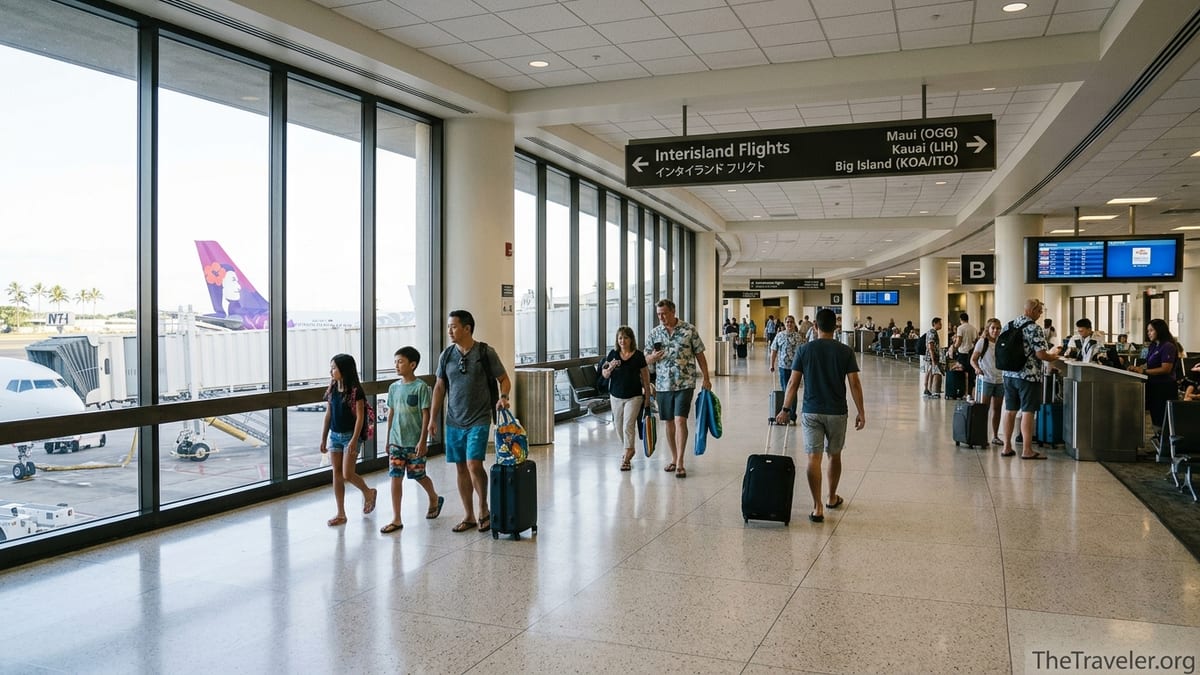
Understanding Honolulu’s Terminals for Interisland Flights
Honolulu’s airport is spread out, and knowing which terminal you need makes a big difference in how smooth your connection will be. Interisland flights to Maui (OGG, JHM), Kauai (LIH), the Big Island (KOA, ITO), and Molokai (MKK, LUP) depart from two main locations: Terminal 1 and Terminal 3. Terminal 1 is the primary Hawaiian Airlines hub and is still often called the interisland terminal. Terminal 3 is the small commuter facility used by Mokulele Airlines on the Diamond Head side of the airfield.
If you are flying Hawaiian Airlines between islands, you will use Terminal 1 for check in and departure. That includes a connection such as Los Angeles to Honolulu to Kahului (LAX–HNL–OGG) on Hawaiian, or Honolulu to Lihue (HNL–LIH) on a short Boeing 717 or similar narrow‑body aircraft. Terminal 1 has multiple security checkpoints and a long, curved concourse with all Hawaiian gates, so once you are through security you can walk between interisland and mainland gates without exiting the secure area.
Mokulele Airlines, which operates small Cessna 208 Caravan aircraft to Molokai, Lanai, West Maui’s Kapalua, and some Big Island airports, uses Terminal 3. This is more basic than the main terminals and is reached along Aolele Street, near cargo facilities rather than the main ticketing lobbies. There is no airside connection between Terminal 3 and the main terminals, so if you are changing between Mokulele and any other airline, you must exit, collect bags, and physically transfer between terminals.
Other carriers, such as Southwest and Alaska, may operate some interisland segments, but these flights depart from Terminal 2. If your onward neighbor‑island hop is on a non‑Hawaiian airline, double‑check your booking confirmation to see which terminal is listed. The signage in the public areas points to “Interisland Flights” mainly for Hawaiian in Terminal 1, so it is important to confirm whether you actually need Terminal 1, Terminal 2, or the separate commuter Terminal 3.
Which Airline to Choose for Maui, Kauai, Big Island, and Molokai
Most travelers will choose between Hawaiian Airlines and Mokulele for interisland flights, with Hawaiian carrying the majority of passengers. Hawaiian operates frequent daily jet service from Honolulu to major airports like Kahului on Maui, Lihue on Kauai, Kona and Hilo on the Big Island. For example, on a typical weekday you might find a Hawaiian schedule with flights from HNL to OGG departing roughly every hour during daylight, which gives you more flexibility if something goes wrong and you need to be rebooked.
Mokulele focuses on smaller communities and secondary airports. From Honolulu it flies to Molokai Airport (MKK), the remote Kalaupapa peninsula, Lanai, Kapalua in West Maui, and sometimes smaller Big Island fields. The experience is very different from a jet: you will board a nine‑seat Cessna with no cabin door between the pilot and passengers, and luggage allowances are more restrictive. For example, a typical Mokulele booking might allow a single checked bag around 30 to 35 pounds before overweight fees start, and carry‑ons must be small enough to fit in the compact cabin.
For Maui, Kauai, and major Big Island routes, most visitors find Hawaiian more straightforward, especially if they arrive on a Hawaiian long‑haul flight and can remain in Terminal 1. A traveler flying New York–Honolulu–Kona entirely on Hawaiian, for instance, will check bags through to KOA in New York, clear security once in JFK, and simply walk between gates in Honolulu. For Molokai or Lanai, Mokulele is often the only option, so you need to plan more conservatively, build extra connection time, and expect a more hands‑on, small‑airline experience.
Price can vary considerably. Promotional interisland fares on Hawaiian have sometimes been under 100 dollars one way, but during peak holidays it is not unusual to see last‑minute one‑way tickets over 200 dollars between Honolulu and neighbor islands. Mokulele’s fares also fluctuate and may be higher on routes with no competition, such as Honolulu to Molokai. Booking four to six weeks ahead usually secures better pricing than waiting until the week of travel, particularly for popular routes like Honolulu–Kahului.
How Connections Work When You Arrive in Honolulu
How you connect in Honolulu depends on whether your flights are on one ticket and whether you stay with the same airline. The simplest case is a through ticket on Hawaiian, such as Boston–Honolulu–Lihue purchased as one itinerary. In this scenario, your bags are typically tagged to LIH at your origin, and you do not need to reclaim them in Honolulu. You arrive in Terminal 1, follow the overhead signs to your next gate, and board your interisland flight from the same terminal.
If you arrive on a mainland airline into Terminal 2 and connect to Hawaiian in Terminal 1 on separate tickets, the process is more involved. A common example is a traveler flying San Francisco to Honolulu on United, then a separately booked Hawaiian ticket to Kahului. In that case you would land in Terminal 2, go to baggage claim to collect your checked luggage, then walk outside or use the inter‑terminal walkways to reach Terminal 1. You will need to check in again with Hawaiian at the Terminal 1 ticket counters, drop your bags before the cutoff time, and then re‑clear security. This can easily take an hour or more if queues are long.
International arrivals add a further step. Say you fly Sydney to Honolulu on Hawaiian, then Honolulu to Hilo. You will arrive into the international arrivals area, clear immigration, collect your bags, pass customs, and then recheck bags at the designated transfer desk or ticket counter. You will then clear security again and proceed to your neighbor‑island gate. In busy late‑morning banks of international arrivals, immigration and security queues can be lengthy, so planning only a 60‑minute connection is risky.
Connections involving Mokulele are always treated like separate journeys. For example, a traveler flying Los Angeles to Honolulu on Delta, then on to Molokai with Mokulele, should plan to pick up bags in the main terminal, walk or taxi to Terminal 3 along Aolele Street, and check in with Mokulele at least 45 to 60 minutes before departure. There is no through‑check of baggage between Mokulele and major carriers, so every bag must be reclaimed and rechecked, and you must account for the time to transit between terminals.
How Much Time You Really Need for a Safe Connection
Official connection and check‑in guidelines tend to be optimistic, so it is wise to build in extra time. Honolulu’s airport recommends arriving about 90 minutes before interisland flights and around two hours before overseas flights. In practice, factors such as peak travel seasons, morning security bottlenecks, and long walks along Terminal 1’s concourse can easily add 20 to 30 minutes to your journey between gates or terminals.
For same‑airline Hawaiian connections within Terminal 1, many travelers are comfortable with 60 minutes, and Hawaiian sometimes sells tight connections around an hour on a single ticket. For example, a New York–Honolulu flight arriving at 2:00 p.m. might be sold with a 3:05 p.m. departure to Kauai. This is usually workable if the inbound is on time, but even a minor delay or slow deplaning can make it stressful. Families with young children, older travelers, or anyone unfamiliar with the airport should favor a buffer of 90 minutes or more whenever possible.
For self‑planned connections between airlines or terminals, think of 90 minutes as the bare minimum and two to three hours as a safer window. A traveler landing on Alaska Airlines in Terminal 2 at 11:00 a.m. with a separately ticketed Hawaiian flight to Maui at 12:10 p.m. is taking a real risk. Delays in taxiing to the gate, waiting for bags, walking to Terminal 1, and clearing security could easily push them past Hawaiian’s baggage cutoff, even if the Maui flight departs on time. In contrast, a 2:00 p.m. Maui departure on the same day would allow a far more comfortable cushion.
Connections to Mokulele in Terminal 3 should be planned with even more conservatism. Because the commuter terminal is separate and Mokulele’s small aircraft are sensitive to weight and balance, the airline is strict about check‑in deadlines. If you land in Honolulu at 1:30 p.m. and have a 2:30 p.m. Mokulele flight to Molokai, you may not have enough time to get to Terminal 3, check in, and have bags weighed and accepted. Booking a later departure, even if it appears to lengthen the day, can save the cost and frustration of a missed flight.
Baggage Rules, Tagging, and Security Nuances
Baggage handling is one of the biggest sources of confusion on Honolulu interisland connections. On a single Hawaiian ticket from the mainland or abroad through to a neighbor island, your checked bags are usually tagged to the final island destination and transferred automatically in Honolulu. For example, on a Chicago–Honolulu–Kona itinerary booked entirely with Hawaiian, you would typically drop your bags in Chicago and not see them again until you arrive in Kona.
On separate tickets, most mainland and international airlines will only tag bags to Honolulu, even if you have a confirmed onward interisland reservation. A traveler flying American Airlines from Dallas to Honolulu with a self‑booked Hawaiian ticket to Kauai should expect to collect bags in Honolulu, clear customs if arriving internationally, and then recheck with Hawaiian. Public reports suggest that occasional exceptions exist when airlines have interline agreements and staff are willing to help, but this should never be counted on. Planning as though you will have to reclaim and recheck bags is the safer assumption.
Mokulele does not participate in standard baggage interlining with major carriers at Honolulu. Even if you arrive on Hawaiian and continue on Mokulele, you will need to collect bags and transport them to Terminal 3 yourself. Mokulele’s weight limits are stricter than those of large airlines, and passengers may face additional fees if checked luggage exceeds the modest allowance. In practical terms, a traveler connecting to Molokai with heavy dive gear or camera equipment might find it worthwhile to ship bulky items separately or lighten their load to avoid surprises at check in.
Security screening also plays a role. If you remain within Terminal 1 on Hawaiian, there is no need to re‑clear security between flights. However, any terminal change that requires going landside, such as moving from Terminal 2 to Terminal 1, or from the main complex out to Terminal 3, will require you to pass through TSA again. During morning and early afternoon peaks, security lines can be slow, so factor in at least 20 to 30 minutes just for screening, more if you are traveling with children, strollers, or medical equipment.
What Happens When Things Go Wrong
Missed connections in Honolulu can be frustrating, but your options depend heavily on how your itinerary was booked. When your entire journey is on one ticket with a single airline, such as Hawaiian from a mainland city through Honolulu to Maui, the airline generally takes responsibility if a delay on its own flight causes you to miss the connection. In that scenario, agents at HNL can rebook you on the next available flight to your island at no additional cost, subject to seat availability.
However, if you arranged separate tickets yourself, you bear most of the risk. For example, a family who buys a discounted Los Angeles–Honolulu ticket on a low‑cost carrier, then a separate Hawaiian ticket to Lihue, will likely be treated as a no‑show on the Hawaiian flight if the inbound is late and they miss check‑in. Rebooking may require buying new same‑day tickets at walk‑up prices, which can be significantly higher than advance fares. Travel insurance or credit cards with missed‑connection benefits may help recoup some of these costs, but only if the policy explicitly covers self‑made connections.
With Mokulele, recovery options can be limited by the size of the fleet and fixed schedules. If a weather delay or aircraft issue disrupts a Kapalua or Molokai departure, the airline may rebook you on the next flight with available seats, but that might be many hours later or even the following day. Since there is no standby jet with dozens of open seats, travelers to smaller islands should build extra margin into their itineraries, especially if they have important events or departures scheduled right after arrival.
Realistically, the best protection against missed‑connection stress in Honolulu is conservative planning. Schedule at least a 90‑ to 120‑minute buffer between unrelated tickets, avoid the last flight of the day to your island when possible, and consider spending a night in Honolulu if your international or mainland arrival is in the late afternoon or evening. This approach adds some cost but greatly reduces the chance that a single delay will strand you overnight or force you to reshuffle hotel and activity bookings on the neighbor islands.
Practical Tips for a Smoother Interisland Experience
A few practical habits can make your Honolulu connection feel more manageable. First, pack a small personal item with essentials you would need if your checked bag arrives late, such as medications, a change of clothes, and swimwear. Short interisland sectors are prone to tight baggage connections, and on busy days bags may arrive on a later flight even when you do not. Having what you need in your cabin bag allows you to continue with your plans while the airline delivers your luggage.
Second, familiarize yourself with your terminal layout before arrival. While you will not have access to online maps in flight, you can study the general shape of Terminal 1’s concourse, the location of the inter‑terminal shuttle stops, and the approximate distance to Terminal 3 beforehand. That way, when your plane doors open, you know whether you can stroll to your next gate or need to move quickly. This is particularly helpful on tight but ticketed connections, like a one‑hour Hawaiian‑to‑Hawaiian transfer where every minute counts.
Third, keep an eye on your booking for schedule changes in the weeks before you fly. Airlines sometimes adjust departure times or swap aircraft, and a once‑comfortable 90‑minute connection can quietly shrink to just over an hour. If you see your layover getting shorter, reach out to the airline well before travel to see whether they can move you to a slightly earlier or later interisland segment. It is usually easier to make adjustments a month in advance than on the day of travel.
Finally, be realistic about island hopping. It is easy to imagine visiting Oahu, Maui, Kauai, and the Big Island all in one trip, but each hop involves check‑in, security, and potential delays. For many travelers, focusing on one or two islands and minimizing intra‑trip connections results in a more relaxing vacation and fewer chances for missed flights or lost luggage. When you do connect through Honolulu, treat the transfer as part of the journey, not just a quick bus ride, and plan your timing accordingly.
The Takeaway
Honolulu is the central hub for flights to Maui, Kauai, the Big Island, and Molokai, and understanding how the airport and airlines work together is the key to a low‑stress connection. Hawaiian Airlines operates out of Terminal 1 and offers the simplest path for most travelers, especially on single‑ticket itineraries where bags are checked through. Mokulele’s Terminal 3 services smaller communities and requires more careful planning, particularly around baggage and connection times.
Build in generous layover buffers, especially when connecting between different airlines, terminals, or tickets. Whenever possible, choose through tickets on a single carrier and avoid last‑flight‑of‑the‑day connections to your island. If a tight schedule is unavoidable, arrive prepared with essentials in your carry‑on, a clear understanding of your terminal layout, and flexible expectations. With thoughtful planning, a connection in Honolulu can be a straightforward bridge between your long flight and the beaches, trails, and towns waiting on Hawaii’s neighbor islands.
FAQ
Q1. How much layover time do I need in Honolulu for an interisland connection?
For a same‑airline Hawaiian connection within Terminal 1, aim for at least 60 to 90 minutes. For connections involving different airlines or terminals, plan on 90 minutes to 2 hours or more to allow for baggage claim, check‑in, and security.
Q2. Do I have to pick up my bags in Honolulu before flying to Maui, Kauai, or the Big Island?
If your entire trip is on one ticket with the same airline, your bags are usually checked through to your final island. If you booked separate tickets or are switching airlines, expect to collect and recheck your bags in Honolulu.
Q3. Which terminal does Hawaiian Airlines use for neighbor‑island flights?
Hawaiian Airlines uses Terminal 1 for its interisland and most mainland flights. If you are connecting to Maui, Kauai, or the Big Island on Hawaiian, you will depart from Terminal 1.
Q4. Where does Mokulele Airlines depart from at Honolulu Airport?
Mokulele operates from Terminal 3, a smaller commuter terminal on the Diamond Head side of the airport complex. It is separate from Terminals 1 and 2, and you must go landside to reach it.
Q5. Can airlines in Honolulu tag my bags directly to a Mokulele flight?
In most cases, no. Mokulele does not routinely interline baggage with major carriers, so you should plan to collect your bags in the main terminals and check in separately at Terminal 3.
Q6. Is 1 hour enough to connect from a mainland airline in Terminal 2 to a Hawaiian interisland flight in Terminal 1?
One hour is usually too tight, because you may need to wait for bags, walk to Terminal 1, check in, and clear security again. A buffer of 90 minutes to 2 hours is much safer for this kind of connection.
Q7. What happens if I miss my Hawaiian interisland flight due to a delay?
If all flights are on one Hawaiian ticket and a delay on their own flight causes the misconnection, they will usually rebook you on the next available flight. If you are on separate tickets, you may have to buy a new interisland ticket.
Q8. Are interisland flights between Honolulu and the other islands often delayed?
Short interisland flights are generally reliable, but delays can occur due to weather, air traffic, or aircraft rotation. Allowing a healthy buffer in your schedule helps prevent a minor delay from disrupting onward plans.
Q9. How early should I arrive for a Mokulele flight from Honolulu to Molokai or Lanai?
Plan to arrive at Terminal 3 at least 60 to 90 minutes before departure, especially if you are checking bags. Mokulele’s small aircraft and strict weight limits mean check‑in cutoffs are enforced.
Q10. Is it better to overnight in Honolulu before flying to another island?
If your international or mainland flight arrives late in the day, or if you are worried about tight connections, spending a night in Honolulu and flying to the neighbor islands the next morning can significantly reduce stress and missed‑connection risk.