


German bureaucracy has a reputation for being detailed, rule-bound, and paperwork-heavy. For expats, this administrative environment shapes almost every formal step of settling in, from registering an address to interacting with immigration offices. Understanding how the system is organised, where bottlenecks occur, and how far digitalisation has progressed is central to assessing whether relocation to Germany is operationally manageable.
Structural Features of German Bureaucracy That Affect Expats
German bureaucracy is built on a federal system in which responsibilities are divided between the federal government, 16 states, and thousands of municipalities. For expats, this means that many core procedures are regulated nationally but implemented locally, so exact requirements and user experience can vary significantly between cities and regions. Registration offices, immigration authorities, and document-issuing bodies often operate with their own appointment systems, forms, and internal timelines.
The administration is characterised by a strict legalistic approach. Almost every step is anchored in legislation and secondary regulations, and public officials are obliged to follow written rules closely. This provides predictability but also limits flexibility in exceptional cases. Expats usually encounter this when documents do not match standard formats, when foreign certificates require legalisation or sworn translation, or when systems are not designed for non-standard biographies such as remote workers or multi-country commuters.
Germany also maintains extensive information and documentation requirements. National and expert bodies estimate that information and reporting obligations across the economy consume tens of billions of euros annually in direct compliance costs and a notably higher figure in indirect effects. These structural conditions help explain why procedures for individuals can feel meticulous, slow, and document-intensive, particularly when compared with more digitalised European administrations.
At the same time, a number of initiatives are under way to measure and reduce administrative burdens. An administrative burden index is updated regularly to track the effect of new regulations on compliance costs, and the current federal government has publicly committed to sizeable percentage reductions in bureaucracy over the coming years. These efforts do not remove existing complexity overnight but signal an institutional awareness that the system must be simplified and modernised.
Typical Administrative Journeys for Newly Arrived Expats
Although formal procedures depend on personal status and purpose of stay, most expats go through a similar sequence of key bureaucratic interactions. The first visible point of contact is often the local citizens’ office responsible for registering a residential address. Registration within a set period after moving in is compulsory for residents and can trigger downstream data updates to tax, social security, and other registers. In most cities, initial registration still requires a personal visit, predefined documents, and a formal confirmation from the housing provider.
Non-EU nationals usually require interaction with the local immigration authority for residence documentation, even if a visa was issued abroad. These offices handle residence permits, extensions, changes of purpose (for example from study to work), and many status-related certificates. Appointment slots can be scarce in large metropolitan areas, so expats are frequently advised by universities, employers, or relocation firms to request time slots several weeks in advance of expiry dates or arrival, where permitted.
Further administrative steps often include registration for broadcasting contributions, opening bank accounts that require proof of address, or resolving matters such as issuing tax identification numbers and social insurance details. While some of these subsequent items are handled automatically once registration is complete, others require separate forms or online submissions. The need to navigate multiple authorities, each with its own communication style and processing speed, is a defining feature of the bureaucratic landscape.
Universities, multinational employers, and municipal welcome centres sometimes provide checklists and advisory sessions that outline this journey. Where such structured support exists, expats typically report a more predictable experience. In areas without coordinated guidance, newcomers often rely on informal online communities or commercial facilitators to interpret local expectations, especially when German-language documentation is dense or ambiguous.
Documentation Standards, Forms, and Language Practices
German administration relies heavily on formal documents and standardised forms. Original passports or national identity cards are almost always required for identification, and certified copies are accepted only in explicitly allowed cases. Birth, marriage, or qualification certificates issued abroad may need to be presented with an apostille or consular legalisation and a translation produced by a court-certified translator within Germany. Requirements can differ between authorities, and even between departments within the same city, which can surprise expats expecting uniform rules.
Forms are often available as downloadable PDFs or web forms, but the underlying structure still reflects paper-based processes. Many forms request detailed information that may not be standard in other countries, such as previous addresses with exact dates, religious affiliation for church tax purposes, or highly specific classification of employment status. Signature fields and declarations attesting to the accuracy of information are central, and omissions can lead to delays or repeat visits.
The working language of almost all authorities is German. In larger cities and at specialised expat offices, staff may be able to communicate in English or other languages, but individuals cannot rely on this. Many official forms and notices exist only in German. Some municipalities offer bilingual information sheets or unofficial translations for orientation, yet the legally relevant version is German. For expats who do not speak the language, this creates a strong incentive to bring a German-speaking colleague, partner, or interpreter to important appointments.
Language barriers can also interact with procedural rigidity. If a case officer cannot clarify a non-standard situation in a shared language, they are more likely to strictly apply default rules and request exhaustive documentation. From a relocation-planning perspective, this makes investment in translation and interpretation capacity a practical risk-mitigation measure, particularly for complex household situations or non-routine immigration histories.
Appointment Systems, Waiting Times, and Regional Variations
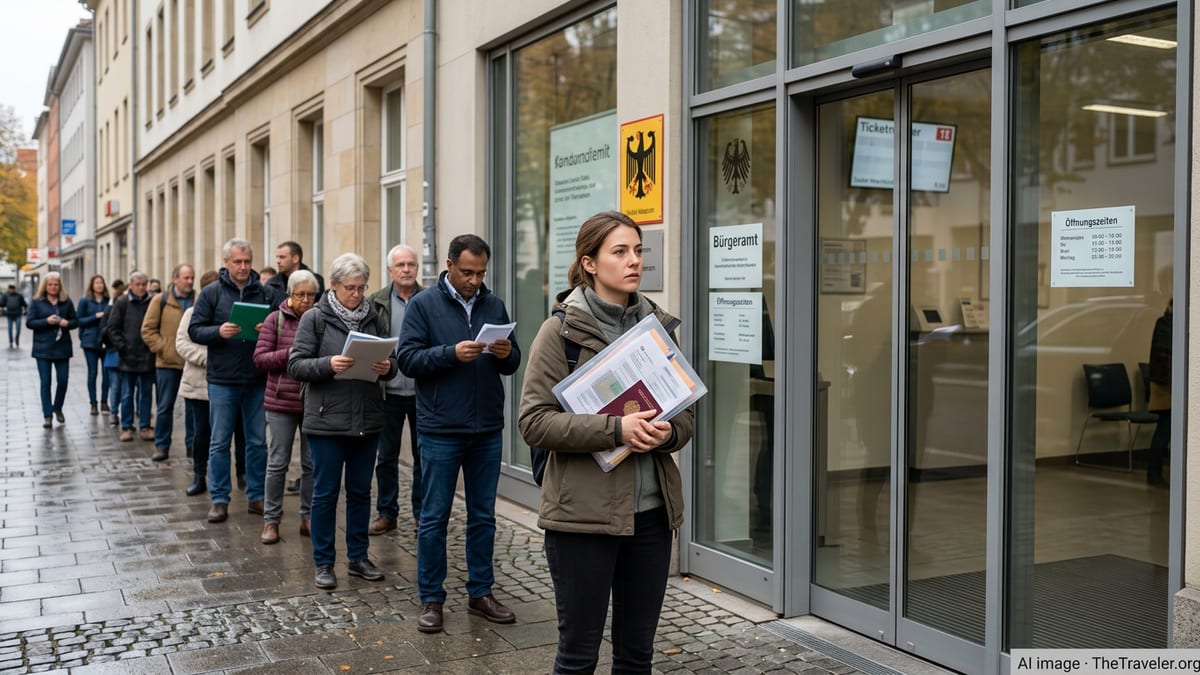
In most urban areas, German authorities operate appointment systems for in-person visits, especially for registration and immigration matters. Online booking portals are widely used, but capacity constraints mean that expats frequently encounter messages indicating that no appointments are currently available. In some cities, new slots are released in batches at specific times of day or days of the week, and high demand can result in rapid booking and visible scarcity.
Reports from universities, relocation providers, and expat communities indicate that waiting times for routine appointments can range from a few days in smaller towns to several weeks or more in high-demand cities. For immigration-related matters, waiting periods of four to eight weeks for standard processing are commonly referenced, and longer delays can occur during peak periods or when offices face staff shortages. Some authorities treat email or online contact forms submitted before a permit expiry date as a timely application, issuing interim certificates that preserve legal stay and work rights while the case is processed.
Regional variation is significant. Certain states and municipalities have invested heavily in digital queues, centralised service centres, and extended opening hours, resulting in comparatively smoother experiences. Others continue to rely on traditional counter service with limited daily quotas. Large cities with sizable expat populations often experience the sharpest bottlenecks, particularly in their immigration offices, and attempts to centralise or modernise these functions have at times created transitional backlogs.
These appointment dynamics have operational consequences for relocation planning. Employers, universities, and individuals must schedule start dates, travel, and housing access with realistic lead times for key interactions. Missing or delayed appointments can postpone access to formal residence documentation, which in turn may affect the ability to sign certain contracts, receive benefits, or prove status to banks and other private-sector actors. Conservative scheduling and early booking are therefore important elements of any relocation timeline to Germany.
Digitalisation of Public Services and Its Limits
Germany has committed to broad digitalisation of public administration, including the obligation to make hundreds of administrative services available online. As of late 2025, sector analyses suggest that around 60 percent of defined services are accessible digitally to some extent, with notable differences between regions and between citizen-facing and business-facing procedures. This represents progress but still falls short of full coverage, and many digital services coexist with legacy paper-based workflows.
For expats, the current state of digitalisation is mixed. In several states, change-of-address notifications can be submitted online, and certain certificates or extracts can be requested via portals with postal delivery. Some municipalities have introduced online pre-registration forms that shorten in-person visits. However, initial address registration after arrival from abroad and most residence-permit procedures still typically require at least one physical appearance at the relevant office, particularly when biometric data must be collected.
User experience and technical reliability also vary. Fragmented IT landscapes mean that different authorities use different front-end systems, passwords are not always interoperable, and identity verification for online accounts can itself involve offline steps such as visiting a post office. Surveys consistently show that only a small minority of residents perceive German authorities as digital frontrunners, and frequent complaints concern partially digitalised processes that still require printing, signatures, or physical submission of documents.
Nevertheless, digitisation efforts continue to accelerate. The federal government has identified a set of frequently used services as priority candidates for full digital delivery and is experimenting with one-for-all solutions in which a leading state develops a reusable digital process for others. A dedicated ministry is now responsible for digitalisation and state modernisation, and expats can expect gradual but uneven improvements over the coming years rather than an immediate transformation of bureaucratic interactions.
Complexity, Administrative Burden, and Reform Efforts
From a macro perspective, German bureaucracy imposes significant costs on the economy and society. Advisory councils and economic research institutes estimate that compliance with information and documentation obligations consumes at least several tens of billions of euros per year in direct costs and absorbs a measurable share of total working hours. Broader assessments that factor in indirect effects and opportunity costs point to even higher figures, in the range of over one hundred billion euros of lost potential output annually.
These high-level numbers reflect a dense and growing body of regulation. Studies of the legal corpus show that the volume of federal legislation has reached new highs, with particularly strong growth in areas such as business law and financial regulation since 2010. While administrative and social law have expanded at a slower pace, the overall result is an increasingly intricate rulebook that public officials must navigate, and that filters down into procedures for individuals.
Policy responses focus on both measurement and simplification. Instruments such as a one-in-one-out or one-in-two-out rule for new regulatory burdens, quantified administrative burden indices, and mandates for regulatory impact assessments are intended to prevent further escalation. Targeted reduction programmes aim to decrease compliance costs for businesses by at least a quarter over a defined period and to lower the overall burden by many billions of euros. For citizens and expats, these reforms may translate into shorter forms, reduced documentation requirements, and faster processing, although tangible benefits typically materialise slowly.
Recently, authorities have also begun to involve users more actively in identifying bottlenecks. An example is a national portal that allows residents, including expats, to flag particularly cumbersome procedures and suggest improvements. Popular inputs are intended to inform legislative simplification packages scheduled for the coming years. While such platforms do not alter day-to-day rules immediately, they indicate a recognition that the lived experience of bureaucracy, especially for non-natives, needs systematic feedback loops into policymaking.
Risk Areas and Practical Mitigation Strategies for Expats
For relocation planning, several bureaucratic risk areas stand out. The first involves time sensitivity. Many rights in Germany are linked to deadlines, for example for registration, residence permit extension, or appeal of administrative decisions. Missing a cut-off can have legal consequences that are difficult to reverse. Because appointment backlogs are common, expats should initiate contact with authorities well before deadlines, making use of online forms or email channels where a time-stamped submission can preserve rights even when face-to-face appointments are not immediately available.
The second risk area concerns document completeness. Incomplete or non-standard documentation is a common reason for repeat visits or processing delays. Expats benefit from preparing original documents, certified translations, and, where appropriate, internationally recognised legalisation such as apostilles before arrival. Having digital copies organised and easily shareable is also useful, particularly as more authorities accept uploads via secure portals. Where instructions are unclear, written confirmation from the authority about required documents can reduce ambiguity.
Language and interpretation form the third risk area. Errors in understanding forms or oral explanations can lead to incorrect declarations or missed obligations. Investing in professional translation for key documents and, when stakes are high, using either a sworn interpreter or a trusted German-speaking representative at appointments is often justified. Some municipalities and universities provide free or low-cost advisory services in multiple languages, which can be integrated into formal relocation programmes.
Finally, expats should consider resilience strategies for dealing with slow or unresponsive offices. These may include scheduling buffer time before the start of employment or study, ensuring that contracts and travel plans allow for administrative contingencies, and documenting all interactions with authorities. Employers and relocation providers who regularly work with specific offices often develop informal knowledge about optimal contact times, escalation channels, and realistic processing expectations, which can substantially de-risk the experience for assignees and their families.
The Takeaway
German bureaucracy presents a distinctive mix of predictability, legal precision, and procedural friction. For expats, the system is neither uniformly hostile nor effortlessly user-friendly. Instead, it is a dense rules-based environment that rewards advance planning, meticulous documentation, and realistic expectations about processing times and digital capabilities.
Structural characteristics, such as federal fragmentation, language requirements, and high documentation standards, interact with under-resourced offices and only partially implemented digitalisation. This combination produces the long queues, scarce appointments, and complex forms frequently reported by newcomers, especially in major cities and in immigration-related matters. At the same time, the system’s formality can work in favour of prepared expats, since rights and procedures are generally well defined once understood.
Reform initiatives, including ambitious targets to cut bureaucratic costs and accelerate the digital transformation of public administration, signal that the current model is under pressure to adapt. New feedback instruments and priority digital projects are designed to gradually simplify interactions over the next several years. However, these are incremental processes rather than immediate fixes.
For individuals and organisations evaluating relocation to Germany, the key question is not whether bureaucracy exists but whether it can be managed. With adequate lead times, robust documentation strategies, language support, and realistic contingency planning, German bureaucracy is demanding but navigable. Under-resourced, last-minute moves that underestimate administrative complexity, by contrast, face a materially higher risk of disruption.
FAQ
Q1. Is German bureaucracy really worse for expats than for locals?
In most core procedures expats face the same rules as locals, but language barriers, foreign documents, and immigration-related steps add extra layers of complexity that residents born in Germany do not encounter.
Q2. How long should expats expect to wait for key appointments?
Waiting times vary widely by city and office. In large urban areas, several weeks for registration or immigration appointments is common, while smaller municipalities may offer slots within days.
Q3. Can most bureaucratic procedures be done online in Germany?
Only a portion of services is fully digital. Many procedures have online elements such as forms or appointment booking, but often still require at least one in-person visit or the submission of signed documents.
Q4. Do German authorities usually speak English with expats?
Some staff in larger cities and specialised expat offices speak English, but the official working language is German, and expats cannot assume that English will be available for every interaction.
Q5. Why are documents and forms so detailed in German administration?
Germany follows a legalistic administrative tradition in which decisions must be clearly justified based on written rules and documentation, leading to extensive information requests and highly structured forms.
Q6. Are there real efforts to reduce bureaucracy in Germany?
Yes. The federal government has set measurable reduction targets, tracks administrative burdens with official indices, and is rolling out digitalisation and simplification initiatives, although changes are gradual.
Q7. How can expats best prepare for German bureaucracy before moving?
Preparation includes gathering original documents and certified translations, understanding local registration and immigration steps, booking early appointments where possible, and arranging language support for key visits.
Q8. What happens if an expat cannot get an appointment before a deadline?
In some cases authorities accept timely online or email submissions as proof that obligations were met, but this depends on local practice, so expats should seek written guidance from the relevant office as early as possible.
Q9. Is bureaucratic complexity the same across all German cities and states?
No. Implementation differs by region. Some states and municipalities are more digitalised and responsive, while others rely heavily on traditional paper-based processes and have longer queues.
Q10. Should German bureaucracy be a decisive factor in relocation decisions?
For most expats it is a manageable challenge rather than a decisive barrier, provided that relocation plans allow sufficient time, documentation, and support to navigate key administrative steps.