


The United Arab Emirates has built a government administration model that is unusually geared toward serving a predominantly expatriate population, with digital platforms and specialized service centers handling most interactions. For potential expatriate movers, understanding how these systems work in practice is essential to judging how complex everyday administration will be once in the country.
Overview of the UAE Government Landscape for Expats
The UAE is a federal state of seven emirates, each with its own government alongside federal ministries and authorities. For expatriates, this means that some administrative functions are handled at federal level, such as identity documents and many immigration matters, while others are managed at emirate level, such as municipality services and some residency formalities. Coordination is increasingly digital, but expats must still be aware of which body is competent for each task.
Expatriates make up roughly 85 to 90 percent of the UAE’s total population, so most front-line government processes are designed with non-nationals in mind. Federal bodies such as the Federal Authority for Identity, Citizenship, Customs and Port Security and the Ministry of Human Resources and Emiratisation, along with emirate-level entities like the General Directorate of Residency and Foreigners Affairs in Dubai, structure their services around large volumes of foreign residents and workers.
Over the last decade the UAE has pursued a “smart government” strategy that pushes nearly all routine transactions online. Government portals and apps are now the primary interface for expatriates, supported by licensed service centers that help residents navigate procedures, data entry and document submission. The result is a system that often feels highly efficient once accounts are set up correctly, but can appear rigid and process-driven to newcomers.
Administrative rules are regularly updated, including service channels and document formats. Expats considering relocation should assume that the dominant interaction model will be digital-first and that physical visits to government counters will typically be reserved for identity verification, biometrics or exceptional cases where online channels cannot be used.
Federal vs Emirate-Level Responsibilities Affecting Expats
For expatriates, the division of responsibilities between the federal and emirate-level authorities is a defining feature of how administration functions. At federal level, core identity management is handled by the Federal Authority for Identity, Citizenship, Customs and Port Security, which oversees Emirates ID cards and the core population registry used by many other entities. Labour regulation for the private sector outside certain free zones is managed primarily by the Ministry of Human Resources and Emiratisation, including work permits and employment contracts.
At emirate level, each emirate operates its own residency and foreigners affairs directorate or equivalent, as well as municipality and economic departments. Expatriates deal with these entities for residence label processing in passports in some cases, tenancy contract registrations used for address records, and licensing of local businesses. In Dubai, for instance, the General Directorate of Residency and Foreigners Affairs works alongside Amer-branded service centers, while the economic and municipality departments operate their own portals and counters.
Free zones introduce another layer of administration. Many expatriates work for companies based in free zones such as JAFZA, DIFC or ADGM, which have their own registries and licensing systems. These free zone authorities typically interface with federal systems for identity and immigration but handle establishment records and certain internal approvals independently. For the individual expatriate, this can mean dealing with both a free zone portal and federal or emirate systems in parallel.
In practice, expatriates usually experience this layered structure indirectly through their employer’s PRO (public relations officer) or outsourced service providers. However, those intending to open companies, sponsor family members or manage their own paperwork should plan for interactions across multiple administrative tiers and portals, each with distinct log-in systems that increasingly converge through a single digital identity.
Digital Identity and Access: UAE Pass and Core Platforms
Digital identity is the cornerstone of how expatriates access government administration in the UAE. UAE Pass, the national digital identity system, provides a unified login for thousands of federal, emirate-level and private-sector services. Once an expatriate has a valid Emirates ID, UAE Pass can typically be activated and upgraded to a verified level, allowing secure authentication and digital signatures on official documents.
UAE Pass is used to log into major government portals, request official documents, and authorize sharing of identity data or certified copies of records. Government communications increasingly assume that residents have access to UAE Pass, and new initiatives commonly require it as the sole login method. This centralization improves efficiency by reducing the need for multiple usernames and passwords, but it also means that any technical issue with UAE Pass can temporarily block access to a wide range of services.
Beyond UAE Pass, expatriates interact with several key digital platforms. The official federal e-government portal consolidates information and links to services at both federal and emirate level. Separate apps and websites exist for major entities such as the identity authority, the labour ministry and local municipalities. Many services that expats rely on, such as paying government school tuition for children without full documentation or completing domestic worker processes, have been redesigned as end-to-end digital workflows using UAE Pass authentication.
Digital transformation has reduced the need for paper, but has increased dependence on accurate data in the central identity and residency databases. Expats must expect that errors in their name spelling, passport number or nationality coding can have cascading effects across multiple systems, often requiring coordinated updates via official service channels. Maintaining valid mobile numbers and email addresses linked to UAE Pass is operationally essential, as one-time passwords and approval prompts are the main security controls for transactions.
Service Channels: Portals, Smart Apps and One-Stop Centers
Government administration for expatriates in the UAE is delivered through a mix of self-service portals and assisted channels. Online portals and smart apps are prioritized, enabling residents to submit applications, upload documents, pay fees and track statuses remotely. Many common services, such as renewal of Emirates ID, updates to personal data, or requests for certificates, can be initiated and completed entirely online if the identity profile is in good order.
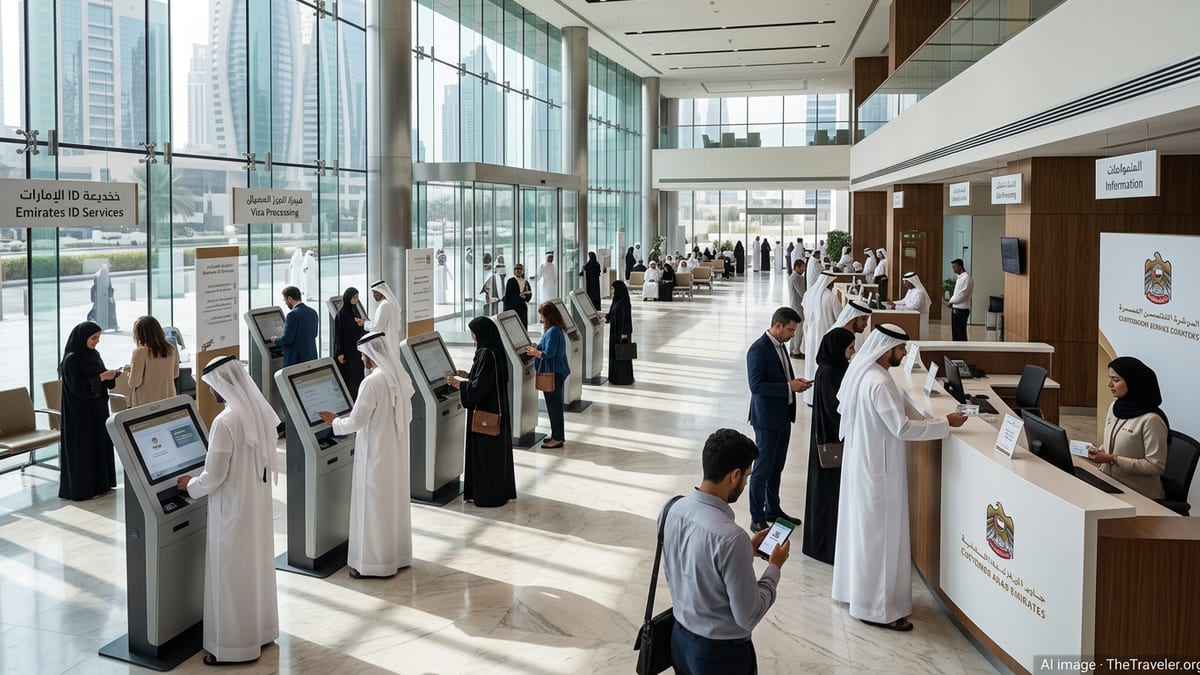
Assisted channels complement these digital tools. In Dubai and other emirates, certified “one-stop” centers such as Amer and Tasheel handle immigration, labour and related services for residents and employers. These centers operate under the supervision of the relevant government department but are run on a service-center model, providing staff who prepare applications, validate document sets and submit them electronically into government back-end systems. Similar centers exist in Abu Dhabi and other emirates, often co-located with trade and labour service hubs.
These centers are widely used by expatriates who prefer in-person guidance, have complex cases, or face language or technical barriers with digital platforms. They usually charge service fees in addition to official government charges, but can significantly reduce the risk of rejected applications due to formatting or documentation errors. In many cases, physical biometric collection, such as fingerprinting for Emirates ID, is carried out at specialized sites or partner centers, even when the application itself is submitted online.
Telephone hotlines and live chat functions exist for major ministries and authorities, but they are primarily designed to provide procedural guidance rather than make discretionary decisions. Appointment booking systems for certain services, such as some residency or court matters, are commonly integrated into apps and portals, and walk-in access without prior booking has become less common in larger emirates.
Typical Administrative Journeys for Expat Residents
From the expatriate perspective, government administration in the UAE is experienced as a series of standard “journeys” repeated over time. The most common include onboarding as a new resident, periodic renewals of identity and residency documents, updates to civil status or dependants, and interactions with labour authorities in employment-related matters. Each of these journeys increasingly follows structured digital steps with clearly defined required documents and fee schedules.
Once basic residency and identity registration is complete, recurring interactions center around renewals and data maintenance. Renewals of Emirates ID and residency entry permits are usually initiated by employers or sponsors, but individuals are responsible for attending biometrics appointments and ensuring that information such as address and marital status is accurate. Many expatriates also interact with municipal or land department portals to register or renew tenancy contracts, which can be prerequisites for related services such as school admissions or family sponsorship adjustments.
Administrative processes involving dependants are particularly relevant to expatriates relocating with families. Sponsoring spouses, children or, in specific categories, domestic workers requires multiple sequential interactions across immigration, identity and labour or domestic worker platforms. While these processes have been simplified and in some cases consolidated into unified digital platforms, they remain documentation-heavy and time-sensitive, with penalties applied for late renewals or failures to cancel records when dependants depart permanently.
For expatriates running businesses or working in regulated professions, further journeys include business license issuance and renewals, professional registrations and, in some emirates, approvals from specialized regulators. These processes are typically handled through dedicated economic or free zone portals but rely on the same underlying identity and residency records that all expatriates use, making consistency of personal data across platforms critical for smooth processing.
Service Quality, Efficiency and Common Pain Points
From a relocation-assessment standpoint, the UAE’s government administration is generally regarded as efficient and structured, particularly in comparison with many other expatriate destinations. International surveys often rate the country highly for ease of dealing with local bureaucracy and for the clarity of administrative requirements, reflecting the country’s sustained investment in process design and digitalization.
Processing times for standard transactions are typically short by global standards, with many services delivered in hours or a few working days once complete applications are submitted. Use of unified digital identity, online payments and automated status updates via SMS or email supports this efficiency. For expatriates with straightforward cases who are comfortable with digital tools, routine administration rarely becomes a major barrier to living and working in the country.
However, several recurring pain points are relevant for decision-making. Technical issues with UAE Pass or linked apps can temporarily block access to multiple services simultaneously, and resolving these problems sometimes requires in-person verification or waiting for back-end fixes. Inconsistent transliteration of names across documents, or discrepancies between passport and Emirates ID data, can trigger rejections or require manual corrections across multiple systems. Newcomers also report challenges understanding the boundaries between federal, emirate and free zone responsibilities, leading to duplicated effort or misdirected applications.
Expatriates should also expect a strict approach to deadlines and fines embedded in the system. Late renewals of identity or residency documents, or failures to cancel permits correctly, usually result in financial penalties that accumulate over time. The system is designed to encourage continuous data accuracy and status compliance, and it offers little flexibility once deadlines have passed, even when delays were due to misunderstandings or employer inaction.
Use of Intermediaries: PROs and Administrative Service Providers
Given the complexity and volume of administrative interactions, the intermediary role of public relations officers and specialized service providers is a defining feature of how expatriates experience government administration in the UAE. Most medium and large employers maintain in-house PRO functions that manage interfaces with immigration, labour and identity authorities, including preparation and submission of documentation and coordination of biometrics or medical appointments for foreign staff.
Smaller employers and individual expatriates often rely on licensed business centers, typing centers and consultancy firms that operate as intermediaries. These providers prepare applications, ensure that document sets meet current formatting requirements, and submit transactions through official portals or at one-stop centers. They monitor regulatory updates and platform changes more closely than most individuals, which can reduce the risk of administrative errors, particularly during the first year of residence or when managing complex family sponsorships.
While the use of intermediaries adds cost, it can significantly reduce the time expatriates must spend understanding detailed procedural rules and navigating multiple digital platforms. This is especially relevant for residents who lack Arabic proficiency or who are unfamiliar with local document conventions. At the same time, reliance on intermediaries can distance expatriates from direct awareness of their own administrative status, making it important to retain copies of key documents and monitor personal profiles in core systems such as UAE Pass and the identity authority’s portals.
In assessing relocation practicality, expatriates should consider whether their prospective employer operates a structured PRO function and whether they are likely to need independent assistance for family or business-related procedures. In major cities, the service ecosystem around government administration is dense and competitive, but in smaller emirates the range of high-volume intermediaries may be more limited, making digital literacy more critical for self-managed administration.
The Takeaway
For expatriates evaluating a move to the UAE, the government administration environment is a central practical factor. The system is highly digitized, standardized and geared to handling a large foreign population, which typically results in fast and predictable processing for routine transactions. Unified digital identity, consolidated portals and one-stop centers are designed to minimize the need for repeated in-person visits to multiple agencies.
At the same time, the model is data-intensive and unforgiving of inconsistencies or missed deadlines. Expats must be prepared to manage digital identities carefully, keep official records synchronized, and respond promptly to renewal and update requirements. Use of intermediaries remains common and often advisable, particularly in the early stages of relocation, but informed oversight of one’s own administrative profile is essential.
Overall, for individuals comfortable with online administration and structured processes, the UAE’s government system is unlikely to be a significant barrier to relocation. Those who are less at ease with digital platforms or who anticipate complex family or business situations should factor in the need for additional support and a learning curve in understanding the interplay between federal, emirate and free zone authorities.
FAQ
Q1. Do expatriates in the UAE handle most government administration online?
Yes. Most standard services for expatriates are designed to be completed through online portals and smart apps, with physical visits mainly required for identity verification or biometrics.
Q2. Is UAE Pass mandatory for accessing government services as an expat?
In practice, yes. While some services still allow alternative access, UAE Pass is increasingly the default and sometimes the only login method for major federal and emirate-level platforms.
Q3. How complex is it to navigate differences between federal and emirate authorities?
The division can be confusing initially, but processes are usually well signposted on official portals. Employers’ PROs and one-stop centers commonly bridge the gaps for expatriates.
Q4. Are processing times for administrative procedures generally fast?
For routine, correctly submitted applications, processing times are typically short by global standards, often within a few working days and sometimes within hours.
Q5. How reliant are expatriates on employers or PROs for dealing with authorities?
Most expatriates with employment visas rely heavily on employers’ PRO functions for work and residency procedures, while handling some personal and family-related tasks themselves.
Q6. What are common administrative challenges expats face in the UAE?
Frequent issues include technical problems with digital identity apps, inconsistencies in personal data across systems, and penalties for late renewals or uncancelled permits.
Q7. Can non-Arabic-speaking expatriates manage government processes without difficulty?
Yes in most cases. Core portals and apps provide English interfaces, and service-center staff are accustomed to assisting non-Arabic speakers, especially in major cities.
Q8. How does the system handle changes in personal circumstances, such as marriage or childbirth?
Such changes require targeted updates across identity, residency and sometimes municipality systems. Processes are defined but can involve multiple steps and supporting documents.
Q9. Are free zone administrative requirements very different from the rest of the UAE?
Free zones run their own licensing and establishment systems, but still rely on federal and emirate platforms for identity and immigration. Expatriates often deal with both sets of systems.
Q10. Should expats planning to relocate budget for professional administrative assistance?
It is advisable to budget for some professional help, particularly for family sponsorships or business activities, even though many basic processes can be completed independently online.