


Naguabo does not behave like a standard Puerto Rico beach town. You come here for river days, mountain views and a low-key Malecón lined with seafood joints, not for resort umbrellas. That also means the usual San Juan or Luquillo budget benchmarks do not quite fit. Below is what I actually paid on recent trips to Naguabo, how those numbers compare with current prices, and what different styles of visit really cost once you add rental cars, fuel, rivers and the south-side access to El Yunque.
Get the latest updates straight to your inbox!
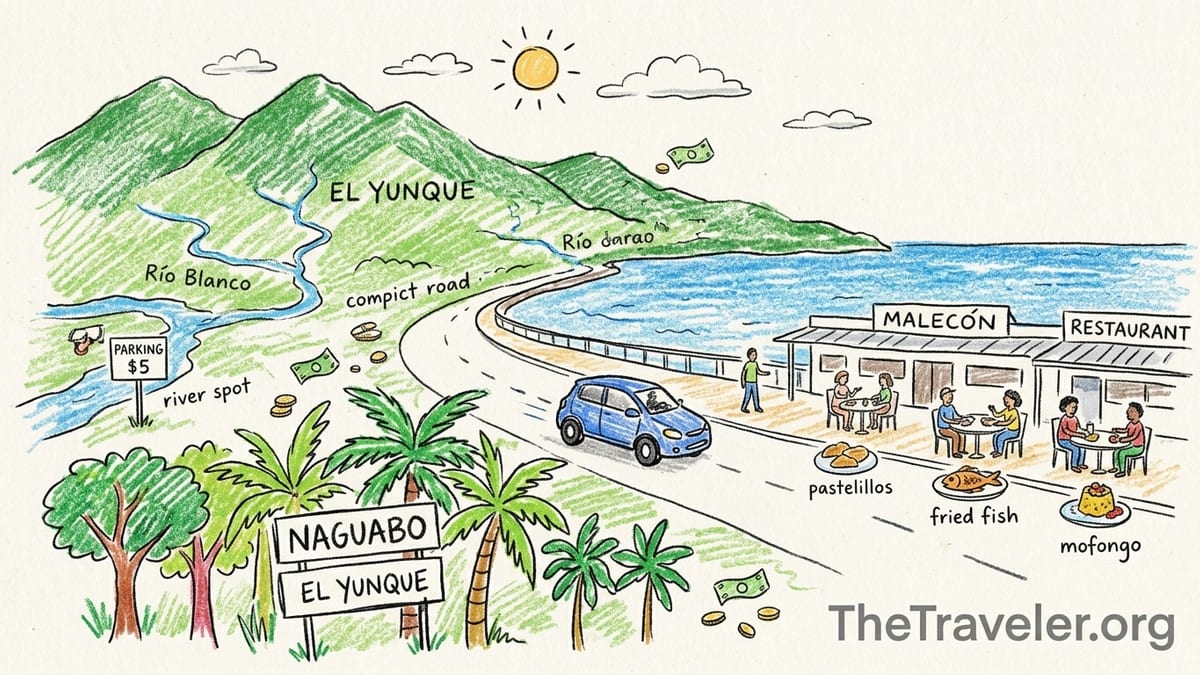
How I Structured My Naguabo Trips and Costs
My time in Naguabo has been part of larger eastern Puerto Rico road trips rather than a single-purpose vacation. On my most recent loop in March 2025, I flew into San Juan, spent nights in Luquillo and Fajardo, and used Naguabo as a dedicated food and river stop on two different days. That matters for the budget because it would be misleading to dump the entire week-long car rental and fuel bill on Naguabo alone. Instead, I calculate a fair share of the transport costs based on actual time and distance in the municipality.
Across visits, I have experienced Naguabo in three distinct ways that match how most travelers actually use it. First, as a quick Malecón stop for a long lunch and stroll along Playa Húcares. Second, as a full food plus river day that combines a seafood meal, a swim at Charco El Hippie or another river spot, and a slow drive into the foothills of El Yunque along PR‑191 on the south side. Third, as an overnight nature stay where Naguabo becomes the base for hiking, river access and quiet evenings rather than a detour.
For each style I will lay out what I personally spent on specific dates, then compare that with current menu prices, parking fees and tour rates checked in late 2026. When I mention my own spending, I name the month and year. When I reference current rates, I make it clear that they are researched prices, not my receipts, and I rely on menus, local operators and recent traveler reports rather than broad Puerto Rico averages.
Cost-wise, Naguabo sits in an interesting middle ground. It is usually cheaper than San Juan for food and accommodation, but seafood on the Malecón can reach big-city totals for a long, indulgent lunch, and the need for a rental car or guided excursion for rivers and El Yunque can quietly push the daily budget up.
Rental Car, Fuel and Parking: The Naguabo Share
On my March 2025 road trip, I rented a compact car at Luis Muñoz Marín International Airport for seven days, paying 329 dollars including basic insurance but before fuel. That came to about 47 dollars per day. Across those seven days, I spent roughly one and a half days worth of driving time in and around Naguabo: a half-day Malecón stop on the way between Luquillo and Humacao, and a full day looping from Luquillo to Naguabo, up Río Blanco toward PR‑191 and back. Allocating costs by time and distance, I treat 1.5 of the seven rental days as Naguabo use, or about 70 dollars of the rental total.
Fuel is easier to apportion. Across the week I spent 82 dollars on gasoline, refilling three times. The Naguabo segments covered about 140 kilometers of a roughly 520 kilometer total, based on odometer readings I logged in a notes app. That puts around 22 dollars of the fuel bill onto Naguabo. Combined with the rental share, my realistic transport cost attributable to Naguabo on that trip was about 92 dollars for 1.5 days, or a bit over 60 dollars per full Naguabo day for two people traveling together.
Parking in Naguabo itself felt modest but real. At Charco El Hippie, a popular river swimming hole inland from town, I paid 5 dollars cash to park on a private lot in March 2025, which aligns with recent reports that quote a similar parking fee collected by local attendants at the entrance area. Along the Malecón of Naguabo, where Playa Húcares fronts the waterfront restaurants, I used a small pay lot next to the strip and spent 3 dollars for roughly three hours of parking on a Saturday afternoon in March 2025. Free street parking was possible a bit farther back from the water, but on a busy weekend midday it was mostly full.
Current checks in October 2026 suggest that my allocation is still reasonable: eastern Puerto Rico compact car rentals commonly start around 40 to 50 dollars per day before extras, and traveler accounts still describe 5 dollar parking at Charco El Hippie and a mix of free and low-fee lots around the Malecón. If you arrive by Uber from San Juan or Luquillo instead of renting, recent travelers report ballpark fares of 80 to 100 dollars one way, which makes a rideshare-only approach potentially more expensive than a simple rental if Naguabo is part of a multi-day eastern circuit.
What I Actually Spent Eating on the Malecón
Seafood on the Malecón is the classic Naguabo experience, and it can be either pleasantly affordable or surprisingly pricey depending on how you order. On my March 2025 visit, two of us had a late lunch at a midrange restaurant facing the water, ordering as if it were our main meal of the day. We shared an order of pastelillos de chapín, a whole fried snapper for one, a mofongo stuffed with shrimp, two Medalla beers and a bottle of water. With tax and a 15 percent tip, the total came to 74 dollars. That was on a Saturday, March 15, 2025.
A month earlier, in February 2025, I stopped solo on a weekday for a simpler lunch at another Malecón spot. I chose a plate of camarones al ajillo with rice and beans, plus a soft drink. That meal came to 21 dollars including tip. Both bills were noticeably higher than what I was paying for comparable comida criolla plates at inland cafeterias farther west, but they felt in line with waterfront pricing and generous portions.
When I cross-check those numbers with menus and recent reviews as of October 2026, the price pattern holds. Full seafood plates at sit-down Malecón restaurants commonly land in the 20 to 35 dollar range per person depending on the fish and preparation, while appetizers like fried fish turnovers, tostones or sorullitos usually run 6 to 12 dollars. Recent customers at one popular bar and restaurant on the Malecón report spending around 50 to 60 dollars per person for a full meal with drinks when ordering multiple courses and cocktails, which fits the upper range if you treat it as a special night out.
Where Naguabo can feel like a deal is if you keep things simple. On another visit in late 2024 I grabbed pastelillos and a soda from a small stand behind the main waterfront strip and spent under 10 dollars for a very filling snack-style “lunch.” For travelers on a tighter budget, pairing one sit-down seafood meal with cheaper snacks or bakery stops elsewhere in town can keep the daily food cost around 25 to 35 dollars per person instead of pushing it into big-city territory.
Rivers, Waterfalls and South-Side El Yunque Costs
The rivers and the quieter southern access toward El Yunque are where Naguabo stands out. They are also where the budget can swing from nearly free to a significant line item depending on how you visit. On my March 2025 river day, I drove from Luquillo to Naguabo, continued inland along the Río Blanco valley and spent the late morning at Charco El Hippie. After paying 5 dollars for parking, I brought my own snacks and water and did not use any paid facilities beyond a basic portable toilet included in the parking area. That meant my direct out-of-pocket cost for several hours at the river was just those 5 dollars, plus the previously allocated fuel.
Later that same day I followed the southern continuation of PR‑191 out of Naguabo into the foothills of El Yunque. The road climbs toward the forest boundary and offers views back toward the town and coast. The section I drove did not have a staffed federal entrance station or per-person fee. My cost for that scenic drive was effectively fuel and time. However, it is important to treat weather and safety as currency too. Local sources emphasize that Naguabo’s rivers and mountain roads are deeply affected by rainfall higher up, and travelers need to watch forecasts for the upper watershed rather than just the sunny conditions along the coast.
Guided river and canyon tours from the Naguabo side of the mountains can add structure and safety at a higher price point. As of late 2026, one local operator runs a petroglyph canyon and river hike that meets near the main road in Naguabo, then caravans to a private starting point. The tour includes equipment and guiding, while parking at the private access point is quoted around 3 dollars per vehicle. Typical guided river and cliff jumping tours in this part of Puerto Rico are often priced in the 60 to 90 dollar per person range depending on length and inclusions. Meanwhile, some independent travelers who considered hiring guides for Charco Frío in the broader east reported quoted rates upward of 80 dollars per person, and chose instead to self-guide after paying only a modest parking fee.
Compared to the official El Yunque visitor areas reached from the north, where timed reservations and regulated parking may apply, the Naguabo side operates with fewer gates but more responsibility placed on drivers and hikers. On my visits I did not pay a distinct El Yunque entrance fee from the south. I only incurred parking and gas costs. Still, a traveler choosing a commercial rainforest tour from San Juan that swings through the eastern foothills could easily spend 100 to 150 dollars per person for transport, guiding and river time, even if they never enter the forest from Naguabo itself.
Accommodation: When You Actually Sleep in Naguabo
Most visitors appear in Naguabo on day trips and drive back to Luquillo, Fajardo or San Juan to sleep, but there is a case for spending at least one night. In January 2024 I did exactly that, booking a simple guesthouse in the hills above town to turn a river day into an overnight nature stay. For a private room with a double bed, fan, good mosquito screens and a shared kitchen, I paid 96 dollars including cleaning fees and taxes for one night booked through a major home-sharing platform on January 23, 2024.
That rate felt slightly lower than comparable whole-apartment listings I had priced in Luquillo at the time, but it was not a bargain-basement stay. It did, however, shift other costs. By sleeping in Naguabo, I cut down on back-and-forth driving, which saved some fuel and gave me a second river morning without the need for another long car day. I also cooked breakfast and one dinner at the guesthouse, lowering my restaurant spend. For that overnight, my food costs for two people came to roughly 36 dollars total: 14 dollars on groceries picked up at a small supermarket in town, and 22 dollars on a modest meal of fried fish and sides at a local spot backing the Malecón.
Researching current 2026 prices, budget and midrange options in Naguabo typically cluster between about 80 and 150 dollars per night for private rooms or small apartments, with higher-end eco-lodges in the surrounding hills charging more in exchange for seclusion and views. A handful of properties along the Río Blanco corridor and in the countryside market themselves specifically to hikers and river bathers, sometimes bundling access to private swimming holes or offering guidance on navigating PR‑191 and nearby trails. Hostels in the strict sense are limited, and dorm beds advertised for Naguabo more broadly on backpacking sites tend to quote around 20 to 35 dollars per night where they exist.
If you already have a car, one night in Naguabo as a couple or small group can end up cost-neutral compared with staying in pricier coastal hubs once you factor in reduced driving and fewer restaurant meals. For solo travelers, though, a Malecón day trip from Luquillo or Fajardo by rental car might still work out cheaper than absorbing a full private-room price in town.
Three Real Trip Styles: Sample Budgets
To make this practical, here is how my actual spending and current prices translate into three realistic Naguabo trip styles. These are approximations rather than strict formulas, and assume you already have a rental car for an eastern Puerto Rico itinerary. All figures are in US dollars and exclude flights.
For a quick Malecón stop like my February 2025 solo lunch, imagine two travelers driving from Luquillo for half a day. Allocating half a day of car rental and fuel to Naguabo, you get roughly 30 dollars in transport. Add one seafood meal and a couple of drinks at 25 to 35 dollars per person based on current menus, and shared parking costs of up to 5 dollars. You land around 95 to 115 dollars total for two people for a relaxed lunch, waterfront walk and coffee, or roughly 50 to 60 dollars per person.
For a food plus river day similar to my combined Malecón and Charco El Hippie outing in March 2025, think about a full day in the area for two. My own day included 5 dollars for river parking, about 60 dollars in allocated rental and fuel, and a 74 dollar seafood and beer lunch, for a total near 140 dollars for two people. Substituting in current menu ranges, you might expect 60 to 80 dollars for a generous Malecón meal for two, 5 to 10 dollars for river parking or small fees, and the same 60 dollars in vehicle costs, landing in the 125 to 150 dollar range for two. If you instead pay for a guided river or canyon trip at 70 to 90 dollars per person plus a small parking fee, that one day can climb to 200 to 250 dollars for two.
For an overnight nature stay akin to my January 2024 guesthouse night, a more comprehensive budget for two might include 100 to 130 dollars for accommodation, an allocated 60 dollars for car and fuel if Naguabo represents about one and a half driving days, 30 to 50 dollars in groceries, and one restaurant meal at around 40 to 60 dollars for both. That puts a one-night, two-day Naguabo segment in the neighborhood of 230 to 300 dollars for two people. If you stretch the stay to two nights while adding only modest extra driving and cooking more meals in, the per-day cost often drops.
These sample budgets illustrate a key pattern. What is genuinely cheap in Naguabo are the core natural experiences once you are there: rivers, mountain drives and viewpoints rarely carry high fees. What makes a visit more expensive than travelers often expect are the layers around those experiences, especially seafood-heavy meals, reliance on private tours instead of self-driving, and accommodation that is oriented more to nature stays than to stripped-down backpacker dorms.
What Felt Cheap, What Surprised Me
On a gut level, Naguabo felt cheaper than many Puerto Rico destinations in all the places where the environment does the work. Spending several hours at a river for the price of a parking spot, or driving a spectacular mountain road for the cost of fuel, delivers strong value. The freedom to linger without worrying about closing times or reservation slots plays into that feeling. Even my 96 dollar countryside guesthouse night in January 2024 felt like good value relative to the calm, views and bird noise at dawn.
Food occasionally surprised me in the other direction. A 74 dollar lunch for two on the Malecón in March 2025 was a highlight meal and generous in portions, but the total was closer to what I associate with big-city seafood restaurants than with small-town waterfront strips. Paying over 20 dollars for a single plate of shrimp with sides on a separate visit made me more conscious of how quickly ordering appetizers, mains and drinks on the Malecón can push the daily budget up if you are not mixing in cheaper snacks or supermarket runs.
The other silent budget driver was the rental car. Because Naguabo’s best rivers, the southern branch of PR‑191 and even the Malecón itself are not well served by public transport or ride-hailing once you leave the main highway, going without a car would have meant expensive point-to-point rides or lost flexibility. Allocating around 60 dollars per full Naguabo day to rental and fuel for two people is not trivial, and it is an expense that repeats with each return visit.
Overall, the shape of spending in Naguabo skews away from official ticket booths and toward the choices you make about comfort and convenience. Travelers who self-drive, share costs among two or three people, eat one big Malecón meal rather than several, and embrace snack-style food elsewhere tend to experience Naguabo as a relatively good-value piece of an eastern Puerto Rico itinerary.
The Takeaway
Looked at purely through receipts, my Naguabo costs on recent trips clustered into three key areas: around 60 dollars per Naguabo day in shared rental car and fuel, 25 to 40 dollars per person for Malecón meals if I ordered freely, and 80 to 130 dollars per night for simple but pleasant accommodation when I chose to stay over. Rivers, waterfalls and the southern approach to El Yunque itself stayed either free or very low-cost, aside from modest parking fees and occasional guided-tour prices that I personally chose to skip.
The town rewards travelers who are deliberate about how they allocate those costs. If I returned with the exact same trip styles, I would probably spend a little more on accommodation and a little less on food. Specifically, I would happily pay closer to 130 or 140 dollars per night for a hillside eco-lodge or cabin with direct river access, then cook more of my own meals and limit Malecón visits to one special lunch or dinner rather than treating every Naguabo meal as a seafood blowout.
I would also plan at least one fully car-light day centered on walking within the hills or staying near a river retreat, consciously lowering the time and money sunk into driving and fuel. That is easier on the budget and more aligned with why Naguabo stands out in the first place: its quiet, its rivers and its sense of being a little off the obvious east-coast track.
If you arrive with realistic expectations about seafood prices, commit to self-driving or sharing a rental, and treat river days as the low-cost high-reward anchor of your time here, Naguabo can be both memorable and financially manageable. It is not the cheapest corner of Puerto Rico, but it offers excellent value where it matters most.
FAQ
Q1. How much should I budget per person for a simple half-day Malecón visit to Naguabo?
For a quick half-day stop with one seafood meal, shared parking and an allocated share of rental car and fuel, a realistic budget is around 50 to 60 dollars per person if two people are traveling together.
Q2. What does a full food and river day in Naguabo usually cost?
If you self-drive and combine a river like Charco El Hippie with a sit-down Malecón lunch, expect roughly 60 dollars in shared car and fuel costs, 60 to 80 dollars for a generous seafood meal for two, and 5 to 10 dollars in parking and small fees, or around 65 to 75 dollars per person.
Q3. Are Naguabo’s rivers and waterfalls free to visit?
The rivers and waterfalls themselves do not usually have entrance fees, but you should assume a modest parking charge at popular spots on private land, often around 5 dollars in recent years, plus your transport costs to reach them.
Q4. How expensive are seafood meals on the Malecón compared with San Juan?
Seafood plates on the Malecón commonly run 20 to 35 dollars per person, which is similar to midrange San Juan restaurants. A full meal with appetizers and drinks can easily reach 50 to 60 dollars per person if you order freely.
Q5. Is it cheaper to stay overnight in Naguabo or to base in Luquillo or Fajardo?
Basic guesthouses and small apartments in Naguabo often cost around 80 to 150 dollars per night, which can be slightly lower than some beachfront areas. Once you factor in reduced driving and the ability to cook, an overnight in Naguabo can be cost-competitive, especially for couples or small groups.
Q6. Do I need to pay an entrance fee to access El Yunque from the Naguabo side?
On the southern approach along PR‑191 near Naguabo there is typically no separate entrance booth like on the main northern side. Costs are more about fuel, time and any guided tours you choose, rather than a specific gate fee.
Q7. How much do guided river or canyon tours from Naguabo cost?
Guided river and canyon tours that meet in or near Naguabo often fall in the 60 to 90 dollar per person range, plus a small parking fee of a few dollars at private access points, depending on length and inclusions.
Q8. Can I visit Naguabo without renting a car?
It is technically possible using taxis or ride-hailing from hubs like San Juan or Luquillo, but one-way fares of 80 to 100 dollars have been reported. For river access and mountain drives, a shared rental car is usually more economical and flexible.
Q9. What daily budget makes sense for a two-night nature stay in Naguabo?
For two people, budgeting 120 dollars per night for accommodation, 40 to 60 dollars per day for food if you mix cooking and restaurants, and around 60 dollars per day for a shared rental car and fuel gives a comfortable range of roughly 110 to 130 dollars per person per day.
Q10. Where would it be smartest to save or splurge on a Naguabo trip?
It is usually smart to save by self-driving, using supermarket snacks and limiting high-end restaurant visits, and to splurge on at least one high-quality river or hillside stay where the setting justifies a higher nightly rate.