


Airport lounges were once the domain of business-class tickets and elite frequent flyers. Priority Pass has changed that, turning lounge access into a paid membership and a common perk on premium credit cards. Yet the rules, restrictions, and real value can be confusing. This guide walks through how Priority Pass works in 2026, what you actually get at the airport, and how to decide if it is worth it for your style of travel.
Get the latest updates straight to your inbox!
What Priority Pass Is and Where It Works
Priority Pass is a global membership program that buys you access to a network of third-party airport lounges and related services, rather than any single airline’s own clubs. As of 2026, the network spans more than 1,300 locations in over 140 countries, ranging from classic lounges to a growing mix of game rooms, nap pods and small co-working spaces. In practical terms, it is often the easiest way for an economy-class traveler to get into a quiet space with Wi-Fi, snacks and a seat near a power outlet before a flight.
Unlike airline-branded clubs such as Delta Sky Club or United Club, Priority Pass does not usually run the lounges itself. Instead, it partners with independent lounges and some airline lounges that sell excess capacity. At New York JFK, for example, Priority Pass members can use lounges in Terminal 1 and Terminal 4, including options like the Primeclass or Air India Maharaja lounges when capacity and flight rules allow. At Los Angeles International Airport, members can access spaces like the KAL Business Class Lounge in the Tom Bradley International Terminal on qualifying itineraries, even if they are flying in economy on another carrier.
The experience varies widely from airport to airport. In some hubs, Priority Pass may be the only non-airline-lounge option, such as a single contract lounge in a smaller European or Asian airport. In others, it is part of a dense “lounge mall.” JFK Terminal 4 is a good example: travelers there might choose among a Priority Pass lounge, an Amex Centurion Lounge or a Chase Sapphire Lounge, depending on which cards they hold and how crowded each space is at that hour.
Because the network is stitched together from many operators, Priority Pass is best thought of as an access key. It gives you permission to enter whatever participating lounges happen to be in the terminal you are using, subject to their own capacity limits, time restrictions and airline rules.
Membership Levels and What They Cost
If you buy Priority Pass directly, you choose from three annual membership tiers that trade off up-front fee against per-visit cost. As of spring 2026, the published prices are in the ballpark of 99 dollars for the entry-level Standard plan, 329 dollars for Standard Plus and 469 dollars for Prestige, though exact amounts and currencies vary by region. Guest visits typically cost about 35 dollars per person on top of any member entry fee, so taking family or colleagues along can add up quickly.
The Standard plan is aimed at light travelers. You pay a relatively low annual fee but no visit is actually free. Each time you enter a participating lounge, you are charged roughly 35 dollars, and each guest is charged the same. For a U.S.-based traveler who only flies twice a year out of a home airport with a decent public seating area, this can be an expensive way just to get a couple of drinks and Wi-Fi.
Standard Plus sits in the middle. You pay a higher annual fee, but you get about 10 lounge visits included each membership year. After those are used, further visits are charged at the usual per-visit rate. This tier tends to suit travelers who take half a dozen round trips annually. A consultant flying monthly between Dallas and Chicago, for instance, might use one visit on departure each way and get most of the year’s trips covered by the 10 included entries.
Prestige is the top tier and is designed for frequent flyers who will use lounges regularly. The annual fee is the highest, but member visits are unlimited during that membership year, while guests still pay a per-visit charge. A road warrior who connects through hub airports 15 or 20 times a year may find that Prestige quickly pays for itself, especially in places where buying one-off lounge access at the door can run 50 to 75 dollars for a single visit.
Getting Priority Pass Through Credit Cards
In the United States, many travelers never buy Priority Pass directly. Instead, they receive a version of membership as a complimentary benefit on a premium credit card. Popular examples include the Chase Sapphire Reserve, American Express Platinum and Business Platinum, Capital One Venture X and certain high-end cards from Citi, U.S. Bank and regional banks. These card-linked memberships often resemble the Prestige tier in practice: the cardholder gets unlimited visits, though guest policies and access to non-lounge experiences can differ by issuer.
For instance, the Chase Sapphire Reserve includes a Priority Pass Select membership that typically offers unlimited lounge visits for the primary cardholder and up to two free guests per visit before extra charges apply. A family of three departing from JFK Terminal 4 could check into a participating Priority Pass lounge with the Sapphire Reserve cardholder, spouse and teenager all covered, paying nothing extra unless they brought additional companions. By contrast, a similar membership obtained through another bank might allow only the cardholder in for free and charge for every guest, changing the economics for family travel.
Card issuers also decide which types of Priority Pass locations you can use. American Express, for example, removed access to restaurant and non-lounge venues from its Priority Pass benefit several years ago. That means an Amex Platinum holder can use traditional lounges in the network but cannot claim food credits at participating airport restaurants. Some Visa and Mastercard-branded premium products still include access to those restaurant and specialty partners, so two travelers standing at the same airport café might see different rules depending on which bank issued their membership.
To complicate things further, you usually need to enroll before you can use the benefit. Having the credit card in your wallet is not enough. With most issuers you must activate Priority Pass through your card account, wait for a separate membership number and physical or digital card, and then show that at the lounge door. Travelers who apply for a premium card shortly before a big trip often discover this too late, arriving at an airport like London Heathrow or Singapore Changi expecting to enter a lounge, only to find they never completed the Priority Pass enrollment step.
How Access Works on the Day You Travel
On the day of travel, using Priority Pass is straightforward once you understand the sequence. After checking in for your flight and clearing security, you head toward the lounge listed in the Priority Pass app for your terminal. At the entrance, the staff will ask to see your same-day boarding pass and your Priority Pass membership, either as a physical card or a digital card in the mobile app. They then swipe or scan your membership to record a visit against your account and admit you and any registered guests, if space is available.
Most lounges impose a time limit, commonly around three hours before scheduled departure, although the exact rule can vary. At a busy hub like JFK Terminal 4, a contract lounge that partners with several airlines and Priority Pass may enforce a three-hour maximum stay during peak evening departure banks. A traveler flying on a late-night international flight may not be able to check in much earlier than that, even if they arrive at the airport well ahead of time to clear security.
Capacity control is an increasingly important part of the experience. Lounges are meant to be quieter than the public gate area, so operators regularly restrict entry when they fill up. This can be especially noticeable during banked departure times in North American and European hubs. A member arriving at a Priority Pass lounge in Denver or Boston during the evening rush might encounter a wait list, be given a pager, or be told to check back later. Some branded lounges, like Chase Sapphire Lounges, publicly note that while Priority Pass members can enter, cardholders of that bank’s own premium card will be prioritized when seats are scarce.
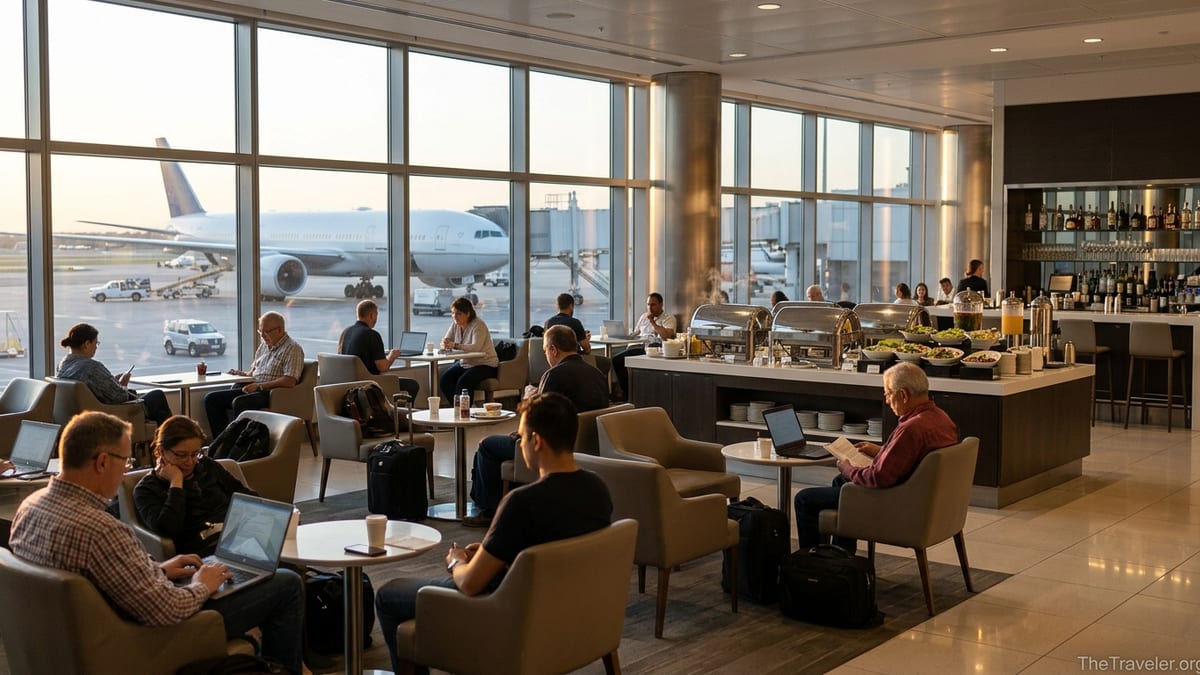
Once inside, you can typically expect Wi-Fi, soft drinks, coffee, tea, light snacks and often a self-service buffet. Showers, hot meals, alcohol selection and workspace quality vary by location. A well-regarded lounge such as the KAL Business Class Lounge at LAX may offer a more substantial buffet, better runway views and a quieter atmosphere, while a smaller lounge in a secondary European airport might consist of a single room with packaged snacks and basic seating. Priority Pass does not standardize the product across its network, so expectations need to be calibrated to the specific lounge and airport.
Examples of Priority Pass at Real Airports
Seeing how Priority Pass works in specific airports helps make the fine print more concrete. Take New York JFK, one of the busiest gateways in the United States. A traveler flying economy from Terminal 1 on a European airline might pull up the Priority Pass app and find access to a contract lounge such as Primeclass or an airline-operated lounge that sells excess capacity. They could spend the pre-boarding period in a quieter space with hot food and showers rather than waiting at a crowded gate, but access might be limited to passengers on international flights, and the lounge could close in the early afternoon on days with fewer departures.
Over in Terminal 4 at JFK, the ecosystem is even more complex. A Chase Sapphire Reserve cardholder with Priority Pass could choose between a Chase Sapphire Lounge that prioritizes Chase guests and a different Priority Pass lounge that admits members from multiple banks. If the Sapphire Lounge is running a wait list for non-Chase guests during the evening Europe departures, the traveler might find it easier to walk down the concourse to another participating lounge instead of waiting.
Outside the United States, Priority Pass can be particularly valuable where airline competition is fragmented and no single carrier dominates. At an airport like Istanbul Sabiha Gokcen or Bali Denpasar, a Priority Pass card can open the door to a large independent lounge that serves passengers from several airlines and cabins. A backpacker flying on a low-cost carrier may still enjoy a hot shower, a proper meal and a quiet place to recharge electronics between flights for less than the cost of buying separate airport meals and paid Wi-Fi.
In some regions, non-lounge experiences are an important part of the network. Before recent policy changes, certain credit card-issued Priority Pass memberships in the United States allowed access to airport restaurants or sleep pods. A traveler in Portland or Miami could sit down at a partner restaurant, show their Priority Pass card and receive a fixed credit toward food and drinks. While some issuers have since dropped these restaurant credits from their benefits, others still support them, so it is worth checking the app before assuming a lounge is your only option.
Limitations, Pitfalls and How to Avoid Surprises
Despite the promise of worldwide lounge access, Priority Pass is not a magic key that always guarantees a quiet armchair and unlimited buffet. One of the most common complaints from members is overcrowding. Lounges at busy hubs can fill up quickly during peak hours, and operators may limit entry even to paid members. A traveler with Priority Pass at a major European hub on a Sunday evening might be turned away from the only lounge in their terminal and told to return closer to departure if seats free up.
Another source of frustration is terminal layout. In some airports, especially in the United States, terminals are not connected airside, or access between them requires exiting security. A traveler flying domestically out of one terminal may see an appealing Priority Pass lounge listed in another terminal on the app, only to realize they would have to clear security twice to reach it and then return to their gate. Airports like Chicago O’Hare and JFK are common examples where lounges in other terminals are technically accessible but practically inconvenient for short connections.
Differences between credit card-issued memberships can also trip up infrequent users. An American Express Platinum cardholder may assume they can use a participating restaurant in Seattle or Denver because their friend with a different bank’s Priority Pass did so a few months earlier, only to be told at the door that their particular membership does not include non-lounge venues. Similarly, a Capital One Venture X user might discover that while their Priority Pass opens many partner lounges, access to a Chase Sapphire Lounge comes with extra conditions such as only one visit per calendar year through Priority Pass when they are not a Chase cardholder.
Billing surprises are a final concern. Because many visits and guest entries are tracked automatically at the lounge door, it is easy to lose count. A Standard Plus member who uses all 10 included visits early in the year may continue to tap into lounges, only to receive a statement later with several additional 35 dollar charges. To avoid this, travelers should periodically check their remaining visits in the Priority Pass app or via their credit card benefits page and keep guest numbers conservative when they are not sure how many complimentary entries remain.
Is Priority Pass Worth It for You
Whether Priority Pass is a good value depends heavily on how often you travel, where you fly and whether you already hold a card that bundles membership. For someone who flies only once or twice a year from a home airport with comfortable public spaces, paying directly for a Standard membership rarely makes sense. That traveler might be better off buying a single-pay lounge pass from an airline on the rare occasions they want peace and quiet, or simply choosing a restaurant and treating themselves to a nice pre-flight meal.
For moderate travelers who do not have access through a premium credit card, Standard Plus can begin to make sense if they realistically expect to use most of the included visits. A frequent leisure traveler flying from a smaller city in the Midwest to major hubs two or three times a year might get solid use from 10 visits, especially if their itineraries often include connections where a lounge makes waiting more pleasant.
The equation changes if you are already paying for a premium card primarily for other reasons, such as travel protections or bonus earning. In that case, Priority Pass is effectively a no-extra-cost perk. A Chase Sapphire Reserve user who values its travel insurance, car rental coverage and flexible points transfers might treat lounge access as icing on the cake. Capital One Venture X cardholders often think similarly: they justify the annual fee with the card’s travel credit and miles-earning, and consider both the Capital One-branded lounges and Priority Pass network as useful secondary benefits.
In deciding if Priority Pass will be genuinely useful, look at your past year of travel rather than your best-case plans. How many trips did you actually take, and through which airports and terminals. If you mostly fly short nonstop routes from a hometown airport that has only one small partner lounge before security, even a free membership might see little use. If you routinely connect through busy hubs, have multi-hour layovers, or travel with children who benefit from a quieter space to regroup, the same membership can feel invaluable.
FAQ
Q1. What exactly does a Priority Pass membership give me
It gives you access to a network of participating airport lounges and some non-lounge venues around the world, subject to each location’s rules, time limits and capacity. You do not get access to every airline club, but rather to the specific lounges that have agreements with Priority Pass at each airport.
Q2. How much does Priority Pass cost in 2026 if I buy it directly
Pricing varies by region, but as a rough guide the entry-level Standard plan is around 99 dollars per year plus a per-visit fee, Standard Plus is roughly in the low 300s with about 10 visits included, and Prestige is in the high 400s with unlimited member visits. Guest visits usually incur an additional charge.
Q3. Do I get Priority Pass automatically if I have a premium credit card
Not automatically. Many premium cards include a Priority Pass membership, but you typically must enroll through your card account, receive a separate membership number and then use your Priority Pass card or app at the lounge. Simply showing the credit card itself is often not enough.
Q4. Can I use Priority Pass to access airline-branded lounges like Delta Sky Club or United Club
In most cases, no. Big airline-branded lounges in the United States generally do not participate in Priority Pass. Access to those clubs usually depends on flying in a premium cabin, holding certain airline credit cards or having airline elite status, not on Priority Pass membership.
Q5. Are food credits at airport restaurants still part of Priority Pass
It depends on who issued your membership. Some banks have removed restaurant and non-lounge venues from their Priority Pass benefits, while others still allow them. The only reliable way to know before you sit down to order is to check the description of the venue in the Priority Pass app under your specific membership.
Q6. How many guests can I bring into a lounge with Priority Pass
Guest rules differ by membership type and credit card. Directly purchased memberships usually allow any number of guests as long as you pay a per-visit fee for each. With card-issued memberships, some issuers include one or two complimentary guests, while others charge for every additional person. Always verify the guest policy linked to your card before traveling with a group.
Q7. Can a lounge turn me away even if I have Priority Pass
Yes. Lounges can restrict entry when they are full, limit visits to certain times before departure, or apply rules such as only admitting passengers on international flights. Priority Pass membership gives you eligibility to enter, but access is still subject to capacity and each lounge’s specific conditions.
Q8. Do I need a business- or first-class ticket to use Priority Pass
No. One of the main advantages of Priority Pass is that it works regardless of your ticket class. As long as you have a valid same-day boarding pass and a membership with remaining visits, you can generally enter participating lounges even when flying economy.
Q9. How do I avoid unexpected visit charges on my account
Track your usage in the Priority Pass app or through your credit card benefits page, especially if you are on a plan with a limited number of free visits. Be careful when bringing guests and ask the lounge agent to confirm how many chargeable entries will be recorded for your visit, so there are no surprises on your next statement.
Q10. Is Priority Pass worth it if I mostly fly from one home airport
It depends on that airport’s lounge options and your travel frequency. If your home airport has several good Priority Pass lounges and you fly monthly, membership can add real comfort and value. If there is only one small partner lounge you rarely pass through, or if you fly just once or twice a year, buying a standalone membership may not be cost-effective, though a complimentary membership from a credit card can still be a nice occasional perk.