


Foreign nationals increasingly view Portugal as an attractive relocation destination, but persistent administrative backlogs and opaque procedures can significantly affect the day-to-day experience of living legally in the country. This briefing analyses how slow Portuguese bureaucracy really is for foreign residents, focusing on residence-related procedures and the structural factors that shape processing times and predictability.
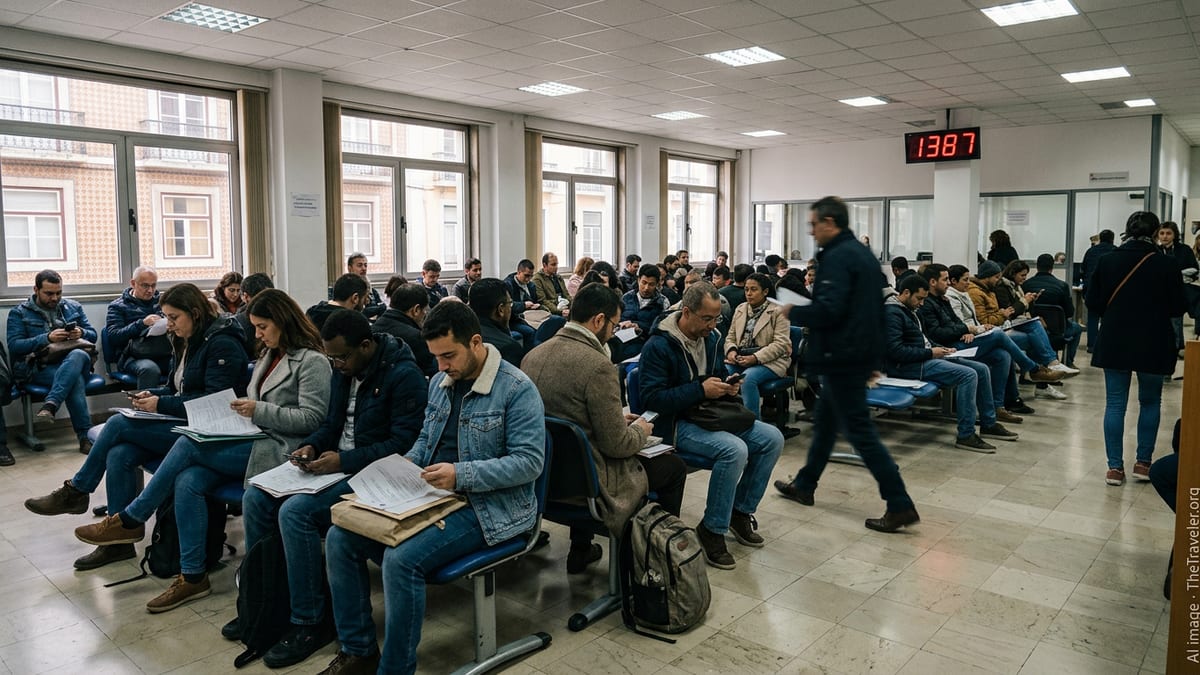
Overview of Portuguese Bureaucracy for Foreign Residents
For foreign residents, the most consequential aspect of Portuguese bureaucracy is the system that governs legal stay: residence permits, renewals, status changes and related registrations. Since late 2023, these functions have been handled by the Agency for Integration, Migration and Asylum (AIMA), which replaced the former border and immigration authority SEF. The transition coincided with a surge in applications and exposed systemic weaknesses in capacity, coordination and digital infrastructure.
Publicly available information and independent reports indicate that, by early 2025, the immigration backlog in Portugal had grown to several hundred thousand open cases, including initial residence permits, renewals and status regularisation files. Government statements in 2025 referred to a total universe of close to 900,000 pending migration-related processes across categories, suggesting structural congestion rather than temporary fluctuation.
For individuals, this translates into multi-month waits not only for initial residence permits but also for renewals and even relatively routine updates. Complaints about delays filed with the Portuguese Ombudsman and national press have increased markedly since AIMA’s creation, and user testimony collected by immigrant associations consistently highlights difficulty obtaining appointments, lack of status updates and uncertainty about legal documentation during extended waiting periods.
In comparative governance indicators, Portugal sits around the OECD average for general government effectiveness, which masks sharp contrasts between relatively efficient tax and social security systems and much slower migration and population registries. For foreign residents, the immigration and civil registration interfaces are the points where bureaucratic slowness is most acutely felt.
Residence Permit Processing Times in Practice
Measured processing times for residence permits vary significantly by category and by stage. The process typically includes: consular visa issuance (when required), scheduling and attending an AIMA biometrics appointment, administrative decision-making on the residence permit, and physical card production and delivery. Each of these stages can add weeks or months.
Consular sections and specialist trackers report that residence visas tied to work, study or remote work typically take around 2 to 3 months from application to decision at the consulate level in 2025–2026. However, this is only the first part. After arrival in Portugal, foreign residents must secure an AIMA appointment and then wait for the residence card. For many, the AIMA stage is considerably longer than the consular stage.
Data compiled by migration consultancies and practitioner surveys in 2024 suggested average total timelines of approximately 6 to 9 months from initial application overseas to receipt of a residence card in Portugal for mainstream categories, with wide dispersion. In practice, cases of 12 to 18 months between arrival and final residence card issuance are not uncommon, particularly in high-demand districts such as Lisbon, Setúbal and Faro. Individual complaints reported waiting more than a year between first attempting to book an appointment and attending biometrics.
Even after a successful appointment, foreign residents often face additional delays while cards are produced by the state mint and dispatched. Reports from late 2024 and 2025 describe post-appointment waits of 2 to 4 months for the physical residence card, compared with the 2 to 3 weeks that were more typical under the previous SEF regime. This final phase may seem administrative, but it directly affects the ability of residents to prove legal stay to employers, banks and other authorities.
Backlogs, Legal Deadlines and Compliance Gaps
Portuguese law generally anticipates that residence permit applications should be processed within a maximum of 90 days, and court decisions in 2024 reaffirmed this target for AIMA. However, official statistics and case backlogs indicate that this normative standard is not being met in a large share of cases. The gap between legal deadlines and real-world performance is an important dimension of bureaucratic slowness for foreign residents.
Estimates around the time of the SEF-to-AIMA transition referred to more than 300,000 pending residence permit files. Subsequent statements in early 2025 spoke of a total immigration case backlog approaching 900,000, with investment-based residence permits explicitly deprioritised relative to other categories. These figures underscore that delays are not isolated anomalies but reflect systemic overloading relative to processing capacity.
In response to mounting criticism, the government has announced action plans, increased staffing and launched dedicated renewal portals for certain permit types. In 2025, AIMA reported issuing around 386,000 residence permits in a single year, an increase of around 60 percent compared with the previous year, and set the goal of clearing specific backlogs by 2026. While these measures signal political recognition of the problem, they have not yet translated into consistently predictable timelines for individual applicants.
From a risk management perspective, the key issue for foreign residents is not only how long processes take on average, but also the variance and the frequency of extreme delays. Evidence from complaints and user forums points to a significant tail of applicants experiencing waits that substantially exceed officially communicated timeframes, with limited effective recourse beyond formal complaints and judicial challenges.
Variation by Permit Type, Region and Channel
Portuguese bureaucratic performance is uneven across permit types, regions and service channels. Foreign residents encounter different speeds depending on their specific profile and where they interact with the system. This heterogeneity can create both opportunities to mitigate delays and inequalities between categories of migrants.
Investment-based residence permits, commonly known as Golden Visas, have been explicitly identified by the government as low priority. Officials have indicated that these files will be processed only after more pressing cases are addressed, and external assessments project that clearing the existing Golden Visa backlog could extend well into the latter part of the decade if current throughput levels persist. Applicants in this category therefore face some of the longest and most uncertain waiting times in the system.
By contrast, some regions and specialised channels have managed to deliver comparatively faster processing for certain cohorts. For example, local offices in less congested cities have periodically reported average processing times for remote worker residence permits that are substantially shorter than those in Lisbon, partly due to targeted regional investments and lower application volumes. Where appointment capacity exists outside the main metropolitan areas, applicants able to relocate regionally or accept travel for biometrics may experience more efficient service.
EU and UK nationals covered by withdrawal or free-movement arrangements generally interact with distinct administrative streams, which can be simpler but are not immune to delays. Specialist law firms advising UK nationals in 2026 still warn of significant waits between application for post-Brexit residence document renewals and final issuance, prompting some residents to seek assistance from consular services or the national ombudsman when files stall.
Everyday Administrative Interfaces Beyond Immigration
While residence permits are the most critical interface with Portuguese bureaucracy for foreign residents, other administrative domains also influence perceived slowness. These include tax registration, social security numbers, civil registration, municipal permits and utility contracts. In many of these areas, processing delays intersect with immigration backlogs because residence documentation is required to complete other registrations.
Tax and social security authorities in Portugal have made comparatively greater progress in digitalisation, with much routine interaction now possible online. Obtaining a tax identification number can often be completed the same day through a local office or via a representative, and tax returns are typically processed within weeks. These relatively efficient areas contrast sharply with the slower performance of migration and civil identity systems.
Where bureaucracy becomes bottlenecked for foreign residents is at the junctions between systems. To register with social security or access certain public services, newcomers frequently need an issued residence card or at least formal proof of application. When AIMA delays card issuance or does not provide clear interim documentation, individuals can encounter cascading obstacles: difficulties signing employment contracts, opening bank accounts, exchanging foreign driving licences or enrolling dependants in certain services.
In addition, municipal procedures, such as registration at the local parish or obtaining building and renovation permits, can be time consuming. Recent OECD analysis of municipal permitting found that processing times for building licences in major Portuguese cities are high by international standards, with procedures in Lisbon and Porto often involving several hundred days from application to final approval. Although this relates primarily to property development, it illustrates the broader institutional culture of cautious, paperwork-intensive administration that also shapes interactions for individual residents.
Systemic Drivers of Delay and Reforms Under Way
Several structural factors explain why Portuguese bureaucracy is slow for foreign residents, particularly around immigration procedures. First, demand has risen rapidly. Portugal has experienced sustained net immigration and strong interest from remote workers, retirees and investors, increasing the volume and diversity of applications without proportionate growth in administrative capacity.
Second, the institutional transition from SEF to AIMA redistributed responsibilities for border control, asylum and migration management across several bodies. While the reform aimed to modernise and humanise migration governance, the handover generated operational disruption, including data migration challenges, staff reassignments and inconsistent communication between central and regional offices. The timing of the transition during a period of already elevated demand amplified the impact on processing times.
Third, although digital tools have been introduced, they remain partial and sometimes unstable. Online portals for renewals and data updates have periodically experienced technical problems, leading to stalled files and uncertainty about whether submissions have been correctly registered. Foreign residents have reported being unable to progress beyond specific steps in these platforms for months, with limited technical support or proactive notifications from the administration.
Reform efforts are ongoing. The government has announced additional recruitment for AIMA, increased funding, and specific goals to clear defined backlogs by set dates. Specialised renewal portals have been expanded, and guidance has been issued to other public entities to accept proof of appointment or pending applications as sufficient to demonstrate lawful stay. However, implementation is uneven. As of early 2026, backlogs remain substantial, and public reporting continues to document long waits and high complaint volumes from foreign residents.
Practical Implications and Risk Management for Relocating Individuals
The practical question for potential relocators is not whether Portuguese bureaucracy is slow, but how that slowness will concretely affect their plans and tolerance for administrative uncertainty. The data and qualitative evidence suggest that foreign residents should plan for a multi-stage, often protracted process, and structure relocation timelines and commitments accordingly.
At a minimum, individuals requiring residence permits should assume that the total journey from initial application to physical residence card could span 6 to 12 months, with some risk of longer durations, especially for investment-based routes or in high-volume regions. During parts of this period, legal status may be based on a combination of expired documents, automatic extensions and proof of pending processes, which can be confusing to employers, landlords and service providers.
Relocating individuals who are highly sensitive to bureaucratic delays, or whose professional roles depend on frequent cross-border travel, should factor this into decision-making. Extended card issuance times can complicate international travel, particularly to jurisdictions unfamiliar with Portuguese automatic extensions and pending-application protections. Conversely, those with flexible timelines, remote work arrangements and tolerance for administrative ambiguity may find the trade-off acceptable, given other perceived advantages of living in Portugal.
Comparatively, Portugal offers more lenient residence pathways in some respects than neighbouring countries, but balances this with slower and less predictable bureaucracy. From a relocation risk perspective, it is advisable to build contingency time into start dates, avoid hard deadlines tied to receipt of specific documents, and budget for legal assistance if processes stall.
The Takeaway
Portuguese bureaucracy for foreign residents is characteristically slow in the immigration and identity domains that matter most for legal stay and everyday functioning. Evidence from government statistics, court rulings, ombudsman interventions and user experience points to systemic backlogs and frequent breaches of normative processing deadlines, despite significant recent efforts to expand capacity and digital tools.
While some administrative interfaces, such as tax and core social security operations, are relatively efficient, the overall experience for foreign residents is defined by lengthy waits for residence permits, renewals and related documentation, combined with limited proactive communication from authorities. Performance varies by permit type, region and channel, but even the best-functioning segments of the system rarely match the timelines observed in the most efficient European administrations.
For relocation planning, the rational approach is to treat Portuguese bureaucratic slowness as a structural feature rather than a temporary anomaly. Individuals and organisations considering a move should factor potential delays into contractual arrangements, onboarding schedules and travel plans. Where legal certainty and administrative speed are critical decision criteria, Portugal may present higher procedural risk than some alternative destinations. Where other factors outweigh these concerns, the key is to enter the process with realistic expectations and sufficient buffer to absorb delays.
FAQ
Q1. How long does it typically take to receive a Portuguese residence card after arrival?
Most foreign residents should expect 6 to 12 months from initial overseas application to receiving a physical residence card, with substantial variation by category and region.
Q2. Are Portuguese immigration authorities legally required to process applications within a set timeframe?
Yes. In general, residence applications are expected to be decided within around 90 days, but in practice this target is frequently exceeded due to large backlogs and capacity constraints.
Q3. Which types of residence permits in Portugal face the longest bureaucratic delays?
Investment-based residence permits and complex regularisation cases tend to experience the longest delays, while mainstream work, study and family permits are somewhat faster but still slower than formal standards.
Q4. Do some regions in Portugal process foreign resident cases faster than others?
Yes. Heavily populated districts such as Lisbon and surrounding areas are typically slower, while some regional offices with lower demand have reported significantly shorter waiting times for appointments and decisions.
Q5. How predictable are Portuguese bureaucratic timelines for foreign residents?
Predictability is limited. There is a wide range of outcomes, and even well-prepared applications can encounter delays at the appointment, decision or card-production stages without clear explanation.
Q6. Does digitalisation of services make Portuguese bureaucracy faster for migrants?
Digital portals have simplified certain renewals and data updates, but technical issues and partial coverage mean that online systems have not yet eliminated backlogs or ensured consistently rapid processing.
Q7. How do Portuguese bureaucratic delays affect everyday life for foreign residents?
Delays can complicate employment contracts, international travel, banking, driving licence exchanges and access to some services when proof of legal residence is requested but cards are delayed.
Q8. Is it possible to speed up a delayed residence application in Portugal?
Options are limited. Filing formal complaints, seeking assistance from the Ombudsman or using legal channels can prompt action in some cases, but there is no guaranteed fast-track route for most applicants.
Q9. How does Portugal compare to other EU countries in terms of bureaucratic speed for foreign residents?
Portugal is broadly mid-range in general governance indicators but slower than some Northern and Central European countries in migration processing, especially at times of institutional transition and high demand.
Q10. What should prospective movers realistically plan for regarding Portuguese bureaucracy?
Prospective movers should plan for multi-month timelines, build buffer periods into relocation schedules, avoid commitments that depend on exact issuance dates and be prepared for limited communication from authorities.