


I meant to treat Sugarlands as a formality: a quick stop at the visitor center near Gatlinburg to grab a map, use the restroom, and get on with “real” Great Smoky Mountains adventures. Instead, that short pause turned into hours. By the time I finally pulled back onto Newfound Gap Road, Sugarlands had quietly become one of my favorite parts of the Smokies, a base camp of sorts where forest, history, and easy-to-reach trails all braided together in one surprisingly rich pocket of the park.
Get the latest updates straight to your inbox!
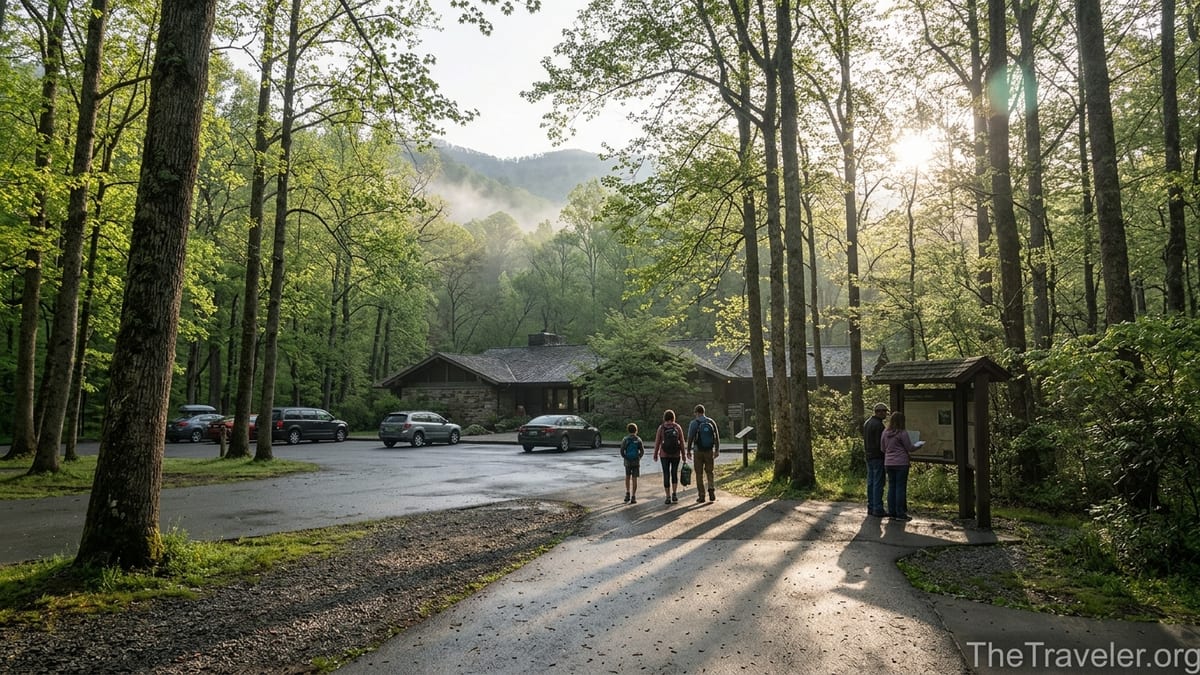
Arriving at Sugarlands: From Pit Stop to First Impression
If you are entering Great Smoky Mountains National Park from Gatlinburg, Sugarlands Visitor Center sits just a couple of miles beyond the park boundary on Newfound Gap Road. It is one of the park’s main hubs, sharing that status with Oconaluftee on the North Carolina side, and it sees a steady stream of guests picking up maps, backcountry permits, and advice from rangers. On busy weekends in spring and fall, the parking lot begins to fill shortly after 9 a.m., and by midday it can feel like a small town.
My plan was simple: arrive early, duck inside for ten minutes, then continue toward Newfound Gap and Clingmans Dome. Instead, Sugarlands immediately slowed me down in the best way. The building itself feels like a classic national park structure, low and unobtrusive, framed by hardwood forest and the steady sound of a creek. Just outside the entrance, an information board clearly lays out current trail conditions, road closures, and weather updates, which are essential in a park where afternoon thunderstorms and fog can change plans quickly.
Inside, I found more than the basic pamphlets I expected. Rangers answered specific questions about trail options given the day’s forecast, pointed out family-friendly routes, and highlighted less obvious spots like the Cove Mountain Trail and nearby Cataract Falls. I watched other visitors arrive just as rushed as I had, only to spread out over the exhibits, linger at the relief map of the park, and realize, as I did, that Sugarlands is not just a gateway but a destination.
Inside the Visitor Center: Exhibits, Rangers, and Quiet Surprises
What makes Sugarlands memorable begins with its compact but thoughtful natural history museum. Along one wall, mounted displays and dioramas highlight the extraordinary biodiversity that gives the Smokies their international reputation. You can study examples of salamanders that thrive in the region’s damp, cool microclimates, examine cross-sections of local tree species, and learn why the park is sometimes called the “Salamander Capital of the World.” It is the kind of exhibit that can give context to every hike that follows.
For families traveling with kids, the exhibits are a gift. A typical scene: parents leaning in to read about black bear behavior while children dart between interactive displays, pointing out animal tracks pressed into model soil or watching short videos on forest ecology. On my visit, a ranger was informally answering bear safety questions near a display of fur and skull replicas, patiently explaining the difference between black bears and grizzlies and reinforcing the importance of distance and food storage.
The bookstore is another unanticipated rabbit hole. Beyond the usual park magnets and postcards, shelves are lined with detailed trail guides, wildflower and tree identification booklets, local history volumes, and children’s activity books. Prices for pocket-sized field guides often fall in the 6 to 12 dollar range, making them easy add-ons that genuinely enrich hikes. I watched one couple debate between a trout-fishing handbook and a wildflower guide, finally deciding on both after a ranger pointed out that spring bloom timing can vary by elevation.
Perhaps the most valuable resource, however, is human. At the information desk, you can talk to rangers and volunteers who spend their days answering variations of the same question: “We have half a day; where should we go?” When I mentioned wanting something scenic but not crowded, with time left afterward to drive Newfound Gap Road, a ranger drew a quick loop on my map around the Sugarlands Valley Nature Trail and Cataract Falls, suggested stopping at a roadside overlook higher up, and circled Oconaluftee as a good afternoon target if traffic allowed. It felt like having a local guide, free of charge.
The Sugarlands Valley Nature Trail: An Easy Walk That Tells Big Stories
Less than a five-minute drive from the visitor center along Newfound Gap Road sits the trailhead for the Sugarlands Valley Nature Trail, a fully paved, roughly half-mile loop tucked into the woods along a gentle stream. The parking area is small, with a handful of spaces including designated accessible spots, but cars cycle in and out frequently, especially early and late in the day. The trail is relatively flat and has been assessed for accessibility, making it one of the best options in the park for visitors with limited mobility, strollers, or small children.
On paper, the loop is modest: about 0.5 miles roundtrip, no big climbs, no sweeping views from cliffs. In practice, it is a concentrated introduction to what makes the Smokies special. The smooth path winds through a cove hardwood forest where tulip poplar, maple, and oak cast a mottled shade over thick understory plants. Interpretive signs and subtle remnants of stone walls and chimneys hint at the communities that once dotted this valley before the national park was established.
As I walked, I passed a grandfather guiding his granddaughter’s hand along the rail as he read aloud from one of the signs, explaining how families once farmed these slopes and how quickly nature reclaimed the land after cabins were removed. A little farther along, a couple using mobility devices paused near a small bridge over the creek, taking in the rushing water only a few feet from the trail edge. The combination of accessibility and immersion is rare; here, people who might struggle on the park’s steeper paths can still experience wild forest, water, and history up close.
The loop does not demand much time, yet it invites lingering. Benches along the way give you permission to stop and listen to birdsong or simply watch light shift through the canopy. In the height of summer, the air along the stream is a few degrees cooler than in nearby Gatlinburg, and in early spring, wildflowers often carpet the forest floor in shades of white, pink, and yellow. What started as a quick stroll easily stretched into nearly an hour as I circled a second time, noticing new details on each pass.
Cataract Falls and Easy-to-Reach Smokies Scenery
One of Sugarlands’ greatest surprises is how much classic Smokies scenery you can reach with minimal driving and effort. From the visitor center, a short, well-marked trail leads to Cataract Falls, a photogenic cascade shaded by hardwoods and rhododendron. The walk is roughly three-quarters of a mile roundtrip, mostly gentle, following a creek and crossing small bridges before ending at the falls themselves.
On my visit, families arrived in steady waves. Some parents carried toddlers in backpack carriers, while others let children amble along the path, stopping to examine moss on rocks or toss leaves into the water. Near the falls, people took turns stepping forward to snap photos, careful to give each group a turn at the best vantage point. It never felt empty, but it also never felt overwhelming, particularly in the early morning or late afternoon when day-trip crowds thin.
What sets Cataract Falls apart is not its height compared to larger waterfalls deeper in the park, but its accessibility. You do not need to commit to a multi-hour hike or navigate remote gravel roads. For travelers stopping in the Smokies for only a day or two, or for those with limited energy after a long drive, Cataract Falls delivers the sound of rushing water, lush greenery, and the cool mist of a mountain stream with a minimal investment of time.
Just beyond the falls trail, the Gatlinburg Trail begins its roughly two miles toward town, offering another easy option with river views and a mix of forest and the occasional glimpse of old homesteads. For runners staying in Gatlinburg, this trail has become a popular early-morning route, allowing them to jog from town toward Sugarlands and back without ever getting in a car.
History Written Into the Landscape: From Homesteads to Park Headquarters
The name “Sugarlands” comes from the abundance of sugar maple trees that once characterized this valley. Before the establishment of Great Smoky Mountains National Park in the 1930s, the area was home to small Appalachian communities, with farmsteads, churches, and schools tucked into hollows along the streams. Very little of that built environment remains, but if you slow down, traces of the past appear everywhere.
Along the Sugarlands Valley Nature Trail, low stone walls cut through the undergrowth, and the occasional chimney stands detached from any house. These fragments hint at the daily lives of families who cleared, planted, and harvested this land, only to leave when it became part of a growing national park. Interpretive signs near the visitor center and along nearby paths fill in some of these stories, explaining how the valley’s communities negotiated relocation, and how quickly forest reclaimed the clearings once plows fell silent.
Today, Sugarlands serves as park headquarters, hosting administrative offices in addition to the visitor center. That dual identity is part of what makes it feel like the Smokies’ nerve center. When special events are scheduled, from seasonal ranger talks to holiday programs celebrating traditions “across the mountains,” they frequently anchor at Sugarlands and its sister visitor center in Oconaluftee. Visitors who happen to arrive during these events can catch demonstrations of traditional crafts, old-time music, or storytelling that connect present-day tourism with the deeper cultural roots of the region.
Even on ordinary days, small touches keep the human history visible. In the bookstore, you might find memoirs written by residents who grew up in pre-park communities, or historical photo collections that show log cabins where today only chimneys remain. Sitting on a bench outside the visitor center, with modern cars passing on Newfound Gap Road and forest crowding the edges of the parking lot, it feels like the past and present are layered tightly together.
Using Sugarlands as a Launchpad: Drives, Trails, and Day Plans
Part of Sugarlands’ appeal is strategic. For many visitors, it becomes the natural launching point for exploring the Tennessee side of the park. Newfound Gap Road, the only route that crosses the park from north to south, begins here and rises over 5,000 feet toward its namesake pass, serving up overlooks, trailheads, and connections to deeper backcountry at almost every turn.
A typical day might start with an hour or two at Sugarlands, combining a quick spin through the exhibits, a talk with a ranger, and a walk to Cataract Falls. From there, drivers can head up Newfound Gap Road, stopping at pullouts like Campbell Overlook to get a sweeping view of Mount Le Conte, or continuing to Newfound Gap itself, where cooler temperatures and wide vistas mark the literal and figurative high point of the drive. Hikers can branch off on trails like the Appalachian Trail segment to Charlies Bunion or shorter walks near the state line.
Another option is to use Sugarlands as a home base for more modest hikes. The Cove Mountain Trail begins near the visitor center and climbs away from the crowds into quieter forest, eventually reaching a fire tower site for those willing to commit to a longer day. For visitors who want a middle ground between the gentle Sugarlands Valley loop and the more demanding high-elevation hikes, trails like this offer a satisfying challenge without the commitment of a full backcountry expedition.
Because Sugarlands is only a short drive from Gatlinburg’s lodging options, it also works well as an anchor point for multiple days in the park. Travelers staying in cabins or hotels in town can make a habit of stopping by each morning, checking the latest updates on closures or bear activity, and choosing that day’s destination based on current conditions. Over time, the visitor center begins to feel less like a one-off attraction and more like a familiar neighborhood corner in the middle of a vast protected landscape.
Beyond the Pavement: Horseback Riding and Nearby Adventures
For those who want to experience the Smokies without lacing up hiking boots, Sugarlands is also a gateway to horseback riding. Just outside the main park entrance, outfitters such as Sugarlands Riding Stables offer guided trail rides that weave along mountain streams and through second-growth forest, giving both first-time and experienced riders a different perspective on the terrain. Typical rides last about an hour to ninety minutes, with longer options sometimes available for visitors who want more time in the saddle.
On a warm afternoon, I watched as a group of riders assembled at one of these stables, staff members pairing each guest with a calm, sure-footed horse. Helmeted children climbed into the saddle with a mix of nerves and excitement, while adults listened to a short orientation about trail etiquette and safety. Once the group moved out, the line of horses disappeared into the trees, leaving behind only the occasional clop of hooves and the murmur of conversation. For families whose energy is already taxed by travel, or for older visitors who prefer not to tackle steep trails, this is an appealing way to immerse themselves in the landscape.
Even if you skip the horses, simply driving the short distance between downtown Gatlinburg and Sugarlands can feel like a transition into another world. The noise and bright signs of town quickly give way to dense greenery, river views, and the understated architecture of the national park. Many visitors choose to spend part of the day sampling Gatlinburg’s restaurants or attractions, then retreat to Sugarlands and its nearby trails for quieter, cooler hours under the canopy.
A useful detail for modern travelers: parking at Sugarlands requires a valid park parking tag if you plan to stay more than 15 minutes, part of a system introduced to help support maintenance and services throughout Great Smoky Mountains National Park. Tags are available in daily, weekly, and annual options at a range of price points that are relatively modest compared with many other national parks, and they can be purchased in advance or at select locations, including some visitor centers.
The Takeaway
By the time I left Sugarlands late that first afternoon, my original plan for a quick stop felt almost comical. In a relatively small area, I had walked an accessible forest loop rich with history, stood at the base of a waterfall, browsed through carefully chosen books, and spoken with rangers whose local knowledge reshaped my itinerary. The experience set the tone for the rest of my Smokies trip, grounding big vistas and long drives in a more intimate understanding of the place.
If you are heading into Great Smoky Mountains National Park from Gatlinburg, it is tempting to treat Sugarlands as a box to check before you climb higher into the mountains. Resist that impulse. Arrive an hour earlier than you think you need to. Wander the exhibits, talk with the staff, and walk one of the short trails that fan out from the visitor center. Whether you are traveling with young children, older relatives, or a group of avid hikers, Sugarlands offers something that can meet you where you are that day.
In a park celebrated for its sweeping ridgelines and backcountry solitude, Sugarlands is the rare place where accessibility, storytelling, and natural beauty overlap almost effortlessly. What starts as a pit stop often becomes an anchor point, a favorite memory, and, for many travelers, the part of the Smokies they find themselves most eager to revisit.
FAQ
Q1. Where exactly is Sugarlands Visitor Center located in Great Smoky Mountains National Park?
It sits about two miles south of downtown Gatlinburg, Tennessee, along Newfound Gap Road at the northern entrance to Great Smoky Mountains National Park.
Q2. How much time should I plan to spend at Sugarlands if I am in a hurry?
If you are short on time, plan on at least one to two hours, which allows for a walk through the exhibits and a short hike to Cataract Falls or the Sugarlands Valley Nature Trail.
Q3. Are the trails around Sugarlands suitable for young children and older adults?
Yes. The Sugarlands Valley Nature Trail is paved, relatively flat, and about half a mile long, making it especially good for strollers, young children, and many older visitors.
Q4. Do I need a parking tag to stop at Sugarlands Visitor Center?
Yes, if you plan to park for more than 15 minutes, you will need a valid Great Smoky Mountains National Park parking tag, which is available in daily, weekly, and annual options.
Q5. Can I see a waterfall without doing a strenuous hike near Sugarlands?
Yes. Cataract Falls is accessible via a short, mostly gentle walk from Sugarlands Visitor Center and offers a rewarding waterfall experience with minimal elevation gain.
Q6. Is Sugarlands Visitor Center open year-round?
It is typically open most days of the year, though hours can vary by season and on certain holidays, so it is wise to confirm current opening times before your visit.
Q7. What kind of information can rangers provide at Sugarlands?
Rangers and volunteers can offer up-to-date details on trail conditions, road closures, bear activity, weather, and personalized recommendations based on your time and abilities.
Q8. Are there any accessible facilities or trails at Sugarlands?
Yes. The visitor center itself is accessible, and the Sugarlands Valley Nature Trail is a paved, relatively flat loop designed to accommodate many visitors with mobility challenges.
Q9. Can I go horseback riding near Sugarlands?
Yes. Several local outfitters just outside the main park entrance, including Sugarlands Riding Stables, offer guided horseback rides that explore forested trails near the area.
Q10. Is Sugarlands a good starting point for exploring the rest of the Smokies?
Absolutely. With its location at the base of Newfound Gap Road, access to easy trails, and on-site rangers, Sugarlands works well as a launchpad for both short visits and multi-day itineraries.