


Landing at Tokyo Narita Airport can feel overwhelming. The airport sits about 60 kilometers east of central Tokyo, so choosing the right way into the city has a big impact on your budget, comfort, and how quickly you reach your hotel. As of mid‑2026, travelers can choose from several reliable options by train, bus, and taxi, each with its own tradeoffs in price, speed, and convenience.
Get the latest updates straight to your inbox!
Understanding the Basics: Time, Cost, and Where You Are Going
Narita International Airport is much farther from central Tokyo than Haneda Airport, so you should plan for at least 60 to 90 minutes of travel after you land. Most visitors are heading for major hubs such as Tokyo Station, Ueno, Shinjuku, Shibuya, Asakusa, or Ginza. The right transport choice depends heavily on which of these areas you are staying in, your arrival time, and how much luggage you are carrying.
Broadly speaking, you can think of three main routes into the city. Fast limited express trains such as the JR Narita Express and Keisei Skyliner are best if you want to get to Tokyo Station, Shinjuku, Shibuya, Nippori, or Ueno quickly and in comfort. Highway buses, including the Airport Limousine Bus and low‑cost shuttles, take longer but can drop you closer to major hotels and are easier with big suitcases. Taxis and private cars are the most convenient option but cost significantly more than public transport.
In 2026, typical costs range from around 1,000 to 1,500 yen for slower trains or budget buses into Tokyo Station, around 2,500 to 3,200 yen for high‑speed trains or premium buses, and anywhere from roughly 18,000 to more than 25,000 yen for a taxi into central neighborhoods. These figures can shift slightly with timetable revisions or fuel surcharges, so treat them as approximate rather than exact.
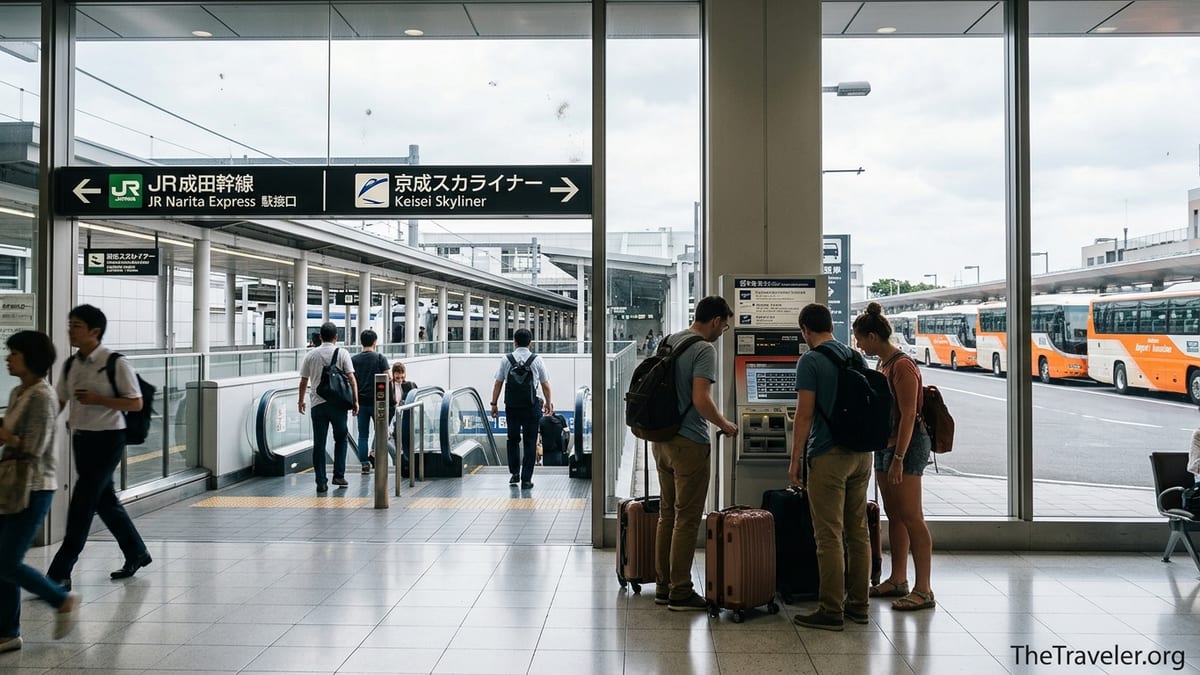
Because Narita has three terminals, you should also note which one you arrive at. The JR Narita Express and Keisei Skyliner both serve Terminal 1 and the combined Terminal 2·3 station. Buses and taxis pick up directly outside each arrivals hall, so once you are through customs you simply follow the brightly colored signs for “Railways,” “Bus,” or “Taxi.”
Fastest Into Town: Keisei Skyliner and JR Narita Express
If your priority is to reach central Tokyo quickly and comfortably, the two premium train services are the Keisei Skyliner and the JR Narita Express, often abbreviated as N’EX. Both are limited express trains with reserved seating, luggage racks, and onboard restrooms, and both run frequently throughout the day from early morning until late evening.
The Keisei Skyliner is currently the fastest option between Narita and the city. It connects Narita Airport to Nippori in about 36 minutes and to Keisei Ueno in roughly 41 minutes, with trains usually running every 20 minutes at peak times. A one‑way adult ticket costs a little over 2,500 yen in 2026, depending on whether you pay by regular ticket or IC card. This train makes the most sense if you are staying in Ueno, Asakusa, Akihabara, or anywhere on the JR Yamanote Line reachable with an easy change at Nippori.
The JR Narita Express is the most straightforward option if your accommodation is around Tokyo Station, Shinjuku, Shibuya, Shinagawa, or Yokohama. Typical journey times are around 53 to 60 minutes from Narita to Tokyo Station, and up to 90 minutes for Shinjuku or Yokohama, with most trains running direct to those endpoints. One‑way fares into central Tokyo are generally just over 3,000 yen in 2026 for standard class, with all seats reserved. JR occasionally offers foreign visitor discounts or round‑trip deals, so it is worth checking at the JR East Travel Service Center after landing.
In practice, a jet‑lagged traveler landing at 4:00 p.m. and staying near Shinjuku Station might simply follow the “JR Line” signs, buy a Narita Express ticket for Shinjuku at the counter, and ride straight through without changing trains. Someone staying in Ueno, on the other hand, can reach their hotel significantly faster by taking the Skyliner to Keisei Ueno, then walking or making a short hop on the subway or JR Yamanote Line.
Cheapest Rail Options: Keisei Access Express and Local Trains
Budget‑minded travelers willing to trade speed and comfort for savings often choose the Keisei Access Express or other regular commuter trains. These services are slower and may be crowded during rush hours, but they deliver substantial savings compared with the premium express trains, especially for solo travelers or backpackers.
The Keisei Access Express runs through from Narita Airport into central Tokyo on commuter lines, reaching stations on the Toei Asakusa Line and beyond, such as Oshiage for Tokyo Skytree, Asakusa, Nihonbashi, and even Shinagawa. Typical travel times to central districts are around 70 to 90 minutes, and fares are often in the range of 1,200 to 1,500 yen depending on the exact destination. Seats are not reserved, so you may need to stand if the train is busy, but this route is a strong choice if you are staying in the old downtown or anywhere directly served by the Asakusa Line.
Keisei also operates a slower Limited Express service on its main line to Nippori and Ueno. Travel times are around 75 to 90 minutes, with prices generally just over 1,000 yen. A common real‑world scenario is a budget traveler landing mid‑day, buying a regular Keisei limited express ticket for about half the price of the Skyliner, and then transferring at Nippori to the JR Yamanote Line for Shinjuku or Shibuya.
JR’s regular rapid services on the Sobu Line and Narita Line are another low‑cost option, though they are less straightforward if you are new to Japan. These trains are covered by standard JR tickets and by Japan Rail Passes. Travel time into Tokyo can easily exceed 90 minutes, and you may need to stand for part of the journey, but the fare is closer to the budget Keisei trains. This can make sense if you arrive outside the main Narita Express timetable or if you already hold a rail pass and prefer not to buy a separate express ticket.
Bus Options: Airport Limousine and Budget Shuttles
For many visitors, especially those with large suitcases or traveling with children, buses are the most practical way from Narita into Tokyo. You simply load your luggage in the underfloor compartment, sit down, and wait until the coach drops you near your hotel or chosen station. Journey times are typically 60 to 120 minutes, depending on traffic and exact destination.
The Airport Limousine Bus is the best known service, connecting Narita Airport with major Tokyo hubs such as Tokyo Station, Shinjuku Station, Shibuya Mark City, Ikebukuro, and a long list of large hotels around Ginza, Roppongi, and Odaiba. As of 2026, most central Tokyo routes cost in the region of 2,800 to 3,200 yen per adult, with discounted fares sometimes available for children. For example, a traveler heading to a skyscraper hotel in Shinjuku’s west side might take a Limousine Bus directly from Narita to the hotel driveway in about 90 minutes, avoiding the need to drag luggage through packed train stations.
Several lower‑cost highway bus services also run between Narita and Tokyo Station or Ginza. Typical fares are around 1,000 to 1,300 yen one way, making them comparable in price to budget rail but often more comfortable because you are guaranteed a seat. Common patterns include a shuttle from Narita to Tokyo Station’s Yaesu side or a coach into Ginza or Nihonbashi, where you can transfer to the subway or a taxi for the last short hop to your accommodation.
Do keep in mind that buses are more vulnerable to traffic jams, especially around evening rush hour and on holiday periods when expressways into Tokyo can slow significantly. A bus that is normally scheduled to take 75 minutes from Narita to Tokyo Station might stretch to 100 minutes or more on a busy Sunday evening. If you have a tight onward connection such as a long‑distance Shinkansen ride from Tokyo Station, a train from the airport is usually safer.
Taxis and Private Transfers: Door to Door Convenience
Taking a taxi from Narita Airport all the way into central Tokyo is the most convenient but also by far the most expensive option. Regular metered taxis can easily cost 25,000 yen or more to reach districts like Shinjuku or Shibuya, especially if you travel late at night or encounter heavy traffic. The ride usually takes around 60 to 90 minutes, depending on where you are staying and the state of the expressways.
To control costs, many visitors choose fixed‑fare taxis or private transfer services instead of flagging a standard cab. At Narita, there are designated taxi counters in the arrivals halls where staff can arrange a flat‑rate car into specific Tokyo wards. As of 2026, fixed fares into central areas typically start around 18,000 to 22,000 yen for a standard sedan. For a group of four sharing one vehicle, this can work out at roughly 5,000 to 6,500 yen per person, which is not dramatically higher than taking a premium train plus local transfers, but with the advantage of being dropped right at your hotel entrance.
Private transfer companies and pre‑booked car services offer a similar experience, often with English‑speaking drivers and meet‑and‑greet service in the arrivals hall. Prices vary with vehicle size and time of day but are broadly in the same band as fixed‑fare taxis. These options are particularly attractive for families with young children, travelers arriving very late or very early when train and bus options are sparse, or anyone carrying bulky sports equipment or several large suitcases.
A good example would be a family of five arriving on a late‑night flight with strollers and heavy bags. Instead of navigating transfers on the last trains of the evening, they might book a minivan‑sized private transfer in advance. They pay more overall than they would for public transport, but they gain predictability and avoid the stress of maneuvering through crowded stations while exhausted.
Choosing the Best Option for Your Itinerary
To choose the right way from Narita to Tokyo, think through four main factors: where your hotel is located, what time your flight arrives, how much luggage you will have, and your budget. There is no single best option for everyone, but some patterns are clear when you match real‑world situations to the available services.
If you are staying near Tokyo Station, Kanda, or Nihonbashi and arriving in the daytime, the Narita Express or a fast highway bus to Tokyo Station are both sensible choices. The train is more predictable in timing, while the bus may drop you closer to your specific hotel. If your hotel is in Ueno or Asakusa, the Keisei Skyliner to Ueno or Nippori followed by a short local train or subway ride is usually fastest, while the Keisei Access Express to Asakusa or Oshiage can save money if you are not in a hurry.
Travelers booked into Shinjuku or Shibuya usually find the Narita Express the simplest train option, as it runs directly to those hubs without transfers. If you are worried about navigating big stations with luggage, or arriving in the evening rush, the Airport Limousine Bus services that terminate at Shinjuku Station or Shibuya Mark City may be more relaxing. For hotels inside large complexes such as those in Shinjuku’s west side or around Shibuya’s bus terminal, the coach often drops you very close to reception.
For very tight budgets, especially solo travelers or students, the Keisei Limited Express, Access Express, or low‑cost buses around 1,000 yen are hard to beat. In that case, plan your route in advance, allow plenty of time, and avoid the busiest commuter peaks if possible. Meanwhile, groups with several people and heavy bags should always compare the combined cost of four or five express train tickets against a single fixed‑fare taxi or private van, which may be only slightly more expensive while being much easier door to door.
Practical Tips for Tickets, Luggage, and Late Arrivals
Once you have decided on a mode of transport, buying tickets at Narita is straightforward. For the Narita Express, JR East Travel Service Centers and ticket machines near the JR entrances sell reserved‑seat tickets, and staff at the counters can help you choose the right destination if you show your hotel address. For the Keisei Skyliner and other Keisei trains, look for the Keisei ticket counters and blue ticket machines near the Keisei entrance. Overseas visitors sometimes qualify for packaged deals that combine a Skyliner ride with a 24‑, 48‑, or 72‑hour Tokyo subway pass, which can be good value if you plan to use the subway extensively during your first days in the city.
Highway bus tickets can be bought at counters and vending machines in the arrivals halls, usually marked clearly as Limousine Bus or with the name of the specific operator. Staff will ask for your destination area and recommend the closest stop. On busy days, some popular routes can sell out specific departures, but another bus is often available within 30 to 60 minutes. If you have a tight schedule, consider booking your bus seat in advance through a travel agent or online before your trip, then simply checking in at the counter after you land.
If you are worried about handling luggage on trains, remember that the Narita Express and Skyliner both provide dedicated luggage racks at the ends of each car, and overhead shelves for smaller bags. Commuter trains such as the Keisei Access Express and JR rapid services have no special luggage space, so you will need to keep bags near your seat or feet, which can be tiring on a crowded journey. Buses store large suitcases under the floor, which many travelers find less stressful after a long flight.
Late‑night and very early‑morning arrivals require special attention. The last Skyliner and Narita Express departures are usually around 10:30 p.m. to 11:00 p.m., and regular trains do not run all night. If your scheduled arrival is after 9:00 p.m., check the most recent train timetables ahead of time and have a backup plan, such as a highway bus or fixed‑fare taxi, in case of delays. At the other extreme, if you land before the first trains start running, resting at the airport for a short time or booking a private transfer may be more comfortable than waiting on platforms with luggage.
The Takeaway
Getting from Narita Airport into Tokyo city is no longer the confusing puzzle it once seemed. With reliable fast trains, a range of buses, and plentiful taxi and private car options, almost every type of traveler can find a route that fits their schedule and budget. The key is to think through your priorities before you land, rather than leaving the decision for when you are jet‑lagged in the arrivals hall.
As a rule of thumb, choose the Keisei Skyliner if you are heading for Ueno or the northeast side of the city, the Narita Express if you are bound for Tokyo Station, Shinjuku, Shibuya, or Yokohama, and buses if you value a seat and simple luggage handling over sheer speed. Reserve taxis and private transfers for late‑night arrivals, families, or times when door‑to‑door convenience is worth the extra cost.
Whichever option you choose, signage at Narita is clear, staff are accustomed to helping foreign visitors, and services are generally punctual. With a little advance planning and an idea of current prices and travel times, your first journey from Narita into Tokyo can be a smooth start to your time in Japan rather than a stressful obstacle.
FAQ
Q1. What is the fastest way to get from Narita Airport to central Tokyo?
The Keisei Skyliner is usually the fastest, reaching Nippori in about 36 minutes and Keisei Ueno in around 41 minutes under normal conditions.
Q2. Which option is best if my hotel is near Tokyo Station?
The JR Narita Express to Tokyo Station is the simplest and most reliable, though budget buses to Tokyo Station’s area can be cheaper if you do not mind extra time.
Q3. How much does the Narita Express cost in 2026?
A one‑way adult ticket from Narita Airport to central Tokyo is typically just over 3,000 yen, with occasional discounts or round‑trip deals for foreign visitors.
Q4. Is the Skyliner covered by the Japan Rail Pass?
No. The Keisei Skyliner is operated by Keisei Railway, not JR, so it is not included in the Japan Rail Pass. You must buy a separate ticket.
Q5. What is the cheapest way to reach Tokyo from Narita?
The lowest fares are usually on budget highway buses or local Keisei trains such as the Limited Express or Access Express, often around 1,000 to 1,500 yen one way.
Q6. Are buses from Narita to Tokyo reliable during rush hour?
They are reliable but can be delayed by traffic. At peak times, a bus scheduled for 75 minutes may take closer to 100 minutes, so avoid them if you have a tight connection.
Q7. How expensive is a taxi from Narita into central Tokyo?
Regular metered taxis commonly cost between about 25,000 and 30,000 yen, while fixed‑fare taxis start around 18,000 to 22,000 yen depending on the exact destination.
Q8. What should I do if my flight arrives late at night?
Check the latest train timetables in advance and have a backup such as a highway bus or fixed‑fare taxi, since the last Skyliner and Narita Express departures are late in the evening, not overnight.
Q9. Can I use an IC card like Suica or PASMO from Narita?
Yes. You can use IC cards on most local and rapid trains and many buses, though you still need separate tickets or seat reservations for services like the Narita Express and Skyliner.
Q10. Which option is best for families with children and lots of luggage?
Families often prefer the Airport Limousine Bus for easy luggage handling and direct hotel stops, or a pre‑booked private transfer or fixed‑fare taxi for true door‑to‑door service.