


Los Angeles is famously car oriented, but Hollywood is one of the better connected neighborhoods for visitors who prefer not to drive. Metro rail, local buses and shuttles make it possible to reach major sights without renting a car, although services thin out at night and journeys can take longer than the map suggests when traffic or waiting times are factored in. This guide explains how to get from LAX and Hollywood Burbank airports to Hollywood, how to move around once there, and how to decide between renting a car, using public transit, or relying on rideshares and taxis.
Get the latest updates straight to your inbox!
Understanding Hollywood’s Transport Landscape
Hollywood sits roughly in central Los Angeles and is served by the Metro B Line subway, several key bus corridors and plentiful rideshares, as well as an extensive but often expensive parking network. Compared with many parts of LA, it is one of the few areas where a car free stay can work reasonably well, especially if most of your plans focus on Hollywood itself, Universal City and Downtown Los Angeles.
At the same time, the broader city is still shaped by the car. Distances are long, freeways are frequently congested, and transit connections often require at least one transfer and some walking. Metro trains and buses typically run every 10 to 20 minutes in the daytime on core routes, but frequencies can drop late in the evening and early morning, and planned maintenance can occasionally disrupt schedules. Visitors should always check the latest information from operators before traveling, particularly for late night or early Sunday services.
Traffic conditions in Los Angeles can vary dramatically by time of day and day of week. A ride between Hollywood and LAX that takes 35 to 45 minutes in light traffic can stretch beyond 75 minutes during the afternoon rush or in bad weather. When planning, it is wise to build generous buffers for airport trips and event nights and to mentally treat quoted journey times as best case estimates, not guarantees.
For many visitors, the ideal approach is a hybrid: use rail and bus where they are strong, especially for predictable point to point journeys, and lean on rideshares or taxis when arriving late, carrying heavy luggage, or heading to neighborhoods with limited transit coverage.
Getting from LAX to Hollywood
For most international and domestic visitors, the trip begins at Los Angeles International Airport. From LAX, the main options to reach Hollywood are rideshares and taxis, the Union Station FlyAway coach combined with rail or rideshare, the Metro rail and shuttle combination via the LAX/Metro Transit Center, and car rental. Each has trade offs around cost, time, luggage handling and comfort.
App based rideshares and licensed taxis are often the most straightforward option, particularly after a long flight or if you arrive late at night. Depending on traffic and the exact location of your Hollywood hotel, the drive typically takes around 35 to 60 minutes in moderate conditions, with significantly longer times possible during weekday peaks. Fares can fluctuate with demand; surge pricing is common during busy periods or major events, so it is worth checking the fare estimate in your app before committing. Many recent local riders report that for one or two people, this convenience premium is acceptable, and that it feels safer and easier than navigating multiple transfers with luggage after dark.
The LAX FlyAway coach to Union Station remains a popular non stop option. Official information indicates that the Union Station route runs daily and now charges a one way fare in the mid teens per adult, paid by card, mobile payment or app. From Union Station, you can transfer to the Metro B Line toward North Hollywood and ride several stops to reach Hollywood/Western, Hollywood/Vine or Hollywood/Highland stations. In normal conditions, the coach and subway together can take around 60 to 90 minutes, not including waiting and walking time. The main advantages are predictable pricing, luggage storage on the bus and avoiding airport rideshare surcharges. The main downsides are the extra transfer and the need to manage bags through a busy rail hub and station escalators.
Metro promotes a rail link between LAX and the rest of the city using the LAX/Metro Transit Center station on the K and C Lines, served by the airport’s Route M Metro Connector shuttle. Current guidance suggests that you ride the shuttle from your terminal to the LAX/Metro Transit Center, take the K Line north, transfer to the E Line, then connect to the B Line at 7th Street/Metro Center for Hollywood. A standard Metro base fare is currently under two dollars with free transfers within a set time window when using a TAP card, making this the cheapest option. However, recent rider reports emphasize that the multiple transfers, station changes and waits between trains can make the journey feel lengthy, especially if the shuttle or rail frequencies are uneven. With luggage, many locals describe this option as best for budget focused, confident transit users arriving during the day rather than late at night.
Car rental from LAX is widely available, with companies accessed via dedicated rental car shuttles. Renting can make sense if Hollywood is just one stop within a broader Southern California driving itinerary that includes beaches, desert or theme parks that are poorly served by transit. For a Hollywood focused visit of only a few days, however, the combination of daily rental fees, hotel parking charges and heavy traffic often outweighs the convenience of having your own vehicle, especially for solo travelers or couples.
Arriving from Hollywood Burbank Airport
Hollywood Burbank Airport, also known as Bob Hope Airport, sits much closer to Hollywood than LAX and is particularly convenient for domestic visitors. In light traffic, a rideshare or taxi from the terminals to central Hollywood can take as little as 20 minutes. During rush hour, especially on weekdays when traffic backs up through the Cahuenga Pass, the same journey can stretch closer to 40 minutes or longer.
Rideshares and taxis are again the simplest choice, especially for first time visitors. Fares vary with distance and demand, but in practice the shorter distance from Burbank to Hollywood often means lower prices than from LAX. As at LAX, it is wise to check your app for a live estimate at the time of arrival and to allow extra time if you are arriving in the late afternoon.
For travelers with light baggage, rail connections are a viable alternative. Burbank Airport has a nearby regional rail station served by Metrolink and some Amtrak services on certain lines. From there, you can ride into Downtown’s Union Station and transfer to the Metro B Line toward North Hollywood and Hollywood. Journey times depend on the specific train you catch and transfer waits, so timetables should always be checked close to travel. Frequent local buses also link Burbank, the Universal City area and Hollywood, but they can be slow in traffic and involve multiple stops.
Given the relative proximity and less complicated transfer patterns, visitors flying into Burbank who are staying in Hollywood often find that paying for a direct rideshare or taxi is worth the time saved, while rail can work well for those arriving in the daytime who are comfortable navigating schedules.
Using Metro Rail and Buses in and around Hollywood
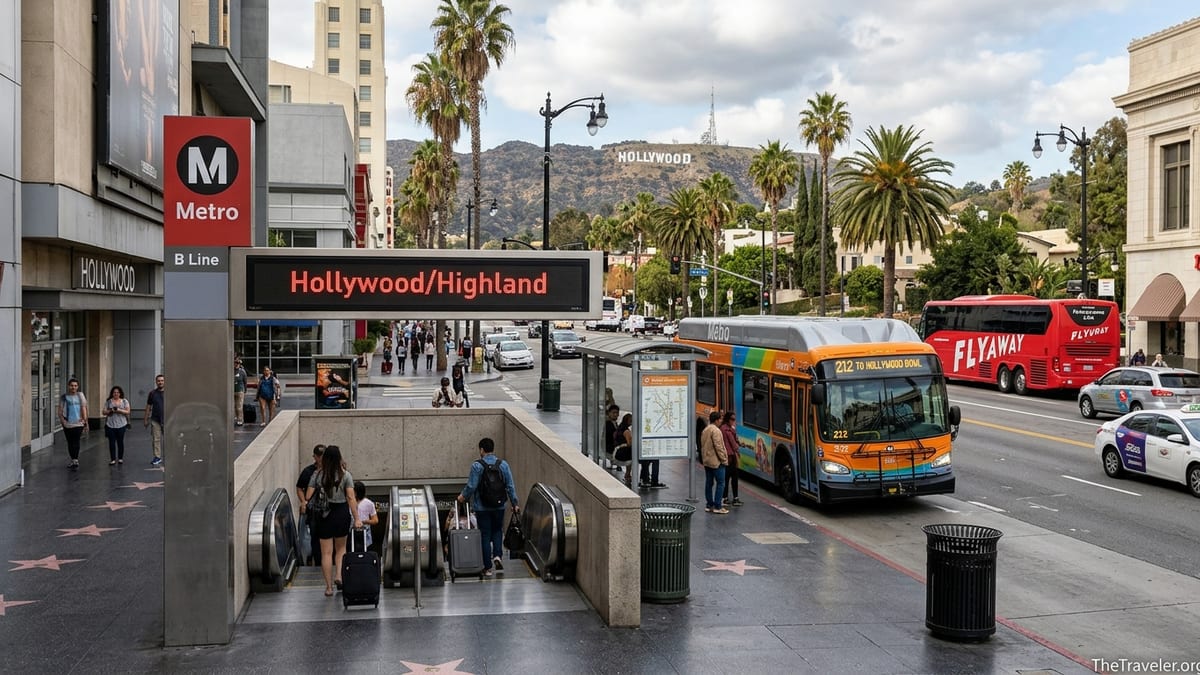
The backbone of car free travel in Hollywood is the Metro B Line. This subway line runs between North Hollywood and Downtown Los Angeles, with key stations at Hollywood/Highland, Hollywood/Vine and Hollywood/Western in the heart of the neighborhood. From Hollywood/Highland, the line continues north to Universal City/Studio City station, making it the most efficient way to reach Universal Studios Hollywood from a hotel near the Walk of Fame.
On typical weekdays and weekends, B Line trains run every several minutes during the daytime and somewhat less frequently late at night, with reduced service on some holidays. Schedules can be affected by maintenance, and there have been recent periods of evening and weekend work, so travelers should always verify the latest timetable and any planned closures on Metro’s official channels before relying on a last train. Platforms are accessed via long escalators and sometimes stairs, and while stations are equipped with elevators, they may occasionally be out of service, so travelers with mobility needs should factor this into planning.
Local buses and city circulator services fill in the gaps between rail stations and nearby neighborhoods. Multiple Metro bus lines run along Hollywood Boulevard, Sunset Boulevard and Santa Monica Boulevard, offering connections toward West Hollywood, Los Feliz, Griffith Park and other districts. There are also DASH neighborhood shuttles operated by the city that provide shorter loops, often at lower fares but with more limited hours. Route numbers, frequencies and spans of service change periodically, so visitors should rely on current operator maps or trip planning apps rather than older online advice.
It is important to have realistic expectations about comfort and environment. Bus stops may not always have shelters, seating or lighting, and trains and buses can feel quieter and less staffed late at night. Many local riders suggest that tourists traveling after around 10 or 11 p.m., especially those unfamiliar with the city, may prefer to use rideshares for peace of mind, even if that means paying more than a late night rail or bus fare.
Getting Around Hollywood and Nearby Attractions
Once you are based in Hollywood, reaching nearby sights is relatively straightforward with a mix of rail, bus and short rideshares. For Universal Studios Hollywood, visitors can ride the B Line one stop from Hollywood/Highland to Universal City/Studio City and follow the signed pedestrian route and shuttle up the hill to the theme park entrance. In normal conditions, the train journey itself is under 10 minutes, but you should allow extra time for walking, security lines and waiting for the hillside shuttle.
To reach Downtown Los Angeles from Hollywood, the B Line provides a direct subway link. Trains run through Hollywood stations and continue to central hubs such as 7th Street/Metro Center, Pershing Square and Civic Center/Grand Park before terminating at Union Station on many schedules. This makes it easy to visit cultural institutions, sports events or historic areas without dealing with downtown parking. Depending on the time of day, the subway ride from Hollywood/Highland to 7th Street/Metro Center is often around 15 to 20 minutes, with additional time needed to walk at each end.
West Hollywood and the Sunset Strip are not directly served by rail, but are close enough for a short rideshare or a bus journey along Santa Monica Boulevard or Sunset Boulevard. For Griffith Park and the Griffith Observatory, visitors typically combine a bus ride along Los Feliz Boulevard or Vermont Avenue with a transfer to a park oriented shuttle, or they use rideshare directly to the observatory’s drop off area if they want to minimize transfers and uphill walks. Service patterns into the park can vary by season and day, so observatory and city transportation pages should be consulted before a visit.
For many Hollywood based visitors, a typical car free day might look like this: ride the B Line from Hollywood/Highland to Universal City in the morning for a day at Universal Studios, return by subway in the late afternoon, then travel down the B Line to 7th Street/Metro Center in the evening for dinner and a brief walk around Downtown before heading back. Exact departure and arrival times will shift with timetable changes, so this should be treated as a sketch rather than a fixed itinerary, but it illustrates how the subway can structure a day without driving.
Parking and Driving in Hollywood
For those who do choose to drive or rent a car, parking is a central consideration. Around the major intersection of Hollywood Boulevard and Highland Avenue, now anchored by the redeveloped shopping and entertainment complex, large parking garages offer structured parking for visitors to the Walk of Fame, nearby theaters and attractions. Many hotels also have their own garages or valet services. Hourly rates are common for short visits, often supplemented by higher daily maximums, and some venues or restaurants offer validated parking that reduces the fee for a limited time.
Street parking exists but can be challenging for visitors. Signs often combine several restrictions, such as resident only permits at certain hours, street cleaning windows on fixed days, and special rules on event nights or during filming. Enforcement can be strict in busy areas. To avoid tickets or towing, drivers should read every sign on the block carefully before leaving a vehicle, and if anything is unclear, opt for a paid lot instead of taking a chance on the curb.
Event nights and weekends can bring additional complications. Premieres at historic theaters, large gatherings along the Walk of Fame and neighborhood festivals can close lanes or entire blocks, which in turn affects both traffic flows and parking availability. In these cases, it can be more efficient to park once in a central garage and move around on foot, or to leave the car at the hotel and rely on rail or rideshares for the evening.
Beyond Hollywood, many other parts of Los Angeles rely heavily on driving, and parking norms vary widely. Beach communities, for example, often combine meters, small lots and residential permit zones near the shoreline. Visitors who plan to range widely by car should factor potential parking fees across the whole trip, not just the daily rental cost, when comparing the economics of driving versus a car free stay.
Reaching the Hollywood Bowl and Other Event Venues
The Hollywood Bowl is one of the city’s most iconic venues and also one of the most logistically complex for drivers, thanks to its hillside location and limited roadway access. To manage demand and reduce congestion, the Bowl and local agencies operate a network of Park and Ride locations and closer in Bowl Shuttles that carry ticket holders from parking lots around the region to the venue. Official sources describe more than a dozen Park and Ride sites and several shuttle lots, including one at the main Hollywood shopping complex near Hollywood/Highland, with round trip fares that have remained modest compared with typical event parking prices.
From Hollywood itself, many visitors either walk or use the local Bowl Shuttle from the central Hollywood parking complex. The walk from Hollywood/Highland station to the Bowl is uphill and can take 20 to 30 minutes for those comfortable with inclines, so it is manageable for some but not ideal in very hot weather or for anyone with mobility challenges. Shuttle buses from designated lots generally drop passengers closer to the entrance. Demand can be intense on popular nights, and recent patron comments note that some Park and Ride departures sell out in advance, so purchasing shuttle or Park and Ride tickets early in the season or well ahead of a high profile concert is recommended.
Rideshare and taxi access to the Bowl is subject to specific drop off and pick up zones, which can be adjusted from season to season. Typically, vehicles are funneled to designated areas before and after performances, and there may be temporary road closures or restrictions near the gates. This can mean a longer walk than expected between your car and your seat, and waits for rideshares after the show as many people request trips at once. The venue’s latest guidance should always be checked before relying on a last minute ride.
Policies around parking tiers at the Bowl, including stack parking where cars may be blocked in until others leave, also change periodically. Because event operations, shuttle times and pricing are reviewed each season, the safest approach is to use the Bowl’s official visitor information shortly before your concert date rather than relying on older advice. This will also provide up to date information on any accessibility shuttles or accommodations for guests with limited mobility.
Accessibility, Safety and Comfort Considerations
Accessibility and personal comfort are key factors when choosing between transit, rideshares and driving in and around Hollywood. Many Metro stations, including those on the B Line in Hollywood, are deep underground and accessed by long escalators. Elevators are available but may occasionally be out of service for maintenance. Visitors who use wheelchairs, have mobility impairments or are traveling with strollers should check station status reports where available and allow extra time to navigate between street level and platforms.
At street level, some bus stops in the Hollywood area are simply signposts without shelters, benches or lighting. In warmer months, waiting in direct sun can be uncomfortable, and during rare rainstorms there may be little cover. Carrying water, sun protection and a charged phone is wise for anyone planning to rely on surface transit, as is building in time for delayed or bunched buses, which are a fact of life in urban traffic.
As in many large cities, perceptions of safety on transit vary. Daytime rides on the B Line and major bus routes are generally busy with commuters and tourists, but late at night services can feel quieter and less structured. Some visitors are comfortable riding until close to the end of service, while others prefer to switch to rideshares earlier in the evening, particularly if traveling alone or carrying valuable gear. It is sensible to stay aware of your surroundings, keep bags close, and avoid extremely empty train cars when alternatives exist.
Ultimately, deciding whether to lean on transit should involve more than just comparing fares. Personal mobility, familiarity with urban systems, language comfort, and the willingness to make transfers in sometimes crowded or unfamiliar stations all matter. Groups that include children, older relatives or anyone anxious about underground spaces may find that paying a bit more for door to door rides is worth the reduced stress.
Should You Rent a Car for a Hollywood Stay?
The decision to rent a car for a Hollywood based visit depends on your itinerary, group size and comfort with driving in heavy urban traffic. If your plans center on Hollywood attractions, Universal Studios, the Hollywood Bowl and a day or two in Downtown Los Angeles, then Hollywood’s rail connections, supplemented by short rideshares, are usually sufficient. In this scenario, avoiding rental and hotel parking costs can free up budget for dining, tours or event tickets.
Car rental begins to make more sense if you plan frequent trips to areas with weaker transit options, such as Malibu beaches, Orange County theme parks, desert towns, or late night venues scattered across multiple neighborhoods. Families or groups of three or more sometimes find that sharing a rental car brings per person costs closer to or below those of repeated rideshares, especially when split over several days. Driving also allows more flexibility in timing and route choice, although it requires someone in the group who is confident navigating congested freeways and unfamiliar surface streets.
For visitors on tight budgets, a hybrid strategy can work well. One option is to rely on transit and rideshares during the core Hollywood part of the trip, then rent a car only for longer day trips when needed, returning it promptly afterward. This avoids paying for a car to sit idle in a garage while you are exploring walkable areas but still grants access to more far flung destinations.
Whatever you choose, planning ahead is crucial. Check current transit maps and schedules shortly before travel, review recent rider experiences to understand typical delays and crowding, and confirm event specific transport details for venues like the Hollywood Bowl. With realistic expectations and a willingness to mix modes, you can explore Hollywood and much of Los Angeles effectively, whether you arrive behind the wheel or without a car at all.