


Singapore Changi Airport is one of the easiest major airports in Asia to navigate, but first-time visitors are often surprised by how spread out the terminals are and how many transport options there are into the city. Whether you are heading straight to a hotel downtown, transferring between terminals, or squeezing in a quick visit to Jewel, understanding how the airport connects to Singapore’s MRT, bus network, taxis and rideshares will save you time, stress and money.
Get the latest updates straight to your inbox!
Understanding Changi’s Layout and Transport Hubs
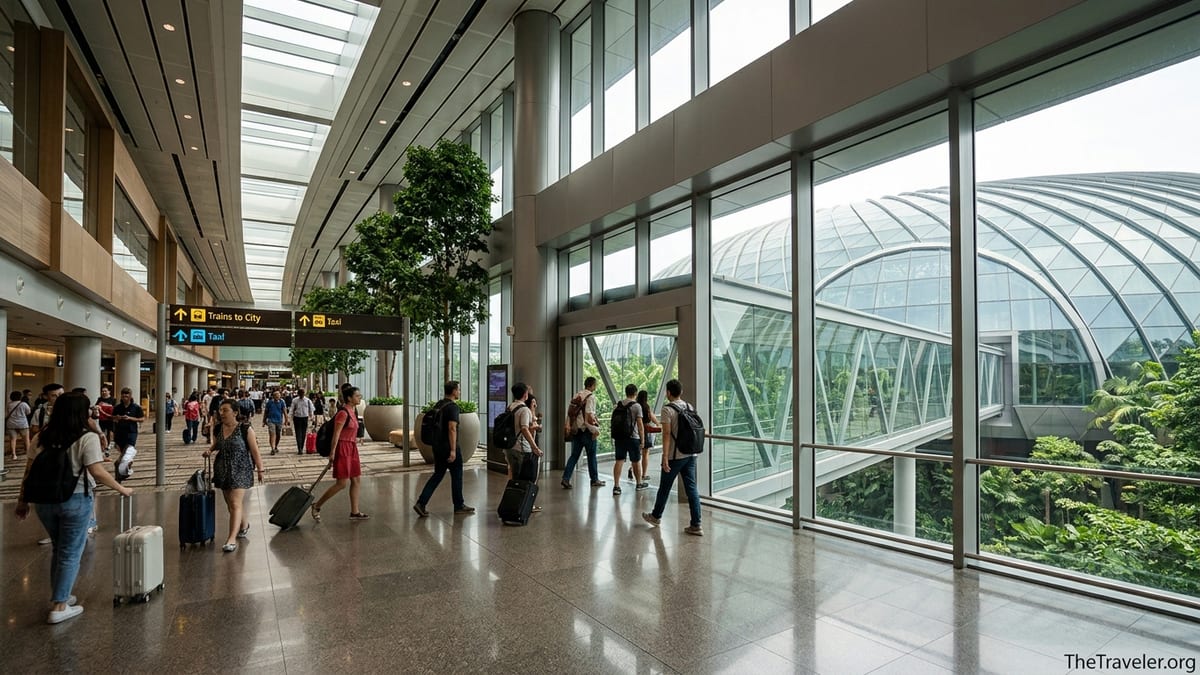
Changi Airport has four passenger terminals: T1, T2, T3 and T4. Terminals 1, 2 and 3 form a cluster around Jewel Changi Airport, the glass-and-steel complex with the famous indoor waterfall. Terminal 4 sits separately across the runway and is linked by shuttle bus rather than by rail. This matters because most public transport links, including the MRT station, are concentrated between Terminals 2 and 3, not at every terminal door.
Changi Airport MRT station sits underground between Terminals 2 and 3, and is the main rail gateway into the city. If you arrive at T2 or T3, you can simply follow signs to “Trains to City,” ride the escalator or lift down to the basement and be on the East West Line branch in a few minutes. From T1 or Jewel, you walk across an indoor link bridge to T2 or T3 first. From T4, you must take a free shuttle bus to T2 before you can access the MRT.
Taxi ranks and rideshare pick up points are located at the arrivals level of every terminal, including T4 and Jewel. They are clearly signed inside the terminal, usually as “Taxi” or “Point-to-Point Transport.” Public buses run in a loop that serves the basements of T1, T2 and T3, with some routes continuing to T4. This means that even if you land far from the MRT station, you almost always have a direct road option to the city outside your own arrivals hall.
If you have a connection or a short layover, you can move between T1, T2 and T3 by walking corridors and travellators or by using the free Skytrain that links the terminals airside and landside. Many transfer passengers walk from T3 to T1 via Jewel in 10 to 15 minutes at a relaxed pace. For T4, an airside and a landside shuttle bus connect to T2; allow around 10 to 15 minutes of bus time plus waiting.
Taking the MRT: Fast and Affordable Into the City
The MRT is the most cost-effective way to get between Changi Airport and central Singapore for solo travelers and couples with manageable luggage. From any terminal, follow the green signs showing the MRT icon and “Trains to City.” The station is at Basement 2 beneath the walkway that connects Terminals 2 and 3. If you land at Terminal 1, you will cross through Jewel and into T2 or T3 before descending. From Terminal 4, you first ride the free shuttle bus to T2, then follow the same signs.
At the station, you can tap in directly with a contactless Visa, Mastercard or mobile wallet, or you can buy a reusable stored-value card from the ticket machines. For short visits, many travelers simply tap their bank card and skip any additional passes. A typical adult fare from Changi Airport to City Hall or Bugis comes to only a few Singapore dollars, depending on exact distance and payment method, and the journey takes around 35 to 45 minutes with one change at Tanah Merah or Expo.
Most routes from the airport to popular hotel areas involve a change from the Changi Airport branch line to the main East West Line. For example, if you are heading to the Civic District near City Hall, you will usually change at Tanah Merah and ride straight into town. For Marina Bay or the Downtown Core, you might change at Expo to the Thomson–East Coast Line, then again at Suntec-area stations to reach your final stop. Trains start early in the morning and run until around midnight, so late-night arrivals after that window will need to consider taxis, buses or a private transfer instead.
The main drawback of the MRT is luggage. Trains can be crowded during local rush hours, particularly on weekday mornings and evenings. If you are carrying two large suitcases or traveling with young children after a long flight, the tight spaces, lift queues and standing time might outweigh the savings. On the other hand, a solo backpacker landing at 3 pm will typically find the MRT a comfortable balance of speed and price.
Using Public Buses to and from Changi
Public buses are an even cheaper alternative than the MRT, and they can be very convenient if your hotel is near a specific bus corridor. Several regular routes operated by Singapore’s main bus companies serve the airport, running in a loop through the basements of Terminals 1, 2 and 3 before continuing into residential and city areas. A common example is bus 36, which runs from Changi to the city via the East Coast and passes near many hotels along Nicoll Highway and around Suntec.
To catch a bus from the airport, follow signs for “Buses to City” or “Public Bus.” The bus bays are usually one or two levels below arrivals; you will take a lift or escalator down, pass a row of ticket machines and a small information counter, and then step into a sheltered bus terminal. Most locals tap on with the same stored-value cards or contactless bank cards they use for the MRT. Fares are time- and distance-based, but for a typical ride to the central area you can expect to pay only a few Singapore dollars.
The trade-off with buses is time and comfort. A bus from Changi into the city can take anywhere from 45 minutes to over an hour depending on traffic and your stop, and you will need to keep track of where to get off. Unlike the MRT, there is no space specifically reserved for luggage, so large suitcases can be awkward at busy times. Buses also stop running earlier than taxis, so for late-night arrivals or very early flights, buses are often not practical.
Public buses make most sense if you are staying near a direct route and are comfortable navigating with a maps app. For instance, a budget traveler staying in the Marine Parade area might choose bus 36 directly from the airport instead of going all the way into the city center by train and then back out again by bus or taxi. Families traveling with children and multiple suitcases, however, usually find that the savings do not compensate for the slower, more crowded journey.
Taxis and Rideshares: Door-to-Door Convenience
Official taxis and app-based rideshares are the most comfortable way to travel between the airport and your accommodation, particularly if you arrive late, have heavy baggage or are traveling in a small group. Taxi stands are just outside the arrivals halls at every terminal. You will see clear signs for “Taxi” and a queueing area where airport staff direct passengers into the next available cab, typically from well-known companies such as ComfortDelGro, SMRT Taxis or Premier.
Fares are metered and based on distance and time, with surcharges added for airport pick up, peak hours and late nights. As of 2026, many travelers report paying somewhere in the region of a few tens of Singapore dollars for an off-peak ride from Changi to central locations such as Orchard Road, Marina Bay or Bugis, and slightly more during evening peak or after midnight. Airport surcharges are usually a fixed amount added to the fare during defined time bands, so two separate parties taking a taxi at the same time to the same area can expect similar totals.
Ride-hailing services such as Grab and Gojek are widely used from Changi. The apps show designated pick up points, usually on the same level as the taxi queues but at specific zones, for example “Terminal 3 Arrival Door 4.” You book inside the terminal once you have your bags, then follow the app instructions to the right curb. Prices are usually shown as fixed fares that already include airport fees, though dynamic pricing can raise costs significantly during rainy weather or late-night surges. Many locals compare the estimated Grab fare with the taxi queue and choose whichever promises the fastest comfortable ride.
For groups of three or four sharing a car, taxis and rideshares often compare favorably with MRT or bus, once you divide the door-to-door fare among everyone and factor in the convenience of being dropped right at your hotel reception. A family landing at 11 pm with two exhausted kids, for example, may find that spending a bit more on a direct car from Terminal 2 to a hotel in Clarke Quay is well worth avoiding a train change and late-night walk with luggage.
Getting Between Terminals and Visiting Jewel
Many travelers at Changi are not heading straight into the city at all, but rather moving between terminals or trying to fit in a quick visit to Jewel. If you are connecting on a single ticket with your bags checked through, you can usually stay airside and follow the signs for your next gate, using the free Skytrain or connecting walkways. T1, T2 and T3 are joined by Skytrain and inter-terminal corridors, so you can change terminals without re-clearing immigration. Skytrain rides between terminals take only a few minutes, though you may wait several minutes for the next train.
Terminal 4 is physically separate. Airside, a dedicated shuttle bus for transfer passengers links T4 with the main complex, and landside there is a free shuttle between T4 and T2. Travel time is commonly around 10 to 15 minutes each way, and you should also allow time to walk from the drop-off point to your check-in counter or gate. For example, a traveler arriving on a regional airline into T4 and departing a long-haul flight from T3 might spend around 25 to 30 minutes moving between terminals with shuttle and walking, so building in at least an hour of buffer is wise.
Jewel is connected directly to Terminal 1’s public arrivals hall and linked to Terminals 2 and 3 by sheltered walkways. From T1 arrivals, you can be in Jewel’s central atrium in just a few minutes by following the overhead signs. From T2 or T3, it is typically a 5 to 10 minute indoor walk via link bridges, passing restaurants and shops along the way. Many transit passengers who have cleared immigration stroll from T3 through Jewel to T1, grab a meal with a view of the Rain Vortex, and then walk back to their departure terminal.
If you are in transit and wish to visit Jewel, you need to clear immigration, so you must be eligible to enter Singapore and have enough layover time. Travelers with around five hours between flights often find they can comfortably pass immigration, walk to Jewel, enjoy a coffee or a quick meal, and return to security with time to spare. Those with under three hours between flights are usually better off enjoying Jewel’s views from the Skytrain that passes through the complex, or staying within their departure terminal.
Private Transfers, Hotel Shuttles and Special Options
Beyond public transport, taxis and rideshares, there is a growing segment of pre-booked private transfer and chauffeur services at Changi. These range from standard sedans to premium black-car services and larger people carriers for big families or small tour groups. Many providers allow you to pre-arrange a meet-and-greet service, where a driver waits in the arrivals hall holding a sign with your name, helps with luggage and escorts you directly to the vehicle parked in a designated bay.
Private transfers cost more than regular taxis or most Grab rides, but they offer predictability. Business travelers arriving on a late-night long-haul, or older travelers who prefer to avoid handling luggage on their own, often book these services through their hotel or a transfer company. The price is fixed in advance, so there is no uncertainty about tolls or surcharges, and you do not need to manage cash or payment cards at the airport after a tiring flight.
A small number of hotels around the airport and in the city run scheduled shuttle buses to and from Changi. These are more common for airport hotels in the Changi Business Park or along the East Coast than for properties in Orchard or Marina Bay. If your hotel offers this, it can be a cost-effective middle ground between public transport and a private car, particularly if you are traveling during peak hours when taxis and rideshares are less predictable.
There are also specialist options for passengers with limited mobility or oversized sports equipment. Some private transfer companies advertise vehicles equipped for wheelchairs or with extra-large luggage space suitable for golf bags, bicycles or musical instruments. These need to be arranged in advance, and they are worth considering if standard taxis or four-seat rideshares will be too tight for your group and gear.
Practical Tips for Choosing the Right Option
The best way to get to or from Changi depends on your budget, group size, arrival time and luggage. As a rough guide, solo travelers arriving in the daytime with a backpack or one suitcase tend to prefer the MRT, especially if they are staying near a station like Bugis, City Hall or Orchard. The cost is low, services are frequent, and the journey time is competitive given city traffic. Adding a short taxi or rideshare hop at the end of the MRT ride can still keep overall costs modest while improving comfort.
Couples and small groups of three or four often gravitate toward taxis or rideshares, particularly if they are heading to hotels in areas that are less direct by train, like Sentosa or some parts of the East Coast. Splitting the fare between several people keeps individual costs reasonable, while the convenience of being dropped outside the lobby reduces stress. Families with young children, people traveling with elderly relatives and those landing after midnight are usually happiest choosing a car-based option even if it costs more.
Time of day matters too. During rush hours, trains can be crowded, but city traffic also slows taxis. In heavy rain, which is common in Singapore’s tropical climate, rideshare prices can spike and taxi queues can lengthen. In those situations, travelers with light luggage sometimes find that walking a little farther to the MRT station and taking the train saves both time and money. Conversely, on quiet Sunday mornings or late evenings when the MRT is running but roads are empty, a taxi can whisk you from Terminal 3 to a Marina Bay hotel in a short, smooth ride.
Finally, consider your own travel style. Some visitors love figuring out local transport systems, standing in front of the route map at Changi Airport MRT station and plotting a path to their capsule hotel in Little India. Others prefer to open a rideshare app or walk straight to the taxi line, knowing they will be delivered to the right address without a single platform change. Changi offers enough options that you can lean into whichever approach makes your arrival or departure feel calm and manageable.
The Takeaway
Singapore Changi Airport is designed to make onward journeys as straightforward as possible, but it helps to know where the key hubs are. The MRT station between Terminals 2 and 3 offers a fast, inexpensive route into the city, best suited to travelers with light luggage arriving at reasonable hours. Public buses provide ultra-low-cost connections for those comfortable with a longer ride and more local experience.
Taxis and rideshares remain the most popular choice for many visitors thanks to their door-to-door convenience, predictable comfort and 24-hour availability. For groups, families and late-night arrivals, the higher fare often feels justified. Private transfers and hotel shuttles sit at the premium end of the scale, trading higher prices for pre-arranged certainty and additional services like meet-and-greet.
Within the airport, free Skytrains, shuttle buses and sheltered walkways make it easy to move between terminals and to visit Jewel during longer layovers. Whatever option you choose, following the clear signage, allowing a little buffer time and matching your transport mode to your budget and energy level will ensure that getting to and from Singapore Changi Airport is one of the simplest parts of your trip.
FAQ
Q1. How long does it take to get from Changi Airport to downtown Singapore by MRT?
The MRT journey from Changi Airport to central stations like City Hall or Bugis typically takes around 35 to 45 minutes, including one train change along the way.
Q2. Is it easy to get a taxi from Changi Airport late at night?
Yes, taxis operate 24 hours and are available at all terminals, though you may encounter a small airport and late-night surcharge and occasional short queues after busy flights.
Q3. Which terminal is Jewel connected to, and can I walk there from any terminal?
Jewel is directly connected to Terminal 1 and linked to Terminals 2 and 3 by indoor bridges, so you can walk from any of these in about 5 to 15 minutes.
Q4. How do I get from Terminal 4 to the MRT station?
From Terminal 4 you take a free shuttle bus to Terminal 2, then follow signs to the basement MRT station between Terminals 2 and 3 to board trains into the city.
Q5. Are public buses from Changi Airport suitable if I have large luggage?
Public buses accept luggage, but there is no dedicated baggage area, so large suitcases can be awkward at busy times and may not be as comfortable as the MRT or a taxi.
Q6. Can I use my contactless bank card to pay for MRT and buses from Changi?
Yes, most visitors can tap in with contactless Visa or Mastercard cards or mobile wallets, which makes it easy to ride the MRT and buses without buying a separate pass.
Q7. How much does a taxi from Changi Airport to the city usually cost?
Exact fares vary by time, route and traffic, but many travelers report paying in the range of a few tens of Singapore dollars for a metered ride to central areas.
Q8. Is it realistic to visit Jewel during a 3-hour layover?
It can be tight. You must clear immigration and allow time to return through security, so many travelers prefer at least 4 to 5 hours between flights for a relaxed Jewel visit.
Q9. Do any hotels offer free shuttle buses from Changi Airport?
A few airport-area and business hotels offer scheduled shuttles, but most downtown hotels do not, so it is important to check directly with your hotel before you travel.
Q10. What is the quickest option from Changi Airport if I am traveling with young children and heavy bags?
For families with tired children and multiple suitcases, a taxi or pre-booked rideshare from the arrivals level is usually the quickest and least stressful way to reach the hotel.