


Los Angeles International Airport is one of the busiest and most confusing hubs in the United States, but it does not have to be chaotic. With a bit of planning and a few local tricks, you can move through LAX faster, avoid unnecessary stress, and even make your time there reasonably pleasant. These eleven smart tips are based on the latest layout, services, and real traveler experiences at LAX in 2026.
Get the latest updates straight to your inbox!
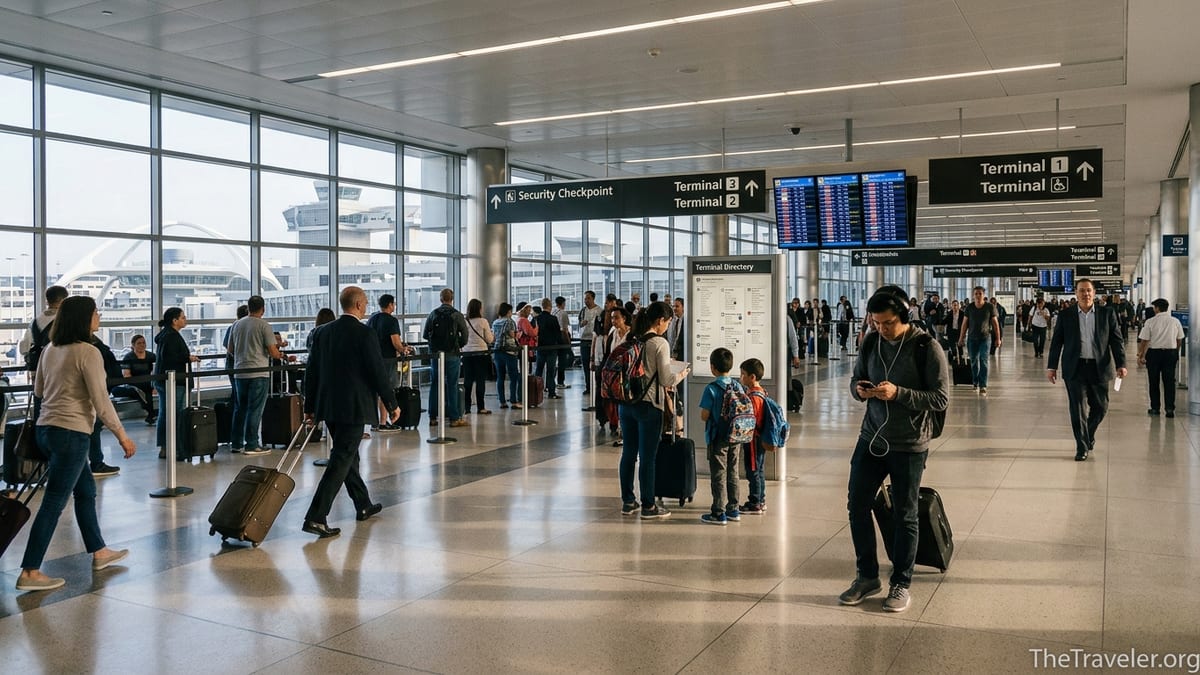
1. Understand the Horseshoe Layout Before You Arrive
LAX is arranged in a big U-shaped loop known locally as the horseshoe. There are nine terminals: 1 through 8 plus the Tom Bradley International Terminal, often labeled Terminal B. They all sit around a central road called World Way, with arriving traffic on the lower level and departing traffic on the upper level. Knowing roughly where your airline sits in that horseshoe can save you a surprising amount of time the moment you are dropped off.
Most domestic Southwest flights use Terminal 1, American Airlines is mainly in Terminals 4 and 5, Delta largely operates from Terminals 2 and 3, and United is in Terminals 7 and 8. International carriers are concentrated in Tom Bradley International Terminal, though some also depart from other terminals, so it is worth checking your exact departure terminal on your boarding pass or airline app the day before you fly. If you tell your rideshare or taxi “United, Terminal 7” instead of just “LAX,” you avoid a slow loop around the entire airport as the driver guesses the right stop.
Once inside, you can walk between several terminals on the secure side, but not all are equally connected. There is an airside corridor running from Terminal 4 through 8, including access to Tom Bradley, but walking from, say, Terminal 1 to Tom Bradley still means leaving security and re-clearing. If you are connecting, give yourself enough time for these walks; going from one end of the horseshoe to the other can easily take 20 to 30 minutes at a normal pace if crowds are heavy.
Right now the much-discussed SkyLink automated people mover connecting terminals, parking, the rental car center, and the Metro station is still in testing, with regular shuttle buses doing the work instead. That means you should still assume your own feet and the existing terminal loop shuttles will be your main tools for getting around once you are inside the airport footprint.
2. Time Your Arrival Around Realistic Security Waits
The standard advice to arrive two hours early for domestic flights and three hours for international is a good baseline at LAX, especially at peak times like early morning, late afternoon, and Sunday evenings. Security waits can vary by terminal and time of day, but typical averages hover around 10 to 20 minutes in normal conditions, with occasional spikes much higher before busy bank departures. What matters most is not the airport average but your specific terminal at your specific hour.
Use a live wait time tool or your airline app on the morning of travel to get a sense of current queues. Several services now provide terminal-by-terminal estimates, and some airlines show “short,” “medium,” or “long” waits inside their apps. If you see Terminal B reporting long lines while your domestic departure from Terminal 5 shows a short wait, you do not need to pad your schedule as heavily. On the other hand, if your red-eye out of Tom Bradley departs just after midnight on a Sunday, and wait times have been trending long, arriving the full three hours early is prudent.
A practical example: if you are on an 8:00 a.m. American Airlines flight to New York out of Terminal 4 on a weekday, plan to be dropped off by 6:00 a.m. That gives you enough buffer for a 20-minute bag drop queue, a 20-minute security line, and the walk to your gate, with a little left over to grab a coffee. For an 11:00 p.m. international departure from Tom Bradley, consider arriving by 8:00 p.m., because that terminal can see long bursts of traffic as multiple wide-body flights leave in a tight window.
Always factor in local traffic, especially if you are coming from central Los Angeles, Hollywood, or the Valley. A 30-minute drive at noon can turn into 70 minutes during the evening rush. Many Angelenos now build a “traffic cushion” of at least 30 extra minutes into whatever time a navigation app gives them for the drive to LAX.
3. Use TSA PreCheck, CLEAR, and Digital IDs Strategically
If you travel more than a couple of times a year through LAX, enrolling in TSA PreCheck or a trusted traveler program like Global Entry can be one of the best stress reducers. At LAX, nearly every terminal has PreCheck lanes that usually move faster than standard lines, especially in morning and evening peaks. In practice, that often turns a 25 to 30-minute standard wait into 5 to 10 minutes in the PreCheck lane, and the experience is easier because you generally keep your shoes and light jackets on and your laptop in your bag.
CLEAR operates in multiple LAX terminals and can be stacked with PreCheck. With CLEAR Plus, an ambassador verifies your identity via biometrics and walks you to the front of the relevant security lane. Travelers flying Delta, United, and certain partner airlines are especially likely to see CLEAR kiosks at their home terminals. This does not eliminate the security screening itself, but it typically shortens the time you spend zigzagging in the queue.
Another small but meaningful upgrade at LAX is the growing acceptance of digital IDs for security checks. Many travelers now use a mobile driver’s license or a digital ID in their smartphone wallet in place of a plastic card, which can simplify the document check. It is not universal in every line, so you should still carry your physical ID or passport, but when it works it can speed up the interaction at the front of the queue and reduce the fumbling that slows everyone down.
If you do not want to commit to a paid program, you can still apply these ideas tactically. Check whether your airline uses a dedicated priority or elite line at your terminal; even passengers with certain co-branded credit cards or premium cabin tickets sometimes get access to shorter security lanes. For example, a same-day business class ticket on a major international carrier at Tom Bradley often includes access to a priority check-in area and a separate, shorter security line that can shave 15 to 30 minutes off your total time.
4. Plan Smart Connections and Terminal Transfers
Connecting through LAX can be straightforward or stressful depending on how much time you allow and whether you need to re-clear security. If you are on a single ticket with the same airline or alliance, your bags are typically checked through, and your connection may be a simple airside walk between terminals. For instance, a Delta flight arriving in Terminal 3 and a Delta connection departing from Terminal 2 usually requires nothing more than following overhead signs and walking 10 to 15 minutes.
Complications arise when you change airlines or move between domestic and international flights on separate tickets. A common scenario is landing on a low-cost carrier in Terminal 1, collecting checked luggage, walking out to the curb, looping over to Tom Bradley, and then checking in for an international flight. That kind of move requires both landside transit and going back through security, which can easily take an hour or more in total. In those cases, aim for at least a 3-hour buffer between scheduled arrival and departure, more if you are arriving in the afternoon peak or checking bags.
If you have mobility challenges or are traveling with small children, build additional time into any inter-terminal connection. Some of the new walkways and connectors at LAX are long, and you may find yourself covering what feels like several city blocks between gates. Airlines can arrange wheelchair assistance with advance notice, and it is far easier to make that work when you have a generous connection time.
When in doubt, especially on separate tickets, treat LAX like two separate trips layered back to back. Ask yourself: if you were starting fresh at LAX for the second leg, how early would you want to arrive? Use that answer to set a safe minimum connection time. It is much less stressful to have an extra hour in a lounge or café than to sprint across terminals with a boarding group already lining up.
5. Beat the Curbside Chaos With Smarter Drop-offs and Pickups
One of the most stressful parts of LAX is not security or check-in but the curb outside the terminals. The upper departures level in particular can back up badly at busy times, with cars jockeying for a few feet of curb space while passengers pile out in a hurry. You can avoid much of that chaos with a few local strategies that regular LAX users swear by.
First, consider getting dropped off at a neighboring terminal and walking. For example, if traffic is gridlocked in front of Tom Bradley and you are flying out of there, it is perfectly reasonable to ask your driver to drop you at Terminal 4 or 5 and walk indoors to Bradley via the connectors. The walk is usually 10 to 15 minutes, often faster than sitting through a stalled traffic jam at the exact terminal door. Similarly, passengers flying from Terminal 1 sometimes find it easier to be dropped at Terminal 2 when the horseshoe entrance is backed up.
For rideshare pickups, LAX directs most app-based services like Uber and Lyft to designated zones. Depending on current policies, that may mean your driver collects you at a centralized pickup area rather than directly outside the terminal baggage claim. In practice, this involves following green signs for rideshares, joining a short queue, and then matching with a vehicle once you are in the correct zone. Allow 10 to 20 extra minutes for this, especially on weekend evenings or after large international arrivals, when queues can form at the pickup area.
If you value simplicity over price, traditional taxis and some premium rideshare options are often allowed closer to the terminals, which can save time if you are traveling with heavy luggage or a large group. The trade-off is cost: a metered taxi to central Los Angeles will typically run higher than a standard rideshare, especially in off-peak times, but you skip the walk and the wait at the centralized zone.
6. Make the Most of the LAX Rental Car Center and Public Transit
LAX’s new consolidated rental car center, located east of the airport near the 405 freeway, brings most major agencies under one roof. Instead of each company operating its own shuttle, a shared fleet of blue shuttles now carries passengers between the terminals and the center. In real terms, that means fewer overlapping buses clogging the loop and a more predictable journey to your rental car, but you still need to budget time for the transfer.
From baggage claim to the rental car center, plan on 20 to 30 minutes in typical conditions: about 5 to 10 minutes waiting for a shuttle and 10 to 20 minutes riding through traffic depending on where you are along the horseshoe. If you land at a busy time, adding a 10-minute buffer is wise. Returning your car works in reverse, and you should aim to have the keys back to the agency at least 60 to 90 minutes before a domestic flight and two hours before an international one to leave room for the shuttle ride and check-in.
Travelers looking to save money or avoid driving in Los Angeles traffic can use the LAX shuttle buses to reach the nearby Metro rail connection at the LAX/Metro Transit Center. From there you can ride the Metro system toward downtown, Santa Monica, or other parts of the region, often for a fraction of the cost of a taxi or rideshare. This is especially attractive for solo travelers with light luggage who are comfortable rolling a suitcase onto a train and appreciate the predictability of a set fare instead of a surge-priced car ride.
If you are staying at a hotel along Century Boulevard or near the airport, many properties still run their own courtesy shuttles from the terminals. Look for hotel shuttle signs on the lower arrivals level and check your hotel confirmation for details. In some cases, waiting 10 minutes for a free shuttle can be far cheaper and almost as fast as arranging a short rideshare hop for a single night’s stay.
7. Eat, Recharge, and Relax Like a Regular
Because LAX is such a busy connecting hub, its food and service options have improved considerably in recent years, particularly in Tom Bradley International Terminal and the remodeled domestic terminals. If you arrive early or face a delay, treating that time as a meal or coffee break can go a long way toward reducing stress. Think of the airport less as a holding pen and more as a compact food court and workspace.
Tom Bradley boasts one of the better food courts in the airport, with recognizable fast-casual chains alongside local Los Angeles brands. You might grab a burrito bowl, a salad, or a burger before a long-haul flight instead of relying on limited in-flight options. Terminals 4, 5, and 7 also have a decent mix of sit-down restaurants, bars, and grab-and-go counters, so you can match your choice to how much time you have before boarding.
Power outlets and USB ports are scattered throughout most gate areas, but they can be in high demand. A compact multi-port charger or travel power strip makes you a very popular person when every outlet is already in use. If you know you will need to work, scope out quieter corners a bit away from the main gate cluster. For example, walking just one or two gates past your boarding area often reveals unused seating even when the immediate gate zone looks full.
Lounges can also be a major stress reducer at LAX, particularly on long international itineraries. Major carriers and alliance partners operate lounges in several terminals, with Tom Bradley again being the most developed. Some premium credit cards offer access to independent lounges or give you day passes to airline lounges, which can be a worthwhile splurge when you need a shower, reliable Wi-Fi, or a quiet place to recharge between flights.
8. Pack and Prepare to Glide Through Security
Many of the security headaches at LAX come from travelers arriving at the checkpoint unprepared. You can remove a lot of friction simply by packing with the screening process in mind. That means avoiding loose metal items in your pockets, packing liquids in a clear quart-size bag that is easy to pull out, and wearing shoes that you can slip on and off quickly if you are not in a PreCheck lane.
Consider using a small pouch or zippered section of your carry-on for everything you know will need to come out: laptop, tablet, liquids bag, and any bulky electronics like cameras. When you reach the bins, you simply open that one compartment and move each item to the trays, instead of rummaging through multiple pockets. On the other side of security, you can reassemble everything in reverse order without clogging the end of the belt.
Families with children will have a smoother time if they talk through the process in advance. Let kids know that their backpacks and stuffed animals will go through the X-ray but come out on the other side. Place snacks and water bottles in an easy-to-access part of your bag so you can quickly dispose of or empty any liquids that exceed the limits before security staff have to pull them out. The more streamlined you make your bins, the less likely you are to trigger secondary bag checks that can add 10 to 15 minutes to your screening.
At LAX, certain terminals occasionally pilot newer screening technologies that may reduce the need to remove electronics or liquids. Even when those are in use, it is wise to follow the posted instructions for your specific lane. Being cooperative and ready tends to move you through faster and keeps the line flowing for everyone else.
9. Handle Delays, Cancellations, and Irregular Operations Calmly
With heavy traffic and ongoing construction projects, LAX is no stranger to delays and occasional operational disruptions. Weather issues elsewhere in the country, air traffic control constraints, or maintenance problems can quickly ripple through the departure boards. The key to minimizing stress is to use multiple channels of information and keep your options open.
Always install your airline’s app before you travel and log into your reservation. In many cases, the app will show a delay, gate change, or rebooking option before the information appears on the overhead screens or before a gate agent makes an announcement. If your flight is significantly delayed or canceled, you may be able to accept a new routing or even rebook yourself on a different flight directly in the app, saving a long wait in a customer service line.
If you do need human help, consider calling the airline’s customer service while you stand in line at the airport. Often a phone or chat agent can make changes faster than the overwhelmed staff at the counter. If you booked through a travel agency or an online travel company, their support teams can sometimes see additional inventory and alternative routings that are not obvious through the main airline channel.
During major disruptions, hotels along Century Boulevard and in nearby neighborhoods like El Segundo can fill up quickly with stranded passengers. If you suspect you may need to overnight near the airport, start checking room availability as soon as you see an extended delay or cancellation, not after everyone on your flight gets the bad news at the same time. It is much easier to cancel a backup room than to find a last-minute bed after everything has sold out.
10. Save Money and Time With Smart Parking and Drop-off Choices
If you are driving yourself to LAX, deciding where to park can have a big impact on both cost and stress. The closest options are the official LAX parking structures inside the horseshoe and the larger economy parking areas just outside the loop. The on-site structures are usually more expensive per day but offer the shortest walk or shuttle ride to the terminals, which is appealing for short weekend trips or travelers with bulky luggage.
Many travelers save money by using off-airport parking lots and garages located along Sepulveda Boulevard, Century Boulevard, and neighboring streets. These facilities typically run their own shuttles that loop between their lot and each terminal, often 24 hours a day. In practice, you might pay noticeably less per day than the official airport parking while adding only 10 to 20 minutes to your total transit time. Booking in advance, especially for holiday periods, can lock in better rates and reduce the risk of arriving at a “lot full” sign.
If a friend or family member is dropping you off, you can use the cell phone waiting lots located just outside the terminal loop. Your driver waits there for your text or call when you are ready to be picked up, rather than circling endlessly around World Way. This is particularly useful for arrivals in the evening, when curb space is tight and the temptation to stop in prohibited zones can lead to tickets or stressful encounters with traffic officers.
For very short visits, such as picking up someone who already has their bags and is waiting at the curb, a quick stop in the short-term parking structure can be cheaper than a ticket and far less stressful than competing for curb space. A 30 to 60-minute parking fee often compares favorably to the time and frustration cost of circling, especially when flights are slightly delayed and arrival times keep shifting.
11. Keep an Eye on Ongoing Construction and Future Changes
LAX is in the middle of a multi-year modernization program, with projects that affect terminals, roads, and transit connections. Construction can change traffic patterns around the airport, temporarily close certain lanes or walkways, and alter where shuttles pick up and drop off. Checking the airport’s official notices or local news coverage in the week before your trip can alert you to any major changes that might impact your plans.
Examples include lane closures on the main approach roads, adjustments to shuttle bus routes serving the rental car center or the Metro connection, and periodic changes in where rideshares and taxis are allowed to load. Travelers who ignore these updates sometimes find themselves surprised by a relocated pickup zone or a detour that adds 15 minutes to their drive. By contrast, those who scan a quick construction update before leaving home can choose alternate routes or allow extra time without undue stress.
As new facilities open, such as additional terminal expansions or improved transit links between the airport and the broader Los Angeles Metro system, the balance of what is fastest or easiest can shift. For instance, a direct people mover connection to the Metro station will eventually change the calculus for travelers deciding between rail and rideshare into the city. Staying loosely informed means you will be ready to take advantage of new options as soon as they become genuinely reliable for ordinary travelers.
Because LAX is a key gateway for major events, from global conferences to sporting tournaments, you may also encounter temporary surges or security measures linked to those occasions. If you are traveling during a known busy period, such as around large international matches or holidays, lean toward the conservative side with your timing and consider investing in expedited security or priority boarding options if they are available to you.
The Takeaway
Navigating Los Angeles International Airport does not have to be an ordeal. By understanding the basic horseshoe layout, giving yourself realistic time for security and terminal transfers, and using tools like TSA PreCheck, CLEAR, and airline apps, you can turn a potentially stressful experience into a mostly predictable one. Smart curbside strategies, thoughtful packing for security, and good use of food, lounges, and power outlets can make even long waits more bearable.
The common thread behind all eleven tips is simple: treat LAX as a system you can learn instead of a mystery you have to endure. A little homework before you arrive, combined with flexible backup plans for traffic, delays, and construction, will save you both time and stress. The airport will still be busy, but you will be moving through it with a traveler’s calm rather than a newcomer’s panic.
FAQ
Q1. How early should I arrive at LAX for a domestic flight? For most domestic flights, plan to arrive at the terminal about two hours before departure, slightly earlier during morning and evening peaks or busy holiday periods.
Q2. Is two hours enough for an international flight from LAX? Two hours is often tight for international departures, especially from Tom Bradley; three hours is a safer target, and more if you need to check bags or change terminals.
Q3. Can I walk between terminals at LAX without leaving security? Yes, several terminals are connected airside, particularly from Terminal 4 through Terminal 8 and Tom Bradley, but some connections still require exiting and re-clearing security.
Q4. Is TSA PreCheck worth it if I only fly through LAX a few times a year? If you value shorter security waits and a less stressful screening experience, PreCheck can be worthwhile even for a few trips, especially during peak travel seasons.
Q5. Where do Uber and Lyft pick up at LAX? Rideshare pickups are directed to designated zones signed at the terminals; follow the rideshare signs from baggage claim and allow extra time during busy hours.
Q6. How long does it take to get from the terminals to the rental car center? From baggage claim to the consolidated rental car center, expect roughly 20 to 30 minutes including shuttle wait time and the ride, plus a buffer at peak times.
Q7. What is the best terminal at LAX for food and amenities? Tom Bradley International Terminal generally has the widest selection of food and amenities, with several domestic terminals like 4, 5, and 7 also offering solid options.
Q8. Do I need a car in Los Angeles if I land at LAX? Not necessarily; you can use rideshares, taxis, hotel shuttles, and the Metro connection from the transit center, though a car can be convenient for exploring widely spread neighborhoods.
Q9. What should I do if my flight from LAX is delayed or canceled? Monitor your airline’s app, look for self-service rebooking options, and consider calling customer service while you queue at the airport for faster assistance.
Q10. Is it safe to plan a tight connection at LAX? Tight connections can work on a single ticket with the same airline, but if you must change terminals or re-check bags, aim for a generous buffer to reduce the risk of missing your onward flight.