


The moving dunes of Słowiński National Park near Łeba look like remote desert, but in reality they are a carefully managed protected area with specific access rules, paid transport options and longer walking distances than many visitors expect. Understanding the difference between getting to Łeba, reaching the Rąbka park entrance and finally standing on Łącka Dune will save you time, money and disappointment.
Get the latest updates straight to your inbox!
Łeba, Rąbka and Łącka Dune: Three Different Destinations
For planning, treat Łeba, the Rąbka entrance and Łącka Dune as three separate steps. First you reach the seaside town of Łeba on the Baltic coast, accessible by regional trains from Lębork and seasonal services from Gdynia, as well as regional buses including the Słupsk–Łeba line. Once in town you are still several kilometres from the national park’s main entrance at Rąbka, which sits on the edge of Lake Łebsko west of the centre.
From central Łeba to the Rąbka gate is roughly 3 to 3.5 kilometres along a paved road through forest and holiday developments. You can walk this in about 35 to 45 minutes, cycle it in 10 to 15 minutes or, in the main season, use local minibuses or electric tourist vehicles that shuttle from Łeba’s waterfront and Wojska Polskiego Avenue to the entrance. Even if you arrive in Rąbka by taxi or shuttle, private cars do not continue past the park gate.
The famous moving dunes begin several kilometres inside the park boundary. From the Rąbka entrance to the base of Łącka Dune is about 5.3 to 5.5 kilometres one way along a marked forest road and nature trail. A straightforward out-and-back walk from Rąbka to the dune and back is therefore around 11 kilometres, not counting detours to the beach or the former rocket-launcher site. Visitors who imagine the dune rising immediately behind the gate are often surprised by the distance.
This three-step geography matters when you are visiting without a car. A traveller starting at Łeba train station, walking to Rąbka and then out to the dune and back easily covers 17 to 18 kilometres in a half-day. Renting a bicycle in Łeba or using the seasonal electric carts from Rąbka significantly reduces effort and time, but they do not remove the need for at least some walking in sand.
Park Routes, Bicycles and Where You Must Start Walking
Słowiński National Park has an official network of walking and cycling routes, and on the Łącka Dune side most visitors follow the nature trail from Rąbka to the dune front. The main route is a wide, mostly flat forest road running roughly parallel to Lake Łebsko. Signboards and maps at Rąbka show a distance of just over 5 kilometres one way, which recent park materials and independent route measurements confirm.
Bicycles are allowed on this approach road from Rąbka towards Łącka Dune. The forest section is generally hard-packed and comfortable for standard trekking or city bikes. Families commonly rent simple single-speed or 3–7 speed bikes in Łeba and ride from the town through Rąbka to the foot of the dune. Cyclists share the route with walkers and with licensed electric carts, which increases congestion in July and August but keeps the surface reasonably firm.
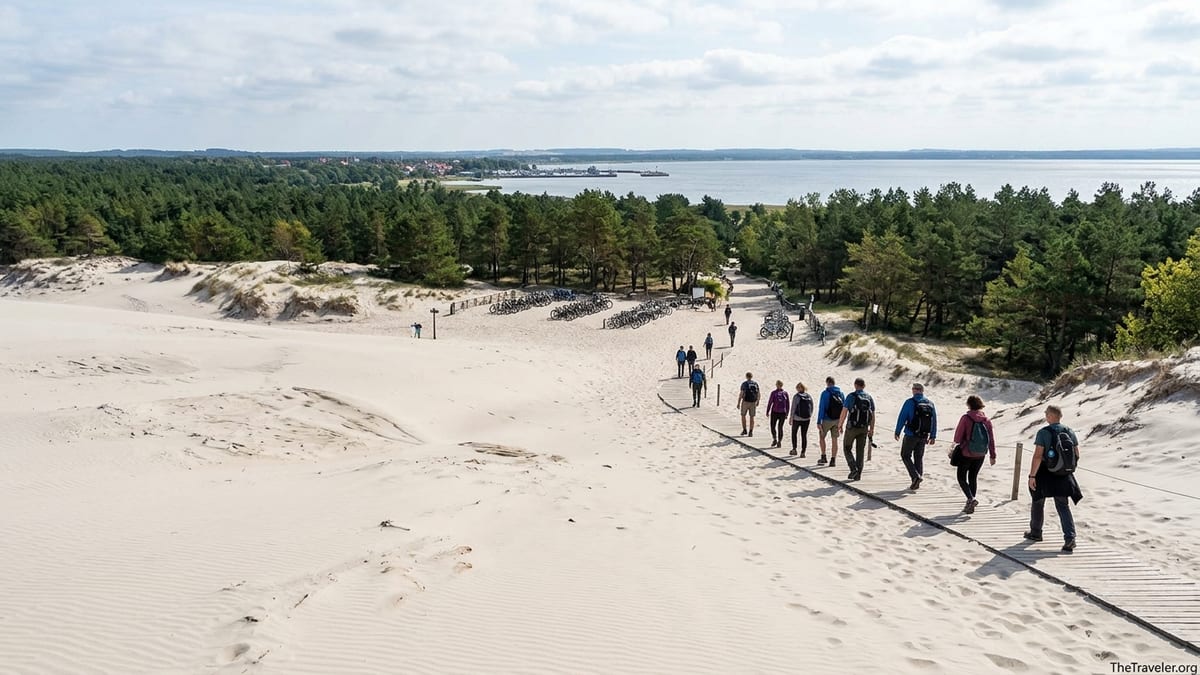
Crucially, bicycles cannot be ridden on the protected dune itself. The park requires bikes to be left at designated parking stands before the sand slope begins. Recent regulations and on-site signage assign specific “parking for bicycles and prams” near the dune front, and enforcement is fairly strict because the dune is part of a strict protection zone. From the bike stands it is several hundred metres of soft, loose sand to reach the main ridge and viewpoints.
Wheelchairs and strollers can be used along much of the forest road from Rąbka, especially the first kilometres where the surface is compact. However the final sandy section from the end of the forest track up to the dune ridge is not suitable: the sand is deep, the gradient is moderate and wheel traffic is not allowed beyond the marked limits. Visitors with reduced mobility can still enjoy the contrasting forest and lake views but should not expect to reach the highest dune crest.
Walking, Cycling and Electric Carts: What It Really Looks Like
Walking from Rąbka to Łącka Dune is the simplest and cheapest option. At an unhurried pace most visitors cover the 5.3 kilometre one-way route in about 1.5 hours, including photo stops and reading interpretive boards. The forest provides partial shade for much of the way, though the last stretch closer to the dune becomes progressively more open and sandy. A realistic plan for walkers from Rąbka is at least 4 hours for the round trip, plus time on the dune and beach.
Renting bicycles in Łeba is popular, especially with families and day-trippers from Gdańsk. Several rental outfits near Łeba’s main streets and harbour offer standard city bikes, children’s bikes, trailers and child seats. Recent price examples reported by visitors in 2026 show day rates in the range of 40 to 60 PLN per adult bike, with hourly rates around 15 to 20 PLN for shorter use. Most shops require a deposit or ID, and some allow you to pick up in town and drop back by early evening after returning from the park.
The electric visitor transport, often referred to locally as “melex” carts, operates on the same forest road. An official regulation in 2024 confirmed that licensed operators are allowed to run year-round on the Rąbka to Łącka Dune route, but in practice full-frequency tourist services concentrate in the summer season from roughly May to September. Recent price examples show a return ride from Rąbka to the dune costing about 35 PLN per adult, with child and discounted rates a little lower.
Timetables vary by operator, but one major company currently runs all the way from Rąbka to just beneath Łącka Góra before 11:00 and again after 17:00 in July and August, when dune-top crowds are heaviest. In the busiest midday hours, when the dune front is packed, those carts typically run only as far as the former rocket-launcher site, leaving about 1.8 kilometres of walking to reach the dune. Seats are first-come, first-served and in peak summer there can be queues, so factor waiting time into your schedule.
Tickets, Fees, Restrictions and the Rocket-Launcher Museum
Access to Słowiński National Park is regulated by a system of entrance tickets and separate fees for some facilities. According to the park’s current tariff for 2024–2025, the basic individual entrance ticket to the park’s tourist area costs 8 PLN for adults and 4 PLN for concession holders such as children, students and seniors. Family discounts, including for holders of Poland’s Large Family Card, are also recognised with lower per-person rates.
The entrance fee is payable at staffed ticket booths in Rąbka or via online systems promoted by the park and by local information portals. It covers entry to the marked routes, including the Rąbka to Łącka Dune trail and the beach section. It does not include paid attractions like private electric carts, boat cruises on Lake Łebsko or commercial sightseeing services. Organized groups, some school groups, active-duty military personnel and certain disabled visitors have exemptions or heavily reduced tickets under the park’s regulations.
The former rocket-launcher site, known locally as the “Wyrzutnia Rakiet”, lies roughly halfway between Rąbka and Łącka Dune along the same forest road. This makes it easy to combine with a dune visit. You can walk or cycle to the museum area, visit the small outdoor and indoor exhibits on missile testing history, then continue onward another two to three kilometres to the dune front. As of late 2026, indicative museum entry prices publicized by regional tourism sources are about 10 PLN per adult and 5 PLN per child, with additional fees for guided lessons aimed at school groups.
Because Łącka Dune lies in a strictly protected zone, visitors must follow marked paths and are not allowed to wander freely across sensitive areas. Fencing, ropes and warning signs indicate where access is forbidden to prevent erosion and protect pioneer vegetation. Climbing is allowed only on the designated dune ridge and viewpoints, and sliding down steep faces, sandboarding or taking plants and sand are prohibited. Regulations also restrict dogs on key sections of the trail; even on a leash, pets are not generally permitted on the core dune route from Rąbka, so check the latest rules if travelling with animals.
Weather, Wind, Sand and What the Walk Feels Like
The moving dunes exist because of the Baltic climate, and those same forces shape the visitor experience. Strong onshore winds blow dry sand inland at a rate measured in metres per year, slowly burying forests and creating the stark desert-like scenery. On the day you visit, those winds may feel refreshing or punishing. In exposed sections, gusts whip loose sand around ankle and knee height, which can be uncomfortable for children.
Even on days that feel cool in Łeba, temperatures on the dune surface can be much higher. The pale sand reflects sunlight, and without shade your body absorbs both direct radiation from above and reflected heat from below. In July and August, mid-afternoon visits regularly feel like walking in a dry, bright oven despite the proximity of the sea. Many visitors underestimate how draining the last sandy climb to the ridge can be after an 11 kilometre walk.
From the forest edge to the main dune ridge, the surface underfoot shifts from firmer sand with some roots to deep, powdery sand where each step sinks. In this upper zone progress slows significantly, particularly for small children or anyone carrying heavy bags. The lack of shade makes sun protection vital: a wide-brimmed hat, high SPF sunscreen, sunglasses and light, breathable clothing are more important here than on a typical Baltic beach stroll.
Windblown sand is also a real threat to electronics and cameras. On gusty days tiny grains lodge in lens rings, camera controls and phone ports. To protect gear, many photographers switch to a simple weather-sealed zoom lens before leaving the forest, keep cameras in padded pouches when not shooting and use clear filters or inexpensive UV filters to shield front elements. Wiping lenses with a dry cloth when sand is present can cause micro-scratches, so wait to clean glass until you are back indoors.
Distances, Difficulty and a Practical Half-Day Itinerary
From central Łeba railway station to the top of Łącka Dune and back entirely on foot is close to 18 kilometres. Breaking this down helps you assess difficulty. The town to Rąbka leg of about 3 to 3.5 kilometres each way is fully paved and easy. The 5.3 kilometre forest road from Rąbka to the dune base is almost completely flat on compacted sand and gravel. The final few hundred metres on the dune itself include the only real climbing and the deepest sand.
A fit walker accustomed to day hikes will find this a moderate outing, mainly due to length and exposure rather than steep terrain. Families with young children and visitors unused to longer walks often feel it as a strenuous half-day, especially in high summer heat. Using bicycles for the town and forest sections sharply cuts effort, leaving only the sandy climb on foot. Taking the electric carts further reduces physical demand but adds cost and some waiting time.
A realistic half-day itinerary for a car-free visitor might look like this. Start around 08:30 in Łeba, rent bicycles near the centre, and ride the 3 kilometres to Rąbka, buying park tickets at the entrance. Cycle the forest road to the bicycle parking near Łącka Dune, lock the bikes and walk the final sandy approach, reaching the ridge around 10:00 when the light is still soft and crowds thinner. Spend 30 to 45 minutes exploring the viewpoints and then descend to the Baltic beach for a short walk and perhaps a quick swim if conditions and lifeguard flags permit.
By late morning begin retracing your steps through the forest, optionally stopping at the rocket-launcher museum on the way back. With a relaxed pace and photo stops you are likely to be back in Łeba around 13:00 to 14:00, in time for a harbour lunch. Those relying on electric carts rather than bikes can follow a similar timetable, but should allow extra buffer for possible queues at the Rąbka cart stop, particularly in July and August or on sunny weekends.
Seasons, Facilities, Water and Food
The moving dunes are accessible year-round, but the character of the trip changes dramatically with the seasons. Summer, from late June through August, brings the warmest temperatures, the fullest range of transport services and the heaviest crowds. Electric carts operate to or towards the dune most of the day, bike rentals in Łeba are fully open and small snack stalls sometimes appear near Rąbka and by the rocket-launcher site. In this period, sun exposure, queues and afternoon thunderstorms are the main concerns.
In spring and autumn, cooler air and lower visitor numbers make walking more comfortable, though strong winds and showers are more frequent. Electric carts still run through much of May and September but may have reduced frequency outside school holidays. Some bike rental shops in Łeba shorten opening hours after mid-September. In winter the dunes take on a stark, beautiful character, sometimes dusted with snow, but days are short, winds can be brutal and sand or ice make the approach more tiring. Many commercial services, including some carts and seasonal snack stands, either stop entirely or run only on weekends, so you must confirm what will be operating close to your visit date.
Facilities on the route are limited. Toilets are available at Rąbka near the entrance and around the rocket-launcher museum. There are no permanent toilets at the dune ridge or on the beach section. Drinking water is not reliably available beyond Rąbka, and the Baltic sea water is not suitable for consumption. A sensible rule of thumb is to carry at least 1.5 litres of water per adult in summer, plus snacks or a light lunch, especially if travelling with children.
Food options directly on the route are basic and seasonal. At Rąbka you may find kiosks selling drinks, ice cream and simple fast food in summer, but choice dwindles shoulder-season and disappears in winter. The only reliable full meal options are back in Łeba, where harbour-side bars and restaurants serve fish, pierogi and other Polish staples well into the evening in peak season. For an early start and flexibility, most visitors carry sandwiches, fruit and high-energy snacks to eat either in the forest shade or on a quieter section of the beach west of the dune.
Budget, Gear and Who the Dunes Are For
For walkers travelling without a car, a realistic budget for a summer 2026 visit from Łeba is relatively modest. Park entry will cost around 8 PLN per adult and 4 PLN per child. If you choose to walk from town to Rąbka and along the forest road, there are no further compulsory fees. Adding a simple picnic bought in Łeba’s supermarkets may add 20 to 40 PLN per person depending on taste, bringing a bare-bones half-day outing to roughly 30 to 50 PLN each.
Cyclists should factor in bike rental on top of park entry. With typical day rates of 40 to 60 PLN for adult bikes and somewhat lower for children, a family of four might spend 160 to 200 PLN on rentals plus another 24 PLN for park tickets. Optional extras, such as entry to the rocket-launcher museum and occasional treats at Rąbka kiosks, can push the total towards 230 to 260 PLN. Using electric carts instead of bikes, at about 35 PLN per adult for a return ride from Rąbka to the dune, a couple might spend 70 PLN on transport and 16 PLN on park fees, not including any bus or taxi between Łeba and Rąbka.
For most visitors, the essential gear list is straightforward. Sturdy sandals or breathable walking shoes with closed toes work better than flip-flops, which clog with hot sand on the dune slope. A small daypack for water, snacks, a light fleece or windbreaker even in summer, sun protection and a basic first-aid kit increases comfort and safety. For photographers, an inexpensive protective filter, a cloth bag around the camera when not in use and a sealable plastic pouch for phones and memory cards can reduce the risk of sand damage.
The dunes reward travellers who enjoy landscapes and do not mind effort. Nature photographers, hikers, families with outdoorsy children over about eight years old and visitors who appreciate quiet moments looking over lake, forest and sea are likely to find the trip deeply memorable. People who dislike wind and sand, those with significant mobility limitations who wish to reach the very top of the dune, or travellers expecting a quick ten-minute stroll from bus to viewpoint may come away frustrated. Managing expectations and matching your plan to your fitness and interests is key.
Checklist, Easier Alternatives and Final Verdict
Before setting out, run through a simple checklist. Confirm how you will reach Rąbka from Łeba without a car, whether by walking, rented bicycle or seasonal shuttle. Check that you have park entrance fees in cash or a means of electronic payment accepted at the gate. Pack sufficient water, sun protection and a windproof layer. If you plan to use electric carts or visit in shoulder or off season, verify current operating dates and times at the Łeba tourist information office or through up-to-date local sources, since services change more often than park regulations.
A lower-effort alternative for those unsure about the full dune walk is to focus on the forest approach and lakeside atmosphere rather than the highest dune crest. You might, for example, take an electric cart from Rąbka to the rocket-launcher museum, explore the exhibits, then stroll a short way further into the forest without committing to the full sandy climb. Another option is to enjoy Łeba’s town beaches and short coastal walks east of the harbour, which offer easy access to dune-backed sands without the long distances or strict protection rules of Łącka Dune.
In an honest assessment, the moving dunes are one of Poland’s most distinctive natural spectacles, but they are not a casual photo stop. Reaching them from Łeba without a car involves real distance, exposure to wind and sun, and at least a final stretch of soft sand. With good preparation, sensible budgeting and realistic timing, a half-day at Łącka Dune can be a highlight of a Baltic itinerary. For those willing to walk or cycle and embrace a little discomfort in exchange for an unusual landscape, the shifting sands of Słowiński National Park are well worth the effort.