


Perched high above the clouds on La Palma, the Roque de los Muchachos Observatory (Observatorio del Roque de los Muchachos, ORM) is one of the world’s leading astrophysical research sites. It hosts a cluster of powerful international telescopes and operates as a working scientific facility, not as an open museum you can freely wander around. Visiting is possible and rewarding, but it follows strict rules, fixed visiting slots and controlled access that travelers must understand before planning a summit day.
Get the latest updates straight to your inbox!
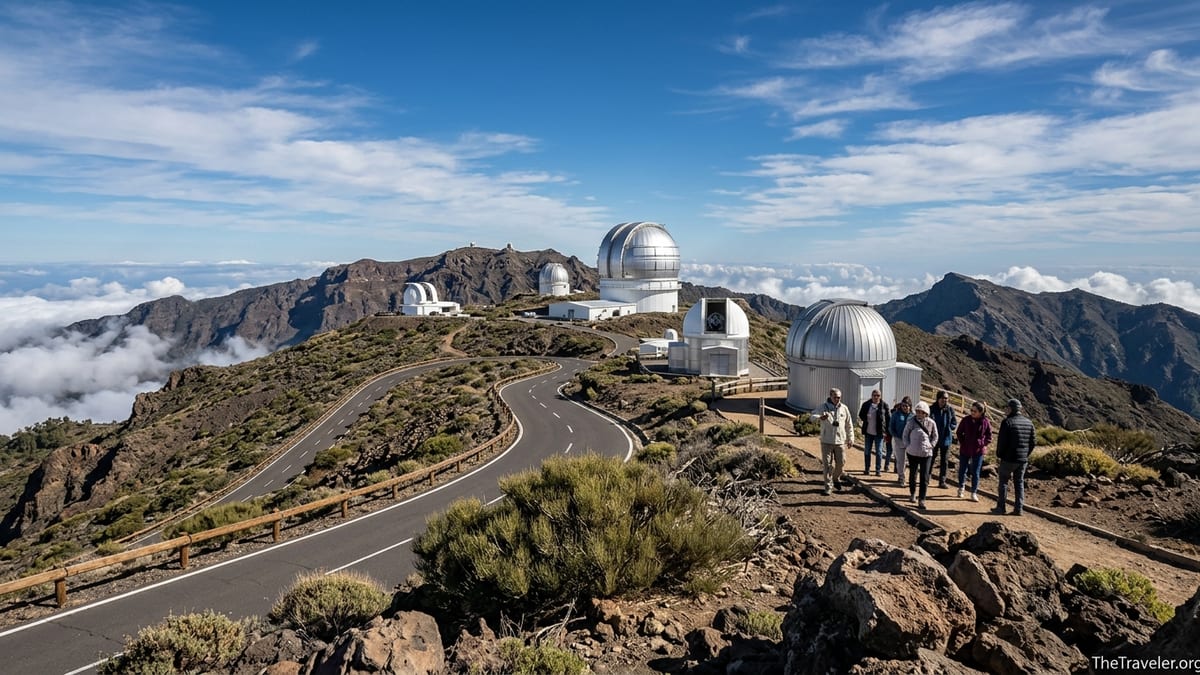
What the Roque de los Muchachos Observatory Actually Is
The Roque de los Muchachos Observatory sits near the highest point of La Palma at around 2,400 meters above sea level. It forms part of the Observatorios de Canarias run by Spain’s Instituto de Astrofísica de Canarias and brings together many international telescopes operated by different countries and research consortia. These include large optical and infrared facilities and several specialized instruments devoted to solar, gamma ray and robotic observing.
For visitors, the crucial point is that ORM is a professional research campus, not a theme park. Roads and viewpoints around the summit are open to the general public during the day, but access to telescope buildings and their immediate compounds is tightly controlled. You cannot simply drive inside a dome or walk unescorted around the instrument areas on a whim, and individual telescopes manage access according to their own operational needs.
Public outreach forms part of the observatory’s mission, so a regular program of guided daytime visits is offered whenever scientific operations and weather allow. These official visits give a curated glimpse of the facilities and the science without interfering with night‑time observing. Space on these tours is limited and planning begins online, well before you turn the steering wheel onto the LP‑4 mountain road.
It is also important to separate the observatory from the summit viewpoints and the Roque de los Muchachos Visitor Centre. You can visit the viewpoints and the visitor centre independently during their opening hours, but entering the working observatory area or stepping inside a professional telescope generally requires a pre‑booked guided visit.
Daytime Only: What an Observatory Tour Typically Involves
Public visits to ORM are daytime only. At night the observatory is closed to the public for both scientific and safety reasons, and the site is governed by strict sky‑protection rules that limit light and traffic. Night‑time astronomy activities for tourists on La Palma are organized at external viewpoints and stargazing sites, not inside the observatory perimeter.
According to the official visit information, tours for private individuals are led by trained “Starlight Guides.” These guides are certified in both astronomy outreach and the specific safety procedures required at ORM. Group sizes are deliberately kept small so that a telescope control room or platform is not overcrowded, and to ensure each group can move efficiently around sensitive infrastructure.
Typical public visits last around 90 minutes from meeting time to farewell, provided conditions and operations cooperate. The usual structure is a welcome and introduction at or near the Roque de los Muchachos Visitor Centre, followed by an exterior tour of part of the site and, if operations permit, entry into one of the telescopes. Inside, the guide usually explains how the dome and mirror systems work, what instruments are mounted, and how the team protects dark skies and image quality. Final details are always subject to last‑minute operational needs, so guests should expect some flexibility.
The specific telescope included on any given day can change depending on maintenance schedules, scientific programs and safety considerations. The observatory itself warns visitors not to assume a particular named facility will be part of the visit. When booking, you should read the current tour description carefully and accept that telescope access is always “subject to availability” rather than guaranteed.
How Booking Works: Channels, Languages and Eligibility
For individual travelers, the observatory’s official position is clear: visits must be reserved in advance through an authorized system. As of late 2026, the Instituto de Astrofísica de Canarias directs private visitors to book through the Starlight Foundation’s online platform or through partner tour operators that use the same allocation. Same‑day, walk‑up access to telescope buildings without a reservation is generally not allowed and the on‑site staff cannot “add” casual visitors to a full group.
Most tours are offered with guiding in Spanish and English, sometimes in separate monolingual groups and sometimes in mixed bilingual commentary depending on demand and the operator. Other languages may be available with specific tour companies, but these are not guaranteed by the observatory and should not be assumed. If language is essential for you, select a tour explicitly labeled in your preferred language at the time of booking.
Age restrictions apply because of safety, building infrastructure and insurance conditions. Current information from operators that work with the observatory indicates that children under about six years old are typically not admitted to telescope tours, even if they can reach the summit, due to stairways, confined spaces and emergency procedures. Families should always verify the exact minimum age on the reservation page before paying, as rules may be tightened or relaxed over time.
Visitors must bring a booking confirmation or ticket and a valid ID that matches the booking name. Security guidelines encourage guides to check names before allowing access beyond the external parking and common areas. Although ORM is not an airport‑style facility with scanners for regular public tours, expect basic identity checks at minimum and be prepared to follow any updated screening steps that may be introduced in response to wider security policies.
Getting There: Access Roads, Meeting Points and Practical Logistics
The observatory crowns La Palma’s backbone on the LP‑4 road, which climbs to the summit from both Santa Cruz de La Palma on the east and the Garafía side on the northwest. There is no routine public bus linking coastal resorts directly to the observatory gate, so almost all visitors arrive either by private rental car or with a prearranged excursion coach or minibus provided by a tour company.
The official visitor guidance emphasizes that ORM does not provide transport. Reaching the meeting point is entirely your responsibility, and late arrivals are treated as no‑shows once a tour has departed. The drive from Santa Cruz or Los Cancajos typically takes around 70 to 90 minutes depending on roadworks, weather and traffic, and includes many curves, steep gradients and sections exposed to cloud banks. Drivers who are not accustomed to mountain roads should allow generous extra time.
Public information from the observatory and local tourism bodies underlines the need to check weather forecasts, road conditions and any civil protection advisories before setting off. Because the site sits above 2,000 meters, winter snow, ice or strong winds can close stretches of LP‑4 with little notice. The observatory follows island safety protocols and may cancel visits if access becomes unsafe, even on the day of the tour. In those cases, visitors are normally informed through the booking platform or their tour operator and offered refunds or rescheduling, according to each provider’s policy.
When you reach the observatory complex, you are usually instructed to park near the first main building just past the turnoff into the site or at the Roque de los Muchachos Visitor Centre parking, depending on your tour instructions. The official visitor recommendations specify that guides meet groups in the designated parking area and that participants must bring their reservation receipt to be admitted. Independent wandering into unauthorized service roads or telescope compounds while you wait is not permitted.
On‑Site Rules and Visitor Conduct Inside a Working Observatory
Once inside the observatory grounds, you are expected to follow both general safety rules and specific instructions from your Starlight Guide. Official regulations ask visitors to stay with their assigned group at all times, wear seat belts when moving vehicles within the site, and obey posted speed limits and internal traffic signs. Areas not explicitly included in the tour are off‑limits, even if a gate appears open.
Because ORM is recognized for its exceptionally dark skies and protected under regional “sky law” regulations, light discipline is a constant priority. Even by day, visitors are asked not to use high‑powered torches, flashes or other strong lights near telescope buildings. Inside domes or control rooms, flash photography and video lighting are typically prohibited, and guides may ask you to dim camera screens. The use of tripods or bulky equipment is sometimes restricted in tight spaces or where cables and floor tracks pose a tripping hazard.
The observatory’s guidelines also prohibit smoking in all buildings and common areas, in line with Spanish public health rules. Littering is not tolerated; the summit lies in a protected pre‑park zone bordering Caldera de Taburiente National Park, and visitors are asked to use designated waste points or carry rubbish back down the mountain. Pets are not suitable for these visits and are usually not allowed on tours, both for safety and hygiene reasons.
If protective clothing such as hard hats, coats or shoe covers is provided near a telescope entrance, visitors must wear them as instructed. These measures are designed to protect both people and delicate optical surfaces from dust and accidental damage. Attempting to touch mirrors, instruments or control panels is strictly forbidden, and the guide may shorten or modify the tour if rules are ignored.
Health, Accessibility and Altitude: Is the Tour Right for You?
Standing at about 2,400 meters, the Roque de los Muchachos Observatory is high enough that some visitors feel mild altitude effects such as shortness of breath, lightheadedness or fatigue, especially when climbing stairs quickly. Official visitor recommendations advise people with cardiovascular conditions, severe respiratory problems, uncontrolled high blood pressure or anemia to consult a doctor before planning the trip. Even healthy travelers should hydrate well, avoid heavy alcohol the night before and move slowly on staircases and ramps.
Inside the observatory, several telescope buildings are reached via outdoor paths, steps or gently sloping access roads. Once at a dome, you may face additional internal stairways or occasionally narrow ladders between levels, depending on which facility is used for the visit. Handrails are usually present, but lifts are not guaranteed. For this reason, tour operators and the observatory caution that visits are not fully accessible in every case for those with significantly reduced mobility.
Some local tour companies explicitly invite travelers with accessibility needs to contact them before booking so that they can assess whether the current visit configuration is suitable. In practice, if you use a wheelchair or have difficulty with multiple flights of stairs, you may be able to enjoy the drive, viewpoints and visitor centre but find certain telescope interiors impractical. The best approach is to describe your mobility level when enquiring and to request the latest information on step counts and access routes.
Outdoors, temperatures at ORM can be significantly lower than on the coast, even in summer, and wind can be strong. The official advice is to bring closed footwear, warm layers and sun protection. Conditions can switch quickly from bright sunshine to cold cloud. Dressing in layers and carrying a light jacket is wise all year.
Costs, Tickets and Cancellation Policies
Public telescope visits at ORM are not free, although the observatory itself does not treat them as a profit‑making activity. Ticket revenues typically support the guiding service and associated visitor infrastructure. As of the latest information in late 2026, typical prices for daytime observatory tours offered through licensed operators fall in a moderate range that reflects the small group sizes and specialized guiding. Some operators publish reduced prices for children above the minimum age threshold and for local residents, while others apply a flat rate for all adults.
Exact prices, discounts and what is included can vary between booking channels. Some tours bundle transport from coastal towns, summit viewpoints and the Roque de los Muchachos Visitor Centre with the observatory visit itself; others only cover the guided portion inside the observatory and expect you to arrive independently. When comparing options, check carefully whether your ticket includes hotel pickup, summit photo stops, or only the on‑site scientific part.
Cancellation conditions also differ. In general, when the observatory or public authorities close access because of weather or safety alerts, reputable operators offer either a full refund or rescheduling to another date, since the closure is outside the traveler’s control. For traveler‑initiated changes, such as illness, missed ferries or late arrival at the meeting point, stricter rules usually apply. Some providers allow free changes up to a certain number of hours or days before the tour, while others impose a percentage fee or treat late cancellations as nonrefundable.
Because policies and prices change periodically, travelers should treat any example figures as indicative only and always verify the current rate and conditions on the chosen booking platform just before purchase. Saving a screenshot or confirmation email with the terms at the time of booking can reduce disputes if the weather turns or plans change.
Visitor Centre, Viewpoints or Full Observatory Tour: Which to Choose?
Not every traveler needs to go inside a professional telescope to appreciate Roque de los Muchachos. The summit viewpoints and the Roque de los Muchachos Visitor Centre already provide impressive panoramas of the Caldera de Taburiente and detailed exhibits on the island’s astronomy. For many visitors who are primarily seeking scenery or who travel with very young children or mobility constraints, combining the viewpoints with the visitor centre can be a satisfying summit day without entering the observatory grounds.
However, the guided observatory visit is a clear highlight for science enthusiasts, amateur astronomers and technically minded photographers. It is particularly worthwhile if you are curious about how large telescopes are engineered and operated, or if you want to understand the “dark sky” protections that keep La Palma an astrophysical powerhouse. Teenagers with an interest in STEM subjects often find the experience inspiring, although you should confirm minimum ages and be realistic about their tolerance for technical explanations.
Astrophotographers should remember that the observatory tour is not a night‑time imaging session and that tripod use may be limited inside. For deep‑sky photography, it is better to combine the daytime visit with a separate nocturnal stargazing outing run from approved viewpoints outside ORM. Tour companies across La Palma specialize in these night experiences and coordinate their locations with sky‑protection rules so that scientific observations are not disturbed.
Whichever option you choose, planning should begin with securing a place on the observatory tour if entering telescope buildings is important to you. Availability is constrained by operational schedules and group size limits, especially in high season. Once you have a confirmed slot, you can build the rest of your summit day around it, adding the visitor centre, short walks along the rim paths and perhaps an evening stargazing tour elsewhere on the island to complete your La Palma astronomy experience.