


More news on this day
Hundreds of passengers across Europe faced long queues, missed connections and unexpected overnight stays after more than 40 flights were cancelled and at least 804 were delayed on Sunday at major hubs including Stockholm, Madrid, Athens, Rome, Amsterdam, Berlin, Barcelona, Zurich, Geneva, Brussels, Dublin, Copenhagen and several airports in the United Kingdom, France and the Netherlands.
Get the latest news straight to your inbox!
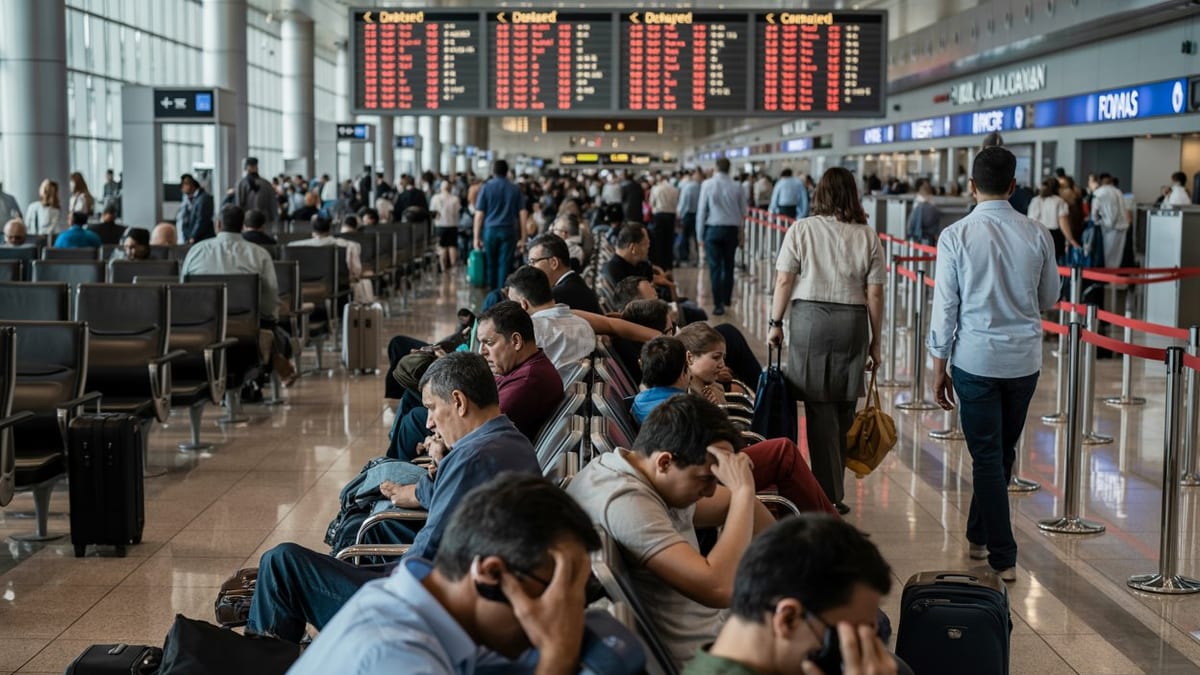
Wide Network Disruption Across Key European Gateways
Publicly available flight tracking dashboards for late May 2026 indicate a fresh wave of disruption sweeping through Europe’s busiest air corridors, with cancellations and rolling delays hitting both short haul and medium haul services. Data summarising operations on Sunday points to at least 40 outright cancellations and more than 804 delayed departures and arrivals across the continent’s main gateways.
The impact is most visible at large transfer hubs that connect northern and southern Europe. Madrid Barajas, Rome Fiumicino, Amsterdam Schiphol and Barcelona El Prat all reported elevated delay levels, with departure boards dominated by late running services and revised estimated times. Similar patterns were recorded at Zurich and Geneva in Switzerland, as well as Berlin and Brussels, where knock on effects from earlier disruptions added to the backlog.
In Scandinavia and the North Sea region, passengers travelling through Stockholm Arlanda and Copenhagen Kastrup encountered long waits as late arriving aircraft from earlier sectors cascaded through evening schedules. Dublin and major airports in the United Kingdom and France also experienced clusters of delayed services, creating particular difficulties for travelers with tight connections or same day return plans.
While the absolute number of cancelled flights is modest compared with some recent strike days or extreme weather events in Europe, the breadth of affected airports means that disruption was felt across a wide geographic area. Even airports with fewer direct cancellations experienced secondary delays as crews and aircraft found themselves out of position.
Operational Pressures Behind Cancellations and Delays
Published aviation statistics and previous punctuality reports for European airports highlight a combination of recurring factors that can produce the kind of network strain seen on Sunday. Seasonal storms, low cloud and shifting wind patterns frequently reduce runway capacity at hubs such as Amsterdam, Madrid and London, while tight turn times and high aircraft utilisation leave little buffer when schedules slip.
In several recent disruption episodes, European carriers have also adopted a strategy of targeted cancellations to protect the remainder of the network. When conditions deteriorate or bottlenecks emerge at one or two key airports, airlines may proactively cancel selected rotations to free up aircraft and crews, thereby limiting the risk of widespread last minute delays later in the day. Industry data from earlier this year shows similar patterns at Amsterdam, Copenhagen, Stockholm and Barcelona, where concentrated pockets of cancellations coincided with broader waves of delay.
Airport punctuality reports for the past year show that while many large European hubs operate with on time performance rates around or above 70 percent over a typical month, there are frequent days when adverse weather or capacity constraints drive average delays sharply higher. The current disruption appears consistent with that pattern, with several airports that normally post relatively strong punctuality figures experiencing temporary spikes in late running services.
Air traffic control capacity, runway maintenance and congestion in crowded airspace over western Europe can also amplify the effects of local problems. When holding patterns build up over France, Germany or the Benelux region, arrivals into cities such as Brussels, Amsterdam, Frankfurt and Paris may be spaced further apart, forcing airlines to adjust subsequent departures and reroute aircraft.
Travelers Face Missed Connections, Extra Costs and Limited Options
The operational pressures translated directly into difficult choices for passengers. Reports from affected airports describe crowds forming around customer service desks, with travelers seeking rebooking, hotel vouchers or clarification on their rights under European air passenger regulations. Families, business travelers and tourists heading into late spring holidays all faced the prospect of extended terminal waits or unexpected overnight stays.
Missed connections were a particular problem at hubs such as Amsterdam, Madrid and Rome, where many passengers rely on tight transfer windows to reach onward flights to smaller European cities or long haul destinations. A delayed inbound service of even 60 to 90 minutes can be enough to trigger a chain of failed connections, especially in the evening bank of flights when onward options are limited.
Publicly available guidance from consumer and passenger rights organisations notes that travelers on flights departing from or arriving into the European Union, the United Kingdom, Norway, Iceland or Switzerland may be entitled to assistance, rerouting and in some cases financial compensation, depending on the length of delay, the distance of the flight and the underlying cause. However, eligibility depends on whether the disruption is considered within the airline’s control, which can be a complex assessment in situations involving both weather and operational factors.
For those stranded at outstations such as secondary UK airports or regional French and Dutch fields, the lack of spare capacity on alternative services made same day rebooking particularly challenging. In some cases, passengers turned to rail or long distance coach options to complete their journeys when replacement flights were not available at acceptable times.
Ongoing Vulnerability of Europe’s Air Network
The latest wave of cancellations and delays underscores the ongoing vulnerability of Europe’s dense and interconnected air transport system to relatively small shocks. With many airlines operating tight schedules and terminals already busy in the run up to the peak summer season, any disturbance can quickly ripple across borders and carriers.
Recent disruption episodes in late winter and early spring highlighted similar themes, with weather and capacity constraints at a handful of large hubs leading to hundreds of cancellations and thousands of delays over the course of a day. The pattern seen on Sunday, with dozens of cancellations and more than 800 delays spread across Stockholm, Madrid, Athens, Rome, Amsterdam, Berlin, Barcelona, Zurich, Geneva, Brussels, Dublin, Copenhagen and airports in the United Kingdom, France and the Netherlands, aligns with this broader trend.
Aviation analysts note that investments in air traffic management modernisation, better staffing resilience and more conservative scheduling could help reduce the frequency and severity of such events, but these measures take time to implement. In the meantime, consumer information services and flight tracking platforms have become increasingly important tools for passengers seeking to anticipate problems and adjust their plans in real time.
As airlines and airports work through the backlog from the latest disruption, attention is already turning to the coming weeks, when traffic volumes are expected to rise further. Travel industry observers indicate that passengers planning trips through Europe’s main hubs in early summer may benefit from building in longer connection times, monitoring flight status closely and considering early morning departures, which are less exposed to cumulative delays.
What Passengers Can Do When Disruption Hits
Travel experts commonly recommend that passengers take a proactive approach when signs of disruption emerge. Checking flight status regularly from 24 hours before departure and enabling notifications in airline and airport apps can provide early warning of schedule changes. When delays appear likely, some travelers are able to move to earlier services on the same route, reducing the risk of missed connections later in the day.
Passenger advocacy organisations advise keeping detailed records of the disruption, including boarding passes, booking confirmations and receipts for meals, transport and accommodation. These documents can be important when submitting claims for reimbursement or compensation under European and UK regulations that govern lengthy delays and cancellations.
In situations where large numbers of flights are affected simultaneously, flexibility can also improve outcomes. Being open to alternative routings through less congested hubs, accepting nearby airports within the same metropolitan area or considering multimodal options such as rail can sometimes lead to faster arrival than waiting for the next direct flight from a heavily impacted airport.
With Sunday’s cancellations and more than 804 delays highlighting once again how quickly routine travel plans can unravel, industry observers suggest that passengers treat contingency planning as a standard part of booking trips through Europe’s busiest hubs, particularly during seasons prone to weather and operational strain.