


More news on this day
Hundreds of air travelers across Europe faced another bruising travel day as at least 40 flights were cancelled and 804 delayed at airports including Stockholm, Madrid, Athens, Rome, Amsterdam, Berlin, Barcelona, Zurich, Geneva, Brussels, Dublin, Copenhagen and multiple hubs in the United Kingdom, France and the Netherlands, according to real time disruption dashboards and aviation data compiled for Sunday.
Get the latest news straight to your inbox!
Widespread Disruption Across Key European Hubs
Publicly available flight monitoring data for late May 2026 indicates a fresh pocket of disruption concentrated along some of Europe’s busiest air corridors, with cancellations and delays rippling from Scandinavia to the Mediterranean. The latest figures show at least 40 flights cancelled and 804 delayed across a network of major hubs, leaving departure boards flashing red and terminals crowded with stranded passengers.
Operations at Stockholm Arlanda, Madrid Barajas, Athens Eleftherios Venizelos, Rome Fiumicino and Amsterdam Schiphol were among the hardest hit, alongside Berlin, Barcelona El Prat, Zurich, Geneva, Brussels, Dublin and Copenhagen. Additional disruption was recorded at large airports in the United Kingdom, France and the Netherlands, where knock on effects compounded the difficulties faced by travelers already en route.
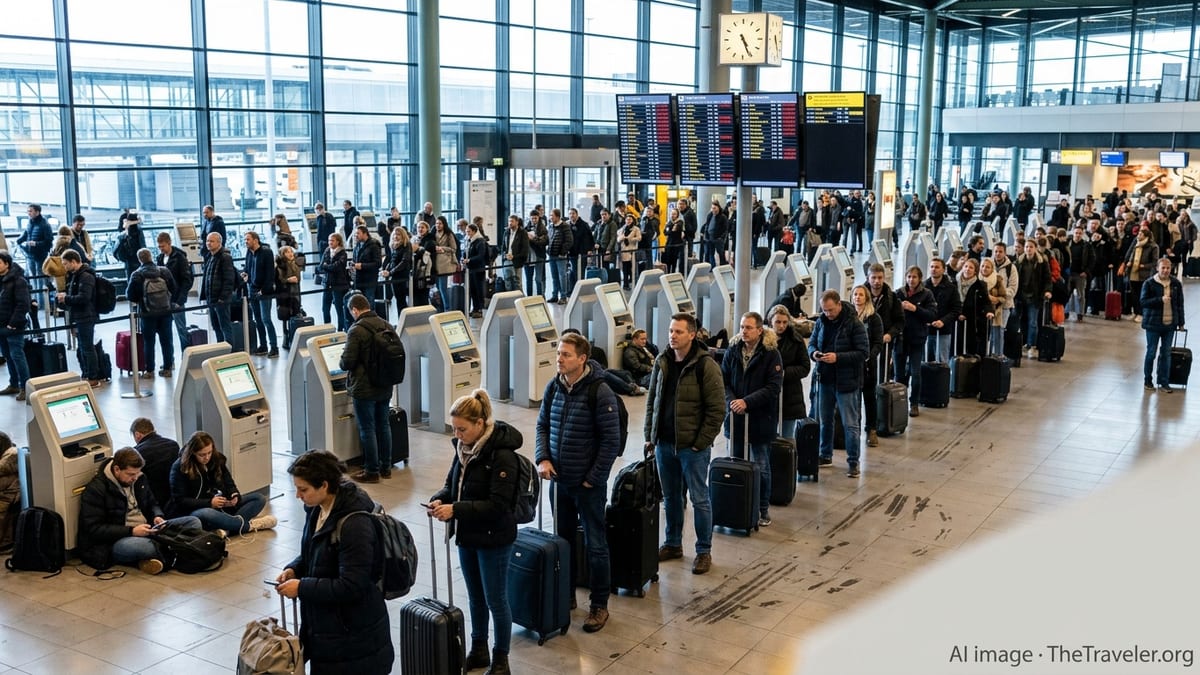
Coverage from European travel and aviation outlets describes passengers stuck in lengthy lines at customer service desks as they seek rebooking options, hotel vouchers and information about their rights. In several cities, evening banked waves of departures were still trying to clear earlier backlogs, contributing to late night and overnight delays.
Weather, Congestion and Knock On Scheduling Problems
While a single underlying cause has not been identified, recent reports from aviation analysts and passenger rights organizations highlight a combination of factors driving the latest wave of disruption. Unsettled weather over parts of western and southern Europe has led to temporary air traffic control restrictions and rerouting, which in turn reduced capacity and pushed some flights into extended holding patterns.
At the same time, high spring demand and tight aircraft and crew utilization have left airlines with little slack when schedules begin to slip. Earlier disruptions in recent days at hubs such as Amsterdam, Copenhagen, Madrid and Paris have already been documented, and industry trackers note that these kinds of incidents can produce rolling effects for several subsequent rotations.
Air travel data from recent months also points to persistent congestion at many of the airports now affected. Annual punctuality reports for Europe list Amsterdam, Stockholm, Athens, Barcelona, Brussels, Copenhagen, Dublin, Rome, Zurich, Berlin and Geneva among the continent’s high volume hubs, where any reduction in runway or airspace capacity can quickly translate into cascading delays.
Stranded Travelers Face Missed Connections and Overnight Stays
The latest disruption has left hundreds of travelers stranded both at origin airports and mid journey connection points. In practical terms, this means missed long haul links, abandoned short city breaks and unplanned overnight stays in hotels or on terminal benches as passengers wait for replacement flights or morning departures.
Published coverage from passenger advocacy groups describes families separated across different flights, tour groups attempting to reroute via alternative hubs and business travelers scrambling to secure last minute rail tickets on already busy cross border routes. Where cancellations have occurred late in the day, some travelers have reported limited availability of same day alternatives, especially on popular leisure routes linking southern Europe with northern capitals.
Rail and coach operators have seen periodic spikes in demand whenever major airports such as Amsterdam, London, Paris, Brussels or Frankfurt encounter widespread delays. When air traffic backs up at nodes like Copenhagen or key Western European hubs, services linking nearby cities often become the fallback for passengers seeking to salvage their trips.
Rights and Options for Affected Passengers
Consumer organizations are once again drawing attention to the protections that apply to many of the flights now affected. For services departing from EU, EEA, Swiss or UK airports, and for flights into those regions on qualifying carriers, regional air passenger regulations can provide rights to care, rebooking or in some cases financial compensation, depending on the cause and length of delay and the distance of the journey.
Public guidance from passenger rights specialists advises travelers to retain boarding passes, booking confirmations and receipts for meals, transport and accommodation obtained while stranded, as these can support any later claims. Passengers are also encouraged to take screenshots of flight status information and any notifications received through airline apps.
However, the extent of compensation can vary significantly. If disruption is ultimately attributed to circumstances considered outside the airline’s control, such as certain categories of severe weather or air traffic control restrictions, travelers may be entitled only to rerouting or refunds rather than additional monetary payments. Operational or scheduling issues within the airline’s control may trigger broader obligations.
Practical Advice for Upcoming Travelers
With schedules still recovering across parts of the European network, travel advisers recommend that anyone due to fly in the coming days build extra resilience into their plans. Checking flight status frequently via airline apps, signing up for push notifications and monitoring airport information screens shortly before leaving for the airport can help reduce the risk of unnecessary trips to the terminal.
Passengers with essential same day connections, such as long haul onward flights or time sensitive events, are being urged to consider longer layovers where possible or to route through hubs that currently show fewer disruptions. For shorter regional trips, flexible train tickets may be worth evaluating as an alternative when air services appear particularly vulnerable.
For now, the latest figures on cancellations and delays underline how quickly conditions can deteriorate across a tightly interconnected European aviation system. As summer demand builds, the experience of hundreds of stranded travelers this weekend serves as a reminder that even a relatively small number of cancelled flights and a few hundred delays can have outsized effects when aircraft, crews and airspace are already running close to capacity.