


I thought I knew what to expect from Eatwith. I pictured something like a polished group tour with food: strangers around a long table, a friendly but distant host, a fun night that would blur into all the others. What I did not expect, booking my first experience on the app in 2025, was how personal it would feel to sit down in a stranger’s home in a city I had never visited and, within an hour, feel like I was eating with old friends.
Get the latest updates straight to your inbox!
From App Icon to Actual Doorbell
Eatwith is a global marketplace where travelers book small-group dinners, cooking classes, and food tours hosted by locals in more than 130 countries. It often gets described as “Airbnb for dinner,” which captures the basic idea but misses how intimate these evenings can feel in practice. You are not simply buying a plate of food; you are accepting an invitation into someone’s routine, neighborhood, and stories.
On paper, the process looks transactional. A host lists an experience, sets a base price, and Eatwith adds about a 30 percent commission to cover taxes, fees, support, and insurance up to roughly a few million euros for peace of mind. A traveler scrolls, pays, and gets a confirmation email. Yet the moment you step off a busy street and into a lived-in kitchen, the platform recedes and the people take over. The app becomes little more than the doorbell that got you there.
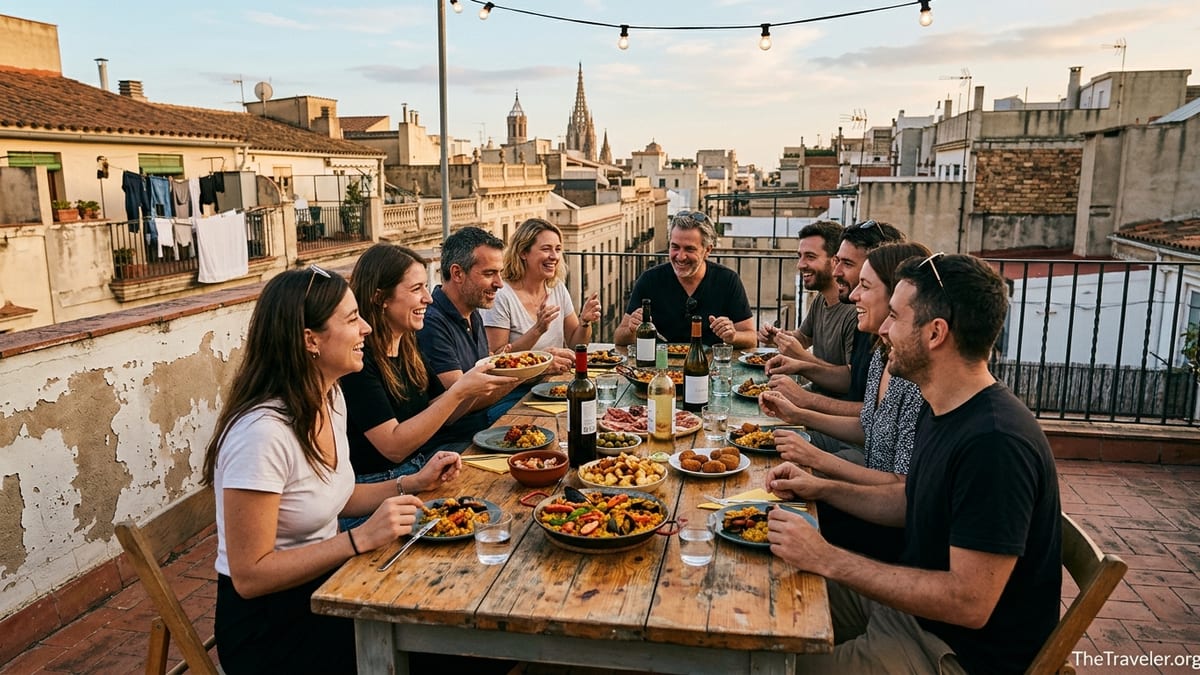
That first time, in Barcelona, my booking simply read “Paella on a rooftop with local wines.” It cost just under 80 euros per person by the time Eatwith’s fee was added, in line with many mid-range restaurant meals in the city. But instead of a white-tablecloth setting, I found myself in Christian’s apartment near the Eixample district, climbing up to a rooftop that looked out over laundry lines, spires, and the warm blur of television screens glowing in neighboring flats. Within minutes, shoes were off, aprons were on, and everyone was chopping vegetables side by side, the way you would for a family Sunday lunch.
Why It Feels More Like a Dinner Party Than a Tour
Traditional tours, even food tours, tend to rely on a script. There is a route, a time limit, a memorized story about the oldest bakery in town. Eatwith experiences certainly have structure, but the dynamic is closer to a dinner party. Hosts are hand-selected and vetted, and many treat their events as extensions of their own social lives rather than a job they clock in and out of. When it works well, guests become temporary friends instead of anonymous customers rotating through a schedule.
In Barcelona, Christian did have a plan. We would visit his local market to pick up seafood, learn the basics of sofrito, and then eat under festoon lights as the sun set over the city. But that structure left room for improvisation. When one guest mentioned having family roots in Galicia, Christian pulled out a bottle of albariño he had been saving from that exact region. Another couple admitted they were nervous cooks, so he handed them the simple but crucial task of stirring the rice, joking that the whole neighborhood’s reputation hinged on their patience.
That kind of tailored attention is possible because groups are small, often between six and twelve people. You are close enough to see the way a host salts by feel or tests pasta dough with the back of a knuckle. In Rome, at a pasta-making class hosted through Eatwith, there were just ten of us shaping cacio e pepe and tiramisù in a bright kitchen near Trastevere. The chef, a former accountant who had retrained in his forties, quietly noticed one guest avoiding the eggs and adjusted her portion on the fly. There was no awkward announcement, just an extra bowl of semolina flour and water slid her way with a nod and a quick aside: “You are team vegan tonight, we cook like your grandmother would have improvised.”
Stepping Inside Real Homes, Not Just Restaurants
The setting is a big part of why Eatwith often feels far more personal than a typical night out. Many experiences are hosted in private homes or unusual spaces that reflect the host’s life. In Rome, you might find yourself in a family apartment with a balcony planted thick with basil and geraniums. In Paris, a supper club could be held in an artist’s loft in Le Marais, where canvases lean against the wall and your dessert is served on mismatched vintage plates.
This home setting changes how people behave. At a restaurant, you might chat politely with the server and exchange a few words with the table next to you. At an Eatwith dinner in a Lisbon hillside neighborhood, the host asked us to sit wherever we liked, then placed a single large bowl of caldo verde in the middle of the table and invited us to help ourselves. Passing a steaming pot to a stranger and worrying whether you took too much is an instant icebreaker. By the time the grilled sardines arrived, the table had already split into gentle debates about football teams and favorite train rides.
Because you are in a real home, you notice the little things that never appear in glossy destination photos. A child’s drawing taped to the fridge. A stack of language textbooks on the sideboard. A calendar filled with dentist appointments and birthdays. These details anchor the experience in everyday life. Cities that can feel like theme parks near major attractions suddenly reveal their ordinary, human rhythm. When a Neapolitan grandmother shows you the family photo hanging above her stove before teaching you to roll gnocchi, you experience Naples not as a checklist of sights but as a web of personal histories.
Conversations You Cannot Order Off a Menu
The most memorable part of Eatwith evenings is rarely the main course; it is the conversation. Sharing a table with locals and travelers from different countries naturally nudges the discussion away from small talk and toward the kind of stories people tell when they feel relaxed and unhurried. Hosts often guide this without it ever feeling forced.
At a tapas and wine night booked through Eatwith in Barcelona’s Gothic Quarter, the host, a former journalist named Fabio, opened with what he called “the question of the night.” As we picked at boquerones and pan con tomate, he asked everyone to share a food memory from childhood. A Mexican guest spoke about her grandfather’s pozole, a German couple described Christmas markets, and Fabio told a story about his grandmother hiding precious saffron in a sewing kit during the years when money was tight. By the time the final dish of crema catalana arrived, we had traded not only travel tips but also stories of migration, family recipes, and what it feels like to move to a new country without knowing anyone.
Because these events are not rushed, conversations have space to deepen. Many Eatwith dinners run for three hours or more, especially those that include a cooking component and multiple courses. Alcohol is often served but not always central; some pasta classes in Rome offer wine pairings, while others focus on technique and serve a simple glass with dinner. Either way, it is the shared effort of cooking and eating that lowers the guard. When you have just kneaded dough next to someone for twenty minutes, asking them what they really think about overtourism or rising rents does not feel intrusive. It feels like a continuation of the trust you have built at the countertop.
What It Actually Costs and How to Choose Well
From the traveler side, Eatwith pricing usually sits between a casual meal out and a special-occasion dinner. Simple home-style dinners in cities like Lisbon or Athens can start in the 40 to 60 euro range per person once Eatwith’s fee is included. More elaborate evenings, such as rooftop barbecues in Barcelona, multi-course tastings in Paris, or market tours plus cooking classes in Rome, often fall between 70 and 120 euros. It is not the cheapest way to eat in a city, but for many travelers it replaces a restaurant dinner rather than being an extra on top of it.
Understanding the fee structure helps manage expectations. The price you see includes the host’s base rate plus that approximate 30 percent service commission, which covers things like payment processing, customer support, and insurance for both sides. Hosts receive the full base rate they set, so when you choose an experience that looks underpriced for the level of effort involved, you can feel reasonably confident that the person welcoming you is not being undercut by hidden platform margins. That transparency can make it easier to treat the evening as what it is: a paid but mutually beneficial exchange of time, skill, and hospitality.
Choosing the right experience is partly art and partly research. Reviews are especially valuable because they highlight practical details: how many people typically attend, whether the host is flexible with dietary needs, how interactive the cooking portion really is. A pasta and tiramisù class in Rome, for instance, might have glowing comments about the chef’s humor and patience with kids, making it a strong choice for families. Another class could be praised for its in-depth technique and small group size, better suited to serious home cooks. Reading the host’s biography matters too. If they mention a background in professional kitchens, you might get more complex recipes; if they describe themselves as a home cook, expect straightforward, comforting dishes and perhaps more emphasis on conversation.
When Things Are Not Perfect, They Are Still Personal
The intimacy that makes Eatwith so special can also mean that imperfections are more visible. Unlike restaurants, which have teams to smooth over issues, these are usually one or two people hosting in a private space. A train delay might push the start time back; a key ingredient might be swapped at the last minute because the market was out. Once, at a market-to-table class in Rome, a sudden storm flooded the courtyard where we were meant to dine. The chef apologized, handed out towels to dry off our shoes, and without fuss rearranged the entire evening around a long kitchen table indoors.
Platforms like Justuseapp and independent reviews do reflect some frustrations from guests: last-minute cancellations when hosts fall ill, communication glitches, or expectations that did not quite match reality. These criticisms are worth reading because they highlight the human side of the platform. Eatwith vets its hosts and offers support and insurance, but it does not turn them into interchangeable service providers. When you book, you are stepping into a small operation that might occasionally wobble.
Paradoxically, those wobbles can strengthen the sense of connection when handled with care. In the flooded-courtyard example, we ended up eating pasta indoors while the chef told stories about how heavy rain used to bring his extended family into one tiny kitchen for hours at a time. After dessert, he pulled out an old photo album of those gatherings, laughing at the feathered hair and high-waisted jeans of the 1990s. It was not the breezy al fresco evening we had imagined, but it was unforgettable and unmistakably personal.
How Eatwith Changes the Way You Remember a City
Travel memories tend to cluster around extremes: the most beautiful view, the worst delayed flight, the best meal. Eatwith experiences often slip into that “best meal” category not because the food is objectively superior to what a talented restaurant chef could produce, but because your own effort and the relationships formed around the table are part of the recipe.
Months after leaving Barcelona, what I remember is not the exact ratio of rice to stock in Christian’s paella. I remember the story he told about his grandfather fishing off the Costa Brava, the neighbor who popped up on the rooftop to borrow olive oil and ended up staying for dessert, the way the group instinctively lingered for an extra hour even after the official end time. In Rome, it is the feel of flour on my hands and the sound of ten people laughing as someone’s first attempt at hand-cut tagliatelle turned into a wobbly but delicious mess.
These kinds of nights reframe the relationship between traveler and local from consumer and service provider to guest and host. The transaction is still there; you paid for a seat at the table. But because the setting is so intimate and the social stakes are slightly higher, you likely show up more attentively than you would for a standard restaurant booking. You ask more questions, you listen more closely, and you might even stay in touch with the people you met. Several travelers I have spoken to still exchange holiday messages with hosts they met through Eatwith years ago, sharing photos of dishes they have tried to recreate at home.
The Takeaway
For anyone used to anonymous city breaks, Eatwith can feel disconcertingly personal at first. You are ringing the bell to a stranger’s apartment, navigating hallways filled with family photos, and sitting down with people you have never met, all in a foreign city. Yet that very vulnerability is what makes these experiences so resonant. Instead of observing local life from a comfortable distance, you step directly into it for an evening, guided by someone whose cooking and stories are rooted in the place you have come to explore.
Is Eatwith for everyone? Probably not. Travelers who prefer strict privacy or who are uncomfortable in unpredictable social settings might find a classic restaurant meal more relaxing. But if you are willing to trade a bit of control for the chance to connect, an Eatwith dinner or class can transform the way you relate to a destination. It turns “I went to Rome and ate pasta” into “I spent an evening in a Roman kitchen, learning an old family recipe and hearing what it is like to live here now.”
In an era when many travel experiences risk feeling standardized, platforms like Eatwith offer a reminder that the simplest ingredients are still the most powerful: a table, a shared meal, and the courage to step into someone else’s everyday world.
FAQ
Q1. What exactly is Eatwith and how does it work?
Eatwith is a platform where locals host small-group dinners, cooking classes, and food tours in their homes or unique venues. Travelers browse experiences by city and date, pay through the app, then receive directions and details from the host before showing up like invited guests.
Q2. How much do Eatwith experiences usually cost?
Prices vary by city and format, but many experiences fall between 40 and 120 euros per person once fees are included. Simple home-style dinners tend to be at the lower end, while market tours plus cooking classes or multi-course tastings sit toward the higher end.
Q3. Is Eatwith safe for solo travelers?
For most solo travelers, Eatwith feels safer and more social than dining alone in a random restaurant. Hosts are vetted, experiences are insured, and events are typically small groups rather than one-on-one. As always, it is wise to read recent reviews, share your plans with someone at home, and follow your instincts.
Q4. Do Eatwith hosts accommodate dietary restrictions?
Many hosts are flexible with common dietary needs such as vegetarian, vegan, gluten-free, or nut-free, especially if you flag them in advance through the app. However, not every experience can be adapted, so check the description carefully and message the host before booking if your restrictions are strict.
Q5. How do Eatwith fees and commissions work?
Hosts set a base price for their experience, and Eatwith adds about a 30 percent commission on top, which is included in the final price you pay. That commission covers taxes, payment processing, customer support, and insurance for both guests and hosts.
Q6. What is the difference between an Eatwith dinner and a standard restaurant meal?
An Eatwith dinner is usually in a private home or unusual venue with a small group and a host who cooks and eats with you. A restaurant meal offers professional service and anonymity, while Eatwith trades some polish for intimacy, conversation, and a closer look at everyday local life.
Q7. How far in advance should I book an Eatwith experience?
Popular experiences in major cities can fill up weeks in advance during peak travel months. If you are traveling in summer or around holidays, booking at least two to three weeks ahead is wise. In shoulder seasons, you may find last-minute spots, but availability is never guaranteed.
Q8. What happens if my host cancels?
If a host cancels, the platform typically offers a refund or the option to rebook with another experience, depending on timing and availability. Communication usually comes through email and the app, so it is important to keep an eye on your messages in the days leading up to the event.
Q9. Are children welcome at Eatwith dinners and classes?
Some Eatwith experiences are family-friendly, including pasta and dessert classes or casual home dinners, while others are adults-only. The listing will usually specify age guidelines. If you are unsure, message the host before booking to confirm whether your children can comfortably join.
Q10. How can I choose the right Eatwith host for my trip?
Start by reading recent reviews and the host’s biography. Look for comments about group size, atmosphere, and flexibility with food preferences. Decide whether you want a hands-on cooking class, a relaxed dinner party, or a structured tasting, then pick an experience whose tone and setting match your own travel style.