


Istanbul Airport is the kind of place that shows up in glossy airline magazines as a futuristic global hub. It is also the place where, after a ten hour red eye, I found myself lost between duty free cologne counters and a maze of escalators, trying to figure out if I was heading toward the city or back to my departure gate. After several trips through in 2025 and 2026, including one short connection and two long layovers, I have a clear sense of what Istanbul Airport actually feels like to use. This is a practical, boots on the ground guide so you can land prepared and skip the confusion I went through.
Get the latest updates straight to your inbox!
First Impressions: A Giant Machine That Mostly Works
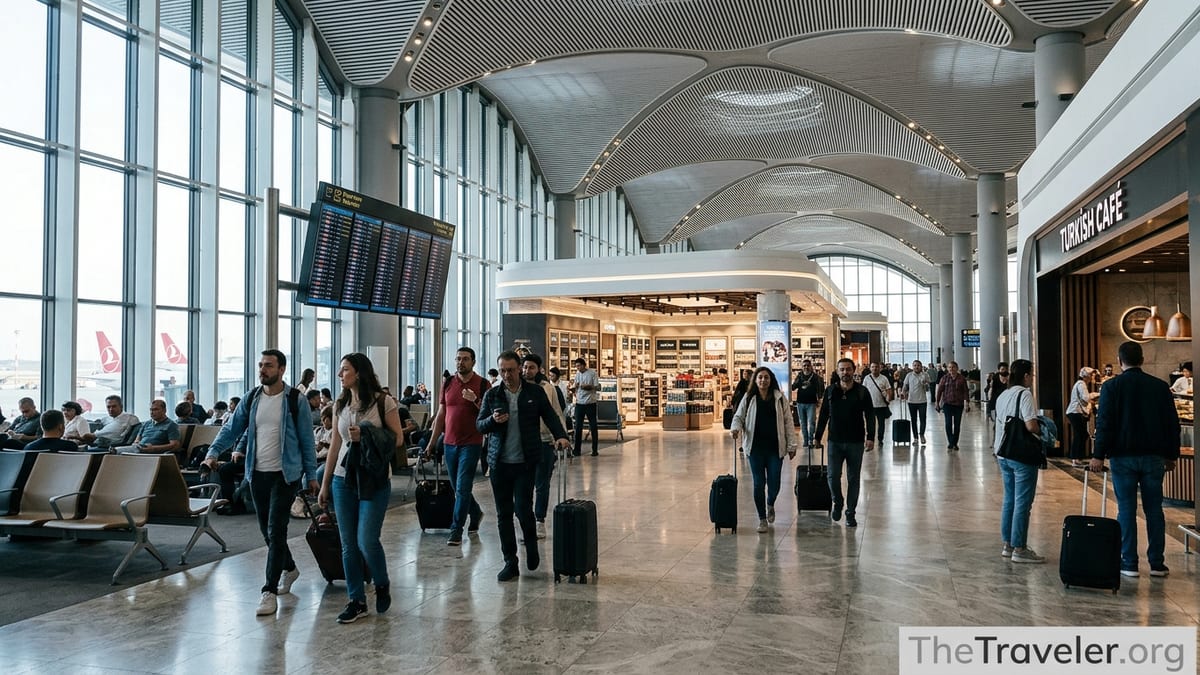
Istanbul Airport is big in a way that photos do not fully convey. In 2025 the airport handled well over 80 million passengers, and current media kits show monthly traffic in 2025 regularly topping 7 to 8 million travelers. Walking out of the jet bridge, you feel that scale immediately. The ceilings are high, the concourses are wide, and there is a constant background hum of rolling suitcases and boarding calls in Turkish and English.
On one recent morning arrival from New York, my taxi time after landing was almost 20 minutes before we even reached the gate. Once parked, the walk from the far end of the international pier to passport control took another 15 minutes at an ordinary pace. Moving walkways help, but if you have a tight connection of under an hour, you need to move with purpose and avoid lingering at shop windows. The signage is clear but there is a lot of it, and you will cover long distances between zones like arrivals, departures, and the metro station.
Architecturally, the airport is impressive and modern. Large windows look out over multiple runways, there are art installations in some corridors, and the main departures hall is bright even on cloudy days. Yet once the terminal is busy, that sense of calm quickly gives way to the reality of crowds. Around midday bank of Turkish Airlines flights, food courts and boarding areas become dense, and you learn to guard your seat if you have one. It is not chaotic in the way of an underbuilt regional airport, but you are constantly aware that you are inside a giant machine designed to move huge volumes of people as efficiently as possible.
In daily use, that machine mostly works. Security and passport control are more streamlined than at many European hubs, and my waits have ranged from 10 to 35 minutes depending on the time of day. Staff generally know the process and keep people flowing, but this is not an airport where you can routinely arrive just 60 minutes before departure for an international flight and expect a stress free experience. Build in buffer time and remember that distances, not just queues, will slow you down.
Arrivals, Immigration, and Baggage: What Actually Happens
On arrival, Istanbul Airport funnels international passengers toward passport control through long, gently curving corridors. You cannot really get lost, but you can misjudge how far it is. From the first checkpoint to the actual immigration hall can be another five minutes on foot. There are separate lines for Turkish citizens, e-gates for certain nationalities, and regular foreign passport queues. As a US passport holder without residency, I have consistently used the standard foreign line.
How long you wait is highly variable. Landing at 6:30 a.m. with a wave of other long haul flights from Asia and North America, I once spent nearly 35 minutes in line. On a late evening arrival from Europe, it was under 10 minutes. The officers tend to be brisk but not unfriendly, asking basic questions about the length and purpose of your stay. Have your hotel address or onward flight information handy. If you need a visa or have questions about entry rules, deal with that before you travel; there is no well marked, hand holding help desk at the front of the queue.
After passport control you descend into the baggage claim level. The carousels are clearly numbered and flight screens are easy to read, but the hall is wide and echoing. In my experience bags have taken between 20 and 40 minutes to appear. If you are connecting onward on Turkish Airlines with a through ticket, your bag will usually be tagged to your final destination and you simply follow transfer signs without claiming it. For separate tickets or low cost carriers, assume you will need to collect and recheck, which can easily add an hour to your connection time.
Customs is usually a formality. Most travelers walk straight through the green channel without being stopped. Occasionally there are random bag checks. Once you exit customs, you immediately hit the arrivals hall with currency exchange booths, mobile SIM vendors, taxi desks, and shuttle counters all competing for your attention. This is where first timers often get overwhelmed. My advice: ignore the sales pitches for a few minutes, step to the side, and decide calmly whether you are taking the metro, bus, or taxi before you commit to anything.
Getting Into the City: Metro, Buses, and Taxis Compared
For most travelers in 2026, the M11 metro is the default way into Istanbul. It runs from the airport to Gayrettepe station on the European side in roughly 30 minutes when fully operational, with a fare around the cost of a standard city metro ride paid with an Istanbulkart or contactless bank card. From Gayrettepe, you can connect to the M2 line toward Taksim and Yenikapı, which covers tourist areas like Taksim Square and the vicinity of the old city. In practice, door to door from the arrivals hall to a hotel near Taksim has taken me about 60 to 75 minutes using this combination, including the walk to the airport station and transfers.
The caveat is that the M11 is not directly under the terminal. After customs, you must follow red metro signs, walk through a long corridor, and ride multiple escalators to reach the station near the multi story car park. With a roll aboard suitcase this is fine, but families with strollers or travelers carrying heavy backpacks will feel the distance. During my last trip, the walk from arrivals exit to the metro platform was a solid 10 to 12 minutes at a normal pace. Once onboard the train, there is no mobile signal in some tunnels, so download your offline maps and know your transfer stations in advance.
If you arrive late at night when metro frequency drops, or during temporary line closures for extension work, the main alternative is Havaist, the official airport coach service. Their large white and blue buses run 24 hours on multiple routes to key points like Taksim, Sultanahmet, Beşiktaş, and Kadıköy. Fares vary by route but are significantly cheaper than a taxi and more expensive than the metro. For example, an early 2026 fare for the Taksim route has been in the low hundreds of lira, payable by card or Istanbulkart. Coaches have luggage holds, air conditioning, and usually Wi Fi and USB charging. In my experience, the ride to Taksim in light traffic took about 45 to 60 minutes; in rush hour it stretched to 90 minutes.
Taxis form a long, organized rank outside the terminal. Official yellow cabs use meters and their base fare structure makes a ride into central Istanbul cost somewhere in the mid hundreds of lira, depending on traffic and exact destination. At off peak times I have paid roughly the equivalent of 25 to 35 US dollars for the trip to Beyoğlu. During evening rush hour on a rainy Friday, the meter climbed higher and the journey took more than an hour. There are also turquoise and black taxis, which are more expensive. Scams at this airport are less about extreme overcharging and more about creative routing or refusing to switch on the meter. Always insist that the meter is used, have your destination written down, and take a photo of the taxi license plate before you get in.
Inside the Terminal: Food, Shopping, and Where to Sit
Once you are airside, Istanbul Airport feels like a self contained mall with aircraft parked outside the windows. International departures is dominated by a central duty free zone selling the usual mix of cosmetics, liquor, Turkish sweets, and electronics. Around this hub, branches of familiar brands like Starbucks, Burger King, and Popeyes sit alongside local outlets selling simit, döner, and baklava. Prices across the board are high compared with the city. A simple latte at a major chain can cost roughly double what you would pay at a café in Karaköy, and a basic plate of pide in a food court runs into the equivalent of well over 10 US dollars.
Quality varies. At one fast food burger outlet near a D gate, my late night meal arrived lukewarm and slightly soggy, which matched reports from other travelers that the airport food is serviceable rather than memorable. At a smaller local café opposite an E gate, a fresh simit and tea tasted far better and cost slightly less. If you have time and are on a budget, stick to simpler Turkish staples and back away from the long lines at international chains. Also note that some cafés close earlier than you might expect, especially in quieter domestic areas, so do not assume you can get a full hot meal at 3 a.m.
Seating is the airport’s main weak point. Around popular gates, particularly in the international zones where Turkish Airlines runs long haul flights, rows of black chairs fill quickly. More than once I have seen families sitting on the floor with children perched on suitcases, and solo travelers standing against walls while scrolling their phones. There are a few quieter corners, especially near less used gates at the far ends of the piers, but you may need to walk 5 to 10 minutes from the central area to find them. Power outlets are scattered and sometimes hidden underneath seats. If you need to recharge a laptop or camera, carry a small power strip or be ready to share a socket with your neighbors.
On the plus side, free airport Wi Fi is relatively reliable once you get through the login process, which may involve scanning your passport at a kiosk or receiving an SMS code to a local number. Streaming high definition video can be hit or miss, but email, messaging, and browsing work well throughout the terminal. The lighting is bright but not harsh, and there are large information screens everywhere showing gate numbers and boarding times. Announcements are usually bilingual in Turkish and English, with occasional additional languages on certain routes.
Lounges, Quiet Corners, and Surviving Long Layovers
Istanbul Airport has several lounges, but most conversation among frequent travelers revolves around two: the main Turkish Airlines lounges and the large iGA Lounge that sells access to passengers regardless of airline or class of service. The Turkish Airlines lounges are spacious with good food, but they can become extremely crowded during peak waves. On a spring afternoon in 2026, I entered with Star Alliance status and found nearly every seat taken, a queue for the hot buffet stretching around a corner, and people hovering for space near the shower waitlist desk. It felt less like a calm retreat and more like a busy hotel lobby.
The iGA Lounge, located in the international zone, offers paid access that often costs the equivalent of a reasonable mid range hotel night in the city. Inside there are buffet stations with Turkish and international dishes, a bar, nap rooms, and showers. During an eight hour layover from Asia to Europe, I paid for access and found it delivered decent value purely for the ability to stretch out in a relatively quiet zone with reliable Wi Fi. However, the lounge has seen policy tweaks, such as limits on maximum stay hours and changing price tiers, so you need to check your access conditions when you buy. Travelers have reported being asked to stick closer to the time limits in 2026 than in years past.
If you do not have lounge access or do not want to pay for it, you can still build a decent layover routine. Near some D and F gates there are padded bench seats without armrests where you can lie down if you are willing to sleep in public view. I have napped there more than once without issue, using a jacket as a pillow and my backpack as a footrest. The terminal stays reasonably bright and busy at all hours, so it feels safer than many older airports for overnight stays, though you should still keep valuables close and use a luggage lock when possible.
For very long layovers, there is an airside airport hotel where you can book blocks of hours for a bed and shower. Prices are not cheap compared with a city hotel but can be worth it if you are arriving from a long haul flight and need actual rest. Alternatively, some travelers choose to clear immigration, ride the M11 into town, have a proper meal in neighborhoods like Karaköy or Beşiktaş, and return for their onward flight. Doing this safely requires a layover of at least 8 to 10 hours and a solid grasp of metro schedules and return times. When I tried this on a 12 hour daytime layover, I enjoyed a full lunch by the Bosphorus, a short walk through the old town, and still made it back to the airport with two hours to spare.
Practical Pain Points: Crowds, Costs, and Wayfinding
The single biggest frustration at Istanbul Airport is crowding. As traffic has grown, especially during times when travelers avoid connecting through certain other regions, Istanbul has absorbed a huge share of connecting passengers between Europe, Asia, and Africa. That means security queues can swell quickly when a cluster of widebody flights arrive at once. During a Friday evening departure wave in 2025, the line for standard security screening wrapped far back into the departure hall and took close to 40 minutes to clear, even though all lanes were open.
Prices are another consistent complaint. Rents and concession fees at major hubs tend to be high, and Istanbul Airport is no exception. Simple items like a bottle of water or a basic sandwich can feel disproportionately expensive when priced in Turkish lira and compared to what you would pay just 40 minutes away in the city. One solution I have adopted is to buy snacks and a refillable water bottle in town, then enter the airport with them. Liquids will be screened at security, but once you are inside you can often use water fountains or bottle filling taps near restrooms to stay hydrated without paying premium kiosk prices.
Wayfinding is good but not perfect. Signage uses clear icons and color coding, and most crucial functions like transfer desks, gates, and exit routes are marked in English and Turkish. Yet because the terminal is so large, it can still be confusing when you need something specific like a pharmacy, baby care room, or quiet prayer area. On one occasion I circled the same part of the departures level twice before finally spotting a small sign for a medical clinic tucked behind an escalator bank. The airport’s information desks are helpful once you find them, but queues can form there too, especially when there has been a disruption like a storm or temporary metro closure.
Despite these pain points, the airport staff I have interacted with have generally been efficient and matter of fact, whether they were helping a confused transit passenger print a boarding pass at a kiosk or redirecting a line at security to even out the load. English proficiency at information desks and airline counters is usually good. At smaller food outlets and retail shops you may encounter more limited English, but basic transactions still work smoothly with a mix of gestures, card payments, and a few Turkish words.
Who Istanbul Airport Works Well For (And Who Will Hate It)
If you are an experienced traveler who is comfortable walking long distances and making metro or bus connections, Istanbul Airport can work very well. The combination of a modern terminal, reasonable public transport options, and a strong network of onward flights means you can often find good connection times and competitive fares. On a winter trip from Chicago to Southeast Asia, flying via Istanbul added only an extra hour of total travel time compared with alternatives, and the ability to stretch my legs in a bright, spacious terminal was welcome.
The airport also suits travelers who value variety in food and shopping over boutique ambiance. If you enjoy wandering duty free aisles, comparing Turkish delight brands, and browsing electronics or fashion stores, there is plenty to fill a few hours. Families with school age children will find playgrounds and kid friendly food options, though strollers and young kids may struggle with the long walks between gates and the sometimes limited seating in busy waiting areas.
Where Istanbul Airport is less ideal is for travelers with reduced mobility or those who dislike crowds. While assistance services are available and can be booked through airlines, the default experience involves a lot of walking, escalators, and time spent in large, noisy halls. Elderly relatives I have traveled with found the sheer volume of people and the sensory load overwhelming after a long flight. If you are in this group, it is worth arranging wheelchair assistance in advance or budgeting for a longer connection with time to rest in a quieter corner or lounge.
Finally, ultra budget travelers who resent paying airport prices will not enjoy spending much time here. Although there are some more modestly priced local cafés and the public transport options are good value, the overall cost of eating and drinking inside Istanbul Airport is high by local standards. If you know this in advance and plan accordingly, you can minimize the sting by fueling up in the city and treating the airport as a place to pass through rather than a destination in its own right.
The Takeaway
After multiple visits in 2025 and 2026, I have come to see Istanbul Airport as a highly efficient but imperfect gateway. It is not the chaotic, unfinished construction site some early reviews described when the new terminal first opened, nor is it quite the serene, luxury oasis portrayed in marketing images. It is a busy, modern mega hub that works best if you treat it with respect, plan your movements, and keep realistic expectations about crowds and costs.
For arrivals, the key lessons are to account for long walks from the gate to passport control, variable waits at immigration, and a potentially lengthy bag carousel wait before you even think about leaving the building. For getting into the city, the M11 metro is usually your best friend, backed up by Havaist coaches and taxis when timing or luggage make rail impractical. Inside the terminal, food and seating are adequate but not outstanding, while lounges can provide welcome respite if you are willing to pay or have the right status.
If you are connecting through Istanbul, build in more time than you would at a compact regional airport, especially if you need to recheck luggage or change tickets. If you are starting or ending your trip here, see the airport as the first or last chapter of your Istanbul experience rather than an obstacle. Bring patience, comfortable shoes, a plan for your onward transport, and perhaps a small stash of snacks from the city. Do that, and Istanbul Airport becomes manageable, even occasionally pleasant, rather than a dreaded part of your journey.
FAQ
Q1. How long does it really take to get from Istanbul Airport to the city center?
In normal conditions you should allow about 60 to 75 minutes from the arrivals hall to Taksim using the M11 metro and a transfer to the M2 line, and closer to 75 to 90 minutes to reach Sultanahmet when you include the tram or a short taxi ride. Havaist coaches can be as quick as 45 to 60 minutes to central areas in light traffic, but this can double at rush hour.
Q2. Is the M11 metro from the airport safe and practical with luggage?
Yes, the M11 is generally safe, modern, and popular with both locals and visitors. Trains have space for suitcases near the doors and the platforms are well lit. The main drawback is the 10 to 12 minute walk from the terminal to the station and the need to manage your own bags on escalators and during transfers.
Q3. How much should I expect to pay for a taxi from Istanbul Airport into town?
Fares fluctuate with traffic and exchange rates, but a metered yellow taxi ride to central districts like Taksim or Şişli usually lands in the mid hundreds of lira, roughly equivalent to a few dozen US dollars. Heavier traffic, tolls, and late night surcharges can push the price higher. Insist that the meter is used and avoid accepting fixed cash prices from unofficial drivers.
Q4. Are the airport lounges at Istanbul Airport worth paying for?
If you have a layover of more than four or five hours and value a quieter space with food, drinks, and showers, the main paid lounge can be worth the cost. It offers a calmer environment than the general seating areas, though it can still get busy at peak times. For short layovers under three hours, it is often more economical to find a quiet corner in the main terminal.
Q5. What is the Wi Fi and mobile signal like inside Istanbul Airport?
Free Wi Fi is available throughout the terminal and is generally stable enough for email, messaging, and normal browsing. You may need to register with a passport scan or SMS code. Mobile reception is strong in most public areas, though it can drop in some interior spaces and is typically absent on large portions of the metro ride into the city.
Q6. How early should I arrive at Istanbul Airport before an international flight?
For most international departures, arriving about three hours before your scheduled flight time is a sensible minimum. This gives you room for possible check in lines, security queues, and the long walks between check in, passport control, and the gates. During major holiday periods or if you need to check oversized luggage, consider arriving even earlier.
Q7. Is food at Istanbul Airport really as expensive as people say?
Compared with prices in Istanbul itself, yes. A simple coffee and pastry can cost roughly double city café prices, and hot meals at international chains are priced like other big European hubs. You can soften the impact by choosing simpler local options, sharing larger portions, or eating before you arrive at the airport when your schedule allows.
Q8. Can I sleep in Istanbul Airport during an overnight layover?
It is possible and many travelers do it. There are padded benches and some quieter zones near less used gates where you can rest if you are comfortable sleeping in public. The airport is bright and busy enough that it feels fairly secure, but you should still keep valuables close and consider using a small luggage lock or cable to deter opportunistic theft.
Q9. What are the best options for getting Turkish lira on arrival?
Arrivals halls are full of currency exchange counters, but their rates are often poor. If your bank card allows it, withdrawing cash from an ATM is usually better value. Many services in the airport and city accept contactless card payments and major credit cards, so you may only need a modest amount of cash for small purchases or places that prefer lira.
Q10. Is it realistic to leave the airport and visit the city on a long layover?
Yes, if your layover is at least 8 to 10 hours between flights and you have a valid visa or visa free entry, you can use the M11 metro or Havaist buses to reach central areas, enjoy a meal and a short stroll, and still return with time to clear security. Build in generous buffer time for transport, security, and potential delays, and avoid venturing too far from well connected districts on tighter schedules.