


Istanbul Airport has spent the past few years reinventing itself as a global super-hub between Europe, Asia and Africa. With the M11 metro line finally providing a fast rail link into the city and airlines like Turkish Airlines turning the airport into a major transfer point, many travelers now find themselves changing planes in Istanbul instead of Dubai, Doha or Frankfurt. This review looks at how Istanbul Airport actually performs in 2026, based on current facilities and recent traveler experiences, and how it compares with some of the world’s best known international hubs.
Get the latest updates straight to your inbox!
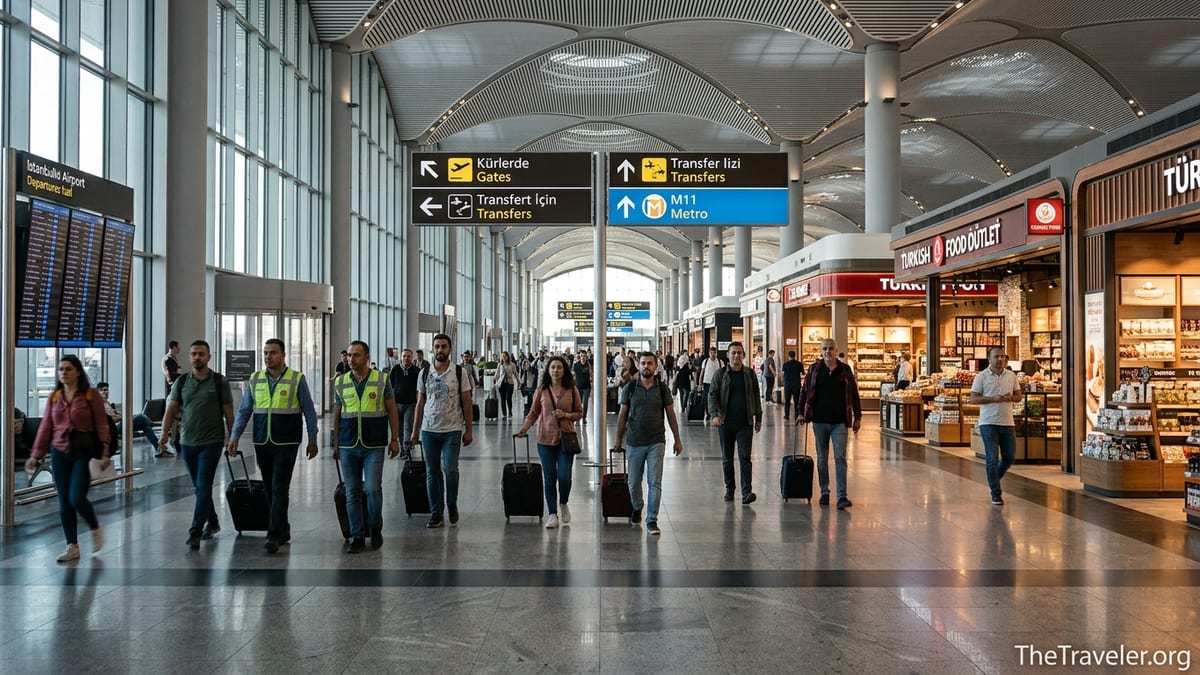
First Impressions: Scale, Design and Wayfinding
Istanbul Airport is enormous, and that is the first thing most passengers notice. The single main terminal handles tens of millions of travelers a year in one sweeping building with high ceilings, glass walls and long, wide concourses. It feels closer in spirit to Dubai International’s Terminal 3 than to the more fragmented layout of London Heathrow. The vast central departures hall, with its mix of duty free, Turkish brands and international chains, is visually impressive and, in good weather, filled with natural light.
On the ground, however, this scale is a double-edged sword. Walking distances can be very long, particularly to some international gates. A connection that would involve a quick tram ride in Doha or Singapore can mean a 15 to 25 minute walk in Istanbul, especially if you are moving between the far ends of the terminal. Moving walkways help, but travelers with limited mobility or tight connections can find the layout challenging in a way that more compact hubs like Zurich or Munich largely avoid.
Wayfinding has improved since the early years. Overhead signage in Turkish and English clearly marks security, transfer and passport control, and the color-coding of zones is reasonably intuitive. Compared with Frankfurt, where terminal changes and mixed signage can be confusing, Istanbul now feels more streamlined. That said, transfer passengers sometimes report that the initial fork between “Transfer” and “Exit to Turkey” is not as visually forceful as it could be, and first-timers occasionally follow the crowd to immigration by mistake when they intended to stay airside.
Cleanliness is generally good but not immaculate. Toilets are serviced regularly yet can show strain during late-night banked arrivals from Africa and Asia. Public seating areas around busy gates may accumulate clutter more quickly than at Singapore Changi or Tokyo Haneda, both of which set the standard for spotless public areas. In Istanbul you should expect conditions that are broadly in line with a busy European hub, rather than the polished calm of the very top-tier Asian airports.
Arrivals, Immigration and Baggage: How Long Does it Really Take?
For many travelers, the decisive moment in judging an airport is not the shopping arcade but the time from aircraft door to curb. At Istanbul Airport this is highly variable. When flights are well staggered, American and European passport holders report clearing e-visa checks and passport control in around 25 to 45 minutes, with checked bags appearing another 10 to 20 minutes later. At quieter times, it can be significantly faster. However, when several wide-body flights from Europe, the Gulf and Central Asia land within a short window, queues at immigration can easily exceed an hour.
Compared with Doha Hamad and Dubai International, which have invested heavily in fast biometric channels for large swathes of their transfer traffic, Istanbul still feels more like a traditional border checkpoint. E-gates exist for certain nationalities and residence permits, but a significant share of passengers must still queue at manned booths. Travelers from countries that require an on-arrival visa or who have complex documentation can see wait times of 45 to 60 minutes in peak evening banks, something that aligns Istanbul more with Heathrow or JFK than with the Gulf hubs.
The baggage system has become more consistent, though it is not the fastest in the world. In 2026 most long-haul arrivals report seeing the first bags on the carousel within 25 to 35 minutes of landing, which is comparable to Frankfurt and better than some reports from New York. Yet oversize luggage, strollers and priority-tagged bags occasionally lag, which can be frustrating for families or premium passengers expecting a seamless start to their trip.
Customs itself is usually a formality. The green and red channels are clearly marked, and inspections appear selective and targeted. In practice most tourists with typical luggage walk straight through without questions, which is similar to the experience in much of Europe. The more meaningful time factor remains immigration and the walk from remote gates to the main hall, which together shape whether arrivals feel Istanbul is efficient or exhausting.
Getting Into the City: Metro, Buses and Taxis Compared
For years, one of the biggest criticisms of Istanbul Airport was its reliance on highway traffic. That changed decisively with the full opening of the M11 metro line, which now connects the airport with the city’s wider rail network. In 2026, the M11 offers a fast backbone: trains run roughly every 15 to 20 minutes and reach inner-city interchange stations such as Gayrettepe in about 30 minutes, with onward links to central areas like Taksim via the M2 metro. An average journey from the airport to Taksim by metro, including one transfer, typically takes around 60 to 75 minutes door to door, depending on walking and waiting times.
Cost-wise, the metro is very competitive. With an Istanbulkart transit card or contactless bank card, the total fare into central districts is usually only a fraction of a taxi fare, often in the equivalent of just a few US dollars, depending on current exchange rates and transfer patterns. This positions Istanbul more favorably than many Western hubs, where airport rail links can be relatively expensive. Compared to London’s Heathrow Express or the Arlanda Express in Stockholm, the M11 plus a local connection is far cheaper, although less direct than dedicated express trains.
Havaist airport coaches remain popular, particularly with first-time visitors staying in hotel areas such as Sultanahmet or Taksim. These modern coaches, with luggage storage and relatively comfortable seating, typically take 60 to 120 minutes depending on traffic. Fares have risen with inflation and now sit in the mid range for airport transport: more expensive than metro or municipal buses but cheaper than a private transfer for solo travelers. On late-night arrivals when the metro is not running, Havaist routes provide the most reliable public option.
Taxis are still the most straightforward door-to-door choice. Under average traffic, the ride from Istanbul Airport to central neighborhoods such as Beyoğlu or Beşiktaş takes around 45 to 75 minutes. Fares fluctuate with meter tariffs and fuel prices but at current levels a one-way trip to the historic peninsula might cost the equivalent of 60 to 90 US dollars for a standard yellow taxi during normal traffic, with night surcharges and congested conditions pushing totals higher. This is broadly comparable to or slightly cheaper than taxi rides from Paris Charles de Gaulle to the city center, though notably more expensive than regulated flat-rate rides from some North American airports when converted at present exchange rates. As in many big cities, some travelers report attempts at overcharging, so using the official taxi ranks, insisting on the meter and noting the vehicle number remain sensible precautions.
Transit Experience: Security, Connections and Layovers
As a transfer hub, Istanbul Airport competes directly with facilities in Doha, Dubai, Abu Dhabi and, for some routes, European connectors like Vienna and Zurich. The core advantage is route network breadth: Turkish Airlines connects Istanbul to an exceptionally large number of cities across Europe, Central Asia, the Middle East and Africa, often making Istanbul the most logical connecting point even if the airport itself is not the absolute easiest to navigate.
Transfer passengers arriving on an international flight and continuing internationally usually follow dedicated “Transfer / Transit” signs and pass through a centralized security screening point. In calm periods this can take only 10 to 20 minutes, but when multiple flights arrive together, lines can back up far down the corridor. Compared with Doha and Dubai, which have gradually smoothed their transfer flows with more staff and dynamic queuing, Istanbul can still feel understaffed at peak times. Travelers with a 1 hour 30 minute connection on a single ticket often make their flights, but connections under an hour are risky unless you are arriving and departing from nearby gates.
Self-transfer passengers, who book separate tickets and must reclaim baggage, face a more complex journey. They must clear immigration, collect bags, exit customs, then re-check in and reclear security. For these passengers a minimum of 3 hours between flights is a realistic buffer, and 4 hours is safer, particularly in the late afternoon and evening when immigration lines stretch. In this respect Istanbul behaves much like Heathrow or Frankfurt, where self-connecting with short turnarounds is rarely advisable.
For layovers of 4 hours or more, Istanbul Airport begins to reveal its strengths. There is a wide spread of cafes, Turkish and international fast-food chains, sit-down restaurants and snack kiosks across the main departures level. Prices are airport-high but roughly in line with major European hubs: a coffee drink may cost similar to what you would pay at Heathrow or Frankfurt, while a proper sit-down meal will feel moderately expensive compared to city prices but not wildly out of step with peers in Dubai or Doha. Wi-Fi is available throughout the terminal; earlier issues with short free periods have gradually been addressed, and in 2026 many passengers report that connecting with a phone number or kiosk registration now yields a usable connection for casual browsing and messaging, though speeds and stability are not yet at Singapore’s benchmark.
Lounges, Sleep Pods and Overnight Comfort
For passengers with access to lounges, Istanbul Airport offers a strong product that stands up well in global comparisons. The flagship Turkish Airlines lounges for business and elite status passengers are among the airport’s highlights, with extensive hot and cold food, Turkish specialties, quiet areas, children’s sections and showers. The design feels modern and spacious, more comparable to the best lounges in Doha or Dubai than to the often cramped lounges at Heathrow or JFK. In peak banks, however, even these large spaces can feel busy, and finding a completely quiet corner is not always easy.
Several independent lounges accessible through pay-per-use programs or same-day passes provide alternatives for economy passengers. Prices float roughly in the range of what you would pay for comparable access at other major hubs, and they generally include buffet-style meals, open soft drinks, basic alcohol, Wi-Fi and shower access. Travelers report that food quality is solid but not exceptional, on par with a good European contract lounge and below the top-end offerings at Singapore Changi or Doha’s flagship lounges.
One element that sets Istanbul apart from some competitors is its formal network of sleeping pods and the on-airport hotel integrated into the terminal complex. Sleep pods in transit areas allow passengers to rent a small enclosed space by the hour, with recent anecdotal pricing in the region of several tens of euros per hour, making them a premium option for short rests. While this is expensive, it can still be attractive for travelers on overnight layovers who want privacy without booking a full hotel stay. The airside airport hotel, accessible directly from the terminal, offers full rooms that can be booked for overnight or shorter daytime blocks, and while room rates are not low, they are broadly comparable to airside hotels at hubs like Doha or Dubai.
For those not paying for pods or hotels, overnighting in the public seating areas is possible but not especially comfortable. Lighting remains bright, announcements continue through the night and cleaning operations generate noise. Compared with Singapore’s carpeted rest zones or the quiet corners in some terminals at Doha, Istanbul feels more like a typical European hub where overnight stays are tolerated rather than encouraged. Smart travelers with early morning departures often opt for a nearby landside hotel, which can be reached by taxi or shuttle, and then return to the airport on the metro or bus at dawn.
Food, Shopping and Sense of Place
Istanbul Airport’s commercial heart has a distinctly Turkish flavor layered on top of familiar global brands. The central duty-free and retail area features large sections dedicated to Turkish delight, baklava, local coffee, glassware and textiles. These sit alongside international fashion labels, electronics and beauty brands. The result is a space that feels more rooted in its country than, for example, some sections of Dubai International, where global luxury brands can dominate, or Frankfurt, where the mix feels more utilitarian.
For dining, travelers have a wide choice but should expect airport pricing. Turkish grill restaurants serve kebabs, meze and fresh bread; kiosks sell simit and börek; international chains offer burgers, pizza and coffee. A sit-down meal with a main course and drink can easily reach a significant fraction of what you might pay for a good restaurant in central Istanbul, but this is broadly in line with what you would see at other hub airports. Those connecting through Istanbul after time in the city often remark on the contrast between inexpensive neighborhood eateries and the marked price jump in the terminal.
Compared with world-leaders like Singapore Changi, which integrates gardens, art installations and unique attractions such as the Jewel complex, Istanbul’s public spaces feel more conventional. While there are some art pieces, Turkish design elements and occasional small cultural displays, the airport has not yet developed the kind of destination-in-itself vibe that Changi or Doha are fostering. That said, many travelers appreciate that Istanbul focuses on the basics: reasonable food variety, recognizable brands for quick meals, and enough retail to handle last-minute souvenir shopping without requiring a degree in terminal navigation.
One area where Istanbul compares favorably to some European hubs is late-night choice. Because Turkish Airlines and partner carriers operate intensive overnight schedules, many outlets remain open well into the small hours, giving passengers on red-eye connections more options than they might have at, say, Vienna or Brussels, where closing times can be earlier and options thinner.
Accessibility, Families and Special-Needs Travelers
Given its scale, Istanbul Airport has made a visible effort to support travelers with mobility issues and families. Elevators, ramps and moving walkways are distributed throughout the main corridors, and assistance desks are positioned near entrances and check-in zones. In practice, the primary challenge for passengers who rely on wheelchairs or who cannot walk long distances is not the lack of infrastructure but the distances themselves. As at Dubai or Frankfurt, pre-booking assistance with your airline and allowing generous time for connections are wise precautions.
Family services are reasonably strong. There are baby care rooms, child-friendly play spaces and dedicated family lanes at security during some operating hours. Turkish Airlines’ main lounges include quiet children’s corners and small play areas, which families on long layovers find particularly useful. However, the comparison with top-tier hubs like Singapore Changi reveals room for improvement: Istanbul does not yet offer the same breadth of dedicated playgrounds, themed areas or interactive installations that can keep children occupied for hours.
For elderly travelers and those unfamiliar with air travel, Istanbul can feel intense at peak times. The terminal’s sheer volume of passengers, combined with long corridors and bustling food courts, can be overwhelming. Clearer signage and more frequent staff presence in key decision points would help, particularly for non-English speakers. Still, compared with older airports like New York JFK’s legacy terminals, Istanbul’s wide, relatively uncluttered halls and modern lifts are an improvement.
Religious facilities and quiet spaces are well integrated, reflecting the airport’s role as a hub in a predominantly Muslim country. Prayer rooms are available in both landside and airside areas, and they are signposted in English and Turkish. This is an area where Istanbul offers more and better-quality space than many Western European hubs and aligns more closely with airports in the Gulf.
The Takeaway
In 2026, Istanbul Airport stands as a capable, ambitious global hub that excels in some areas while lagging in others. Its greatest assets are a vast and growing route network, modern terminal architecture, improved rail connectivity via the M11 metro line and strong premium lounges for passengers flying Turkish Airlines and its partners. For many itineraries between Europe, the Middle East, Africa and parts of Asia, routing through Istanbul is both logical and, for the most part, comfortable.
At the same time, travelers should approach Istanbul Airport with realistic expectations. Walking distances are long, transfer security and immigration queues can spike sharply at peak banks, and city access by road remains vulnerable to traffic. Those used to the near-frictionless experience at Singapore Changi or the increasingly biometric-focused flows in Doha and Dubai may find Istanbul slightly rougher around the edges.
For visitors headed into the city, the combination of metro, Havaist buses and taxis offers a level of choice and price range comparable to many major capitals, and the addition of the M11 line has closed one of the airport’s biggest historical gaps. Inside the terminal, food and shopping are extensive if not groundbreaking, and overnight comfort is much improved by the presence of sleep pods and an on-airport hotel, albeit at prices that reflect their convenience.
Overall, Istanbul Airport has moved firmly into the ranks of serious global hubs. It may not yet match the very best for efficiency or atmosphere, but it has closed much of the gap, particularly since rail access improved. With a bit of planning around connection times, transport choices and lounge access, most travelers will find Istanbul a workable and often enjoyable place to change planes.
FAQ
Q1. How much time do I need to connect at Istanbul Airport?
For a protected international to international connection on one ticket, 1 hour 30 minutes is usually workable but still tight during peak times. For self-transfer on separate tickets where you must clear immigration and re-check bags, plan on at least 3 hours, and 4 hours if your flights fall in the busy evening or early-morning banks.
Q2. Is the M11 metro the best way to get from Istanbul Airport to the city?
The M11 metro is usually the best value, especially for solo travelers with manageable luggage. It connects the airport to the city’s rail network in about 30 minutes, with total journeys to central areas like Taksim typically taking 60 to 75 minutes including a transfer. If you arrive late at night when the metro is closed, or if you have heavy bags or small children, Havaist buses or taxis can be more practical.
Q3. How expensive is a taxi from Istanbul Airport to the city center?
Taxi fares depend on traffic, official tariffs and exact destination, but a typical metered ride to central areas like Sultanahmet or Taksim currently costs the equivalent of roughly 60 to 90 US dollars under normal conditions. Night surcharges and congestion can increase the total. Always use official taxis from the rank, insist on the meter and keep small bills to avoid disputes.
Q4. Are long immigration lines common at Istanbul Airport?
Immigration times vary widely. At quieter times you might clear in 20 to 30 minutes, but in peak evening or early-morning waves, especially when several wide-body flights arrive close together, waits of 45 to 60 minutes are not unusual. Having your documents prepared, checking visa requirements in advance and booking longer connections if you must enter Turkey can help reduce stress.
Q5. Is Istanbul Airport good for overnight layovers?
Istanbul Airport is acceptable but not outstanding for overnight layovers. If you can afford it, sleep pods and the airside airport hotel provide comfortable paid options. Public seating in the terminal is safe but bright and noisy, and not ideal for real sleep. Many travelers with very long layovers choose a nearby landside hotel and return by metro, bus or taxi for their morning departure.
Q6. How does Istanbul Airport compare with Dubai or Doha for transfers?
Istanbul competes well on route variety and lounge quality for Turkish Airlines passengers but trails Dubai and Doha in terms of consistently short security and transfer queues. Walking distances can feel similar to Dubai’s biggest concourses, and longer than in compact hubs like Doha. If your priority is a wide choice of European and regional connections, Istanbul scores highly; if your priority is the smoothest possible transfer, Doha and some Asian hubs retain an edge.
Q7. Is the Wi-Fi at Istanbul Airport reliable?
Wi-Fi coverage now extends throughout the terminal and is generally adequate for messaging, email and light browsing. Some travelers still report occasional dropouts or slower speeds during very busy hours. Compared with airports like Singapore Changi, Istanbul’s Wi-Fi experience can feel less polished, but it is significantly better than in many older European and North American terminals.
Q8. What are food and drink prices like in the terminal?
Food and drink prices at Istanbul Airport are high compared to the city but broadly similar to other major international hubs. Expect to pay international-airport prices for coffee, snacks and sit-down meals, comparable to airports such as Frankfurt or Heathrow. If you are on a budget, consider having a substantial meal in the city before heading to the airport or bringing some snacks with you.
Q9. Are there good options for families with children?
Families will find baby care rooms, some play spaces and family-friendly outlets in the terminal. Turkish Airlines’ main lounges include children’s areas, which are particularly helpful on long layovers. However, Istanbul does not yet match the extensive playgrounds and themed attractions available at top family-focused hubs like Singapore Changi, so parents should still plan to bring their own entertainment for long waits.
Q10. Is Istanbul Airport a good hub choice for trips between Europe and Asia or Africa?
Yes, Istanbul Airport is a strong hub option for many itineraries between Europe and destinations in Asia, the Middle East and Africa, largely thanks to the breadth of Turkish Airlines’ network. While it may not equal the very best hubs for efficiency, its modern facilities, improved rail access and extensive route map make it a practical and often cost-effective connecting point, provided you allow sensible connection times.