


I landed in Helsinki with a tidy, time-boxed plan for Temppeliaukio Church: a 20-minute photo stop at the famous Rock Church on my way to the waterfront. What actually happened was a chain of small surprises that stretched into an entire afternoon, rearranged my itinerary, and shifted how I think about “must-see” attractions in busy European capitals.
Get the latest updates straight to your inbox!
Arriving at the Rock Church With a Perfect Plan
I first saw Temppeliaukio Church in a glossy in-flight magazine, its copper dome glowing under a shaft of Nordic light. By the time I checked into my hotel near Kamppi, the church was at the top of my list, neatly slotted between a late breakfast and a tram ride to the harbour. The plan was simple: walk up Fredrikinkatu, step inside, snap a few photos of the rock walls, and be on my way in under half an hour.
The logistics looked easy on paper. Temppeliaukio sits at Lutherinkatu 3, about a 10- to 15-minute walk from Helsinki Central Station if you take the route past Kamppi shopping centre and then weave into the quiet streets of Töölö. I checked the official website the night before and saw that the church would be open for visitors almost all day, with just a brief closure for a private ceremony. An 8 euro entrance fee for adults, free entry with the Helsinki Card or Helsinki City Pass, and free for under-18s seemed straightforward enough for one of Finland’s most visited buildings.
Reviews I skimmed on major travel platforms promised a short, spectacular stop: most people recommended 20 to 30 minutes, and several mentioned visiting between tour bus groups. I pictured a serene, half-empty sanctuary where I could sit quietly, listen to the famed acoustics, and walk back out having “ticked off” the Rock Church before lunch.
Instead, the first sign that my day would go differently arrived right at the gate, in the form of a laminated notice taped beside the ticket desk.
Closures, Queues and a Surprise Performance
I reached the church in late morning, around what most guidebooks call a “sweet spot” between tour groups. The narrow residential streets around Temppeliaukio were calm, but as I turned the corner onto the small plaza, a line had already formed. A couple from Germany in front of me mentioned that they were on a shore excursion from a cruise ship docked at Hernesaari, and that their coach driver had warned them about crowds at the Rock Church on busy summer days.
At the entrance, staff were collecting the 8 euro fee from independent visitors and scanning QR codes from pre-booked tickets bought online. It moved quickly at first, but then the line stalled. One of the staff stepped outside and announced, in English and Finnish, that the church would close to visitors in 20 minutes to prepare for a wedding. On paper, that still sounded like plenty of time. In reality, with a line that snaked back to Lutherinkatu, it meant my quick visit was suddenly at risk.
I watched a small drama unfold around me. A pair of backpackers debated whether to stay or race back to catch the 2 p.m. ferry to Suomenlinna. A family with strollers weighed the 8 euro fee against what might only be a 10-minute peek inside. A group tour leader negotiated with the staff, explaining that they had pre-booked a time slot through a city pass provider and had a tight schedule that included Helsinki Cathedral and the Sibelius Monument.
By the time I reached the ticket desk, the staff member politely reminded everyone that the doors would close exactly 10 minutes before the posted closure time, a strict rule that catches many visitors off guard. I paid my 8 euros by card, stepped inside, and immediately understood why they enforce it so carefully: the transition from bustling tourist site to functioning parish church can happen in minutes, and that afternoon it would happen even faster because of a scheduled organ performance.
Inside the Rock: Beauty Complicated by Crowds
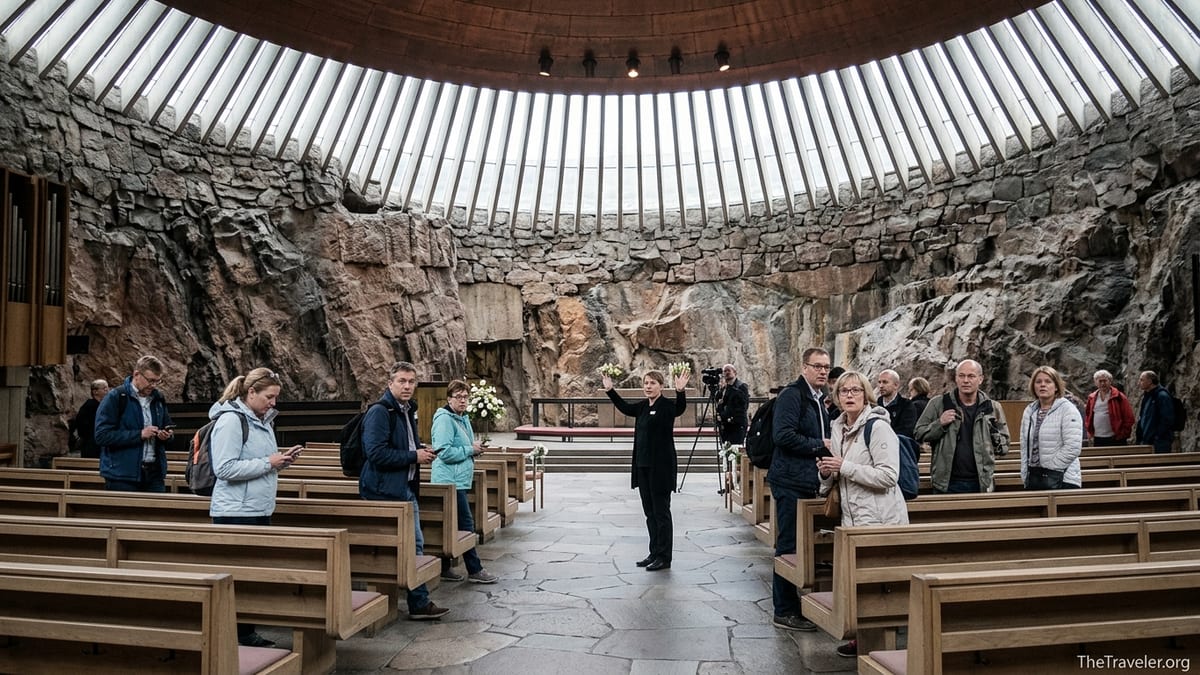
Temppeliaukio’s interior is as extraordinary as the photos suggest. The circular church is hewn directly into two-billion-year-old bedrock, the rough walls still bearing drill marks from construction in the 1960s. Above, a copper dome lined with roughly 22 kilometres of copper strips floats over the space, held by radiating concrete beams and encircled by a band of 180 skylights that funnel pale Finnish daylight into the sanctuary. Even surrounded by tour groups, the effect is quietly theatrical.
What surprised me most, though, was how little space there was to simply stand and take it all in. Every bench seemed occupied. Tripods, which are not allowed, had been replaced by a forest of smartphones held aloft. A guide speaking Italian pointed out the granite crevice that forms the altarpiece, while another explained in Spanish how the church doubles as a concert hall thanks to its acoustics. The murmur of languages echoed off the rock, a far cry from the silent, contemplative experience I had pictured while scrolling through glossy photos from Visit Helsinki and city tourism brochures.
Still, even in the busyness, there were fragments of the calm I had come for. I slipped into an empty spot on a wooden bench and listened as someone sat at the organ and began to play a short piece, possibly as part of sound checks for a later concert. The sound rose effortlessly through the circular space, each note clear and warm. Around me, chatter faded. People put down their phones. A Japanese visitor next to me closed his eyes. For a few minutes, the Rock Church felt less like a tourist attraction and more like the spiritual and architectural experiment the Suomalainen brothers had intended.
Then, just as quickly, it shifted again. A staff member walked to the front with a portable speaker and politely announced that visiting hours were ending and that everyone without a wedding invitation needed to head to the exit.
When a Wedding Rearranges Your Day
As everyone began to move, the church transformed in real time. Staff guided visitors toward the doors, reminding people gently but firmly that photography is not allowed during religious services or private ceremonies. A florist arrived balancing vases of white lilies. A photographer with a camera far more serious than any tourist’s walked in to assess the light. The benches at the back were cleared so that guests could be welcomed.
Outside, the line that had still been growing when I entered dissolved into a loose crowd of visitors trying to decide what to do next. Some looked frustrated, having arrived just as the doors closed. A couple from Spain checked the printed opening hours on a board and realised they would have to shift their plans for the afternoon: the church would not reopen to visitors until later, and they had pre-booked tickets elsewhere in the city.
For me, the early closure meant that my short visit had been compressed but also transformed. I had managed to see the interior but only in a hurried, slightly chaotic way. The experience was rich, yet incomplete. The rough stone, copper dome and skylights were unforgettable, but I had missed the slower, quieter visit I had imagined, where one might sit for half an hour and watch the light move across the rock.
Standing outside on the plaza, I pulled out my phone and checked the church’s website again. Temppeliaukio’s team updates visiting hours weekly, sometimes daily, to reflect services, concerts, funerals and weddings. On paper, it is “open nearly 365 days a year,” but the fine print is critical: Sunday services and special events close it to tourists, and opening times on national holidays like Independence Day or Christmas can be quite different from ordinary days. Had I paid closer attention to the detailed schedule, I might have avoided the tight squeeze between tour groups and wedding guests.
Beyond the Dome: Exploring Töölö After the Detour
With the Rock Church temporarily off limits, I took it as a cue to wander Töölö, a neighbourhood many visitors bypass on their rush between the harbour, Senate Square and the design district. From the plaza, it is just a short walk to the National Museum of Finland, a granite building that looks like a cross between a castle and a railway station, where you can explore Finnish history from prehistory to the present. On a drizzly afternoon, the 16 euro entrance fee suddenly felt like good value, especially compared with standing in the rain hoping the church might reopen.
Continuing toward the water, I followed tree-lined streets to the Sibelius Monument in Sibelius Park. Designed by Eila Hiltunen, the forest of steel pipes honouring Finland’s most famous composer can feel as sculptural and otherworldly as Temppeliaukio’s interior. Tour buses that had just deposited visitors at the Rock Church had now reappeared here, their passengers walking from one icon of Finnish design to another.
If you are planning your own visit, this is where the day can work in your favour. Allowing time to get “bumped” from Temppeliaukio by a service or rehearsal gives you flexibility to explore nearby sights without feeling that the day is wasted. Many travellers I later spoke with mentioned pairing the Rock Church with a visit to the nearby Helsinki Music Centre, Finlandia Hall, or simply lingering in a café around Kamppi or Töölö to sample cinnamon buns and dark Finnish coffee while waiting for the next visiting window.
In my case, the unexpected closure meant cancelling plans to ride a sightseeing boat that afternoon. Yet I never felt shortchanged. If anything, seeing how Temppeliaukio functions as a living parish as well as a tourist magnet offered a more honest portrait of the city than any uninterrupted photo session might have.
What I Wish I Had Known Before Visiting
Looking back, my day at Temppeliaukio Church did not fail because my expectations were too high. It went sideways because those expectations were too narrow. I had pictured a static architectural masterpiece that would quietly wait for me to show up between 10 a.m. and 6 p.m. Instead, I encountered a place that shifts hourly between sacred space and sightseeing landmark, and that dual role affects everything from opening hours to the mood inside.
The most practical lesson is timing. Mid-morning on a summer day, when cruise ships dock and hop-on hop-off buses are circulating, is the most likely moment to face queues and short visits. Travellers who visited on shoulder-season weekdays in late autumn or early spring told me they entered with no line at all and paid roughly the same 8 euro fee, sometimes staying for an entire 45-minute organ recital. Others who came just after 4 p.m., when larger tours had thinned, described the church as “strangely peaceful,” even in July.
Another lesson is flexibility with tickets. While you can simply walk up and pay at the door by cash or card, pre-booking a timed entrance through the church’s official ticketing system or as part of a Helsinki city pass can reduce uncertainty on busy days. It does not override closures for services, but it can help smooth entry when crowds spike unexpectedly. If you are travelling with a family, remember that minors under 18 can usually enter free, and those holding a Helsinki Card, Helsinki City Pass or the Finnish Museum Card may have the entrance fee waived, which can tip the balance when deciding whether to wait out a shorter time slot.
Finally, I wish I had anticipated the emotional shifts inside: the tug-of-war between spiritual space and Instagram backdrop. Knowing that you might share the pews with couples taking engagement photos, architecture students sketching the concrete beams, and musicians quietly warming up makes it easier to accept the Rock Church for what it is: one of Helsinki’s busiest, most layered rooms, not a private meditation chamber.
How to Plan Your Own Visit Without the Stress
After my first, slightly chaotic visit, I returned to Temppeliaukio on a colder weekday a few months later, determined to apply what I had learned. This time, I checked the official calendar that morning, confirmed that only one short midday service was scheduled, and aimed for a late-afternoon slot. When I arrived, there was no queue. The ticket desk staff still collected the 8 euro fee, but the atmosphere was markedly calmer, with individual travellers rather than large groups filling the benches.
With more time, I noticed details I had completely missed before: the way sunlight filtered through the 180 narrow skylights, creating a soft halo along the edge of the dome; the contrast between the smooth, honey-coloured wooden pews and the rough bedrock walls; the small crevices where visitors had left written prayers. An organist practiced a piece by Sibelius, and the acoustics, shaped by the irregular rock surface, were even more striking without the competing background noise of tour commentary.
Several practical strategies emerged from that second visit. Arrive 15 to 20 minutes after the church reopens from a scheduled closure rather than just before it closes, so you are not rushed out. Bring a light jacket: the rock keeps the interior cool even in summer, and it can feel surprisingly chilly if you stay more than half an hour. Budget at least 30 to 45 minutes inside, especially if you want to listen to any live music or just sit and watch the light change. Above all, remember that opening hours are genuinely variable; checking on the day, not just the week before, can save you from standing in a disappointed crowd outside.
If your schedule is tight, pairing the Rock Church with other nearby indoor attractions like the National Museum or a café in Kamppi means you can pivot quickly if you arrive to find a sudden closure. Helsinki’s compact centre and reliable trams make it easy to rearrange an afternoon without losing much time or money, something I only appreciated fully after my first plan evaporated at the church doors.
The Takeaway
My first visit to Temppeliaukio Church was, in almost every practical sense, a failure. I misjudged the timing, underestimated the crowds, and walked away feeling that I had seen the space but not truly experienced it. Yet the very disruptions I cursed at the time ended up teaching me more about Helsinki, and about how to travel, than any perfectly executed itinerary could have.
The Rock Church is not a museum piece or a frozen architectural set. It is an active Lutheran parish, a concert venue with world-class acoustics, and one of Finland’s busiest tourist attractions, all packed into a single circular room carved out of ancient stone. That complexity means your visit may be shortened by a wedding, transformed by a surprise organ recital, or enriched by a quiet half-hour on a nearly empty weekday afternoon. The difference between frustration and fascination often comes down to how much flexibility you allow yourself and how carefully you read the fine print on those ever-changing opening hours.
If you arrive with a rigid schedule and a checklist mentality, Temppeliaukio may very well turn out “different than expected” in the most aggravating way. But if you approach it as a living space in constant negotiation between worship, music and tourism, those same surprises can become the most memorable part of your day in Helsinki. In my case, an interrupted visit led to new corners of Töölö, a deeper appreciation for Finnish design, and a second, slower encounter with the Rock Church that finally matched the photographs in my mind.
FAQ
Q1. Do I need a ticket to visit Temppeliaukio Church?
The church charges an entrance fee for most visitors, currently around 8 euros for adults, payable at the door or via advance online tickets, while minors under 18 usually enter free.
Q2. How much time should I plan for a visit?
Most travellers find that 30 to 45 minutes is enough to look around, take photos, sit quietly and, if you are lucky, listen to some live organ music.
Q3. When is the best time of day to visit?
Late afternoon on weekdays outside peak cruise ship hours tends to be calmer, while mid-mornings in summer can be busy with tours and short visiting windows.
Q4. Can I attend a service instead of paying an entrance fee?
Yes, services such as Sunday worship are open to everyone and generally do not require an entrance fee, but photography is not allowed during services and it is important to respect the liturgy.
Q5. Are photos and videos allowed inside?
Photography is usually permitted for personal use during normal visiting hours, but flash, tripods and filming during services, weddings or funerals are not allowed.
Q6. Is Temppeliaukio Church accessible for visitors with limited mobility?
The main entrance and interior are generally accessible, with ramps and level flooring, though some areas can be slightly uneven due to the rock construction, so extra time may be helpful.
Q7. Do I need to book a guided tour in advance?
Guided tours are offered at various times and may be included in some city passes, but independent visitors can also explore on their own without a pre-booked tour.
Q8. What else can I see near the Rock Church?
Nearby attractions include the National Museum of Finland, Sibelius Monument, Helsinki Music Centre and the cafés and shops around Kamppi and Töölö.
Q9. Is it worth visiting in winter or only in summer?
The church is striking year-round; in winter the low Nordic light and snow outside create a different, often quieter atmosphere compared with busy summer days.
Q10. Can I combine Temppeliaukio with other sights in one day?
Yes, its central location makes it easy to combine with Helsinki Cathedral, the harbour area or a ferry to Suomenlinna, provided you check the church’s specific opening hours first.