


Rising out of the Gulf of Finland just 15 minutes from central Helsinki, the sea fortress of Suomenlinna is one of Northern Europe’s most rewarding half day excursions. Spread across several low islands, this UNESCO listed stronghold combines grassy ramparts, rocky sea cliffs, pastel wooden houses and military history from the Swedish, Russian and Finnish eras. To see its best viewpoints and most important historic sites in a single visit, however, you need to be deliberate about your route and timing.
Get the latest updates straight to your inbox!
Planning Your Visit: Ferries, Tickets and Timing
Suomenlinna feels remote, but it is functionally part of Helsinki’s public transport network. Most visitors arrive on the frequent HSL ferry from Kauppatori, the Market Square by the city center. You can ride this standard ferry with any valid HSL ticket that includes zone A, so common tourist tickets such as AB or ABC day tickets cover the crossing at no extra charge. There is no separate entrance fee to the fortress itself, so the only unavoidable cost is your transport ticket.
The ferry crossing takes roughly 15 minutes and runs all year, though departures are most frequent in summer and early autumn. In July and August, you can generally count on a departure every 20 minutes or so during the day, which makes it easy to pop over for a few hours on a flexible schedule. In winter months and late evenings, sailings are less frequent, so it is important to check times in the HSL app or at the harbor before you stroll off to explore the city.
Most first time visitors do well with around three hours on the islands if they want to walk the classic route from the main pier to King’s Gate with photo stops, a café break and at least one museum visit. History buffs or slow travelers should plan four to five hours, especially if they intend to visit several museums like the Suomenlinna Museum, the Military Museum’s Manege and the Vesikko submarine exhibit. Families with young children may want to allow extra time for playgrounds and breaks on the grassy ramparts.
If your schedule allows, consider visiting early in the morning on a clear summer day or a couple of hours before sunset in late spring or early autumn. The low Nordic light at these times softens the colors of the ramparts and sea, and views from Kustaanmiekka and King’s Gate can be spectacular. Midday in July and August is the busiest, when large tour groups and cruise passengers often arrive, so early or later visits tend to feel more relaxed and photogenic.
Understanding the Layout: Islands, Routes and Orientation
Suomenlinna is not a single compact fort but a chain of islands connected by bridges and causeways. The main ones visitors walk across are Iso Mustasaari, Pikku Mustasaari, Iso Susisaari and Kustaanmiekka. The HSL ferry arrives at the Main Quay on Iso Mustasaari, which functions as the village center with the Visitor Centre, a grocery shop, cafés, and residential buildings. From there, the most popular way to see the major sights is to follow the signposted Blue Route across the islands to King’s Gate.
The Blue Route is roughly 1.5 kilometers one way and is marked with blue signs and plaques in several languages. It passes many of the core attractions, including the church, several museums and important fortifications. Walking the route at a moderate pace with photo stops typically takes 30 to 40 minutes one way, not counting time spent in museums or cafés. Because the path is mostly level but includes cobblestones and some uneven rocky surfaces, comfortable walking shoes are more important here than in central Helsinki’s paved streets.
To avoid backtracking and crowd bottlenecks, it is useful to think of your visit in segments: village and church near the main quay, central dry dock and museums in the middle, and the southern fortifications around Kustaanmiekka and King’s Gate at the far end. If you are traveling with limited mobility, you can focus on the first two segments, where paths are broader and more even. The furthest southern cliffs and some of the earthworks involve gentle slopes and occasionally narrow, packed earth paths.
A simple strategy is to pick up a free island map at the Visitor Centre right by the main pier and then use it together with the posted orientation maps along the Blue Route. Mark the spots you especially want to see, such as the Vesikko submarine or a chosen café, and note how they relate to the main path. This makes it much easier to avoid the common mistake of wandering aimlessly near the pier and then realizing you are running out of time without ever reaching the best viewpoints at the southern tip.
Must See Historic Sites Along the Blue Route
After stepping off the ferry and passing the long yellow Jetty Barracks, your first major historic landmark is Suomenlinna Church. Originally built as a Russian Orthodox garrison church in the mid 19th century, it was later converted into a Lutheran church and today also doubles as a functioning lighthouse, with a light that guides ships into the harbor. Even if you do not go inside, the churchyard offers atmospheric views over wooden houses and the water, especially in late afternoon light.
A short walk further brings you to the Great Courtyard, one of the most architecturally harmonious corners of Suomenlinna. Surrounded by pastel colored barracks and dominated by the statue of Augustin Ehrensvärd, the Swedish military architect who designed the fortress, this square helps you visualize the era when Suomenlinna (then Sveaborg) was Sweden’s pride in the eastern Baltic. Stand near the statue and you can see how the buildings step down toward the sea, forming one of the island’s classic photo frames.
Near the Great Courtyard you will find the Suomenlinna Museum, the best single starting point if you want to understand the site’s layered history in a short time. Exhibits trace Suomenlinna’s evolution from Swedish naval base to Russian stronghold, then to Finnish garrison and eventually a lived in neighborhood and heritage site. Many visitors appreciate the short introductory film, which runs at regular intervals and condenses centuries of warfare, sieges and everyday life into an accessible narrative before you continue outside to see the real ramparts.
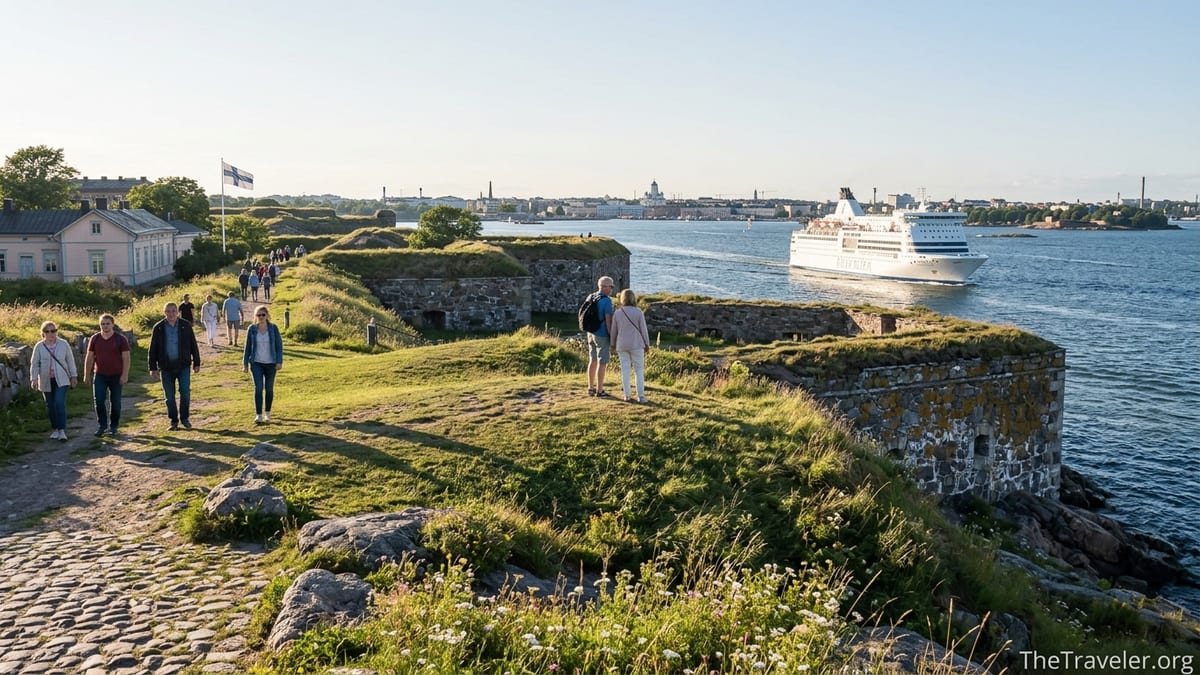
Beyond the central area, the Blue Route leads past the massive stone walls and bastions that made Suomenlinna so formidable. Look for surviving cannons aimed toward the sea and low brick powder magazines tucked under grassy mounds. These earthworks are not only historic defenses but also some of the island’s finest informal viewpoints. Locals and visitors alike often sit on the sunny slopes in summer to look back toward the Helsinki skyline or out toward the open Gulf of Finland, a reminder that Suomenlinna has always balanced military purpose with everyday life.
Where to Find the Best Views and Photo Spots
For many visitors, the highlight of Suomenlinna is the dramatic southern edge of the fortress around Kustaanmiekka and King’s Gate. Kustaanmiekka is a narrow strip of fortifications where stone ramparts run right up to the cliffs overlooking a busy shipping lane. From the grassy tops of these walls you can watch large ferries and cargo ships pass at close range, their size exaggerated by the narrowness of the strait. On a clear evening, the low sun can catch the sides of these vessels and the sea spray below, making for some of the most memorable photos of any Helsinki trip.
King’s Gate, or Kuninkaanportti, is considered the main symbol of Suomenlinna and sits on the southeast tip of Kustaanmiekka. Originally built in the 18th century at the landing place where Sweden’s King Adolf Frederick is said to have stepped ashore, it is a monumental stone gateway opening directly onto the water. Standing at the top of the stairs and looking back inland gives a classic perspective: layers of ramparts, rough rock, and the low silhouette of the fortress against the sky. This is one of the best places for a wide landscape shot that captures both architecture and sea.
Another excellent viewpoint is near the old dry dock in the central part of Suomenlinna. The dock, once used to service warships, is now often quiet, and its stone walls create an amphitheater like space. From the higher path along the edge you get a clear view into the dock and out toward the village, which gives a good sense of how the fortress blended industry, defense and everyday infrastructure. In winter, snow on the dock’s terraces adds clear graphic lines that appeal to photographers.
Do not overlook the more intimate views, either. Low wooden houses with carved details along narrow lanes, laundry lines in resident courtyards, and glimpses of the sea between pines can be just as evocative as the big panoramas. Early summer evenings are particularly atmospheric, when wildflowers spread across the grassy ramparts and the soft light reflects off both the water and the pastel walls. If you are visiting in late autumn or winter, the mood shifts to something more austere and cinematic, with icy paths, muted colors and the sound of wind carrying across the frozen or dark water.
Museums and Inside Experiences Worth Your Time
While Suomenlinna’s open air fortifications and sea views are the main draw, spending at least an hour in one or two museums deepens the experience considerably. The Suomenlinna Museum, located near the main quay, is the gateway for understanding the fortress as a whole. Its exhibits cover not only military history but also everyday life, from the challenges of living on a windswept island to the transition into a modern residential district and cultural site. Many visitors appreciate that the displays are presented in multiple languages and use models and period objects rather than just text panels.
Further along, the Military Museum’s Manege and related exhibitions on the island focus specifically on Finnish military history, particularly in the 20th century. Here you will find uniforms, weapons and personal stories from Finland’s wars, which can feel very immediate given that some of the buildings themselves served military functions during those periods. History enthusiasts often pair a visit here with the Vesikko submarine, a restored Finnish submarine from the 1930s now displayed on the shoreline. Walking through its narrow interior gives a vivid sense of how cramped life was for sailors, and its deck offers another unusual vantage point toward the sea and fortress walls.
Seasonal museums, such as the Ehrensvärd Museum in the official’s residence by the Great Courtyard, add another layer by showing how high ranking officers and their families lived during the Swedish era. In summer, when these houses are open and guided tours are more frequent, it becomes much easier to imagine Suomenlinna as a functioning garrison town rather than simply a cluster of ruins. If you plan to visit several museums in Helsinki and across Finland, it can be worth checking whether a Museum Card or city card includes multiple Suomenlinna attractions, as that can simplify ticketing and save some money over several days.
Because opening hours vary by season and around public holidays, especially in winter and on days like May Day or Independence Day, it is wise to confirm specific museum times shortly before your visit. As a practical example, on some spring public holidays the Suomenlinna Museum and Military Museum may keep shorter hours while cafés stay open into the evening, so visitors who arrive late in the day sometimes find that only the outdoor areas are accessible. Planning your museum visits earlier in your time on the island ensures you will not miss the exhibits you care most about if weather or schedules shift unexpectedly.
Eating, Drinking and Taking a Break With a View
Suomenlinna is not just a museum island. It has a small but active community of residents, and the fortifications are woven around cafés, restaurants and picnic spots that take full advantage of the scenery. Near the main pier and Visitor Centre you will find casual cafés and a small grocery store where you can pick up snacks, pastries and coffee before starting your walk. In summer, outdoor terraces fill with both locals and day trippers who want to linger over coffee while watching the ferries glide in and out.
Further into the island, several restaurants and bistros occupy historic buildings, such as vaulted brick storehouses or old officers’ quarters. Many of these focus on Finnish and Nordic flavors, often with menus that might include salmon soup, local fish and seasonal berries. Prices are broadly in line with Helsinki’s mid range restaurants, and lunch specials are common during the week. If you are on a tight budget, however, a popular option is to bring your own picnic. Grassy slopes near the main ramparts, sheltered spots around the Great Courtyard and rock outcrops facing the sea all make memorable picnic sites when the weather cooperates.
One of the simple pleasures of visiting Suomenlinna is sitting down with a hot drink in a cozy café after walking the windy ramparts. In colder months, find a café with indoor seating and big windows facing the water. You can warm up with coffee, hot chocolate or a cinnamon bun while watching ice floes drift past in the harbor. In summer, soft serve ice cream and cold soft drinks are popular, especially with families, and you will often see children running between the café terraces and nearby playgrounds.
Wherever you pause to eat or drink, be mindful that Suomenlinna is a residential neighborhood and a sensitive heritage site. Use the numerous trash and recycling bins, keep noise levels reasonable in quieter residential lanes, and avoid clambering on fragile structures in search of the perfect photo. The most scenic spots usually have nearby benches or gently sloping grass, so it is almost always possible to enjoy a meal with a view without risking damage to the historic fabric of the fortress.
Seasonal Tips and Responsible Exploration
Suomenlinna is open year round, and each season offers different possibilities for views and experiences. In high summer, long days mean you can visit well into the evening, with sunset often stretching late into the night and casting warm light on the southern cliffs. This is the most popular time, so paths, museums and cafés can be busy and you will likely share viewpoints like King’s Gate and Kustaanmiekka with many other visitors. Early mornings in July and August are therefore especially rewarding, with softer light and far fewer people on the ramparts.
Spring and autumn provide more changeable but often dramatic conditions. Cold, clear days offer crisp visibility across the Gulf of Finland, while fast moving clouds can add texture and contrast to your photos of stone walls and cannons. In April and October, you should be prepared for slick surfaces from rain or early frost on exposed rocks near the sea. Good footwear with grip makes it easier to move safely between viewpoints, particularly if you plan to explore beyond the most level paths.
Winter visits are quieter and can feel almost meditative, with snow drifting across the ramparts and the Helsinki skyline appearing through pale light to the north. The HSL ferry still runs, though sometimes through ice fields, which adds an extra dimension to the journey. While some museums and restaurants operate on reduced hours in midwinter, the core outdoor sights and key viewpoints remain accessible, provided paths are safe. Dress in layers, cover your head and hands, and keep in mind that wind across the open water can make temperatures feel significantly colder than in the city center.
No matter when you visit, exploring Suomenlinna responsibly helps preserve its character and ensures access to the best views for everyone. Stick to marked paths on grassy ramparts to avoid eroding fragile earthworks, and heed any temporary closures around restoration sites. Respect resident privacy by not photographing into windows or private yards, and keep drones grounded unless you have explicit permission, because low flying devices can disturb both people and nesting birds. Small choices like these safeguard the fortress so that future visitors can stand on the same cliffs and look out over the same historic seascapes.
The Takeaway
Exploring Suomenlinna without missing its best views and historic sites is mostly a matter of smart planning and unhurried walking. By starting at the Visitor Centre, following the Blue Route to King’s Gate and allowing time for a couple of carefully chosen museums and a café stop, you can gain both sweeping panoramas of the sea and a grounded sense of the fortress’s past. Even a three hour visit can take you from the bustle of Helsinki’s Market Square to watching ships slip through the narrows at Kustaanmiekka, all against a backdrop of stone, grass and sky.
Whether you come in the glow of a Nordic summer evening or under the austere light of winter, Suomenlinna rewards attention to detail. A carved doorframe on a wooden house, the worn stone of a bastion, a child’s bicycle leaning against a cannon; small scenes like these bring the site to life as much as the grand viewpoints do. With a little preparation and respect for the living community that calls the islands home, you can leave knowing you have seen both the famous postcard angles and the quieter corners that make Suomenlinna one of Helsinki’s most enduring experiences.
FAQ
Q1. How long do I need to see Suomenlinna’s main sights and viewpoints?
Most visitors can walk the main route from the ferry pier to King’s Gate, enjoy key viewpoints and visit one museum in about three hours. History enthusiasts or families who want to see several museums and take longer breaks often find that four to five hours allows a more relaxed pace.
Q2. Do I need to buy a separate ticket for the ferry to Suomenlinna?
You can reach Suomenlinna on the regular HSL ferry from Helsinki’s Market Square using any valid HSL ticket that includes zone A, such as an AB or ABC ticket. There is no separate entrance fee for the fortress itself, though individual museums on the island may charge their own admission.
Q3. What is the best season to visit Suomenlinna for views?
Summer and early autumn offer the most reliable weather and long daylight, which is excellent for photography, especially in the evening. Spring and winter can be beautiful too, with snow, ice and changing light creating a more dramatic atmosphere, but you should be prepared for cold, wind and some reduced opening hours indoors.
Q4. Is the Blue Route suitable for people with limited mobility?
The Blue Route is mostly level but includes cobblestones, some gentle slopes and sections of uneven ground. The areas around the main pier, village center and church are relatively accessible, while the southern fortifications and cliffs near Kustaanmiekka and King’s Gate can be more challenging. If mobility is a concern, focusing on the central parts of the island and checking current accessibility information in advance is advisable.
Q5. Which viewpoints should I prioritize if I am short on time?
If you have only a couple of hours, aim to see the Great Courtyard, the area around the dry dock and at least one of the southern viewpoints at Kustaanmiekka or King’s Gate. These spots offer a mix of historic architecture, impressive ramparts and open sea views that capture the essence of Suomenlinna in a short visit.
Q6. Are there places to eat and drink on Suomenlinna?
Yes, there are several cafés and restaurants on the islands, mostly clustered around the main pier and along the central route. They serve everything from coffee and pastries to full meals with Finnish and Nordic flavors. In summer, outdoor terraces are popular, while in colder months cozy indoor cafés provide welcome shelter from the wind.
Q7. Can I visit Suomenlinna in bad weather?
Suomenlinna is open year round, and the HSL ferry usually operates in all seasons, including through ice in winter. Rain, strong wind or snow can make the ramparts and rocks slippery, so good footwear and appropriate clothing are important. On days of particularly rough weather, you may prefer to focus more on museums and sheltered viewpoints rather than the most exposed cliffs.
Q8. Is Suomenlinna suitable for children and families?
Suomenlinna works very well for families, with open grassy areas, gentle hills and plenty of space to explore. Children often enjoy climbing on safe sections of the ramparts, watching ferries and ships pass, and visiting the Vesikko submarine when it is open. Parents should supervise children closely around cliffs, water edges and old fortification structures, where there are fewer barriers than in a modern playground.
Q9. Do I need a guided tour to understand the history?
A guided tour can add depth and context, especially if you are interested in military history or architectural details, but it is not essential to enjoy Suomenlinna. The island has plenty of informational signs in multiple languages, and the Suomenlinna Museum offers a concise overview. Many visitors combine a museum visit with self guided exploration using the Blue Route map.
Q10. Can I stay on Suomenlinna in the evening or after dark?
There is no general closing time for the outdoor areas, and ferries run into the evening, especially in summer, so you can linger for sunset views. A small number of residents and accommodation options exist on the islands, but most visitors return to central Helsinki for the night. Always check the time of the last convenient ferry back before heading to the far end of the fortress late in the day.