


LeConte Lodge sits high on Mount LeConte in Great Smoky Mountains National Park, a rustic outpost that can only be reached on foot. It inspires almost mythical devotion among repeat guests, but it also confuses first-timers who are used to standard park lodges or Gatlinburg cabins. If you have ever wondered what the cabins are really like, how meals work, or exactly what you get for the price, this inside look at the LeConte Lodge complex will help set expectations before you commit to the hike and the reservation lottery.
Get the latest updates straight to your inbox!
The Setting: A Walk-in-only Mountain Village
LeConte Lodge is not a drive-up lodge. Perched at roughly 6,360 feet on the upper slopes of Mount LeConte, it is the highest guest lodge in the eastern United States and the only place inside Great Smoky Mountains National Park where you can sleep in a permanent structure on a mountaintop. To get there you will hike one of several steep trails, commonly the Alum Cave, Rainbow Falls, Trillium Gap, or Boulevard trails, with elevation gain of about 2,500 to 2,700 feet. Most hikers take three to five hours to reach the lodge depending on fitness and trail choice, which immediately sets the tone: staying here feels more like backcountry trekking than a typical hotel stay.
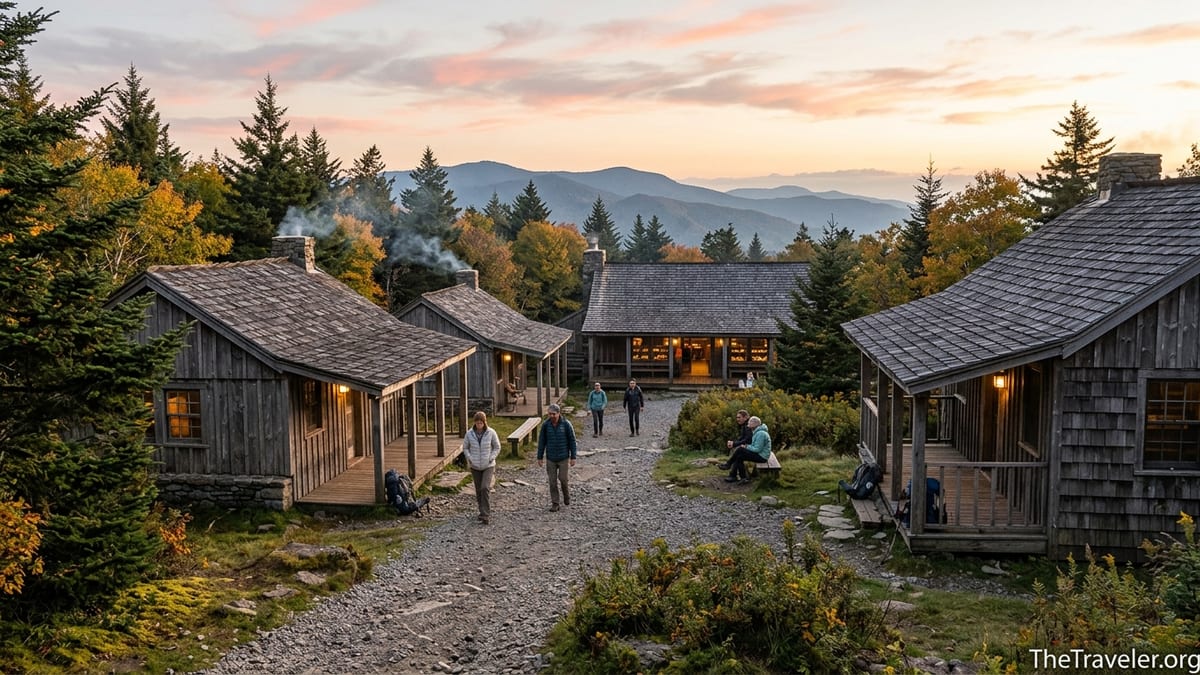
The lodge complex itself is a tight cluster of low, wood-shingled buildings arranged along narrow, gravel paths. There are seven individual guest cabins and three multi-room lodges, plus a central dining hall and a small office and gift shop. Kerosene lanterns glow in cabin windows after dark, and you are just below the spruce fir summit forest, often in cool cloud and mist even when Gatlinburg is hot and sunny. Because everything is packed in on a narrow ridgeline, you will see and hear your fellow guests, but there are quiet nooks and benches where you can watch the sunset fade over the Smokies.
Supplies come up on regular llama pack trains via Trillium Gap, typically several times a week in season. That is how fuel, food, and fresh linens reach the top. It also explains why everything at the lodge is simple, sturdy, and designed to be packed on an animal: no big appliances, no fragile decor, and limited variety in what is offered. When you understand that logistical reality, the whole experience makes more sense.
The operating season usually runs from late March through late November. Reservations for a given year are awarded through a lottery and then a waitlist, and popular dates can book out roughly a year in advance. That scarcity is part of the appeal, but it also means your best experience starts with realistic expectations about what you will actually get once you are up there.
Cabins and Lodges: What Your Room Really Includes
Guest accommodations at LeConte Lodge fall into two main categories: individual cabins and multi-room lodges. Individual cabins are stand-alone, single-room wooden structures with wood plank walls and floors, simple hand-built bunk beds, a small table or shelf, pegs for hanging gear, and shutters over the windows. Multi-room lodges are larger shared buildings divided into separate sleeping rooms, often booked by families or groups who want to stay together. In both cases, think of your space as a backcountry shelter that has been significantly upgraded, not as a Smokies honeymoon cabin.
Every guest bed comes with a mattress, sheet, blanket or quilt, and a pillow, so you do not need to haul a sleeping bag up the mountain unless you prefer your own. Cabins are equipped with propane heaters that staff operate as needed in colder weather, which can mean frost or even snow at the shoulder seasons, despite mild temperatures in the valleys. Light comes from kerosene lanterns that you or staff will light in the evening. There are no electrical outlets, no ceiling lights, and no place to plug in a phone or camera, so plan to arrive with devices fully charged and bring a small headlamp for reading or finding the bathroom at night.
Inside, the vibe is functional and cozy rather than luxurious. Floors creak, beds can be narrow, and wind can rattle the shutters on blustery nights. If you have stayed in traditional mountain huts in the Alps or rustic historic lodges in US national parks, LeConte Lodge will feel familiar. If your benchmark is a modern rental cabin with a hot tub and big-screen TV, this will feel extremely basic. The upside is that the absence of electronics and frills tends to push everyone toward early nights, conversation, and watching the changing light outside.
Sound carries easily through the thin walls, especially in the multi-room lodges where several parties sleep under one roof. If you are a light sleeper, pack earplugs. Many guests also appreciate a small stuff sack to corral gear so they are not rummaging loudly in the night. The cabins lock from the inside, but the atmosphere is communal and relaxed, and most people leave valuables at home given the hike-in nature of the property.
Bathrooms, Water, and Everyday Comforts
One of the most common surprises for first-time guests is the bathroom setup. You do not have a bathroom in your cabin. Instead, you use shared facilities in the main complex. LeConte Lodge has flush toilets in common restrooms, which is a major step up from many backcountry camps, but there are no showers on the mountain and no bathtubs in cabins. For most visitors, that means accepting that you will not truly wash up until you are back down in the valley. A small travel washcloth and a pack of wipes can go a long way toward feeling human after a sweaty hike.
Potable water is provided by the lodge, typically via a spring-fed system. You can fill bottles or hydration bladders on site and you do not need to filter water yourself. Those refills are included in your stay. However, because the water system and storage are limited, staff encourage guests not to leave taps running or waste water. That conservation mindset is part of the overall culture of the lodge, similar to what you find at remote Canadian or Alaskan wilderness lodges where every gallon is hauled or pumped with effort.
There is no guest-accessible kitchen. You cannot bring a camp stove or start fires to cook your own meals anywhere in the complex. All cooking is handled by the staff in the main kitchen that also serves the shared dining hall. If you have brought snacks, those you will eat in your cabin or on the porches, storing them carefully so they do not attract mice or other wildlife. Because of the bear population in the Smokies, you should never leave food unattended outside or toss scraps around the property.
For lighting, you will rely on a combination of the lodge’s kerosene lanterns and your own flashlight or headlamp. At night the complex is very dark by city standards, especially in bad weather. A small lamp beside the bunk can make it much easier to find your way without fumbling. The absence of power also means no Wi-Fi, no cell charging hubs, and often limited or no cell signal. Some guests do pick up intermittent reception depending on carrier, but you should not plan on it. Treat your time at LeConte Lodge as an enforced digital detox.
How Dining Works: Family-Style Meals and Menus
LeConte Lodge operates on an American Plan system, which means your overnight rate for a regular cabin includes dinner on the night of your stay and breakfast the following morning. As of the most recent publicly posted rates, adults typically pay just under two hundred dollars per person before tax for lodging plus these two meals, with lower rates for children. For guests renting the larger group lodges, lodging and meals may be billed separately per person, but the food itself is the same hearty fare served to everyone in the dining hall.
Meals are served at fixed times in a communal dining room. Dinner is usually early evening, around 6 p.m., and breakfast is around 8 a.m., though exact times can shift by season and lodge policy. There are no separate seatings and no made-to-order menus. Everyone arrives at once, sits at long tables or in shared spaces, and is served family-style platters. Typical dinners might include items such as beef or chicken stew, mashed potatoes, green beans or mixed vegetables, applesauce or coleslaw, hot biscuits or cornbread, and a simple dessert like cobbler or cake. Breakfast commonly features pancakes or scrambled eggs, ham or bacon, grits or oatmeal, and biscuits with preserves.
The cooking itself is straightforward but filling, with an emphasis on calories and warmth rather than presentation. Many ingredients are shelf-stable canned or dry goods, again reflecting the reality that everything arrives on llamas or by foot. However, the food has a long-standing reputation for tasting remarkably good after a climb of several thousand vertical feet. Travelers often describe it as “the best canned food you will ever have,” which is less of a complaint and more of an acknowledgment that appetite and setting transform simple dishes into something memorable.
For beverages, water, coffee, and hot chocolate are typically available, with hot drinks often offered to arriving guests in the afternoon. At dinner, adults can usually purchase wine by the glass for an additional set fee per night, and there are limited soft drinks or juices for sale. There is no bar and no mixed drinks. If you are used to full-service park lodges like those at Yellowstone or Yosemite, think less variety but a more intimate and communal experience, where you may end up talking gear and trails with strangers at your table.
Dietary Needs, Sack Lunches, and Snacks
LeConte Lodge can accommodate some dietary needs with advance notice, but there are hard limits given the remote kitchen and the small staff. Vegetarian options are commonly available when requested at the time of reservation, often substituting plant-based or egg dishes for meat portions at dinner and breakfast. The lodge notes that it can attempt to work with certain allergies or restrictions, such as lactose sensitivity or basic gluten avoidance, but cannot guarantee a completely allergen-free kitchen. If you have severe, cross-contamination-level allergies, you will need to speak with the reservations office well before your trip and may decide to bring more of your own packaged food as a backup.
Sack lunches are a key part of the experience if you plan to day hike along the ridge or down to scenic overlooks like Cliff Tops or Myrtle Point. For an additional fee per person, you can order a premade lunch that usually includes items like a sandwich or wrap, piece of fruit, dessert bar or cookie, and a drink mix or juice. These are sold during set hours in the late morning and afternoon in season. Many overnight guests order sack lunches for the day of departure, so they have food for the hike down without having to carry extra weight on the climb up.
The small gift shop in the dining hall doubles as a snack outlet. During posted hours, typically mid-morning and mid-afternoon, you can purchase limited snack items such as candy bars, trail mix, jerky, or packaged cookies, as well as branded mugs, shirts, and souvenirs. Prices reflect the cost of hauling everything up the mountain; expect to pay more than you would at a grocery store in Gatlinburg, but not dramatically more than convenience store rates in other national park lodges.
If you are particular about snacks, coffee, or hydration flavors, bring a modest supply in your pack. Examples that work well in this environment are instant coffee sachets, electrolyte powder packets, or compact high-calorie bars. Just remember that any trash you create needs to be disposed of properly in lodge bins, and you should store food securely in your cabin to avoid attracting mice.
Pricing, Reservations, and What Your Money Buys
Staying at LeConte Lodge is not cheap compared to car-camping or most backcountry options, but its rates are in line with or lower than many historic lodges in Western parks once you factor in meals. Recent official rate sheets list standard adult per-person charges for cabins that bundle lodging with dinner and breakfast, plus state and local taxes. Children between ages four and twelve have reduced rates, and there are separate line items for meal-only charges on group lodges, as well as small “empty bed” fees if fewer people occupy a cabin than its designed capacity. The exact numbers shift year to year, so always check the latest published rate schedule when planning.
Your nightly rate buys you a bed with linens, use of the shared facilities, hot dinner, hot breakfast, potable water, and access to the lodge grounds. You also get intangible value: the chance to watch sunset paint the blue ridges from just below the summit, to step outside your cabin into crisp mountain air at dawn, and to share a table with hikers who chose the same improbable destination. For many repeat guests, it is this combination of place and ritual that justifies the cost more than the physical amenities.
Reservations are managed through a yearly lottery system. In practice, that means interested guests submit date requests for the following season during a window announced by the lodge, and then assignments are made and confirmed. Cancellations do occur, often within a month of a given date, and the lodge runs a waitlist and occasionally posts last-minute openings through its communication channels. People who are flexible with dates and party size have the best shot at snagging a cancellation, especially for one-night stays in shoulder seasons like April or early November.
Because the lodge operates under a concession contract inside a national park, policies around cancellations, payment deadlines, and taxes are spelled out clearly on its official reservation materials. For instance, reservations made within roughly thirty days of arrival generally must be paid in full at booking, and late cancellations can incur forfeiture of part or all of your payment unless the lodge can rebook the space. When budgeting, factor in the cost of parking fees implemented by Great Smoky Mountains National Park for trailhead parking, as well as gas, overnight lodging in the valley before or after your hike, and any specialty gear you might buy for the climb.
What You Will Not Get: Managing Expectations
The fastest way to sour a LeConte Lodge stay is to arrive expecting a modern resort on a mountaintop. You will not find private bathrooms, daily housekeeping service in the hotel sense, televisions, Wi-Fi, air conditioning, or even basic room lighting beyond lanterns. There are no hot showers at the end of your hike. The mattresses are serviceable but not plush, and the walls are thin. Weather can be raw and damp, especially in shoulder seasons, and it is not unusual to spend your afternoon and evening inside clouds, with mist blowing across the porches and limited views.
You should not expect restaurant-style menu choice either. Dinner is what is served that night, and while second helpings are often available for hungry hikers, there is no ordering a different entree because you do not like stew or green beans. Alcohol selection is extremely limited to a simple wine option, and there is no espresso machine, draft beer, or cocktail list. If your idea of a reward for a big hike is a craft beer flight and gourmet burger, that will need to wait until you are back in Gatlinburg or Pigeon Forge.
Another adjustment for many guests is the social environment. Because common spaces are compact, you are in close contact with other parties: sharing tables, passing on narrow paths, listening to their footsteps on the porch outside your cabin at night. Most people choose LeConte Lodge precisely because they enjoy the company of fellow hikers, but if you crave absolute solitude, you may be happier at a backcountry campsite or shelter elsewhere in the park, where you carry your own tent and food.
Finally, while staff are known for being friendly and hardworking, this is not a full-service resort with a concierge desk and an army of employees on call. The same crew members might check you in, serve your dinner, stoke heaters, and haul water. When storms roll through, they might also be busy securing the property or troubleshooting systems. Patience and self-reliance go a long way here; treat it like a supported backcountry trip rather than a hotel where you can ask for anything at any time.
Planning Your Stay: Practical Tips and Realistic Packing
Once you know what LeConte Lodge does and does not provide, you can pack strategically for comfort without overloading yourself for the climb. The lodge supplies a bed, basic bedding, dinner, breakfast, water, dishes, and simple cups and utensils in the dining hall. You need to bring your hiking gear, personal toiletries, headlamp or flashlight, any medications, and clothing suitable for a mountain environment where temperatures can be several degrees cooler than in Gatlinburg and where weather shifts quickly.
Most seasoned guests aim for layered clothing they can adjust as conditions change. For example, a typical early October packing list might include moisture-wicking hiking tops, a light fleece or puffy jacket, a waterproof shell, hiking pants, and dry camp socks. Cotton-heavy outfits that work fine strolling the Gatlinburg strip can leave you chilled when clouds and wind move through at 6,300 feet. Even in midsummer, it can be cool after sunset. A compact knit hat and thin gloves weigh very little and can make evenings on the porch more comfortable.
Footwear deserves special attention. Trails to LeConte are rocky, often wet, and can be slippery in rain or early-morning frost. Sturdy hiking boots or trail shoes with good traction are far more appropriate than casual sneakers. You will be walking through roots, rock steps, and sometimes narrow ledges, so think about stability and ankle support. Trekking poles are not essential but many people find them helpful on the steep descent the next day, especially when legs are tired.
Because there is no electricity or in-room running water, pack a small toiletry kit that works in a dry cabin context. Travel-size toothpaste and toothbrush, biodegradable wipes, a small bottle of hand sanitizer, and a travel towel or bandana will help you freshen up. Leave heavy items like hair dryers, large bottles of shampoo, or extensive makeup kits at home; there is no place to plug them in and little reason to fuss at this level of rustic travel. A paperback book or deck of cards can be more valuable than another outfit when the fog rolls in and evening stretches ahead by lantern light.
The Takeaway
LeConte Lodge offers a rare kind of mountain stay: a real bed and hot, sit-down meals in a place you can only reach by hiking thousands of feet uphill. Inside the cabins, you get shelter, warmth, and basic comfort, not luxury. In the dining hall, you get hearty, set-menu meals that taste better than they would anywhere else because you have earned them. Around you, you get a close-knit cluster of buildings that feels more like a rustic mountain village than a traditional hotel, all under a sky that can shift from gray mist to blazing sunset in a matter of minutes.
Knowing exactly what is and is not included means you can decide if that tradeoff is right for you. If you want private bathrooms, Wi-Fi, and expansive menus, a valley lodge or a modern cabin might suit you better. If you are drawn to trail conversations over family-style dinner, to the glow of lanterns instead of screens, and to the feeling of walking out your cabin door directly into the high Smokies, LeConte Lodge delivers a distinctive experience that is difficult to replicate elsewhere in the eastern United States.
In the end, the value of a night at LeConte Lodge is less about thread count or wine lists and more about the stories you carry down the mountain the next day. You will remember the way the clouds boiled beneath the ridgeline at dawn, the shared pot of coffee in the dining hall after a cold night, and the simple satisfaction of having everything you needed in a small cabin miles from the nearest road. For many travelers, that is exactly what they were hoping to get all along.
FAQ
Q1. Do the cabins at LeConte Lodge have electricity or outlets?
No. There is no electricity in guest cabins, which means no outlets for charging devices and no electric lights. Illumination comes from kerosene lanterns provided by the lodge, and guests are encouraged to bring a headlamp or flashlight for moving around after dark.
Q2. Are bathrooms private or shared, and are there showers?
Bathrooms are shared, with flush toilets located in common facilities rather than inside individual cabins. There are no showers or bathtubs at LeConte Lodge, so you should plan to go without a proper wash until you return to the valley, using basic wipes or a small washcloth to freshen up instead.
Q3. What meals are included in the nightly rate?
For standard cabin reservations, the quoted per-person rate includes dinner on the night of your stay and breakfast the following morning. Both are served at set times in the main dining hall and are offered family-style rather than from a menu. Sack lunches and any snacks or beverages purchased between meals cost extra.
Q4. Can the lodge accommodate vegetarian or allergy-friendly meals?
LeConte Lodge can typically provide simple vegetarian alternatives and may be able to adjust for some common dietary restrictions if they are noted well in advance with your reservation. However, the remote kitchen and limited storage mean it cannot guarantee a completely allergen-free environment, so travelers with severe allergies should discuss options with the reservations office and consider bringing suitable backup food.
Q5. Is there any cell service or Wi-Fi at LeConte Lodge?
There is no Wi-Fi for guests, and cell phone reception is spotty at best, varying by carrier and weather. Some hikers report picking up intermittent signal in certain spots near the ridge, but you should not rely on it. Plan on being largely offline during your stay and use the time as a break from devices.
Q6. How difficult is the hike to reach the lodge?
All routes to LeConte Lodge are considered strenuous day hikes, with roughly 2,500 to 2,700 feet of elevation gain depending on the chosen trail. Distances range from about five to eight miles one way. Most reasonably fit hikers take three to five hours to reach the lodge, longer in poor weather or with heavy packs. Good footwear, water, and a realistic start time are important.
Q7. What is actually provided in the cabins, and what should I bring myself?
Cabins provide beds with sheets, blankets or quilts, pillows, propane heat in cooler weather, kerosene lanterns for light, and basic furnishings like bunks and shelves. You should bring your hiking clothing and layers, toiletries, small towel or wipes, headlamp, any necessary medications, personal snacks, and a book or small game for downtime. A sleeping bag is not required but some guests prefer their own.
Q8. Can I buy food or drinks outside the main meal times?
Yes, within limits. During posted hours the dining hall gift shop sells snacks like candy bars and packaged treats, as well as a small selection of beverages. You can also purchase sack lunches during the day. Selection is modest and reflects what can be hauled up the mountain, so if you have particular favorites, bring a small supply in your pack.
Q9. Are children welcome at LeConte Lodge, and is it suitable for families?
Children are welcome and have reduced lodging and meal rates within a defined age range. Many families treat a stay at LeConte Lodge as a milestone adventure, but it is important that children are able to handle the full uphill hike and the rustic conditions. There are no cribs, playgrounds, or kid-specific programs, so entertainment is essentially the trails, views, and time together in the cabins and dining hall.
Q10. How far in advance should I plan and reserve a stay?
Because space is limited and demand is high, most guests secure reservations many months in advance through the lodge’s annual lottery and subsequent waitlist. If your travel dates are inflexible or you are planning for a peak season weekend, starting the process up to a year ahead improves your odds. Flexible travelers sometimes can pick up cancellations closer to the date, but nothing is guaranteed, so early planning is wise.