


The Alaska Inside Passage is one of the world’s classic cruising routes, combining sheltered waterways, snow capped mountains, glaciers and historic towns in a compact corridor. For many travelers, “Alaska cruise” effectively means “Inside Passage.” Yet not all sailings that use this label follow the same route, visit the same ports or offer the same glacier experiences. Understanding what the Inside Passage is, and how cruise lines use the term, is essential before you choose a ship and itinerary.
Get the latest updates straight to your inbox!
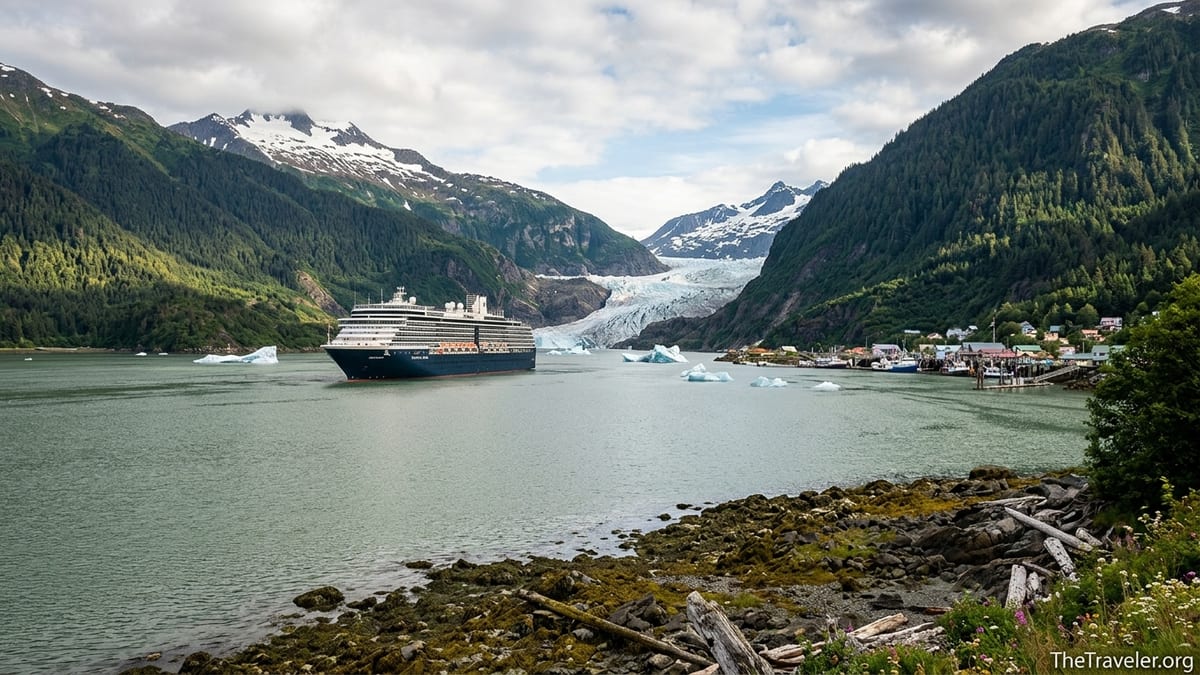
What the Alaska Inside Passage Actually Is
Geographically, the Inside Passage is a coastal sea route stretching along the Pacific coast of North America through the islands of British Columbia and Southeast Alaska. Canadian and U.S. hydrographic and maritime authorities describe it as a network of channels, fjords and narrow passages threaded between the mainland and hundreds of forested islands, providing a partly sheltered alternative to the open Pacific for vessels traveling between Washington State, British Columbia and Alaska.
In Southeast Alaska, the Inside Passage runs through the Alaska Panhandle, a long, narrow strip of territory that includes communities such as Ketchikan, Sitka, Juneau, Hoonah and Skagway. Here, the route passes steep mountains, temperate rainforests and deep inlets carved by glaciers, with many stretches protected from the full force of ocean swells by islands and peninsulas. This geography is what makes the region so attractive for cruising, particularly for first time passengers who may be cautious about rough seas.
Because the Inside Passage is a transport corridor rather than a single, fixed line, ships can follow slightly different paths within it depending on their size, draft, schedule and permitted routes. Larger ocean going ships typically use the wider, deeper channels, while smaller expedition style vessels sometimes deviate into narrower fjords and anchorages that are not practical for big ships. When you see “Inside Passage” on an itinerary, it signals that much of the journey will follow this protected coastal maze, but not that every ship follows the identical track.
How Cruise Lines Use the “Inside Passage” Label
In cruise marketing, “Inside Passage” often appears as a shorthand for roundtrip or one way sailings that focus on Southeast Alaska and coastal British Columbia. Major brands such as Holland America Line, Princess Cruises, Royal Caribbean and Norwegian Cruise Line frequently highlight “Inside Passage” days or “Cruising the Inside Passage” in their day by day schedules on voyages between Vancouver and ports like Juneau, Skagway and Ketchikan. Recent Alaska brochures and online planners show these phrases paired with maps that trace the route along the sheltered channels rather than across the open Gulf of Alaska.
However, not all Inside Passage itineraries are identical. Some seven night cruises emphasize classic roundtrip routes from Vancouver, with extensive time in the Canadian Inside Passage and three or four stops in Southeast Alaska. Others depart roundtrip from Seattle, spending part of the journey outside the most protected channels along the outer coast of Vancouver Island before rejoining more sheltered waters farther north. Itineraries may also differ in whether they include a glacier day in Glacier Bay National Park, Endicott Arm and Dawes Glacier, Tracy Arm Fjord when accessible, or Hubbard Glacier. Current schedules for 2025 and 2026 from mainstream lines show all of these options featured on various Inside Passage or “Voyage of the Glaciers” style routes.
Many cruise lines operate both Inside Passage focused trips and Gulf of Alaska one way voyages that connect Seward or Whittier with Vancouver. The latter often combine time in the Inside Passage with a segment across the open Gulf and visits to additional glacier areas such as Hubbard Glacier or College Fjord. When comparing itineraries, pay close attention to how the day descriptions are worded. “Inside Passage cruising” usually refers to the more sheltered channel sections, while “Outside Passage” or “Gulf of Alaska” indicates exposure to more open ocean conditions.
Key Ports on Inside Passage Sailings
Most big ship Inside Passage cruises feature at least three port calls in Southeast Alaska, with Juneau, Skagway, Ketchikan, Sitka and Icy Strait Point among the most common. Juneau, the state capital, sits on the Gastineau Channel and is a major jumping off point for visits to Mendenhall Glacier and for whale watching in nearby waters. Skagway, near the northern end of Lynn Canal, preserves Gold Rush era streetscapes and serves as the base for the White Pass and Yukon Route scenic railway. Ketchikan, in the southern panhandle, is known for its steep streets, salmon runs, nearby rainforest and extensive collections of totem poles at locations in and around town.
Sitka, located on Baranof Island on the outer coast of the Inside Passage region, reflects a blend of Tlingit heritage and Russian colonial history, with views toward the volcanic peaks of the surrounding islands. Icy Strait Point, adjacent to the predominantly Alaska Native community of Hoonah, is a newer cruise development that is majority owned by local Indigenous shareholders. Here, cruise passengers step directly into a complex of restored cannery buildings, forest trails and adventure facilities that serve as a gateway to nearby wilderness and local culture.
It is important to remember that port combinations vary by line and sailing. Some itineraries may bypass Skagway in favor of longer time in Juneau and an additional call such as Sitka or Haines. Others add less visited communities like Wrangell or Klawock, particularly on premium and smaller ship cruises. When choosing a voyage, note not only which ports are listed but how long the ship is scheduled to be alongside, as port time can significantly affect what you are able to see and do ashore.
What to Expect in Major Inside Passage Ports
In Juneau, typical excursions offered by cruise lines and local operators include coach trips to Mendenhall Glacier visitor areas, whale watching cruises in Auke Bay or Stephens Passage, guided hikes, helicopter or small plane flightseeing to nearby icefields, and visits to attractions such as the Mount Roberts Tramway. Current offerings commonly run from short, introductory sightseeing tours of a couple of hours to combination adventures that can occupy most of the port day. Because weather, daylight and seasonal wildlife patterns change through the May to September season, travelers should always confirm the latest excursion details and physical requirements at the time of booking rather than relying on older brochures.
Skagway’s shore excursion menus lean heavily into the town’s Klondike Gold Rush history and surrounding mountain scenery. The White Pass and Yukon Route railway remains a headline experience, with trains climbing from sea level into the mountains along historic narrow gauge tracks. Many itineraries combine the train with motorcoach portions, gold rush camp re creations or easy walking tours through the historic district. Independent options include hiking, cycling and river float trips. Trip lengths and elevation changes vary widely, so verifying duration and fitness levels in advance is essential, particularly early and late in the season when schedules may be adjusted.
Ketchikan is marketed as the “Salmon Capital of the World” and offers a mix of wildlife, cultural and outdoor excursions. Common options include visits to totem parks and carving centers, rainforest walks on boardwalk trails, bear viewing tours during peak salmon runs, kayak trips and small boat wildlife cruises. Floatplane trips to nearby Misty Fjords National Monument are widely advertised, subject to weather conditions. Available excursions and price ranges differ by operator and month, and some wildlife tours are timed to seasonal fish runs, so travelers should pay close attention to local advice and recent descriptions when planning.
In Sitka, visitors can explore sites connected to both Indigenous Tlingit and Russian eras, including historic churches and cultural centers, as well as coastal walking trails and small boat wildlife trips in Sitka Sound that may encounter sea otters, whales and seabirds. Icy Strait Point and Hoonah focus on locally guided cultural experiences, forest zip lines, coastal hikes and whale watching in productive nearby waters. In this privately developed port area, cruise companies typically partner with the Indigenous owned operator that manages the facilities, so excursion menus are relatively standardized but can evolve season by season. As with other ports, travelers should check the latest descriptions for walking distances, accessibility and current rates when they book.
Glacier Days and Scenic Cruising
One of the defining features of an Inside Passage cruise is a day devoted to glacier focused scenic cruising. For many travelers, this is the highlight of the trip. On mainstream seven night itineraries, that special day may take place in Glacier Bay National Park, Endicott Arm and Dawes Glacier, Tracy Arm Fjord when ice conditions permit, or at Hubbard Glacier, often combined with longer voyages that also cross the Gulf of Alaska. Cruise and national park schedules for upcoming seasons confirm that multiple big ship lines hold permits to enter Glacier Bay on select days, while others consistently feature Endicott Arm and Dawes Glacier or Hubbard Glacier in their route descriptions.
Glacier Bay visits involve the ship entering the national park and slowly navigating its inlets while park rangers come aboard to provide interpretation. Ships do not dock; instead, passengers view several tidewater glaciers from decks and observation lounges as the vessel pauses or slowly turns to give both sides of the ship a view. Access within the bay can vary depending on wildlife protections and ice conditions, and the park continues to limit the number of large cruise ships per day. Travelers should verify whether their specific sailing includes Glacier Bay, since capacity is constrained and not all Inside Passage cruises have access to the park.
Endicott Arm and Dawes Glacier, as well as Tracy Arm, are narrow fjords lined with ice polished cliffs and waterfalls. In recent years, many major lines have shifted more sailings toward Endicott Arm and Dawes Glacier because its entrance and ice conditions can be more consistently navigable than Tracy Arm, which has at times experienced heavy ice. Cruise lines commonly describe these days as “Endicott Arm and Dawes Glacier (scenic cruising),” sometimes paired with optional small boat or “glacier explorer” excursions that bring guests closer to the ice when conditions allow.
Hubbard Glacier, which towers above Disenchantment Bay near Yakutat, appears on longer itineraries and on many one way “Voyage of the Glaciers” style routes operated by premium and traditional lines. On Hubbard Glacier days, big ships usually spend several hours in the bay, approaching the glacier face as closely as conditions and safety guidelines permit, then pivoting for views on multiple sides. In all of these glacier areas, weather, visibility and ice can vary from day to day. Passengers should be prepared for cold, damp conditions even in midsummer and avoid assuming that any particular sailing will guarantee sun or perfectly calm seas.
Scenic Sea Days and Wildlife Along the Inside Passage
Beyond the marquee glacier days, Inside Passage itineraries typically include at least one full or partial day of scenic cruising through narrow channels. These segments may be explicitly labeled “Inside Passage cruising” or simply appear in the schedule as “at sea.” In practice, passengers can expect long stretches of tree lined shores, distant snowfields, and the occasional lighthouse or small community, especially in the more remote portions of the Canadian Inside Passage and northern Southeast Alaska.
Wildlife sightings are a key draw. From ship railings and observation lounges, travelers regularly scan for humpback whales, orcas, porpoises and sea lions in the water, as well as bald eagles along the shoreline. Bears are sometimes visible on tidal flats or river mouths when the ship passes relatively close to shore. Frequency of sightings varies widely with season, time of day, weather and chance, so no reputable line can guarantee specific animals on any given day. Binoculars and layers of warm clothing significantly improve comfort and the ability to linger outdoors when something appears.
Sea conditions in the Inside Passage are typically more sheltered than fully open ocean routes because many channels are protected by islands. This can mean smoother sailing compared with extended crossings of the Gulf of Alaska. However, certain stretches, especially around exposed capes or when a ship briefly transits outside the main channel system, can still experience noticeable motion. Wind, tide and storms all influence the ride. Travelers prone to motion sickness should not assume completely calm seas and may wish to consult a medical professional about preventive measures before departure.
Vancouver vs Seattle Departures
Most mainstream Inside Passage cruises depart either from Vancouver, British Columbia, or Seattle, Washington. Roundtrip Vancouver itineraries usually spend more time within the Canadian Inside Passage, entering sheltered channels shortly after leaving port and remaining largely protected until the ship nears Southeast Alaska. This often translates into extended scenic cruising past British Columbia’s forested islands and coastal mountains. Vancouver is also a major Canadian gateway with international flights, urban parks and cultural attractions that support easy pre and post cruise stays.
Seattle, by contrast, is a United States homeport that can simplify logistics for many American travelers, especially those who prefer to avoid an international flight at the start or end of their trip. Roundtrip Seattle itineraries commonly sail along the outer coast of Vancouver Island for part of the journey before turning into more sheltered channels farther north. While this pattern may involve a bit more open water, it offers the convenience of a domestic port with robust air connections, hotels and attractions such as Pike Place Market and the Space Needle for short city breaks.
Immigration formalities differ between the two. Cruises that begin or end in Vancouver involve entry into Canada and, on most Alaska routes, subsequent entry into the United States in either a port in Southeast Alaska or back in the Lower 48. Passengers typically complete Canadian entry checks at Vancouver’s cruise terminal and U.S. immigration procedures later in the voyage. Roundtrip Seattle itineraries that call at Canadian ports still require documentation valid for both countries. Because entry policies and processing procedures can change, prospective passengers should review the most current government and cruise line guidance close to their departure date.
Small Ships, Large Ships and Different Inside Passage Styles
Inside Passage cruises fall broadly into two categories: large mainstream ships and smaller expedition or boutique style vessels. Large ships operated by well known brands can carry thousands of passengers and offer multiple dining venues, theaters, kids’ programs and elaborate amenities. Their Inside Passage itineraries typically focus on the classic ports and glacier days described earlier, with set dock times and well organized shore excursion programs. Fares can be relatively competitive, especially for standard cabins booked well in advance or during promotions, with onboard style ranging from casual family friendly to premium traditional.
Smaller ships, including some U.S. flagged and expedition lines, generally carry from a few dozen to a few hundred guests. Their itineraries often emphasize more remote anchorages, additional small communities or extended time in wilderness areas. For example, some adventure oriented operators combine Inside Passage routes with days spent kayaking in quiet coves, hiking in less visited areas or exploring in inflatable boats. Because these vessels can maneuver into narrower channels and anchor closer to shore, they can offer a more intimate sense of the landscape, but usually at higher per day prices and with fewer big ship style entertainment options.
The onboard atmosphere also differs. Expedition and small ship cruises may feature daily briefings, naturalist led talks and a stronger focus on outdoor activities, with fewer formal evenings and more emphasis on shared experiences. Cabins can be compact, and some vessels have limited elevator access or fewer accessible staterooms compared with new large ships. Travelers considering these options should look carefully at deck plans, age and refurbishments of the vessel, and whether the onboard style matches their comfort preferences. Large ship passengers, meanwhile, should check whether their desired sailing is on a newer or recently updated vessel, as ship age can influence everything from cabin design to environmental technology.
Practical Logistics: Documents, Timing and Port Accessibility
Because Inside Passage cruises usually involve both U.S. and Canadian waters, documentation requirements deserve careful attention. Most international travelers will need a passport valid for the duration of the trip and often beyond, and many operators advise that U.S. citizens on routes that call in Canada also carry a valid passport book. Entry rules can vary by nationality and itinerary. Certain closed loop U.S. only cruises may offer more flexible documentation options, but rules are subject to change and can be tightened on short notice. Well before booking, travelers should review official guidance from U.S. and Canadian authorities and confirm that their chosen cruise line’s documentation rules align with their citizenship and route.
In embarkation cities such as Vancouver and Seattle, arriving at least one day before boarding is strongly recommended to buffer against flight delays, weather disruptions and congested check in times. Both cities offer ample hotel choices near cruise terminals, though availability and rates can tighten in peak summer months and during large events. On embarkation day, ships set final boarding times well before scheduled departure. Passengers should plan to be at the terminal comfortably ahead of these cutoffs, allowing time for security checks, check in formalities and the possibility of longer lines at peak hours.
Once onboard, it is important to learn how to read the detailed itinerary printed or posted by the cruise line. Port time listings will specify arrival and departure hours, sometimes adjusted closer to sailing, and may note whether a port is a dock or tender call. In tender ports, passengers transfer to shore on small boats that can be affected by sea conditions and may pose challenges for travelers with mobility limitations. Guests who rely on wheelchairs, scooters or other mobility aids should consult both the cruise line and specific shore excursion descriptions for accessibility information, since not all tours or ports can accommodate all needs even when the ship itself offers accessible staterooms.
Checklist: Questions to Ask Before You Book
Choosing the right Inside Passage cruise means matching what is on paper to your priorities in wildlife, culture, comfort and budget. Before committing to a booking, start by confirming which glacier area your sailing includes. Ask whether the itinerary specifies Glacier Bay National Park, Endicott Arm and Dawes Glacier, Tracy Arm, Hubbard Glacier or another destination, and whether the visit is described as “scenic cruising” only or paired with optional closer up excursions. Because park permits and conditions influence access, ensure that your expectations match what is realistically offered on that particular sailing.
Next, look closely at how many total port days are included, which specific ports are listed, and how many hours the ship will be in each one. A cruise with four ports and one glacier day offers a different experience than one with two ports and extended channel cruising. Consider whether you most value time to explore towns and book active excursions, or whether slower days of scenic sailing appeal more. At the same time, examine the schedule for any overnight or late evening departures that might allow you to experience ports at quieter hours or under the midnight sun near the solstice.
Finally, factor in the size and age of the ship, the departure port and your personal priorities. Decide whether you prefer a large resort style ship with extensive amenities or a smaller vessel with a stronger expedition focus. Weigh the convenience of Seattle against the extra Canadian Inside Passage scenery of Vancouver departures and assess the total trip cost, including flights, pre and post cruise hotels, gratuities and typical shore excursion spending. Travelers who prioritize wildlife and wilderness may lean toward itineraries with more glacier time and smaller ship options, while those emphasizing culture and comfort may focus on port rich routes and newer ships with strong onboard offerings. By asking these questions up front and cross checking them against current, detailed itineraries, you can select an Inside Passage sailing that delivers the Alaska experience you have in mind.