


Choosing between a Gulf of Alaska cruise and a traditional Inside Passage itinerary is one of the most important decisions you will make when planning an Alaska voyage. In simple terms, most Inside Passage cruises sail round trip from Seattle or Vancouver through largely protected coastal waterways in Southeast Alaska, while Gulf of Alaska cruises usually run one way between Vancouver and Seward or Whittier, cross more open water in the Gulf, and unlock access to Southcentral Alaska, including Anchorage, Kenai Fjords and Denali National Park. The routes overlap, because many Gulf of Alaska sailings still travel substantial stretches of the Inside Passage, but the experience, logistics and cost of your trip can be very different.
Get the latest updates straight to your inbox!
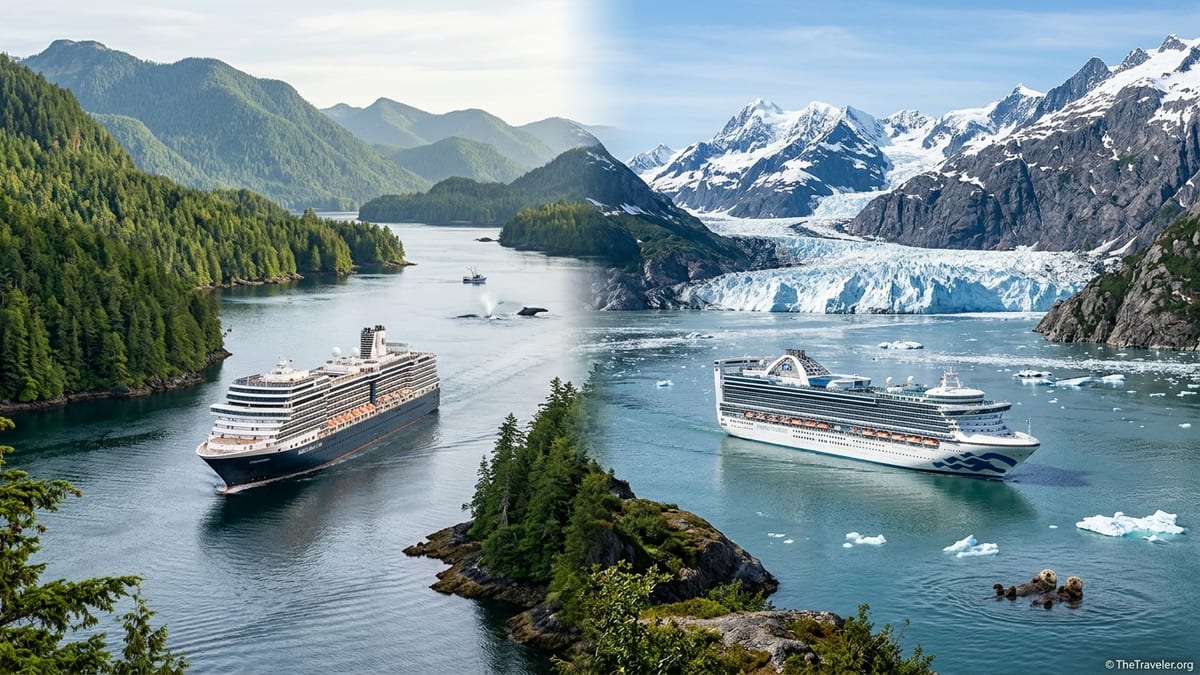
Route Geography: How the Two Itineraries Really Differ
Traditional Inside Passage cruises focus on the long chain of islands and channels that run from the tip of Vancouver Island through Southeast Alaska. In 2027, major lines such as Princess, Holland America, Royal Caribbean, Norwegian and Celebrity all offer seven night round trips from Seattle or Vancouver that spend several days weaving through these protected waters. Round trip Seattle itineraries, such as Princess sailings on Royal Princess or Star Princess, typically loop up via the east or west side of Vancouver Island, call at key ports like Juneau, Skagway and Ketchikan, and often include a scenic day in Glacier Bay or Endicott Arm. Vancouver round trips on ships like Holland America’s Koningsdam or Zaandam stay almost entirely within the Inside Passage from departure to return, with long stretches of island scenery on both the northbound and southbound legs.
Gulf of Alaska cruises take a different shape. These are usually one way itineraries between Vancouver and either Seward or Whittier, the cruise ports for Southcentral Alaska. For 2027, Princess, Holland America, Celebrity, Norwegian and Royal Caribbean all schedule one way Gulf sailings, often marketed under names such as “Voyage of the Glaciers” or “Glacier Discovery.” These voyages still cruise significant portions of the Inside Passage between Vancouver and Southeast Alaska’s ports, but instead of turning back, the ship continues across open water in the Gulf to reach Prince William Sound, College Fjord or Hubbard Glacier before ending near Anchorage.
Because of this overlap, the two options are not mutually exclusive in terms of scenery. A northbound Gulf of Alaska voyage from Vancouver on Princess or Holland America might give you classic Inside Passage scenes for two or three days, then add a night in Prince William Sound and a final day near College Fjord. A round trip Seattle itinerary on Royal Caribbean’s Anthem of the Seas or Norwegian Encore may include a partial run along the outer coast of Vancouver Island where the ship is more exposed to swells, but then it re-enters sheltered channels as it approaches Ketchikan and Juneau.
From a practical standpoint, Inside Passage round trips work best for travelers who want to fly in and out of one city, especially from the United States where Seattle counts as a domestic gateway. Gulf of Alaska itineraries require flying into or out of Anchorage and using a transfer or train to Seward or Whittier at one end of the trip, while starting or finishing in Vancouver at the other. This extra logistical step is what unlocks access to inland Alaska.
Scenery and Landscapes: What You See From the Ship
On an Inside Passage itinerary, the dominant landscape is a shifting panorama of forested islands, narrow channels and distant snowy peaks. Sailing north from Vancouver, ships pass through the Canadian Inside Passage via channels such as Grenville or Princess Royal, with green mountains dropping almost directly into the sea. In 2027, Holland America’s seven day “Alaska Inside Passage” round trip Vancouver shows this classic route clearly in its planning maps, promising multiple full or partial days where land is visible on both sides of the ship and small communities or fishing boats occasionally appear in view.
Once in Southeast Alaska, both Inside Passage and Gulf of Alaska sailings share similar vistas: the colorful stilt houses of Ketchikan, the fjord-like approach to Juneau, and the dramatic mountains that rise above Skagway’s Lynn Canal. When a ship detours up Endicott Arm toward Dawes Glacier, passengers watch icebergs drift past sheer rock walls and waterfalls that feel almost within reach. Scenic cruising days in Glacier Bay National Park add another layer, with broad glacial valleys, actively calving tidewater glaciers, and often low cloud or mist that gives the scene an otherworldly quality.
The scenery shifts notably on the Gulf segment of a one way cruise. North of Glacier Bay or Yakutat Bay, the ship enters the open Gulf of Alaska. On a clear day this can mean far-off views of Alaska’s coastal ranges and the wide horizon of the North Pacific. As Gulf itineraries approach Hubbard Glacier or Prince William Sound, mountains grow taller and more snow covered, and the water turns a milky blue from glacial silt. In Prince William Sound and College Fjord, the ship threads through a dense collection of hanging glaciers and tidewater glaciers spilling down from the Chugach Mountains, a region that one 2027 Holland America planner highlights as “Hubbard Glacier and College Fjord” sailings.
For many travelers, the Inside Passage offers a softer, more continuous scenic experience with fewer hours looking at open ocean. Gulf of Alaska routes add a sense of remoteness and scale when crossing the Gulf and entering Prince William Sound, trading some of the intimate channel cruising for big mountain amphitheaters and broad, glacier lined bays.
Glacier Viewing in 2027: Not All Itineraries Are Alike
It is a common misconception that every Alaska cruise visits the same glaciers. In 2027, official deployment brochures and port schedules show distinct patterns. Glacier Bay National Park access is limited and controlled, and in 2027 it appears primarily on Princess and Holland America itineraries. Princess highlights all Royal Princess and some Star Princess seven day round trip Seattle sailings as including Glacier Bay, while Holland America lists Glacier Bay as part of many Vancouver based Inside Passage routes on ships like Koningsdam, Zaandam and Westerdam. Some Seattle sailings from other lines substitute Endicott Arm and Dawes Glacier or Tracy Arm style fjords for Glacier Bay due to permit limitations.
Gulf of Alaska itineraries tend to concentrate glacier time differently. Princess markets its one way “Voyage of the Glaciers” sailings between Vancouver and Whittier as including both Glacier Bay and College Fjord on separate days, giving two major glacier experiences in a single seven night cruise. Holland America’s “Glacier Discovery” one way routes commonly combine Glacier Bay with either College Fjord or Hubbard Glacier, depending on the ship and date. Celebrity’s 2027 Seward to Vancouver voyages emphasize Hubbard Glacier, which lies near Yakutat Bay, while some Norwegian one way itineraries on Norwegian Jade also feature Hubbard rather than Glacier Bay.
Endicott Arm and Dawes Glacier show up frequently on 2027 round trip Seattle cruises operated by Royal Caribbean, Norwegian and Holland America. For example, a seven night Seattle itinerary listed for July 2027 on Holland America’s Eurodam includes scenic cruising in Endicott Arm along with port calls in Juneau, Skagway and Ketchikan. These fjord visits can be highly scenic and may allow closer approaches to actively calving tidewater glaciers when ice conditions cooperate.
Prince William Sound and College Fjord are primarily the preserve of one way Gulf of Alaska cruises ending or starting near Anchorage. The 2027 Alaska planners from Princess and Holland America both show College Fjord as a highlight of certain northbound and southbound itineraries, where multiple glaciers hang side by side along the fjord’s walls. Travelers who specifically want to see this cluster of glaciers from a large ship will need to choose a Gulf of Alaska route rather than a simple Inside Passage loop.
Wildlife Opportunities: From Ship Railings and in Port
Both Inside Passage and Gulf of Alaska cruises offer strong opportunities to see marine wildlife from the ship. Humpback whales are regularly spotted in Southeast Alaska waters between June and August, especially near Juneau and Icy Strait, and passengers often watch for blows from the open decks or their balconies on sea days. Orcas occasionally appear along Inside Passage routes near Vancouver Island and in Alaska’s narrow channels. Sea otters, harbor porpoises and harbor seals are also frequent sightings when the ship moves slowly near glaciers or in protected bays.
Where the itineraries diverge is in the types of add-on wildlife experiences accessible in port. Round trip Inside Passage cruises that call in Juneau, Icy Strait Point and Ketchikan offer concentrated options for whale watching, bear viewing and seabird excursions. In Juneau, multiple operators run half day whale watching trips that can be easily added to a day in port; on a typical 2027 call, a cruiser could disembark a Princess or Royal Caribbean ship in the morning, join a 3 to 4 hour humpback watching tour in Auke Bay, and be back on board by late afternoon. In Ketchikan, floatplane trips to bear viewing sites such as Traitors Cove or Neets Bay are popular add-ons for August and early September sailings.
Gulf of Alaska routes open different wildlife options at the land end of the cruise. From Seward, travelers can join Kenai Fjords National Park boat tours that combine tidewater glaciers with high chances of spotting sea otters, puffins, Steller sea lions and, in season, feeding whales. Many 2027 cruise tours sold by Princess and Holland America package a Kenai Fjords day cruise either before embarkation in Seward or after disembarkation. From Anchorage or nearby communities, guests can add bear viewing flights to places like Lake Clark or Katmai, which are not practical on a round trip Inside Passage cruise confined to Southeast Alaska.
On board, the mix of wildlife is similar regardless of itinerary, though passengers on one way Gulf cruises that include extensive time in Prince William Sound or College Fjord might spend more hours watching harbor seals hauled out on ice floes near hanging glaciers. Inside Passage cruisers enjoy more sheltered whale watching from decks along island lined channels, where calm seas can make spotting easier. In both cases, it is important to separate what is likely from what is guaranteed. Even in peak season, experienced travelers report that wildlife sightings vary from sailing to sailing, and no itinerary can promise whales or bears at specific moments.
Ports, Inland Extensions and 2027 Itinerary Examples
When comparing Gulf of Alaska and Inside Passage cruises, it helps to look at real 2027 itineraries. For classic Southeast Alaska ports, both options perform well. Most seven night Inside Passage round trips from Seattle and Vancouver call at Juneau and Ketchikan, and many still include Skagway. Icy Strait Point and Sitka appear more often on Vancouver based itineraries from lines such as Holland America and Celebrity. The 2027 Holland America planner shows a seven day “Alaska Inside Passage” route round trip Vancouver that visits Skagway, Juneau, Ketchikan and Glacier Bay, while some Seattle itineraries on Norwegian and Royal Caribbean replace Skagway with Icy Strait Point or Sitka to manage port congestion.
One way Gulf of Alaska cruises usually include two or three of the same Southeast ports, but not always the entire set. A northbound Princess “Voyage of the Glaciers” itinerary between Vancouver and Whittier might stop in Ketchikan, Juneau and Skagway, then devote two separate days to Glacier Bay and College Fjord. A Celebrity Seward to Vancouver voyage may focus on Hubbard Glacier, Icy Strait Point and Juneau. This mix still delivers the core Southeast Alaska experience, but travelers set on visiting every marquee port should study individual schedules rather than assume all names will appear.
The strongest advantage of Gulf of Alaska routes lies beyond the ship itself. Because these itineraries start or finish near Anchorage, they dovetail with land packages into interior Alaska. Princess and Holland America’s 2027 cruisetour brochures highlight combinations such as a seven day Gulf of Alaska cruise plus three or more nights on land, visiting Denali National Park by rail from Whittier or Seward, and sometimes pushing farther north to Fairbanks. Independent travelers can replicate these routes by using the Alaska Railroad from Seward or Whittier to Anchorage and onward to Denali, then flying home from Anchorage.
Round trip Inside Passage cruises do not easily connect to Denali or Kenai Fjords because of distance. While some guests fly into Anchorage before or after their cruise and add a separate land segment, this requires additional flights and backtracking. For visitors whose priority is to combine a cruise with Denali wildlife viewing or a small boat trip among Kenai Fjords’ tidewater glaciers, a one way Gulf itinerary paired with rail or coach travel is by far the more efficient choice.
Sea Conditions and Motion: Where It Is Calmer and Rougher
Sea conditions are one of the most common concerns when choosing between Inside Passage and Gulf of Alaska cruises. In general, itineraries that spend more time in narrow channels and behind islands encounter gentler seas, while those that cross the open Gulf are more exposed. Round trip Vancouver Inside Passage sailings are often the calmest, because they run inside Vancouver Island in Canadian waters and then continue through sheltered channels almost all the way to Ketchikan. Recent traveler reports frequently mention glassy water and minimal motion on these routes, especially in June and July, though strong winds can still create chop.
Round trip Seattle cruises operate differently. Many ships heading north from Seattle must exit to the open Pacific along the outer coast of Vancouver Island for part of the first and last sailing days, particularly on faster seven night itineraries. That segment can be noticeably more lively, with ocean swells and more pronounced rolling, before the ship re-enters sheltered channels closer to Alaska. Travelers prone to motion sickness often report that these first and last days from Seattle feel rougher than the middle of the cruise, even though most of the itinerary follows Inside Passage style waters.
One way Gulf of Alaska cruises between Vancouver and Seward or Whittier combine long stretches of calm with one or two genuinely open water segments. After leaving Southeast Alaska, ships cross the Gulf of Alaska itself to reach Prince William Sound, Hubbard Glacier or College Fjord. This crossing can last a day or more and is where passengers are most likely to feel ship movement. However, conditions vary widely. Some summer crossings reported by 2026 and early 2027 travelers describe gentle swells and sunshine, while others mention gray seas, wind and moderate rolling. It is accurate to say that the Gulf offers more potential for motion, but no reputable source can guarantee that a specific sailing will be rough or calm.
For travelers highly sensitive to seasickness, a Vancouver round trip Inside Passage itinerary is often the best compromise, followed by carefully chosen Seattle or Gulf sailings in mid summer, when weather patterns are often more stable. In all cases, cabins near the middle of the ship on lower decks tend to move less, and modern cruise ships carry stabilizers that help reduce side to side rolling during open water segments.
Trip Length and Value: Seven Nights vs Longer Cruises
Seven night Alaska cruises remain the backbone of the 2027 schedule. Princess, Holland America, Royal Caribbean, Norwegian and Celebrity all deploy multiple ships on seven night Inside Passage and Gulf of Alaska routes between May and September. According to several fare comparison services tracking July 2027 pricing, balcony cabins on mainstream lines in mid July cluster in the range of roughly 1,300 to 2,100 US dollars per person before taxes and fees for seven nights, with the lowest balcony prices often appearing on Vancouver round trips and some Gulf of Alaska one ways.
Longer itineraries, such as 9, 10 or 11 night sailings from San Francisco, Los Angeles or Seattle, add extra sea days and sometimes additional ports like Sitka or Prince Rupert. Holland America’s 2027 materials, for example, show an eight day Inside Passage route from Vancouver that adds Prince Rupert and a late evening stay in Juneau to the classic port trio and Glacier Bay. These extended itineraries can offer more scenic cruising and deeper time in Southeast Alaska, but they also reduce scheduling flexibility and typically carry higher total fares simply because of the extra nights on board.
From a pure scenic value perspective, many travelers find that a well chosen seven night Gulf of Alaska cruise with two distinct glacier days delivers excellent “wow” moments per day, especially if paired with a three or four night land segment in Denali or Kenai. Conversely, a seven night Vancouver round trip with Glacier Bay and three key ports can be ideal for travelers who have limited time and want a concentrated experience of island channels, classic ports and one marquee glacier region.
Ultimately, comparing seven night versus longer options should involve looking at how many full “scenic cruising” days the itinerary lists, which glacier regions are visited, and whether port times are long enough to support the excursions you care about most. A slightly more expensive eight day cruise that includes Glacier Bay and a second glacier day may feel like better value than a cheaper seven night sailing that skirts only one fjord for a few hours.
Real 2027 Costs: Round Trip vs One Way Gulf Itineraries
To understand the true financial difference between Inside Passage and Gulf of Alaska cruises in 2027, it helps to look at concrete scenarios rather than generic statements. Based on publicly available July 2027 pricing snapshots for mainstream lines, a couple booking a seven night Inside Passage round trip from Seattle with a standard balcony cabin might expect a base cruise fare in the vicinity of 1,600 to 2,000 dollars per person, including port taxes and standard gratuities where those are bundled. A comparable seven night Vancouver round trip may be slightly lower, with some balcony fares published around 1,400 to 1,800 dollars per person on selected weeks.
For one way Gulf of Alaska cruises between Vancouver and Seward or Whittier in the same month, balcony fares on Princess, Holland America and Celebrity often fall in a similar or only slightly higher band, sometimes from about 1,500 to 2,100 dollars per person including taxes. The cruise itself is therefore not necessarily dramatically more expensive. The extra cost usually appears in flights and pre or post cruise arrangements. A US couple sailing round trip Seattle can often find competitive non stop flights into Seattle from major hubs or even drive to the port if they live in the western United States, and they only need a hotel night before embarkation.
In contrast, a couple taking a Gulf of Alaska one way itinerary will likely fly into Vancouver and home from Anchorage, or vice versa. Multi city airfare can add a few hundred dollars per person compared with a simple round trip domestic ticket to Seattle, though deals do emerge in shoulder season. Transfers between Anchorage and Seward or Whittier, whether by coach or the Alaska Railroad, will add an additional per person cost, and an overnight in Anchorage is common at one end of the trip. When realistic onboard spending such as drinks packages, paid specialty dining and gratuities are added, along with one or two key excursions like a whale watching tour in Juneau or a Kenai Fjords day cruise from Seward, the total trip cost for two can easily reach several thousand dollars in either scenario.
Where round trip Inside Passage itineraries often win on value is simplicity. A family of four can fly to Seattle, stay one night in a midrange airport or downtown hotel, join a seven night cruise, and fly home on a single open jaw ticket. A similar family choosing a Gulf of Alaska route with an inland extension to Denali may pay more in aggregate because of the extra hotel nights, rail segments and high demand land excursions, even if their base cruise fare is similar. However, some travelers consider the added cost worthwhile because it effectively replaces a separate future trip to inland Alaska.
Traveler Experiences, Pros and Cons, and Who Each Itinerary Suits
Recent traveler reports from 2026 and early bookings for 2027 highlight recurring themes when comparing Inside Passage and Gulf of Alaska cruises. Many repeat cruisers praise Vancouver based itineraries for their calm waters, classic fjord scenery and frequent Glacier Bay access on lines like Holland America and Princess. Some note that round trip Seattle sailings on larger ships provide more onboard entertainment but involve at least one day of more noticeable motion along the outer Washington or Vancouver Island coast. Discussions among travelers looking at 2027 cruises repeatedly flag Glacier Bay as a deciding factor, with some guests switching away from lines that lack Glacier Bay permits in order to secure that specific national park experience.
For Gulf of Alaska routes, travelers tend to point to the depth of the overall Alaska experience rather than the cruise alone. Reviews of recent and upcoming one way cruises often mention the appeal of coupling a northbound voyage with a rail trip to Denali or a Kenai Fjords National Park small boat tour from Seward. Some travelers, particularly those prone to seasickness, express concern about the Gulf crossing, but others report surprisingly gentle conditions and emphasize that the payoff in Prince William Sound and Southcentral Alaska is worth a night or two of extra motion.
In terms of who each itinerary suits, broad patterns emerge. Inside Passage round trips from Seattle or Vancouver align well with first time cruisers, families with younger children and travelers who prioritize ease of transport. The straightforward logistics, domestic flights to Seattle and predictable port pattern make these cruises easy to book and enjoy. Gulf of Alaska cruises, especially when combined with land tours, better serve travelers who see this as a once in a lifetime Alaska journey and want to include Denali wildlife viewing, Anchorage cultural stops or Kenai Peninsula hiking alongside time at sea.
It is important to underline that neither itinerary can promise specific weather or seas. While Inside Passage channels are usually more sheltered, storms can move through in any summer week, creating windy, rainy days on either route. Similarly, while the Gulf of Alaska has the potential for rougher conditions, many sailings cross in relatively calm seas. Sensible preparation with motion sickness remedies and flexible expectations remains the best strategy.
Side by Side Comparison: Inside Passage vs Gulf of Alaska
Looking at the two Alaska cruise styles side by side can clarify the decision. Geographically, Inside Passage round trips trace coastal channels between Vancouver Island and Southeast Alaska’s island archipelagos, looping back to the same port. Gulf of Alaska cruises follow a diagonal route that begins in Vancouver’s Inside Passage waters, touches the Southeast ports, then crosses the Gulf to terminate in Southcentral Alaska. Embarkation for Inside Passage cruises is concentrated in Seattle and Vancouver, while Gulf sailings use Vancouver plus Seward or Whittier, with Anchorage as the air gateway for the northern end.
In terms of glacier access, Inside Passage itineraries in 2027 cluster around Glacier Bay, Endicott Arm and Tracy Arm style fjords. Gulf of Alaska cruises add Hubbard Glacier, Prince William Sound and College Fjord to that mix, with many one way sailings advertising two distinct glacier days. Typical weather exposure differs accordingly. Inside Passage cruises, especially from Vancouver, experience largely sheltered waters with brief open segments; Seattle round trips and Gulf cruises each include at least one more exposed leg where motion can be noticeable.
Wildlife viewing opportunities overlap heavily but manifest differently. Inside Passage sailings support frequent humpback sightings in protected channels and robust whale watching excursions from Juneau and Icy Strait Point. Gulf of Alaska itineraries also see whales and marine mammals from the ship, but their great strength lies in the ability to add Kenai Fjords and inland bear viewing from Anchorage as part of an extended trip. Scenery follows suit: Inside Passage cruises emphasize continuous forested islands and narrow passages, while Gulf routes layer in the more dramatic amphitheaters of Hubbard Glacier, College Fjord and Prince William Sound.
When all trip costs are tallied for two passengers, including comparable balcony cabins, airfare, a pre cruise hotel night, standard gratuities and a couple of major excursions, round trip Inside Passage itineraries tend to produce a lower bottom line and simpler planning, making them ideal for budget conscious travelers and those short on time. Gulf of Alaska cruises usually involve higher total outlay once multi city flights, rail transfers and extra nights in Anchorage or near Denali are added, but they deliver a more comprehensive Alaska experience in a single journey.
Recommendations and Frequently Asked Questions
For first time cruisers and families, a seven night Inside Passage round trip from Seattle or Vancouver is often the smartest starting point. These itineraries combine iconic ports like Juneau and Ketchikan, at least one major glacier day and plenty of sheltered scenic cruising, all while limiting travel complexity. Families benefit from round trip flights and the option to choose ships with extensive onboard amenities, such as Royal Caribbean’s larger vessels or Norwegian’s family focused ships operating out of Seattle.
Travelers prone to seasickness should lean toward Vancouver round trip Inside Passage cruises, which stay inside Vancouver Island and spend the most time in narrow, protected waters. If a Gulf of Alaska itinerary is strongly appealing because of Denali or Kenai Fjords, choosing peak summer dates, selecting a midship cabin on a lower deck and carrying effective motion remedies can help manage the less sheltered segments. Photographers and scenery focused travelers may prefer itineraries that include Glacier Bay plus either Hubbard Glacier or College Fjord, a combination found on several 2027 one way Gulf cruises with Princess and Holland America.
Wildlife enthusiasts who prioritize marine mammals can find rich experiences on either route but may gain the most by pairing a cruise with a Kenai Fjords National Park day cruise or a specialized whale watching excursion out of Juneau or Icy Strait Point. Budget travelers who want to contain costs and still see glaciers, whales and historic ports will typically find better value with seven night Inside Passage round trips from Seattle or Vancouver, particularly shoulder season dates in May or September, when fares often drop relative to peak July and August.
For visitors planning an inland Alaska extension, a Gulf of Alaska cruise is the logical foundation. Sailing one way between Vancouver and Seward or Whittier, then continuing by train or coach to Denali and Anchorage, allows you to experience both Alaska’s coastline and its interior in a single, coherent trip. In answer to common questions: which itinerary is more scenic depends on your preferences. Inside Passage cruises offer more continuous close range scenery, while Gulf routes deliver bigger glacier amphitheaters and access to Southcentral landscapes. Glacier Bay appears on many Princess and Holland America itineraries but not all; travelers should check specific 2027 sailings if Glacier Bay is a priority. Gulf of Alaska cruises are potentially rougher because of the open Gulf crossing, yet many sailings are reasonably smooth, and no route can guarantee calm seas. Combining both routes in one trip is possible through back to back cruises or cruise plus land combinations, and for travelers with the time and budget, the extra logistics can be fully worthwhile for the breadth of Alaska they reveal.