


More news on this day
A FedEx cargo jet overran a runway at Miami International Airport on the evening of November 25, 2026, prompting a temporary Federal Aviation Administration ground stop that contributed to thousands of flight delays on one of the busiest travel periods of the year and complicating Thanksgiving trips for travelers heading to Florida, including those bound for Walt Disney World.
Get the latest news straight to your inbox!
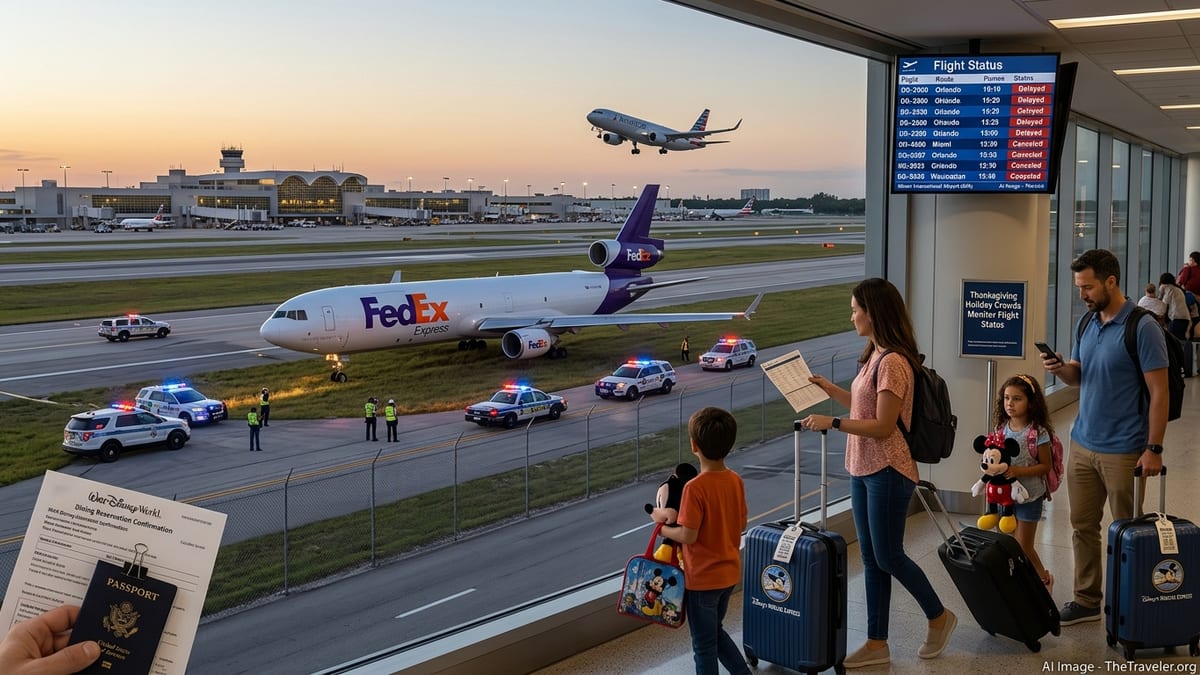
What Happened At Miami International Airport
According to the Federal Aviation Administration and multiple aviation incident databases, a FedEx Express McDonnell Douglas MD-11 freighter arriving from Memphis overran Runway 26R at Miami International Airport at around 8:25 p.m. local time on Wednesday, November 25, 2026. The aircraft came to a stop in the grass beyond the end of the runway near the airport perimeter fence. No injuries were reported among the three-person crew, and there was no immediate fire at the scene. Emergency services responded and secured the area while federal investigators began documenting the overrun.
The incident left Miami International temporarily operating with only one available runway while authorities closed the affected runway and at least two additional runways during the initial response. As a result, departures bound for Miami from other airports were placed under restrictions while arrivals were sequenced more slowly into the remaining operational runway, significantly reducing the airport’s capacity during a peak travel evening.
In response, the FAA issued a ground stop for flights destined for Miami International, halting many departures that had not yet taken off and imposing delays on others already in line. Once the situation was stabilized and a safe operating plan established, the FAA lifted the ground stop and gradually restored normal runway use, though the damaged runway remained closed for inspection and recovery operations.
How The Overrun Fed Into Thanksgiving Flight Delays
The runway overrun at Miami occurred during an already stressed Thanksgiving travel period, with airlines operating dense schedules and airports across the eastern United States managing difficult weather conditions. While the FedEx incident itself affected a limited number of flights directly tied to Miami, the resulting ground stop and runway reductions contributed to a broader pattern of disruption during the evening of November 25 and the morning of November 26.
Real-time tracking data cited by national outlets on Thanksgiving morning indicated that more than 6,000 flights within, into or out of the United States had been delayed and roughly 150 had been canceled by early November 26. Those totals included weather-related disruptions at multiple hubs, lingering technical issues earlier in the week and knock-on effects from the Miami ground stop. Only a portion of those delays were directly linked to the incident in Miami, but for travelers they combined into a single experience of longer-than-expected journey times, missed connections and rebooked itineraries.
The timing of the overrun was especially challenging for passengers making evening departures on November 25, traditionally one of the busier windows for pre-Thanksgiving travel. Aircraft scheduled to operate multiple segments during the night and into Thanksgiving morning were sometimes delayed on their first leg by the Miami restrictions, which then propagated to later flights even after airport-wide conditions appeared to improve. For those traveling on tight connections, particularly through South Florida or via East Coast hubs, small schedule changes could translate into significantly later arrivals.
Current Status At Miami And Orlando Airports
By late morning on Thursday, November 26, the FAA’s real-time status page for Miami International Airport showed that airport-wide arrival and departure delays had eased to 15 minutes or less. The ground stop order was no longer in effect, and there were no general-purpose flow restrictions in place beyond standard holiday congestion. However, the specific runway involved in the overrun remained closed for recovery and inspection, which meant Miami was still operating on a reduced configuration even as most passengers experienced only modest delays.
At Orlando International Airport, the main gateway for Walt Disney World visitors, the FAA’s status information also indicated relatively minor airport-wide delays of 15 minutes or less late on Thanksgiving morning. Orlando was not subject to a ground stop related to the Miami incident, and no systemic federal restrictions were in place for flights to or from Central Florida at that time. Individual flights could still encounter delays arising from conditions at their origin airports or from the wider national system, particularly where crews and aircraft had previously been affected by the Miami ground stop or by severe weather elsewhere.
Travelers should note that these airport-wide metrics provide only a high-level snapshot. A specific flight can face a significantly longer delay if it is tied to an aircraft arriving late from another disrupted airport or if it is part of an airline’s tightly sequenced holiday schedule. For this reason, airlines and airports continue to advise passengers to monitor their booking through carrier apps or websites on the day of travel, even when the general FAA status for Miami or Orlando suggests normal operations.
Implications For Walt Disney World Travelers
For guests heading to Walt Disney World Resort, the most immediate consequence of the Miami incident is the potential for schedule shifts rather than outright trip cancellations. Travelers flying directly into Orlando may face relatively minor delays, but those connecting through Miami or relying on aircraft that were scheduled to pass through South Florida overnight could arrive in Central Florida later than planned on November 26 and into November 27.
Because many Disney vacations are carefully structured around fixed-times experiences, even a several-hour delay can have practical consequences. Guests often schedule dining reservations on their arrival day, arrange prepaid experiences and time-sensitive activities, or plan to use early evening theme park entry. If a flight delay makes it impossible to reach Walt Disney World in time for those commitments, visitors may face cancellation fees or lose access to experiences that are fully booked for the holiday period.
Under Walt Disney World’s prevailing dining reservation policy, most table-service restaurants impose a charge when a booking is canceled less than two hours before the reservation time or when the party does not arrive. The standard fee is 10 dollars per person for many locations, which means a family of four could incur a 40 dollar charge for a missed dinner due to flight disruption. Signature experiences and certain character dining venues may require full prepayment and can charge the entire cost of the meal for late cancellations or no-shows, which significantly raises the financial impact of a travel delay.
What Delayed and Canceled Passengers Can Expect
From an air travel rights perspective, the Miami runway overrun is considered an operational and safety incident subject to federal investigation rather than a routine schedule adjustment. However, for passengers, the rules that apply are the standard U.S. Department of Transportation refund and compensation framework, not a special regime for this specific event.
Under DOT guidance, if an airline cancels a passenger’s flight or makes a significant schedule change and the traveler chooses not to accept the alternative transportation offered, the passenger is generally entitled to a refund of the unused portion of their ticket, including any ancillary fees tied to that flight such as seat selection or checked baggage. This principle applies regardless of the reason for the cancellation, whether it is a safety incident, weather disruption or operational issue within the airline’s control.
These federal protections do not automatically extend to other elements of a Walt Disney World trip. Hotel bookings, park tickets, separately purchased transportation such as rental cars or airport shuttles, and third-party activities fall under the policies of each provider. Some Disney resort and ticket products are flexible or refundable up to a certain point before arrival, while others carry change fees or become nonrefundable closer to check-in. The specific terms depend on how and when the reservation was made and whether travel insurance was purchased that covers delays and cancellations.
Steps Travelers Should Take As Disruptions Continue
For those still en route to Florida over the Thanksgiving period, the most practical approach is to verify plans in stages. First, passengers should confirm the status of their flight through their airline’s official channels before leaving for the airport, paying attention to any aircraft changes or rebookings related to Miami or to severe weather across the eastern United States. At the airport, staying near the departure gate and monitoring announcements remains important, as last-minute adjustments are common during peak holiday operations.
Second, Walt Disney World visitors who see that they will arrive significantly later than expected should review their same-day or first-night plans through the My Disney Experience app or Disney’s website. If a dining reservation, special event or prepaid activity is likely to be missed, contacting Disney or the relevant third-party operator as early as possible can sometimes reduce or avoid fees, especially when the provider is informed well before the scheduled start time. For tightly booked venues such as character meals, same-day flexibility can be limited, but even confirming that a fee will apply can help families avoid surprises when billing statements arrive.
Finally, travelers whose flights are canceled outright and who are unable to secure an acceptable alternative should request a refund from the airline for the unused transportation while re-evaluating the rest of their itinerary. If the overall trip becomes shorter or no longer feasible, it may be necessary to modify Disney hotel and park reservations to new dates or to explore cancellation options. Because policies differ across airlines, hotels and travel agencies, contacting each provider directly and documenting conversations or confirmations can help if questions arise later about what was promised or refunded.