


More news on this day
Thanksgiving air travel across the United States is facing significant disruption as a powerful East Coast storm brings heavy rain, strong winds and coastal flooding on November 26, 2026, while a FedEx cargo jet’s runway overrun at Miami International Airport on Wednesday night has added to delays and cancellations at the start of one of the year’s busiest travel periods.
Get the latest news straight to your inbox!
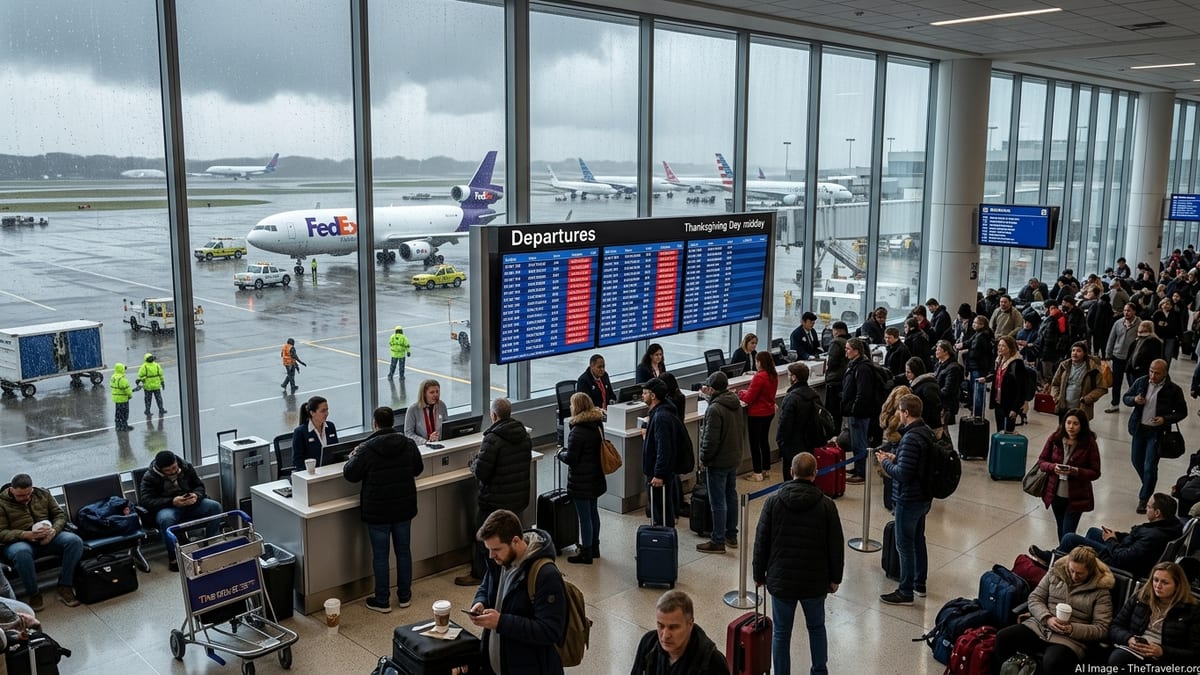
Hundreds of flights disrupted as storms hit key hubs
By early afternoon on Thanksgiving Day, flight-tracking data showed hundreds of cancellations and many more delays across the US air network as the coastal storm intensified along the Eastern Seaboard. FlightAware data cited by multiple outlets indicated that more than 350 flights within, into or out of the United States had been cancelled and more than 700 delayed by midday, with New York City–area airports, Boston, Philadelphia and Washington National among the most affected as bands of heavy rain and high winds moved north along the coast.
The storm’s timing is particularly challenging for travelers because it coincides with the peak of the Thanksgiving travel period. AAA has forecast that about 81.5 million Americans will travel at least 50 miles from home for Thanksgiving this year, with around 4.7 million expected to fly. That volume, combined with weather-related constraints on already busy airspace, leaves relatively little spare capacity to absorb disruptions, so local problems at one hub can quickly spread across airline networks.
While most major Midwestern and interior hubs started the day with comparatively fewer weather issues, ripple effects were already visible in the form of late-arriving aircraft and crew duty-time limits. Airlines that issued weather waivers in advance for selected East Coast airports earlier in the week have been rebooking passengers on alternate flights, but options heading into Thursday afternoon and evening are becoming more limited, particularly on full transcontinental routes and key north–south corridors along the East Coast.
FedEx runway overrun at Miami adds to early travel headaches
The first major jolt to the holiday travel period came on Wednesday night, November 25, when a FedEx Express MD-11 freighter arriving from Memphis overran Runway 26R at Miami International Airport. According to statements from airport officials and the Federal Aviation Administration, the aircraft came to rest beyond the paved surface, sending dirt and debris flying but causing no injuries among the three crew members on board. Emergency services responded, and the FAA opened an investigation into the incident and the condition of the runway.
The overrun forced Miami International to close three of its four runways for inspections and recovery operations, leaving only one runway in use and prompting the FAA to issue a temporary ground stop for flights bound to the airport. Airlines were instructed to hold departures on the ground at origin airports until capacity at Miami improved, which led to a buildup of delays on the evening before Thanksgiving, traditionally one of the busiest single travel days of the year. Some flights were diverted to alternate airports in Florida and the Southeast while crews assessed the runway and surrounding area.
By Thursday morning, Miami had reopened additional capacity, but the airport warned travelers that residual delays and aircraft repositioning would continue to affect operations into Thanksgiving Day. Officials urged passengers to check directly with their airline before heading to the airport, noting that while safety inspections and recovery work were progressing, schedules remained in flux and that some Thursday flights were cancelled outright as airlines attempted to reset their operations following Wednesday’s disruption.
Powerful coastal storm brings flooding, high winds and unsafe flying conditions
The wider travel disruption is being driven primarily by a strong coastal storm tracking up the Eastern Seaboard, which the National Weather Service describes as capable of producing major coastal flooding, damaging winds and heavy rainfall from the Carolinas through New England. Forecast discussions issued on November 25 and 26 highlight a deepening low-pressure system moving northward on Thanksgiving Day, with gale-force winds over coastal waters and widespread coastal flood warnings in effect, especially during high tide cycles.
In New Jersey, Governor Mikie Sherrill declared a statewide state of emergency from 18:00 on Wednesday, November 25, as the storm approached. The declaration, supported by National Weather Service data, covers all 21 counties and reflects concerns over tidal flooding, strong onshore winds and potential infrastructure impacts in low-lying and bayside communities from the Thursday morning high tide through at least early Friday. Local emergency management offices along the Jersey Shore, including communities such as Longport, have issued specific alerts warning residents and visitors of the risk of inundation of streets, parking areas and access roads during multiple tide cycles.
Farther north, the same storm system prompted New York City officials and parade organizers to take the unprecedented step of postponing the 100th Macy’s Thanksgiving Day Parade, which had been scheduled for Thursday morning in Manhattan. Organizers said the decision to move the event to Saturday followed consultations with local authorities about the forecast for strong wind gusts and heavy rain, conditions that raise concerns both for spectator safety and for the operation of large helium balloons and associated equipment along the parade route. The postponement is separate from air travel disruption but illustrates how broadly the storm is affecting holiday plans along the Northeast corridor.
Impacts for travelers on the ground and in the air
For air travelers, the combined effects of the Miami runway overrun and the coastal storm are manifesting in different ways depending on route and timing. In South Florida, most delays on Thursday are tied to residual scheduling issues following the FedEx incident, including displaced aircraft and crews and the need to slot recovery flights around normal passenger operations. While Miami’s weather itself has been more manageable than in the Northeast, the airport’s role as an international gateway means that earlier disruptions are cascading into connections across Latin America, the Caribbean and domestic US routes.
Along the East Coast, the more immediate issue on Thanksgiving Day is weather-related capacity reduction. Strong surface winds, low cloud ceilings and heavy precipitation are triggering instrument-approach procedures, spacing requirements between aircraft and occasional temporary pauses in arrivals as controllers manage runway conditions. In coastal regions from North Carolina through New Jersey, flood warnings and high water levels are also affecting access routes to airports, particularly smaller coastal facilities and roadways prone to ponding or overtopping during king tides and storm surges.
At a national level, federal data from previous holiday periods suggest that weather typically accounts for a relatively small proportion of the total causes of delays compared with airline-related factors such as maintenance or staffing, but when it strikes large hubs simultaneously, the effect on passengers is disproportionate. Early indications on Thursday are that some airlines that issued proactive waivers earlier in the week are using them to consolidate lightly booked flights and protect core trunk routes, helping to keep overall cancellation numbers below what might otherwise be expected given the severity of the storm. However, travellers on smaller regional routes, especially to and from coastal communities, may face limited same-day alternatives if their flight is cancelled.
What Thanksgiving travelers should check next
With conditions evolving through Thanksgiving Day and into Friday, the most important step for flyers is to monitor their flight status directly with their airline rather than relying on earlier confirmations or generic search engine summaries. Airlines are updating schedules in real time in response to both the FedEx runway incident at Miami and the developing storm along the East Coast, and some last-minute cancellations are being made even within a few hours of departure. Where airlines have published weather waivers, affected travelers may be able to change to alternative flights without paying change fees or fare differences within specified date and route limits.
Passengers whose flights are cancelled for any reason retain the right to a refund if they choose not to travel, under existing US Department of Transportation rules. However, when cancellations are due to weather, airlines are generally not obliged to provide hotel accommodation or meal vouchers, so travelers who decide to wait for rebooking should be prepared for the possibility of out-of-pocket expenses. For those connecting through Miami or through major East Coast hubs such as New York, Philadelphia or Boston, checking incoming flight status and weather advisories at both origin and destination can provide an early signal of likely delays.
The coastal storm is expected to continue affecting the mid-Atlantic and Northeast through at least the early hours of Friday, with lingering coastal flooding and strong winds even after the heaviest rain bands move offshore. Travelers with flexibility may find that shifting flights to later on Friday or into Saturday provides a more reliable window, particularly for itineraries involving smaller regional jets or coastal airports. Those who must travel on Thursday should allow extra time for ground transport, be ready for extended queues at security and customer service desks and have contingency plans in case overnight accommodation becomes necessary due to missed connections or rolling delays.