


More news on this day
Canada will head into the 2026–27 holiday travel season still short of air traffic controllers, but Nav Canada reports that delays directly linked to its staffing and equipment fell by nearly 85 per cent at the country’s busiest airports over the summer compared with a year earlier, easing pressure on travellers even as systemic labour gaps persist.
Get the latest news straight to your inbox!
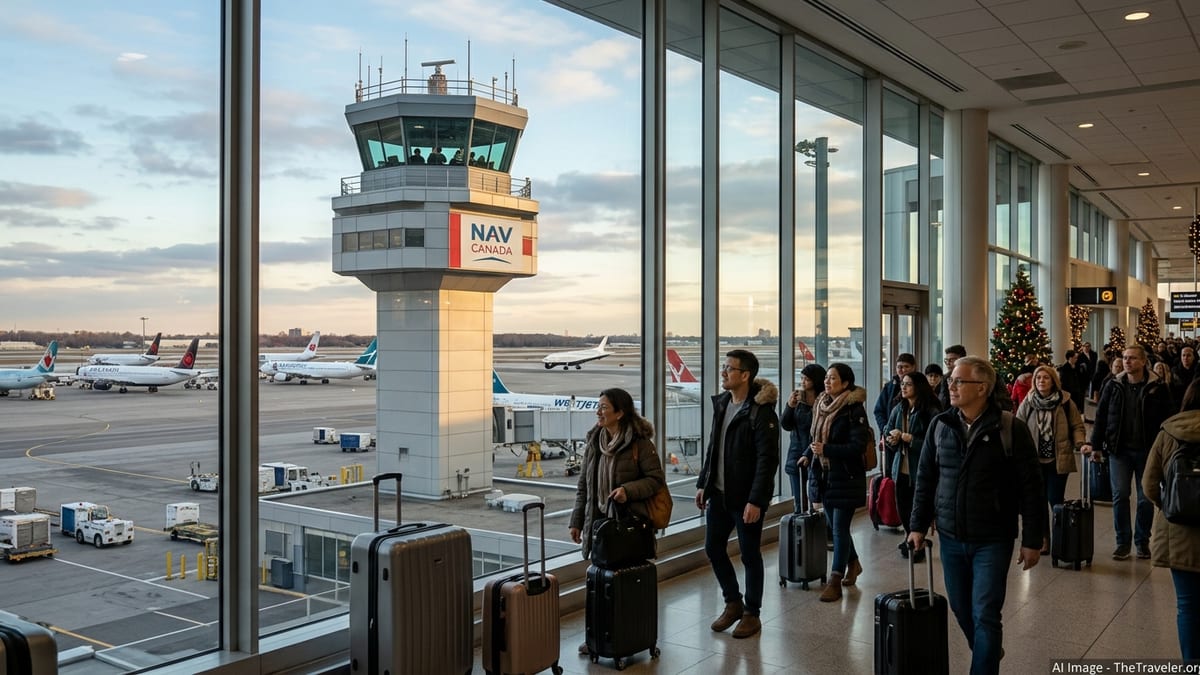
Staffing gap narrows but remains heading into holiday peak
Nav Canada, the not-for-profit corporation that runs Canada’s civil air navigation system, says it currently has more than 2,100 licensed air traffic controllers on staff but remains short of its target by roughly 170 positions. That figure is slightly improved from earlier in 2026, when the shortfall was typically described as “about 200” controllers below plan. The updated estimate, reported on November 26, 2026, reflects incremental hiring and training progress rather than a complete resolution of the staffing challenge.
Internal background material published in May 2026 shows Nav Canada employs more than 2,800 air traffic services professionals in total, including approximately 2,100 controllers and 700 flight service specialists spread across control towers, terminal units and en route centres. Since 2023 the organization has licensed more than 600 air traffic services professionals, of whom over 300 are air traffic controllers, and it reports that staffing growth exceeded attrition by 26 per cent across 2024 and 2025. Those figures underscore that the workforce is expanding, even if headcount has not yet reached management’s long-term planning levels.
Mark Cooper, who became Nav Canada’s chief executive earlier in 2026, has repeatedly framed the staffing issue as part of a wider international problem rather than a uniquely Canadian failure. In recent public comments he has stressed that air navigation service providers around the world are rebuilding training pipelines that were disrupted during the pandemic and that it typically takes between 18 and 30 months for a trainee to qualify as a fully rated controller. That time lag means shortages cannot be eliminated quickly, even when recruitment is strong.
Record training pipeline aims to rebuild controller ranks
To address the gap, Nav Canada says it is running training at record levels. Across its internal schools and a contracted program operated by CAE in Montreal, the agency has more than 500 students in various stages of classroom, simulator and on-the-job instruction. Company statements since early 2026 indicate that, in total, over 600 air traffic services professionals have received licenses or certifications since 2023, including more than 300 new controllers, with close to 500 additional students in training at any given time during 2026.
Training capacity has been a key constraint. Nav Canada operates seven training centres of its own and uses CAE as a primary basic training contractor to increase throughput. The organization has also temporarily reassigned some experienced operational staff and instructors back to frontline work during peak periods while bringing in more than 50 retired controllers on contract to support both operations and mentoring. Management describes this as a bridge strategy intended to keep traffic flowing while the new generation of controllers completes their qualification process.
Despite the stepped-up intake, the agency acknowledges that not every trainee will become a certified controller and that the long qualification path continues to limit how quickly vacancies can be filled. Industry data and Nav Canada’s own planning documents suggest that the full path from initial selection through unit-specific on-the-job training can stretch beyond two years, particularly when a controller transfers to a larger or more complex facility. As a result, executives caution that staffing will likely remain tight at certain locations through at least 2027, even if net hiring continues to outpace departures.
Controller-related delays plunge at Canada’s four busiest airports
Although the staffing shortfall persists, Nav Canada reports a sharp turnaround in operational performance during the 2026 summer high season. In late September the agency published data for Toronto Pearson, Vancouver, Calgary and Montréal–Trudeau showing that the share of scheduled flights affected by traffic management initiatives linked specifically to Nav Canada staffing or equipment fell by nearly 85 per cent between May 1 and August 31, 2026 compared with the same period in 2025.
Across those four major hubs, the total number of flights delayed by such measures dropped from just under 5,000 in summer 2025, representing about 1.5 per cent of all scheduled movements, to fewer than 800 flights, or roughly 0.24 per cent of scheduled operations, in summer 2026. Nav Canada attributes the improvement to a combination of higher controller numbers than at any point since the pandemic, targeted scheduling and incentive measures at key facilities, the temporary redeployment of staff in non-operational roles back to live operations, and new technology such as Arrival Manager tools at all area control centres.
The summer 2026 results contrast sharply with conditions in 2022 and 2023, when a combination of staffing shortages, airline scheduling decisions and airport resource constraints led to persistent delays at several Canadian hubs. The agency is careful to limit its current statistics to delays that it can directly attribute to its own staffing or equipment constraints. Weather, airline staffing, airport infrastructure and knock-on effects from foreign air traffic control problems continue to generate disruptions that are outside Nav Canada’s control, and those issues did not disappear in 2026.
Cross-border pressures and cooperation with the FAA
The improvement in Canadian controller-linked delays has come against a more turbulent backdrop in the United States and in cross-border air travel generally. Statistics Canada data for the first half of 2026 show that while total cross-border trips between Canada and the United States increased, particularly by car, Canadian-origin air travel to the United States fell from year-earlier levels in every month through June. Analysts have connected that pattern to a mix of economic factors and lingering traveller caution after previous summers of disruption.
Those concerns were reinforced on November 13, 2026, when the U.S. Federal Aviation Administration ordered a rare nationwide ground stop that halted virtually all U.S. departures for several hours after a technology outage in its traffic management system. According to subsequent reports, no Canadian systems were directly affected, and Nav Canada handled some diversions and reroutes for aircraft already in the air. The incident renewed focus on the resilience of air traffic control infrastructure across North America ahead of the busy late November and December holiday period.
Despite political tensions between Ottawa and Washington over unrelated trade issues, both governments continue to emphasize operational cooperation in aviation. Recent accounts of Nav Canada’s strategy describe its relationship with the FAA as the strongest it has been, with the two agencies sharing real-time traffic data, coordinating on transborder route planning and jointly managing flows during major events such as the 2026 FIFA World Cup. That cooperation is central to handling days when both systems are strained, even though each jurisdiction faces its own staffing and technology challenges.
What travellers should watch for this holiday season and beyond
For travellers using Canadian airports over the 2026–27 holiday season, the latest data suggests that controller-related constraints at Nav Canada’s largest facilities are far less likely to be the primary cause of delays than they were a year ago. At Toronto Pearson, Vancouver, Calgary and Montréal–Trudeau, only a small fraction of scheduled flights this past summer were affected by measures tied directly to Nav Canada staffing or equipment, even as overall traffic increased and major events added demand. That said, operational bottlenecks related to weather, airline schedules, airport ground handling and foreign air traffic control systems can still significantly disrupt itineraries.
Passengers connecting between Canada and the United States may face additional uncertainties in the wake of the November 13 U.S. ground stop and as the FAA continues to roll out upgrades to its traffic management tools. Travellers planning cross-border trips over peak holiday dates may wish to allow extra connection time, avoid tight layovers through the largest U.S. hubs where feasible, and monitor communications from airlines in the days leading up to departure. While there is no specific forecast of further systemic outages, the recent disruption highlighted how quickly a technical problem in one jurisdiction can ripple across international networks.
Looking into 2027, Nav Canada’s published forecasts and training plans point to ongoing high recruitment and a substantial cohort of trainees moving through the system, but executives have stopped short of giving a firm date by which the controller shortfall will be fully closed. For now, the agency’s message is that it expects to keep gradually narrowing the gap while relying on targeted scheduling, temporary staffing measures and technology to maintain service levels. Travellers should continue to check the latest flight status information, particularly during weather-prone periods, but the most recent evidence indicates that, at least for summer-like peak volumes, Nav Canada’s own staffing constraints are playing a much smaller role in Canada’s overall delay picture than in recent years.