


Few cruise decisions feel as personal as choosing between an inexpensive interior cabin and paying hundreds more for a private balcony. The right choice depends less on simple "inside versus outside" labels and more on how a specific ship is designed, where it is sailing, how many sea days you have, and what else you plan to spend on your holiday. Using recent seven night fares from major cruise lines and concrete itinerary examples, this guide compares the financial and experiential trade offs so you can decide whether a balcony is genuinely worth the premium for your next sailing.
Get the latest updates straight to your inbox!
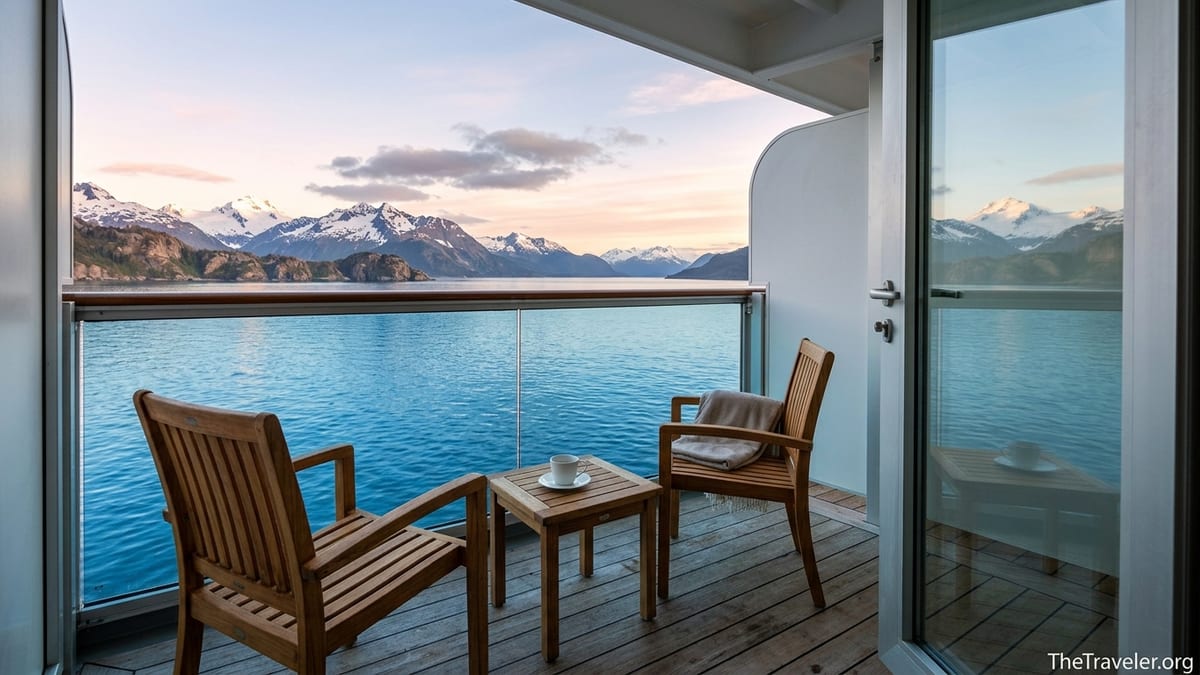
What a Private Balcony Really Buys You
A true exterior balcony cabin adds several tangible things you do not get in an interior: natural light, fresh air, a private outdoor space large enough for two chairs and a small table, and your own line of sight to the sea. That combination changes how the cabin feels and how you use it. Many passengers with balconies report spending early mornings with coffee on their veranda, watching sail in and sail away without needing to claim a lounger on a public deck.
You also gain privacy and low effort relaxation. With a balcony you can sun yourself without other guests nearby, step outside in a robe, or read a book with the door open to hear the waves. On an Alaska or fjords sailing, you can sometimes watch whales or glaciers glide past while staying warm in your own space. For light sensitive travelers or anyone prone to feeling enclosed, waking up to daylight through the glass can also make the cabin more comfortable.
By contrast, a standard interior cabin sacrifices natural light and direct outdoor access. Sleeping in a fully dark room can be a plus if you like to rest late or nap in the afternoon, but some people find the lack of a window disorienting. You must leave the cabin and use public decks for any outdoor time or scenery. For travelers who prefer spending most waking hours in venues, on the pool deck, or ashore, this trade off can feel minor compared with the savings.
The experience of an interior also depends heavily on your tolerance for enclosed spaces. Modern ventilation keeps air fresh, but if you dislike windowless hotel rooms you may feel more confined, particularly on itineraries with many sea days. It is important to be realistic about how much waking time you will spend in the room and whether darkness or the lack of a view might bother you after several nights.
Understanding Balcony, Oceanview and Hybrid Cabin Types
Not all cabins that sound like they have a view actually deliver the same experience. A traditional exterior balcony is a full height glass door that opens to an outdoor veranda with railings open to the sea. This is what most travelers picture when they pay a premium for a balcony. Obstructed view balconies on many Princess and Celebrity ships sit behind lifeboats or structural supports; you still have an outdoor space and some light, but views downward can be blocked by equipment. These cabins often price slightly below fully clear balconies because of that compromise.
Some newer Royal Caribbean and MSC ships offer inward facing balconies overlooking interior spaces such as Central Park or the Boardwalk neighborhoods. You get an outdoor sitting area and fresh air, but no ocean view. These cabins can be excellent for people watching and evening atmosphere, but they are not suitable if your priority is watching the sea or scenery. Royal Caribbean also uses the term "virtual balcony" for certain interior cabins where a floor to ceiling screen shows a live video feed from outside. You still cannot open a door, yet the moving daylight can make the room feel more spacious.
Celebrity’s Edge class ships add another variation called an "infinite veranda." Here, the balcony is integrated into the cabin itself with a large window that can slide down halfway to open. The space that would traditionally be a balcony is enclosed by folding glass doors at the cabin side. When you open the inner doors and lower the outer window, the whole area feels like a balcony; when closed, it functions as part of your indoor living space. This design provides more interior square footage but less separation from the rest of the room, and the open area is partially recessed compared with a standard veranda.
Oceanview cabins fall between interior and balcony. They have a window or porthole but no outside sitting area. On an Alaska sailing with cool or rainy weather, many travelers choose an oceanview instead of a balcony to save money while still getting natural light and a direct view. The key is to read deck plans and cabin descriptions carefully and, if necessary, speak with a knowledgeable agent so you do not pay a balcony level price for an inward facing or heavily obstructed space that does not match your expectations.
Price Check: Real Seven Night Interior vs Balcony Fares
To understand the financial premium for a balcony, it helps to look at specific sailings. Price snapshots here are based on publicly listed lead in fares for double occupancy as of late 2026, excluding promotions that temporarily distort the gap. On a seven night Caribbean cruise in November 2026 on MSC Seascape, a recent fare example showed interior cabins around 276 dollars per person and balconies around 446 dollars per person for the week. That is a balcony premium of roughly 170 dollars per person, or 340 dollars per cabin, equal to about 49 dollars per cabin per night.
Royal Caribbean’s own search results and travel agency consolidators suggest a wider spread on some popular seven night Caribbean departures, particularly on newer ships. Across a range of 2026 and early 2027 Eastern Caribbean sailings, interior lead in fares often cluster around 800 to 1,000 dollars per person, while standard ocean facing balconies on the newest ships can run from about 1,400 to well over 1,800 dollars per person for the same week. That produces a balcony premium commonly in the 400 to 800 dollar per person range, or 800 to 1,600 dollars per cabin for seven nights.
For Alaska, where scenery is a stronger selling point, the gap is visible but not always extreme at the low end of the market. One recent listing for a seven night Alaska cruise on a Princess ship round trip from Seattle in September 2026 showed interior fares from about 309 dollars per person and balcony fares from about 784 dollars per person. The balcony in that example cost roughly 475 dollars more per person, or 950 dollars more per cabin, about 135 dollars per cabin per night. Another northbound Alaska sailing on Discovery Princess in early September priced its interior cabins from the low 600s per person and balconies roughly double that; the exact premium varies by departure date and how full the ship is, but a balcony in peak season Alaska often costs 800 to 1,200 dollars more per cabin than the cheapest interior on the same sailing.
In the Mediterranean, Celebrity and Princess price bands for shoulder season seven night itineraries often show interior cabins starting around 900 to 1,100 dollars per person and standard balcony or infinite veranda cabins from roughly 1,400 to 1,800 dollars per person. That again implies a 1,000 to 1,400 dollar balcony premium per cabin for a week. These ranges are not universal rules, but they reflect real, current fare differences that travelers are encountering when they price 2026 and 2027 voyages.
How Itinerary, Sea Days and Public Decks Change the Value of a Balcony
The same balcony can feel like a bargain or an indulgence depending on where your ship is sailing. In the Caribbean, especially on big resort style ships from Royal Caribbean, Norwegian and MSC, the warm weather and emphasis on outdoor public areas already make it easy to enjoy the sea from open decks, multi level pool areas and waterfront style promenades. On a seven night round trip from Miami or Port Canaveral with three or four port days, many guests spend their waking hours at beaches, in ports, in water parks or enjoying shipboard activities. In that context a balcony is mostly a convenience for quiet time and private fresh air.
The Mediterranean can be highly port intensive. A seven night itinerary from Barcelona or Rome that visits four or five ports gives little time for lingering in your cabin during the day, especially for first time visitors intent on sightseeing. Here the balcony is more about early morning coffee while arriving in port and late evening sailaways past coastal towns. If you are on a budget and care more about seeing Florence, Rome, or the Greek islands ashore, an interior or oceanview can free several hundred dollars per person to spend on excursions and local meals.
Alaska and other scenic cruising routes such as Norwegian fjords are where balcony value changes most. Ships may spend extended hours slowly transiting glaciers or narrow passages where landscape views are the main attraction. A balcony lets you watch this from your own heated seating, step in and out to warm up and use your own bathroom, and avoid crowds at the rail. That said, glacier days usually see narration, wildlife spotting and activity on the upper outdoor decks. To see both sides of a fjord or both faces of a glacier, you will often still want to use public observation areas even if you have a balcony, because the captain may rotate the ship and interesting sights can appear in any direction.
Ship design also plays a role. Newer vessels like Royal Caribbean’s Icon class, Norwegian’s Prima class and MSC’s Seaside class devote large portions of their footprint to outdoor promenades, aft facing terraces and observation lounges with near floor to ceiling glass. These spaces give interior cabin guests surprisingly good scenery access without a private veranda. Older ships built with narrower promenades and fewer panoramic lounges rely more on top deck rails for viewing; on those vessels a balcony may feel more essential on scenic itineraries.
Cabin Location: Motion, Noise and Obstructions
Where your cabin sits on the ship often matters as much as whether it has a balcony. People sensitive to motion usually fare better in lower, more central locations. Movement is generally least noticeable around the middle of the ship and on mid level decks; it increases toward the bow and stern and higher decks, especially in rough seas. If you know you are prone to seasickness, choosing a midship interior on a lower passenger deck can be physically more comfortable than a high forward balcony where the ship’s pitching is more pronounced.
Obstructions and overhangs are another location factor. Lifeboats are typically stowed on one of the lower public decks, and cabins immediately above them can have partially blocked downward views. Cruise deck plans and cross section diagrams often mark these as "obstructed view" balconies, but on some booking engines that note can be subtle. Similarly, deep overhangs from wider upper decks can shade balconies several levels below. That shading is sometimes welcome in the tropics, but it can make balconies feel darker and limit sky views in cooler destinations.
Privacy and noise vary widely. Balconies near public whirlpools, outdoor bars or open air show venues may pick up music until late evening, while those near crew access doors or service areas can experience more activity at odd hours. Aft facing balconies are prized for their wake views, yet they may occasionally pick up vibration or soot, particularly on older ships or those with exhaust outlets positioned directly above certain cabin stacks. Ship specific deck plans, online photo galleries and passenger forums are useful for identifying which cabin rows on a given vessel have reports of soot, vibration or overlooked balconies before you commit to a specific number.
Accessibility should also factor into your decision. If mobility is limited, a centrally located cabin near elevators can reduce walking distances to dining rooms and theaters. On some large ships the most affordable balconies sit far forward or aft, which can require long indoor walks. In those cases, a well located interior closer to key venues might be practically easier to live with than a more remote balcony.
Three Realistic Seven Night Scenarios
Consider a budget minded couple booking a seven night Mediterranean cruise from Barcelona in shoulder season on a mainstream line like MSC or Royal Caribbean. Suppose the interior fare they find is around 950 dollars per person and an ocean facing balcony quotes at 1,550 dollars per person. The balcony premium is 600 dollars per person, or 1,200 dollars per cabin for the week. That money could instead fund two or three ship run excursions at roughly 120 to 180 dollars per person each in ports like Rome, Florence or the Amalfi Coast, plus several local restaurant dinners. For travelers planning full days ashore and evenings in show lounges, the interior keeps overall holiday costs lower without meaningfully reducing their experience.
Next, imagine a family of four booking a seven night Caribbean sailing on a large, activity focused ship with water slides and dedicated kids’ areas. They compare one balcony cabin that sleeps four against two interior cabins across the hall. If the balcony is priced at 1,400 dollars per person for the first two guests and discounted third and fourth passenger rates, the total might come out similar to two smaller interior cabins at roughly 800 to 900 dollars per person, depending on promotions. Choosing two interiors can provide two bathrooms, more total square footage and privacy between parents and children while still saving several hundred dollars overall. The savings can cover the family’s Wi Fi packages, a specialty dining night and access to the onboard water park or go kart track if surcharges apply.
Finally, consider a couple booking a seven night Alaska round trip from Seattle on a Princess ship in early September 2026, when published fares showed interior cabins starting near 309 dollars per person and balconies around 784 dollars per person. For two adults, the balcony costs about 950 dollars more than the cheapest interior for the week, before taxes and fees. In Alaska, that 950 dollars has real alternatives: it could pay for a whale watching trip in Juneau plus a glacier helicopter landing or train ride in Skagway at typical excursion prices of 150 to 300 dollars per person per tour, with money left for bundled photo packages or upgraded dining.
For this Alaska couple, the right choice turns on how they imagine using their time. If one partner tires easily or is particularly sensitive to cold, the ability to watch glaciers pass from a private balcony without holding a rail on a crowded outer deck may be worth the entire premium. If both are active and willing to bundle up early on observation decks, an interior or oceanview cabin that frees cash for bucket list excursions can deliver a richer overall experience for the same budget.
Living in a Windowless Cabin: Comfort, Sleep and Privacy
Spending seven nights in an interior cabin is fundamentally different from staying in a balcony or oceanview. Without natural light, your body clock may lose some cues; many passengers bring a small travel clock or use the television to show the time, since you cannot judge sunrise by the curtains. On the positive side, interiors are excellent for uninterrupted sleep. Parents of young children, shift workers and light sleepers often praise the complete darkness and relatively quiet that come with being fully enclosed and sometimes surrounded by other cabins instead of public spaces.
Ventilation in modern interior cabins on major lines from Royal Caribbean, Celebrity, Princess, Norwegian and MSC is mechanical but generally effective. You cannot open a window, yet cabin air is refreshed continuously, and temperatures are usually adjustable within a comfortable range. Travelers who dislike enclosed spaces should honestly consider whether seven nights in a windowless environment will feel cozy or stifling. If the thought of waking up with no sense of time is uncomfortable, even a small oceanview window can be a meaningful upgrade that costs far less than a full balcony.
Privacy is one aspect where interiors quietly excel. With no outside neighbors and no glass doors, you avoid concerns about people seeing into your space or cigarette smoke drifting from the next balcony over. Sound transmission is mostly side to side through cabin walls, so choosing a room away from elevators and crew doors can make an interior feel like a quiet, private cocoon. For travelers who see their cabin primarily as a place to sleep and shower, an interior can be a practical, restful choice.
By contrast, balcony life has its own privacy considerations. Partition walls between balconies often leave small gaps at floor or ceiling level, and conversations carry in outdoor spaces. On some ships, angled balcony designs allow a higher cabin to look down onto lower neighbors. When choosing a balcony, reviewing side profile drawings and photos of the specific ship can help avoid cabins overlooked by jogging tracks or public viewing platforms.
Older Ships, Newer Designs and Suite Considerations
Older ships from lines like Princess, Celebrity and Royal Caribbean often have smaller standard cabins but relatively generous traditional balconies. You may find that an older vessel sailing classic routes, such as a Princess ship doing Inside Passage Alaska, offers comfortably sized verandas at lower lead in balcony prices than the newest flagship with a water park and multiple neighborhoods. Maintenance matters too: online reviews sometimes mention rust spots, worn balcony furniture or soot around railings on aging ships. It is worth scanning recent passenger comments to confirm that balcony conditions on your chosen ship are satisfactory.
Newer ships tend to experiment with balcony and hybrid cabin layouts. Celebrity’s Edge series uses infinite verandas to increase interior living space without expanding the ship’s overall footprint, while MSC and Royal Caribbean add inward facing balconies overlooking central promenades. These innovations can be wonderful if you prioritize interior comfort or atmosphere, but they represent a different experience from a classic open sided balcony. If your mental picture of a balcony involves leaning on a rail with the sea below, be sure the cabin type you select matches that expectation.
Suites complicate the calculus because their higher prices often bundle benefits unrelated to the balcony: access to concierge services, private restaurants or lounges, expanded room service menus, priority embarkation and sometimes dedicated sundecks. When you price a suite, only part of the fare difference versus a regular balcony reflects the outdoor space itself. Travelers considering a suite should decide whether they truly value those extra inclusions or if a standard balcony plus purchased add ons such as specialty dining and priority boarding achieves similar comfort for less.
Across fleets, accessibility cabins with balconies may be limited and located in specific areas of the ship. These often have larger doorways and roll in showers, which is essential for some guests and irrelevant for others. If you do not need accessible features, avoid booking these categories so they remain available for travelers who rely on them.
Putting It Together: Checklist, Cost Trade Offs and Verdict
When you look at the total vacation budget, the balcony premium is only one component. Daily gratuities, drink packages, Wi Fi, specialty dining, casinos and shore excursions can easily match or exceed the cost difference between an interior and balcony. For a seven night cruise where the balcony costs 1,000 dollars more per cabin, that amount could instead cover two full drink packages for the week, comprehensive Wi Fi for two devices, and several nights in high end specialty restaurants. For families, the same sum might fund private tours in port or an additional hotel night pre cruise.
A practical cabin selection checklist starts with your itinerary and sea day count. Scenic heavy Alaska or fjord cruises, repositioning voyages with many sea days and winter sailings where outdoor public decks may be chilly push the balance toward a balcony or at least an oceanview. Port intensive Mediterranean or Caribbean schedules for active travelers who plan to spend little time in their room tilt toward an interior. Next, consider motion sensitivity, claustrophobia and your personal need for daylight. If you sleep best in darkness and will happily spend your waking hours exploring the ship, an interior midship on a lower deck is often the best value.
Location details come next: study deck plans for lifeboat rows, deep overhangs, proximity to nightlife venues and potential vibration zones near the stern. Decide whether a larger, partially shaded balcony under an overhang suits you better than a more exposed one. On glacier and scenic days, remember that observation decks will still attract you for 360 degree views even if you have a balcony on one side of the ship, so you are not losing the entire scenery experience by choosing an interior.
In the end, who should pay extra for a balcony? Couples on milestone trips, travelers who know they spend hours reading or relaxing in their cabin, and those sailing routes where the landscape is the star are most likely to appreciate the upgrade. People with motion issues who want quick outdoor air access may also find the cost justified. On the other hand, budget conscious travelers, families prioritizing onboard activities over private retreat space, and anyone who prefers to invest in immersive excursions, food and experiences ashore can confidently book an interior or oceanview and treat the ship as a floating hotel. Using real fares and a clear sense of your habits, the best cabin is the one that gives you the richest overall holiday for the money you are willing to spend.