


More news on this day
British startup Global Airlines, which set out to run luxury Airbus A380 services across the Atlantic, has been ordered into compulsory liquidation by the UK High Court after operating just four chartered passenger flights between the UK and New York in May 2025, ending its ambitions before it ever secured its own operating licence and leaving its sole aircraft in long-term storage in France.
Get the latest news straight to your inbox!
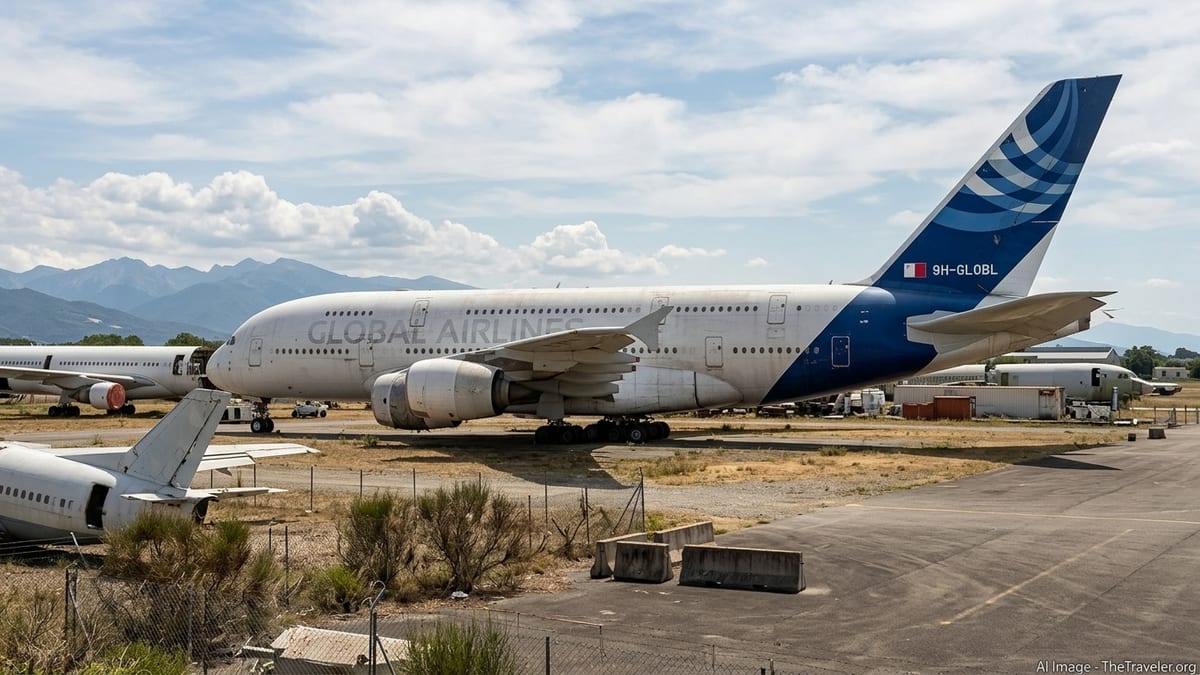
High Court liquidation order confirms the end of Global Airlines
The central development is a winding up order made by the Insolvency and Companies Court in London on 4 November 2026 against Global Airlines Ltd, the company behind the brand. The order, published in the official London Gazette in mid November, puts the business into compulsory liquidation under UK insolvency law. An Official Receiver has been appointed as liquidator and now controls the company’s remaining assets and liabilities, removing day to day control from founder James Asquith and other directors.
According to multiple aviation outlets that have examined the court filing, the petition for liquidation was lodged by a creditor, which indicates that at least some debts were unpaid. Neither the court documents nor the company have publicly detailed the size of the outstanding sums or the full list of creditors, so the precise financial position remains unclear. What is confirmed is that Global Airlines is now in a formal insolvency process and cannot continue trading in its previous form, even though Companies House still temporarily lists the company as active while the legal paperwork catches up.
The liquidation order covers Global Airlines Ltd, the virtual airline entity that marketed tickets and promoted an eventual fleet of four A380s. A related company, Global Airlines Aircraft Ltd, which has held ownership and registration responsibilities for the A380 used on the flights, is subject to a separate strike off process at Companies House. That procedure would remove it from the corporate register after a notice period if no objection is made, suggesting the corporate structure created to support the project is being dismantled in parallel with the court ordered liquidation.
Only four wet leased A380 flights ever carried passengers
Although Global Airlines promoted itself for several years as the United Kingdom’s next long haul carrier, it never obtained its own Air Operator Certificate from the UK Civil Aviation Authority. Instead, when the company finally carried fare paying passengers, it did so as a virtual airline by chartering an Airbus A380 registered 9H GLOBL from Hi Fly Malta. In this wet lease arrangement, Hi Fly provided the operating crew and approvals while Global sold the seats under its brand.
Flight tracking data and detailed reconstructions by specialist aviation publications show that the entire commercial operation consisted of four transatlantic sectors in May 2025. The first pair of flights operated as a round trip between Glasgow and New York JFK, with the outbound sector on 15 May 2025. A second pair of flights linked Manchester and New York JFK later in the month, again as a one off round trip. After these four sectors, there is no evidence of further fare paying operations, and the aircraft did not enter a scheduled program.
Sources differ slightly in describing the scope of operations, with some reports initially referring to “two flights” and others to “two round trips.” The more detailed accounts that list specific dates and routes indicate that four individual passenger sectors were flown, which aligns with aircraft movement records and the subsequent placement of 9H GLOBL into storage. What is consistent across sources is that Global Airlines never progressed beyond this small cluster of charter flights and never launched a regular timetable on either side of the Atlantic.
By July 2025 the A380 used by Global Airlines had been ferried to Tarbes in southern France, a major European storage and dismantling site for large aircraft, and placed into long term storage. Subsequent reports note that the aircraft has remained out of commercial service since, with no confirmed return to the air under the Global Airlines banner. For travelers, this means that any suggestion of future Global branded A380 flights has, in practice, been off the table for more than a year before the court formalized the liquidation.
Why the liquidation matters, and to whom
The immediate impact of the liquidation is relatively narrow because Global Airlines never built a regular schedule and has not sold tickets for future flights since mid 2025. There is no widespread wave of cancellations affecting current winter 2026 27 travel plans in the way that a failure of a large scheduled carrier would cause. Instead, the primary groups affected are any remaining creditors, former partners and suppliers, and a small number of passengers and intermediaries who may still be resolving historical issues from the 2025 charters.
From a traveler’s perspective, the liquidation does definitively close off a niche option that some enthusiasts had hoped might return. Global Airlines marketed a vision of relatively spacious A380 cabins and retro styled service on transatlantic routes from secondary UK cities, potentially providing an alternative to established carriers on certain days. With the company now in liquidation and its only aircraft in storage, such flights will not materialize under the existing structure, and any similar product in the future would have to come from a different operator or a completely reconstituted business.
The case also illustrates the risks inherent in booking with very small or startup virtual airlines, particularly when they do not yet hold their own operating licence or a track record of sustained operations. Global’s only flights relied on a third party operator and ran as one off charters, so once those ended, the company had no ongoing network income to support its plan to gain certification and expand. For most general travelers, this episode serves as a reminder that promotional announcements about future routes or cabin concepts are not guarantees of long term service unless and until a carrier has both regulatory approvals and an identifiable, bookable schedule over a sustained period.
Conflicting reports over fleet and future plans
Throughout its short life, Global Airlines issued a series of statements about acquiring multiple A380s and launching premium transatlantic routes before potentially pivoting toward long haul leisure destinations such as the Maldives. Some of these plans were documented in public announcements and enthusiast media interviews, while others surfaced through reports of discussions with potential investors. However, only one aircraft, the ex Hi Fly Malta A380 registered 9H GLOBL, was ever confirmed as physically delivered into the group’s control and used on passenger flights, and no second A380 ever entered commercial service for the company.
Even in late 2025 and early 2026, after the aircraft had been withdrawn to storage, the founder continued to suggest in public comments that operations would restart on new routes before the end of 2026. The High Court’s liquidation order has now effectively overruled those expectations, at least for the current legal entity. While, in theory, assets such as an aircraft or branding could be sold and reused in a different structure, there is currently no confirmed buyer or firm relaunch plan. Any such outcome would depend on decisions by the Official Receiver and potential investors, and should be treated as speculative rather than a concrete prospect for travelers.
There is also some discrepancy in publicly available information over whether Global Airlines still owns its A380 outright or whether ownership has changed hands since the original bill of sale. Aviation journals that have examined the Maltese registration documents report that Global Airlines Ltd was listed as owner at the time of registration, while at least one finance focused outlet notes that the aircraft’s exact current ownership status is unclear and that, if it remains within the Global group, it would likely be the key asset in the liquidation. Until the Official Receiver publishes a more detailed report, the status of the aircraft from a creditor recovery standpoint is uncertain, although this uncertainty does not affect passengers given that no future flights are on sale.
What travelers should check now
Because Global Airlines has not been selling tickets for current or upcoming seasons, most travelers do not need to take any action in response to the liquidation. Mainstream transatlantic flights between the UK and New York are still provided by established carriers such as British Airways, Virgin Atlantic, United Airlines and others, and these services have not been reduced as a direct result of Global’s closure. Anyone planning trips that might once have relied on the prospect of Global’s A380 services should instead book with existing operators whose schedules are already published and bookable through regular channels.
For the small group of passengers who flew on the 2025 charter services and still have unresolved complaints, such as outstanding refunds or compensation claims, the situation becomes more complicated with the company in liquidation. Under UK insolvency procedures, these individuals would typically become unsecured creditors of Global Airlines Ltd. They can monitor the London Gazette and any communications from the Official Receiver for details of how to lodge claims, but given the likely limited value of recoverable assets relative to debts, there is no guarantee of significant or any payout. As always in such cases, travelers who booked via credit card or certain third party agents may already have had opportunities to recover money through those channels rather than relying solely on the insolvency process.
Aviation enthusiasts who are primarily interested in the fate of the A380 itself will need to watch for separate announcements from the aircraft’s owner, the liquidator, or any acquiring airline or leasing company. If the aircraft is sold and returned to service, it is more likely to appear under a different brand and possibly on different routes than originally advertised by Global Airlines. Until then, the practical takeaway for travelers is straightforward: the much publicized British A380 startup has ended after four chartered flights, and anyone planning trips should base their decisions on airlines with established, certified operations and confirmed schedules rather than on ambitious but unproven startup concepts.