


More news on this day
Kyrgyzstan’s state railway has confirmed that its seasonal Bishkek–Issyk Kul tourist train resumed for summer 2026 on 5 June, providing a slow but scenic rail link to the lake’s western shore that regional tour operators are increasingly packaging with overland travel from Kazakhstan, boosting cross-border tourism into the Issyk Kul region.
Get the latest news straight to your inbox!
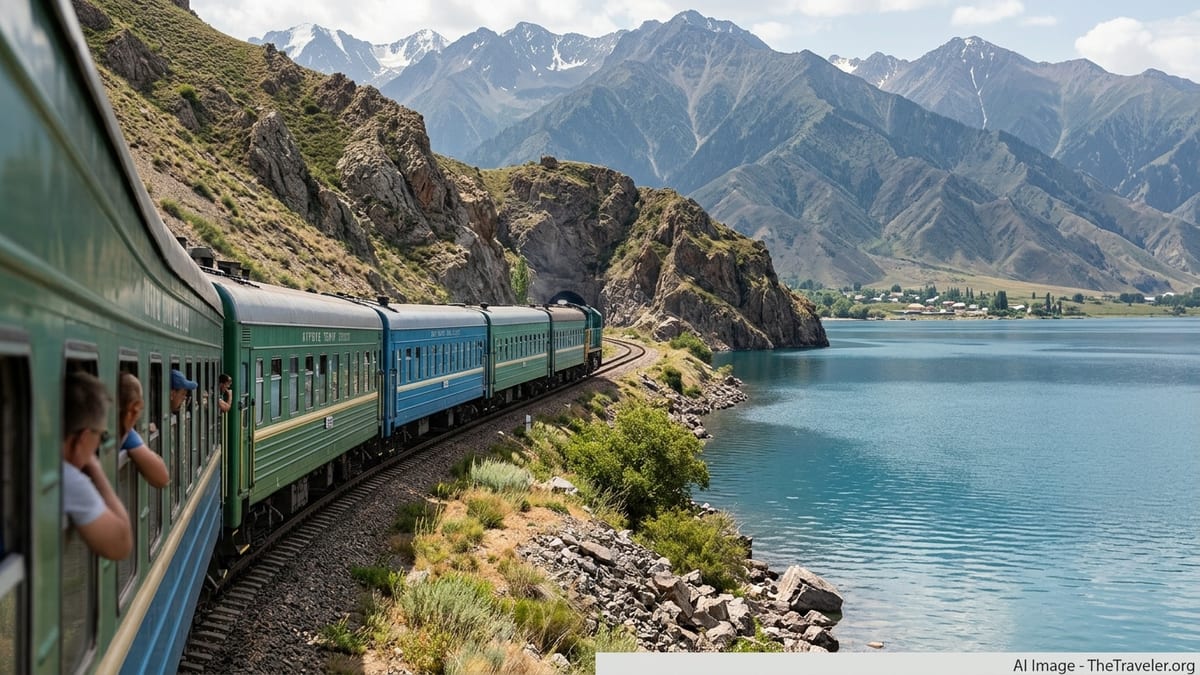
Core Development: 2026 Seasonal Train Restart to Issyk Kul
The central confirmed development for travelers is the restart of Kyrgyz Temir Zholu’s seasonal Bishkek–Balykchy passenger service from 5 June 2026. Kyrgyz financial outlet Akchabar reported that the summer train on this route, numbered 608/609, began operating again on that date, with fares starting from about 150 Kyrgyz som in standard class, positioning it as one of the most affordable ways to reach Issyk Kul for domestic and regional visitors.
The service operates between Bishkek-2, the capital’s main railway station, and Balykchy, a town at the western tip of Lake Issyk Kul. Recent transport guides note that in summer the train often continues a short distance beyond the main station to a halt known as Balykchy Plyazh, which sits close to the shoreline and local beach areas, although travelers are advised to confirm this extension for their specific dates on the official railway timetable rather than assuming it runs every season.
Current specialist travel resources describe the train as slower than road transport but emphasize its appeal as a tourist experience rather than a purely functional commute. The line climbs out of Bishkek and follows the road-and-rail corridor through the Boom Gorge before descending toward the lake, offering sustained mountain and canyon views that have helped it gain a reputation as the “scenic route” to Issyk Kul among regional travelers and online travel communities.
Kyrgyz transport reports and independent travel planners also underline that the train’s summer operation is consistently described as popular and frequently sells out on peak weekend and holiday dates, which supports the view that it has become an important component of the wider tourism offer around Issyk Kul, including for visitors who begin their journeys over the border in Kazakhstan and connect to the railway in Bishkek.
How Travelers from Kazakhstan Reach the Issyk Kul Train
While there is still no direct scheduled passenger train from Kazakhstan to Lake Issyk Kul, current tourism and transport guides explain that Almaty and other Kazakh cities feed into the Kyrgyz summer train through a road and bus corridor into Bishkek. Travelers typically cross the border at the main Kordai crossing between Almaty Region and Kyrgyzstan, then continue by bus or shared taxi to Bishkek’s western bus station, and from there connect by city transport to Bishkek-2 station in time for the Issyk Kul train departure.
The Issyk Kul region itself has long-standing aviation links with Kazakhstan through Issyk Kul International Airport near Tamchy and Karakol International Airport, which both have or have had seasonal flights to Almaty. However, current public schedules and travel-planning resources indicate that these air routes are limited and vary by year, while the Bishkek–Balykchy railway provides the only reliable scheduled rail access toward the lake on the Kyrgyz side. This makes the combination of Kazakh road access to Bishkek and Kyrgyz rail onward to Balykchy a practical cross-border rail-tourism chain, even though the border segment remains by road rather than train.
Evidence of structured rail-based tourism connecting Kazakhstan, Kyrgyzstan and Uzbekistan comes from tourist charter trains that periodically include Kyrgyzstan as one of several stops. Kyrgyz national news agency Kabar reported in April 2025 that an international tourist train itinerary covering Kazakhstan, Kyrgyzstan and Uzbekistan brought passengers from Europe, Singapore and Canada to Issyk Kul and the Ala-Archa National Park, illustrating how Kazakhstan’s rail network already functions as a staging ground for multi-country rail tours that feature the lake as a highlight.
For now, these chartered itineraries are occasional and marketed primarily as package tours rather than regular public services. Their existence, combined with the strong seasonal demand for the Bishkek–Issyk Kul train and the presence of existing suburban rail links from Bishkek toward Kazakhstan, underpins current claims that scenic rail tourism is helping draw a growing share of Kazakhstan-origin visitors into the Issyk Kul region, even though the literal cross-border leg still relies on road travel.
Onboard Experience, Journey Time and Practical Limits
Recent traveler-focused transport guides describe the Bishkek–Balykchy summer train as one of the cheapest long-distance options in Kyrgyzstan, with published starting fares around 150 som for the 2026 season. The journey typically takes significantly longer than the same distance by car or minibus, with older infrastructure reports and current travel-planning sites indicating that private road transfers can cover Bishkek to western Issyk Kul in roughly 3 to 4 hours, compared with a notably longer travel time by rail. The slower pace is framed as part of the attraction for tourists prioritizing scenery over speed.
Onboard comfort is basic, with seating oriented toward domestic passengers on holiday trips rather than premium tourist service. Independent descriptions emphasize open windows, shared compartments and limited onboard catering, so travelers coming from Kazakhstan who are used to Kazakhstan Temir Zholy’s higher-standard long-distance rolling stock should adjust expectations and bring snacks and water. The low fare level also reflects this simpler service profile, which focuses on accessibility rather than high-end amenities.
A practical limitation for cross-border visitors is that the train only runs as far as Balykchy on the western edge of Issyk Kul. Popular resort towns such as Cholpon-Ata, Bosteri and the north shore beaches lie farther east along the lake, while Karakol and the trekking hubs are farther still. Recent traveler accounts and planning sites consistently state that passengers must transfer to road transport at Balykchy, usually by shared taxi, marshrutka or pre-arranged private transfer, to reach their final resort or guesthouse along the shore.
Transport guides published in 2026 also highlight that seats on the summer train can sell out during busy July and August dates, particularly around weekends and local holidays, with some travelers reporting being unable to board without advance purchase. This makes advance booking on official railway channels or through local ticketing platforms a key step, especially for visitors coming from Kazakhstan who have already invested time in crossing the border and may be working with tight itineraries.
Why Rail Tourism Matters for Issyk Kul and Kazakhstan’s Market
Issyk Kul has long been one of Kyrgyzstan’s main tourism destinations, with Soviet-era resorts and sanatoria on the north shore and a more dispersed mix of yurt stays and guesthouses on the south shore. Regional tourism resources note that the area competes with Kazakhstan’s own mountain and lake destinations, but also benefits from its relative proximity to Almaty and other Kazakh cities, making it a natural extension for residents looking for longer summer holidays beyond their domestic resorts.
Kazakhstan’s national railway company has been actively promoting tourist-oriented trains within its own territory, including branded routes such as the Jibek Joly tourist train between Almaty, Turkistan and Tashkent and the Keruen Express charter linking Silk Road cities in Kazakhstan and Uzbekistan. While these services do not yet extend directly into Kyrgyzstan, their marketing and operational model has created a growing regional awareness of rail as a leisure product, rather than just a point-to-point transport mode. This regional context supports Kyrgyz rail’s strategy of framing the Bishkek–Issyk Kul service as a scenic holiday corridor, which is particularly attractive to rail-aware travelers from Kazakhstan.
The international tourist train highlighted by Kabar, which brought guests from Europe, Singapore and Canada through Kazakhstan into Kyrgyzstan and on to Issyk Kul, illustrates how Kazakhstan’s rail infrastructure is already being used as a backbone for combined itineraries that feature Kyrgyz scenery as a key attraction. Even though these trains are organized as occasional charters, they show that tour operators consider a Kazakhstan–Kyrgyzstan rail-and-road combo a viable product for long-haul and regional markets.
From a policy and infrastructure perspective, Kyrgyz sources also indicate that construction started in June 2026 on a new section of railway extending east from Balykchy toward Tamchy and Cholpon-Ata. Travel-planning resources caution that this is an infrastructure project rather than an operational passenger route, and that no through trains to the main resort towns are yet available. However, if completed and opened to passengers in future years, such an extension could deepen the role of rail in Issyk Kul tourism and materially change how travelers from Kazakhstan access the lake.
What Travelers from Kazakhstan Should Check Before Booking
For residents of Kazakhstan planning a trip to Issyk Kul that includes the scenic Kyrgyz train, the first step is confirming the current season’s schedule on Kyrgyz Temir Zholu’s official information channels or at Bishkek-2 station. The 2026 pattern began on 5 June, but travel guides warn that specific departure days and times can change year by year, and that timetables are usually published in late spring for the upcoming summer. Relying on older data or third-party blogs without a recent update can lead to missed departures or incorrect assumptions about how often the train runs.
It is also important to allow ample time for the road segment from Kazakhstan into Bishkek, especially at the Kordai border crossing, where queues can build up in peak season. Since the Bishkek–Issyk Kul train usually departs only once per day when in service, any significant delay at the border could mean missing the day’s only departure. Some travelers choose to spend a night in Bishkek before taking the train, rather than trying to connect directly from Almaty or other Kazakh cities on the same day.
Once in Balykchy, visitors heading for Issyk Kul’s main resort areas need to budget additional time and cost for onward transport. Shared taxis from Balykchy to the north shore resort belt are commonly available during summer daylight hours, with journey times to towns like Cholpon-Ata often in the range of about an hour or slightly more, depending on traffic. Late-evening arrivals can mean fewer onward options, so checking the arrival time of the train and aligning it with onward transfers is a practical step.
Looking ahead, travelers should be aware that several developments which could further strengthen cross-border rail tourism around Issyk Kul remain in the planning or construction phase rather than in daily operation. These include the extension of Kyrgyz rail toward Cholpon-Ata and regional freight-focused projects such as the China–Kyrgyzstan–Uzbekistan railway. For at least the next few summer seasons, the realistic rail-based option for most visitors from Kazakhstan will continue to be a combination of Kazakh road access into Bishkek, followed by the scenic but seasonal Bishkek–Issyk Kul train and a final road leg along the lake.