


More news on this day
UK air passengers risk being stopped at security or forced to check valuable electronics if their phone, laptop or tablet will not power on when requested, under a long standing but still enforced Department for Transport rule that airports such as Heathrow and Gatwick continue to highlight for travelers in 2026.
Get the latest news straight to your inbox!
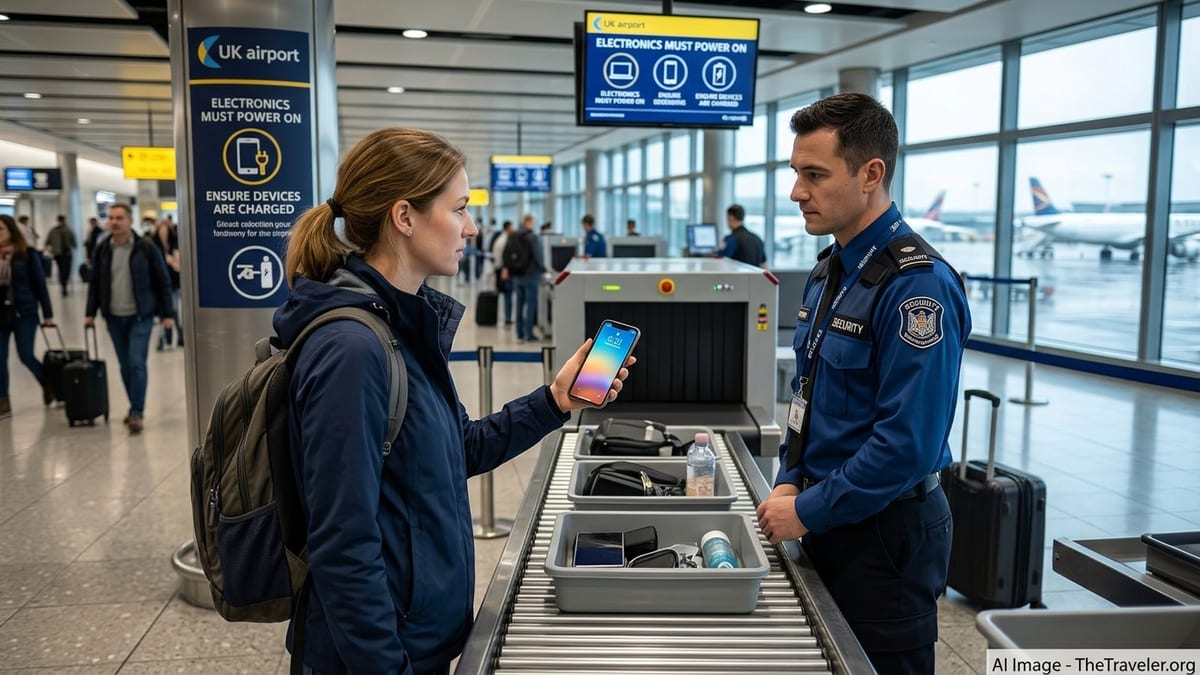
The key rule: devices must power on at UK security
The most important fact for travelers is that UK government guidance requires passengers to be able to switch on electronic devices such as phones, tablets and laptops if asked by security. The Department for Transport’s hand luggage rules state that if a device does not switch on when requested, the passenger will not be allowed to take it onto the aircraft. Airports and airlines then decide how to apply this at the checkpoint and at the gate.
Major UK hubs mirror that position in their own passenger guidance. Heathrow’s hand baggage advice instructs customers to make sure all electronic devices are fully charged and warns that if a device cannot be switched on during screening, the passenger may not be able to take it on board. Gatwick gives similar messages in its security preparation material, telling travelers they may be asked to power up electronics and that items which cannot be verified as working devices are likely to be refused.
Although the rule is not new, its continued prominence in official guidance in 2025 and 2026 means it remains an operational reality. It also interacts with more recent changes, such as the rollout of next generation scanners for liquids and electronics, which can reduce the need to remove items from bags but do not remove the underlying requirement for a device to function if security staff decide to test it.
What can actually happen if your phone or laptop is dead
In practical terms, a dead battery does not automatically mean a passenger will be denied boarding, but it can cause serious disruption. The government rule allows security to refuse an item that cannot be powered on, so staff can require the traveler either to place the device in checked baggage, if that is still operationally possible, or to surrender it. If check in has closed or the bag cannot be retrieved, the passenger can be faced with leaving the device behind or missing the flight.
Airlines reinforce this by telling passengers how they will respond if security wants a device turned on. British Airways, for example, advises that airport security staff may ask travelers to power up electronic or battery powered devices and that if an item is not charged, it should be placed in checked baggage rather than carried into the cabin. Because lithium batteries in loose power banks are not allowed in the hold, that option exists mainly for devices with internal batteries such as laptops and tablets, and only before checked luggage has been handed over.
There is also a separate safety dimension around batteries that affects what can be done with problematic items. Lithium battery fires remain a concern for regulators, and airlines and airports have tightened procedures around power banks in particular. Passengers who try to resolve a flat phone by relying on a power bank discovered late in the process may be blocked if the battery is oversized or in the wrong bag, so a dead primary device can expose other compliance issues at the worst moment.
How new scanners and charging points change the picture
The introduction of next generation security scanners in UK airports has led some travelers to assume that the power on requirement has gone away, but airports stress that this is not the case. Gatwick’s security information explains that its modern scanners allow many liquids and electronics to remain in bags, accelerating the process, yet the airport still points passengers to national rules that devices must be charged and able to switch on if staff decide to test them manually.
Heathrow takes a similar line, combining reminders to charge electronics with practical mitigation. Its security guidance notes that charging points are available throughout the airport for passengers who need them before their flight, and further material from Heathrow and its retail partners highlights that free charging is also offered in some electronics stores airside. This infrastructure reduces the risk that a phone will be completely flat at the checkpoint, but it does not guarantee that power will always be available exactly where or when a traveler needs it.
Charging facilities also vary between terminals and airports. Gatwick’s passenger FAQs, for example, specify particular areas in the North Terminal where plug sockets are available before security and note that additional charging points are located in seating in the departure lounge. Travelers changing airports within the UK or connecting from regional airports that have more limited facilities should not assume a consistent level of access and would be wise to top up devices before arriving at the airport whenever possible.
Implications for travelers: preparation, backups and batteries
For most passengers, the main practical takeaway is that device readiness now needs to be part of pre flight planning in the same way as liquids in hand luggage. Travelers should arrive at UK airports with their primary phone and any laptops or tablets sufficiently charged to boot up on demand, as well as with any screen lock codes or biometric settings working so that the home screen can actually be shown to staff if requested.
It is also important to understand where backup power can and cannot go. UK airport security follows international practice in requiring spare lithium batteries and power banks to travel in cabin baggage, not checked luggage. British Airways, for instance, specifies that all spare device batteries and power banks must be carried in hand baggage and are not permitted in the aircraft hold under any circumstances. That means a traveler cannot solve a dead phone problem by moving a power bank into a checked suitcase at the last minute and will instead have to show that both the phone and any spare batteries meet cabin rules.
Because rules on the number and size of batteries can vary by airline, and because airport security officers retain discretion to investigate anything that appears unusual on X ray images, passengers carrying larger camera batteries, laptop grade power banks or multiple devices should check both their airline’s dangerous goods policy and the airport’s security guidance before travel. If documentation or prior airline approval is required for higher capacity batteries, having proof readily available at the checkpoint can prevent a flat battery incident escalating into a more serious delay.
What to watch in 2026 and how to avoid problems
Looking ahead, there is no indication from official sources that the UK power on requirement will be removed in 2026, even as technology at checkpoints evolves. Government guidance on hand luggage has been updated to reflect new scanning equipment for liquids and electronics, but the instruction to ensure devices are charged and to expect to power them on if asked remains in place. Airports and airlines continue to publish that language in materials that have been refreshed within the past year.
For travelers planning trips through the UK this year, the most reliable approach is to treat the rule as a firm operational constraint rather than a theoretical possibility. That means charging phones and laptops before leaving for the airport, not relying on being able to plug in before security, bringing compliant power banks in carry on baggage, and allowing extra time at security in case a device is selected for additional checks. Those steps cannot eliminate every risk, but they significantly reduce the chance that a dead battery becomes a barrier to boarding.
Because security practices can differ between countries, passengers starting journeys outside the UK or connecting from non UK airports should also check the rules at every point in their itinerary. Some states emphasize liquids over electronics, while others, including the UK, continue to require that devices be demonstrably functional on request. Verifying the latest guidance from both the departure airport and the airline shortly before travel is the safest way to stay ahead of any changes and to avoid surprises at the checkpoint.