


More news on this day
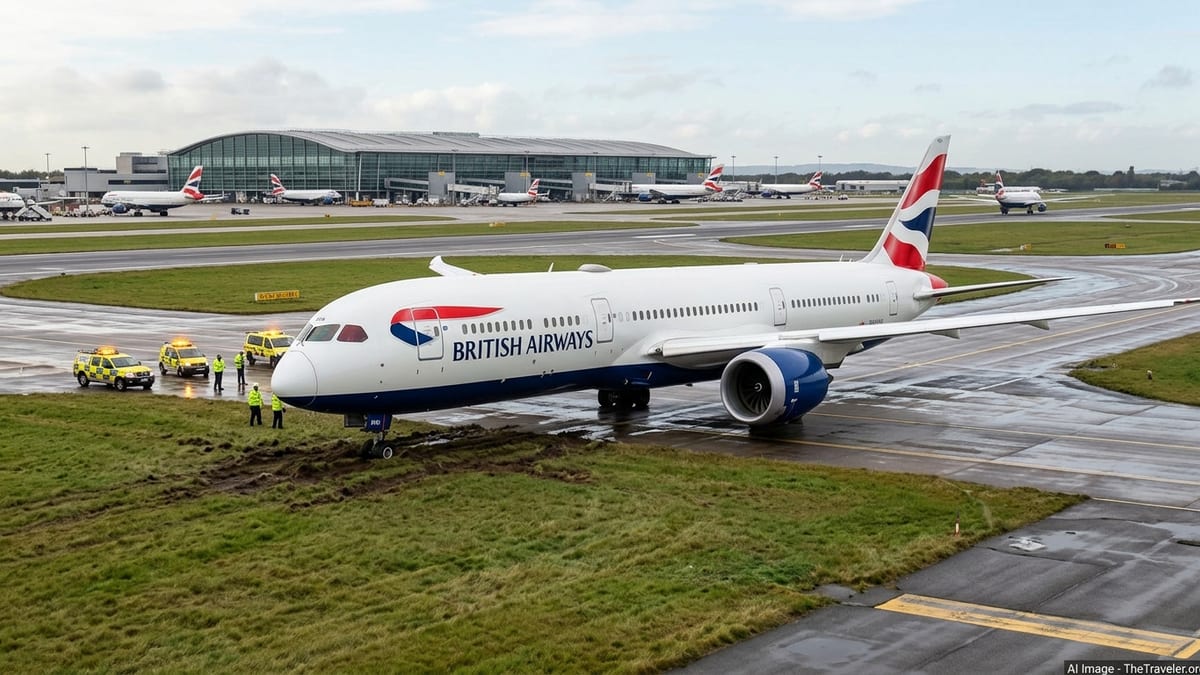
A British Airways Boeing 787-10 Dreamliner operating flight BA75 from London Heathrow to Lagos became stranded with its nose gear sunk in muddy ground after veering off a taxiway at Heathrow on 17 November 2026, forcing the flight’s cancellation and disrupting passengers as airport crews worked for hours to recover the aircraft and inspect the affected taxi route.
Get the latest news straight to your inbox!
What Happened To British Airways Flight BA75
According to multiple aviation incident trackers and media reports, the widebody aircraft was taxiing for departure from Heathrow’s Terminal 5 on Tuesday 17 November when it failed to negotiate a turn and left the paved surface, coming to a stop with its nose landing gear in the grass beside the taxiway. Images shared by aviation spotters show the forward wheels embedded in soft, muddy ground, consistent with heavy rain in southern England in the days leading up to the incident.
The aircraft involved is reported by specialist outlets and flight-tracking communities to be a Boeing 787-10 registered G-ZBLF, one of British Airways’ newest and largest Dreamliners. The jet had been scheduled to operate BA75 to Murtala Muhammed International Airport in Lagos, Nigeria, a daytime service that typically departs around mid-morning from Heathrow.
No injuries have been reported. There is no indication of a fire, collision or fuel spill, and the event is being treated as a taxiway excursion rather than an accident. At the time of writing, neither Heathrow Airport nor the UK Air Accidents Investigation Branch has issued a detailed technical explanation of why the aircraft left the paved surface, so the precise cause remains unconfirmed.
Immediate Operational Impact At Heathrow
The most important confirmed development for travelers is that BA75 to Lagos on 17 November did not depart as scheduled. With the Dreamliner immobilised in soft ground and specialist recovery equipment required to avoid further damage, British Airways cancelled the flight and began rebooking passengers on later services or alternative routings. Reports from flight-tracking services show the original BA75 rotation remaining on the ground for the rest of the day.
Because the aircraft came to rest off the taxiway rather than on an active runway, broader airfield disruption appears to have been limited to the immediate area around the stranded jet. Heathrow operates multiple taxi routes to each runway, so other departures and arrivals could generally continue, although some flights using nearby stands or taxiways likely faced longer taxi times and minor delays while the recovery was in progress.
Heathrow’s standard procedure in such cases is to inspect the affected taxiway and adjacent ground once the aircraft is removed, checking for pavement damage, debris or surface contamination. Until those checks are complete, the specific taxi segment is usually restricted or closed. There has been no indication that the incident affected Heathrow’s overall runway capacity on 17 November, but localized congestion near Terminal 5 is likely to have inconvenienced some passengers.
Response From British Airways And Safety Authorities
British Airways has acknowledged the event in comments to aviation media, stating that the aircraft "left the taxiway while preparing for departure" and confirming that customers would be looked after and rebooked. As of the afternoon of 17 November, the airline had not released a detailed technical statement, which is typical while internal assessments and any regulatory notifications are still under way.
In the United Kingdom, taxiway excursions involving commercial airliners are normally reported to the Air Accidents Investigation Branch. The AAIB then decides whether to launch a field investigation, conduct a shorter desk-based inquiry or simply log the occurrence. Recent AAIB bulletins show that even relatively minor ground-handling and taxi incidents can lead to safety recommendations if systemic issues are identified, but no such determinations have yet been made in this case.
If the 787-10’s landing gear, structure or systems have suffered significant damage from the soft-ground contact, the aircraft could remain out of service at Heathrow for maintenance checks and repairs. That would temporarily reduce British Airways’ long haul capacity, although the airline has previously been able to cover short-term fleet gaps using equipment swaps and wet-leased aircraft. At present, there is no public indication of how long G-ZBLF, if confirmed as the aircraft involved, will remain grounded.
How The Incident Affects Lagos-bound Travelers
For passengers booked on BA75 from London to Lagos on 17 November, the taxiway excursion has an immediate and direct impact: their original flight did not operate. In similar disruption events, British Airways typically offers rebooking on later BA services to Lagos, rerouting via other British Airways or partner hubs, or refunds for those who choose not to travel. Availability on the same day can be tight on this busy West Africa route, particularly in premium cabins, so some travelers may face overnight delays.
Under UK and EU passenger rights rules, a cancellation at short notice generally entitles eligible travelers departing from Heathrow to duty of care, which includes meals and, when necessary, hotel accommodation and transfers, regardless of the technical cause. Compensation payments depend on whether the airline can demonstrate that the event was caused by extraordinary circumstances outside its control. It is too early to say how regulators would treat a taxiway excursion, and affected passengers who wish to claim should keep all boarding passes, booking confirmations and receipts.
Forward bookings on BA’s Lagos services in the coming days are unlikely to be heavily affected, although there may be isolated equipment changes if the grounded aircraft is unavailable. Travelers with tight connections in London on itineraries touching Lagos may wish to monitor their bookings closely through the airline’s app or website and allow extra buffer time on the day of travel.
What Travelers Should Watch For Next
In the short term, the key practical step for affected passengers is to confirm their revised travel arrangements directly with British Airways or their booking agent and, where applicable, to check what support is offered for accommodation and subsistence while they wait for a new flight. Disruption certificates, which some insurers require, are usually available from the airline once the cancellation is formally processed.
Over the coming days, travelers and industry watchers will be looking for confirmation that the Dreamliner has been safely recovered from the grass, the taxiway inspected and any necessary repairs completed so the affected part of the airfield can return to normal use. If the AAIB decides to publish even a brief summary of the event, it may shed light on contributing factors such as weather, taxi instructions, ground friction or crew actions, although such reports typically appear weeks or months after the occurrence.
For now, the impact of the BA75 taxiway excursion remains highly localized: one cancelled long haul departure on 17 November, inconvenience for several hundred Lagos-bound passengers and a temporary operational headache for British Airways and Heathrow’s ground teams. Travelers planning to use Heathrow in the next few days should simply keep an eye on their flight status, but there is no indication at this stage of wider or continuing disruption linked to this specific incident.