


More news on this day
Escalating regional conflict involving Iran and the wider Gulf has pushed many travelers to reassess plans for Dubai and Abu Dhabi, two of the Middle East’s busiest hubs, as governments update advisories and airlines adjust operations in response to a more volatile security environment.
Get the latest news straight to your inbox!
Current government travel advisories for the UAE
Publicly available travel advisories show that the United Arab Emirates remains open to visitors, but the security backdrop has clearly hardened in recent weeks. As of late August 2026, the United States has raised its advisory for the UAE to Level 3, urging travelers to reconsider travel because of the risk of terrorism and the impact of regional conflict. The advisory highlights potential threats to tourist areas and critical infrastructure as part of a wider alert for the Gulf region.
European governments are taking a slightly more nuanced approach. Updated guidance from the United Kingdom in mid September points to increasing regional tensions and refers to recent strikes and retaliatory attacks by Iran that have affected maritime traffic and energy infrastructure, while still allowing travel to the UAE with heightened caution. The safety and security section of this guidance stresses the possibility of attacks against Western and Israeli linked targets but does not advise against visiting Dubai or Abu Dhabi outright.
Other European countries maintain broadly similar positions. The Netherlands assigns a “yellow” risk code to most of the UAE, including Dubai and Abu Dhabi, as of 8 September 2026, which signals that travel is permitted but that security risks are higher than in more stable destinations. France’s foreign ministry also notes an elevated terrorism risk and references past missile and drone incidents in the region, advising travelers to remain vigilant and to keep abreast of developments.
Across these advisories, a consistent theme is that the UAE itself is not at the center of the fighting, but its location close to the Strait of Hormuz and its status as a transport and energy hub increase its exposure to spillover effects. Travelers are being encouraged to monitor official government pages up to the day of departure, as guidance is being updated more frequently than usual.
Impact on flights and airport operations
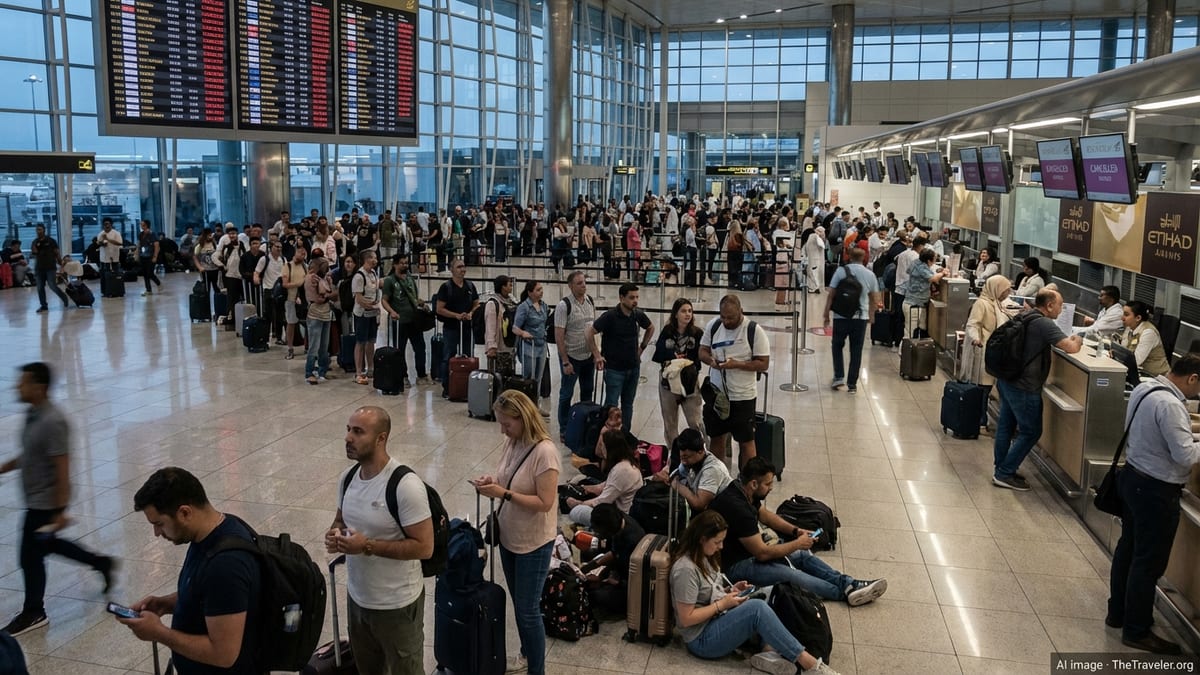
Dubai International Airport and Abu Dhabi’s Zayed International Airport remain operational, and major UAE carriers such as Emirates, Etihad Airways, flydubai and Air Arabia continue to run most scheduled services. Coverage in regional media in early and mid September describes an aviation sector that is still functioning, but with greater day to day unpredictability than travelers are used to.
Reports in early September detailed delays and a small number of cancellations at both Dubai and Abu Dhabi airports, with some regional flights to cities such as Cairo, Bahrain and Kuwait disrupted. Airlines have been advising passengers to arrive at least four hours before departure, complete online check in where possible and check flight status on the day of travel, as schedules can change at short notice when airspace restrictions or security alerts are introduced.
International carriers have adjusted their own risk exposure. Some non Gulf airlines have restored services to Dubai and Abu Dhabi while continuing to suspend flights to Iran and certain neighboring countries, reflecting a wider re routing of traffic around higher risk airspace. Aviation industry coverage indicates that war risk insurance costs for parts of the Gulf have risen alongside reported attacks on shipping in and near the Strait of Hormuz, adding another layer of volatility for airlines and cargo operators.
For travelers, this means that getting to and from Dubai and Abu Dhabi remains feasible on most routes, but flexibility is crucial. Nonstop connections may be reduced on some secondary routes, transit times can lengthen, and last minute schedule changes are more likely. Travel experts recommend building in buffer time for connections and avoiding tight onward plans on the same day of arrival, particularly for itineraries involving other Gulf states.
Security climate on the ground in Dubai and Abu Dhabi
Within the cities themselves, publicly available reporting continues to describe daily life in Dubai and Abu Dhabi as relatively calm, with malls, resorts and office districts operating largely as normal. There have been no widely reported large scale attacks in either city in recent weeks, and local security measures, already visible before the latest regional escalation, remain prominent around airports, major hotels and tourist attractions.
At the same time, Western and regional security assessments class the threat level as elevated. Analyses produced in 2026 by private security consultancies point to Iran’s demonstrated capacity to launch missile and drone strikes at Gulf targets, recalling incidents in 2022 when Abu Dhabi was hit by projectiles claimed by Yemen based forces. These assessments underline that while the absolute probability of another such incident on any given day may be low, the potential impact would be high.
Government advisories also emphasize a risk of terrorism linked to extremist groups and potential attacks on Israeli, Jewish or Western associated sites. Travelers are urged to avoid large political gatherings, to be alert in crowded public places and to follow the advice of local hotel security teams and tour operators. In practice, this translates into the kind of situational awareness now recommended in many major world cities experiencing heightened threat levels.
Visitors should also be mindful of local laws and customs, which are enforced strictly in the UAE and can affect perceptions of safety. Guidance from several foreign ministries points out that behavior considered minor in some countries, including public intoxication, aggressive conduct or displaying political slogans, can lead to detention and fines. Understanding and respecting these rules reduces the risk of run ins with local law enforcement during an already tense period.
How regional conflict could change the risk picture
The clearest message from current analysis is that the main risk to travel in and out of Dubai and Abu Dhabi stems from the possibility of a sudden deterioration in the broader regional conflict, particularly around Iran and the Strait of Hormuz. Reports this week refer to fresh attacks on tankers and continued exchanges of threats between Iran and its adversaries, developments that directly affect shipping, aviation routing and insurance premiums across the Gulf.
Security briefings and diplomatic statements over the past six months have highlighted how regional air defenses have intercepted most recent missile and drone attacks directed at Gulf targets. However, these briefings also acknowledge incidents of damage to oil infrastructure, ports and airports, as well as intermittent restrictions on shipping lanes. Any renewed attempt to target energy or transport facilities in or near the UAE could rapidly push governments to tighten their travel advice and airlines to suspend or curtail services.
For leisure and business travelers, this creates an unusual combination of near term normality and latent risk. Hotels, beaches and attractions remain open in Dubai and Abu Dhabi, and many visitors continue to arrive, but the underlying situation is more fragile than in previous years. Travelers should be prepared for scenarios in which airspace closures, new advisories or a localized security incident alter plans with limited warning.
Analysts also caution that heightened tensions can lead to secondary disruptions, such as cyber incidents affecting airlines or airports, protests in other countries that disrupt flights on key routes, or wider economic fallout that affects travel demand and pricing. Maintaining up to date travel insurance that includes cover for conflict related disruption and checking policy exclusions carefully has become increasingly important for trips to the Gulf.
Practical guidance for travelers considering Dubai and Abu Dhabi
Given the current advisories, many travelers are reassessing whether their trip is essential. Some security consultants now suggest that if business can be conducted remotely, postponing non essential travel to the Gulf is a reasonable option until the regional picture becomes clearer. For those who decide to travel, advance preparation and real time monitoring are key.
Officials in several countries recommend that their citizens register their trip details with consular services, enabling faster contact in the event of a crisis. Travelers are also encouraged to keep copies of passports and key documents, download their government’s travel advice app where available, and share itineraries and contact information with family or colleagues at home.
On the ground, visitors can lower their exposure by choosing accommodation in established districts with robust security practices, staying informed through reputable news outlets and airline alerts, and avoiding unnecessary movement near sensitive sites such as diplomatic missions or energy facilities. Following basic precautions, such as not leaving bags unattended, remaining aware of exits in crowded venues and limiting the display of high value items, aligns with the guidance now routinely provided for major global cities.
Ultimately, the decision to visit Dubai or Abu Dhabi in the current climate depends on individual risk tolerance, the purpose of travel and the ability to adapt plans quickly. The latest publicly available information portrays the UAE’s main cities as functioning and welcoming, yet framed by a more volatile regional backdrop in which conditions can shift rapidly. Travelers weighing their options should regularly review official advisories right up to departure and be prepared to change course if the security picture darkens.