


Few Caribbean experiences are as famous as wading onto Grand Cayman’s Stingray City sandbar while gentle southern stingrays swirl around your legs. For many travelers, though, the idea of standing in open water with wild animals that have barbed tails sounds less like a dream and more like a source of anxiety. If you are nervous about stingrays, are traveling with children, or are not a confident swimmer, it is reasonable to ask a simple question: is Stingray City actually safe?
Get the latest updates straight to your inbox!
What Stingray City Really Is (and Why It Feels So Intense)
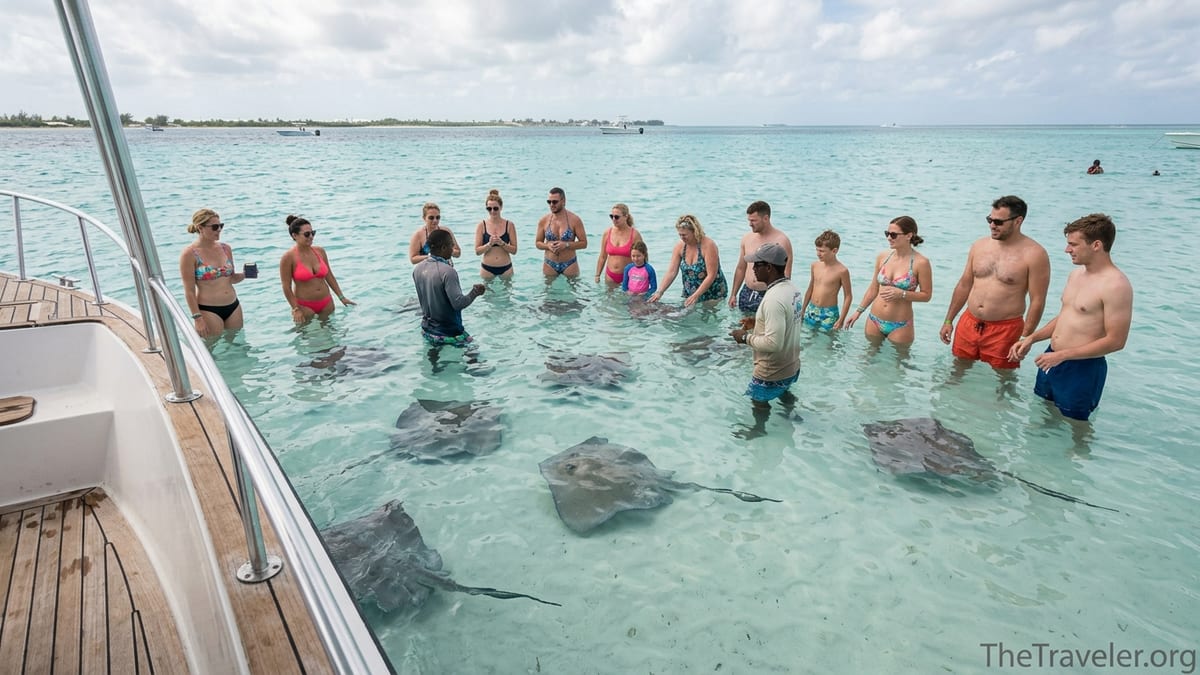
Stingray City is not a theme park or an enclosure. It is a series of shallow sandbars inside Grand Cayman’s North Sound, where wild southern stingrays gather because generations of fishermen and tour operators have consistently fed them. Today it is the Cayman Islands’ single most visited attraction, drawing hundreds of thousands of visitors each year on boat tours from George Town and Seven Mile Beach. Boats anchor in clear turquoise water and guests step off into the sand, usually surrounded within seconds by dozens of stingrays gliding past their legs.
The main stop for families and cruise excursions is the Stingray Sandbar, a wide, bright patch of white sand where the water is typically around waist deep on an adult. On calm days, the surface can look almost like a swimming pool, and you can see each ray approaching from several meters away. Other dive sites called “Stingray City” are deeper, around 10 to 12 feet, used more for scuba and snorkel trips than for nervous first-timers.
What makes the experience intense is not aggression from the animals but their confidence around people. These stingrays associate boat engines with food and are used to being hand-fed squid and fish by guides. Many visitors describe the sensation like being surrounded by large, slippery cats or dogs that brush against your legs and occasionally lean gently into you for a snack. For someone expecting a distant wildlife sighting, that close contact can be surprising at first.
From a safety perspective, this setup cuts both ways. On the one hand, decades of daily contact have shown that serious injuries to visitors are extremely rare, especially when guests follow guide instructions. On the other, the rays’ tame, food-motivated behavior can tempt people to forget that these are still wild animals that deserve caution and respect.
Understanding Stingray Behavior and Realistic Risks
Southern stingrays are bottom-dwelling fish that spend much of their time lying on sand, partially buried, or cruising slowly over the seabed. Their primary defense is a serrated barb on the upper side of their tail, near the base, with venom glands. That barb is designed as a last-resort response to being stepped on or pinned down, not as an offensive weapon. In the Cayman Islands, local dive professionals and the Department of Environment emphasize that stings almost always occur when a ray is startled by pressure from above, such as a careless step or someone trying to sit or lie on the animal.
At Stingray City, the rays are accustomed to people and food. They approach calmly, often from the front or side, and brush gently along your legs or torso. If you hold a piece of fish in a closed fist, they will usually position themselves over your hand and suck the food in with a vacuum-like motion. Visitors often compare it to feeding a large, wet vacuum cleaner. Guides show you how to tuck your thumb under your fingers and keep your palm flat so the ray does not accidentally nibble your fingertips.
Minor incidents do happen. People sometimes get small suction hickeys or light scrapes from a ray’s mouth, or they lose their balance and bump into others when a wave rolls through. On choppier days, the biggest “risk” for many visitors is simply swallowing some seawater or getting jostled by another guest. Tour companies respond by limiting numbers on board, supplying flotation vests, and keeping a close eye on children and anxious swimmers.
Serious injuries at Stingray City are widely reported as extremely rare given the sheer volume of visitors each year. Local health advisories and dive organizations focus more on general marine safety: listening to briefings, shuffling your feet, not cornering animals, and being mindful of boat traffic. Touring with a reputable operator that follows official wildlife interaction guidelines is a key part of keeping those risks low.
Water Depth, Non-Swimmers, and What It Really Feels Like in the Sandbar
One of the biggest reasons Stingray City is marketed as family friendly is the shallow depth of the sandbar. On an average day at mid-tide, adults find the water around their waist or lower chest. Local residents and tour guides often estimate about 3 to 4 feet deep for most visitors. Shorter adults and children may find it closer to chest or shoulder height, so it is important to discuss this with your tour beforehand if you have younger kids.
Conditions do change with tide and weather. On calm mornings, the North Sound can be glassy, with barely a ripple and excellent visibility to the sandy bottom. On windy afternoons, particularly in winter, small waves can roll across the sandbar, making it feel rougher and slightly deeper as water lifts around you. When seas are too rough, responsible operators cancel Stingray City stops altogether or switch to more sheltered activities such as Starfish Point or a mangrove tour.
For non-swimmers, the key comfort factors are flotation, crowding, and exit options. Many boats offer life vests, pool noodles, or linked rope lines off the stern so anxious guests can hold on while in the water. Some visitors choose to step only down to the boat’s swim platform, staying on the ladder while a stingray passes close enough to touch. Others remain on the deck and watch family members interact with the rays from above, which is still impressive when the water is clear and full of motion.
Real-world examples help put this in perspective. Cruise ship passengers in their 60s often book combination tours that include the sandbar and a shallow snorkel stop. Non-swimmers in these groups frequently wear a life jacket and simply stand in the sandbar holding onto the boat’s rail while rays glide past. Local guides are used to coaxing nervous guests into the water for just a minute or two, then helping them back up the ladder if it feels like enough. You are not required to stay in the water for the full time or to feed a ray if that feels too intense.
Families, Children, and Choosing the Right Operator
Families with children are one of the largest groups visiting Stingray City, and tour operators in Grand Cayman design many trips around their needs. Common family-focused tours depart from the George Town cruise terminal or marinas near Seven Mile Beach and combine Stingray City with stops at Coral Gardens for shallow snorkeling or at Starfish Point, where children can see red cushion sea stars in very shallow water. Boats designed for families often have shaded upper decks, onboard restrooms, and easy-to-use ladders rather than narrow dive platforms.
For younger kids, age limits, swim skills, and temperament matter more than the exact depth. Many operators welcome children as young as three or four on the boat but encourage parents to hold them at all times in the water. Life jackets for children may be provided, but it is wise to bring a properly fitting vest or floaties from home if your child is small or nervous. Guides will usually offer to hold a ray while your child reaches out one hand to touch the wing rather than expecting them to stand alone among large fish.
Choosing the right operator is crucial to both safety and wildlife welfare. Some long-established companies, often recommended by repeat visitors and locals, emphasize gentle encounters where rays stay largely in the water and guests rotate through small groups for close interaction. Others focus heavily on staged photographs, sometimes lifting rays out of the water or placing them on people’s backs, which can be stressful for the animals and uncomfortable for more conservation-minded travelers.
Practical steps for families include reading recent reviews that mention how staff treated children, asking whether life vests are mandatory for kids, and clarifying the plan if a child decides not to get into the water once they see the rays. Many parents report that their initially fearful children relax significantly after watching guides handle and feed a ray a few times, or after seeing other kids laughing and splashing nearby.
Handling Rules, Guide Instructions, and Respecting Wildlife
The Cayman Islands Department of Environment has published guidelines for wildlife interaction zones that include Stingray City. These recommendations, echoed by responsible tour operators, are designed to protect both visitors and stingrays. Guests are typically briefed on the boat during the ride out. A good briefing will explain how to stand in the sand, how to move your feet, what to do with your hands, and what types of touching are allowed.
Core handling rules are straightforward. You should never attempt to grab a stingray by the tail, lift it entirely out of the water, or press it against your body. Guiding touches on the top of the wing or a gentle stroke along the side are generally acceptable, as is a quick “kiss” on the snout facilitated by a guide while the ray remains mostly supported by the water. Feeding is usually done with small pieces of squid or fish; guests are shown how to curl their fingers under to avoid accidental nips. Only guides are supposed to distribute food to prevent overfeeding and chaotic competition among the rays.
Respecting wildlife also means understanding that these animals pay a price for daily tourism. Studies have found that stingrays at highly visited sites like Stingray City show different behavior and health indicators than wild rays elsewhere, likely due to constant human interaction and provisioning. Local conservation groups encourage visitors to choose operators who minimize handling, avoid overcrowding, and follow no-touch or low-touch policies when the rays show signs of stress.
As a visitor, you signal your values with small decisions. If a guide encourages you to stack multiple rays for a dramatic photo or to ride one like a surfboard, it is reasonable to decline. If the sandbar seems overly packed with boats, you can spend more time watching from the boat’s bow rather than joining a tight cluster of people. These choices make the experience safer and more pleasant for everyone in the water and help maintain the long-term wellbeing of the stingray population.
Problem-Solving Guide for Nervous Visitors and Non-Swimmers
Many travelers arrive at Stingray City with specific fears: getting stung, losing balance, deep water, or being embarrassed in front of family. Addressing those concerns one by one can make the decision feel less overwhelming. Before you even book, consider your personal comfort with standing in moving water, being close to large animals, and relying on a boat crew for safety. If you are extremely anxious, you might start with a glass-bottom boat tour or a shallow, fish-feeding experience closer to shore to build confidence.
If your main worry is the stingray’s barb, remind yourself how it is actually used. The barb is on the top of the tail base, angled upward, activated when a ray whips its tail in a defensive reaction to pressure from above. At Stingray City, you are standing on the sand with rays gliding beside you. By shuffling your feet and not stepping backward blindly, you greatly reduce the chance of stepping on one. Many guides even demonstrate where the barb sits and explain that the local rays are monitored and observed daily; serious stings among tourists are regarded as highly unusual.
For non-swimmers, practical strategies include requesting a life jacket as soon as you board, asking the crew to anchor close to other boats or the shallowest part of the sandbar, and being one of the first or last to enter the water when it is less crowded around the ladder. You might decide to go only knee-deep, holding onto the ladder or a rope, so rays can still pass within reach while you feel solid on your feet. If waves pick up and you feel unsteady, you can return to the boat at any time; tours do not require you to stay out for the full session.
Parents traveling with a nervous spouse or grandparent can help by planning roles ahead of time. One adult might stay on board with anyone who prefers to watch, taking photos and cheering on the group, while the other gets into the water with the children. Talk openly with your guide about any fears before arrival. Local crews work with anxious guests daily and have simple adjustments, from choosing a calmer side of the sandbar to providing extra floatation, that can transform a stressful situation into a memorable, manageable adventure.
Environmental and Ethical Considerations You Should Know
Part of evaluating whether Stingray City is “safe” is thinking beyond personal risk to the impact on the animals and the wider marine environment. The sandbar and surrounding North Sound are designated wildlife interaction zones, and the volume of visitors has raised questions among scientists and conservation groups about how constant feeding and handling affect the rays’ natural behavior, diet, and long-term health.
Research on southern stingrays in Grand Cayman has found that the animals at Stingray City tend to gather in unusually high densities, rely heavily on handouts, and show altered movement patterns compared with wild populations. Some studies have detected signs of increased stress and changes in immune function, pointing to the costs of daily contact with people. At the same time, tourism has given these rays high economic value while supporting arguments for their protection and for stronger marine conservation rules across the Cayman Islands.
As a traveler, there are ways to tilt the balance toward more ethical encounters. Choose operators that clearly state they follow government wildlife guidelines and limit boat numbers. Ask in advance whether staff lift rays out of the water for photos or whether they encourage low-impact, in-water interactions. Consider visiting during less busy times of day to reduce crowding, such as early morning trips rather than midday when multiple cruise ships are in port.
Finally, remember that your behavior during the tour matters. Do not chase rays that swim away, never try to ride or restrain them, and avoid standing on fragile seagrass or coral patches at secondary snorkel stops. Treat the animals as wild neighbors, not props. By keeping your expectations realistic and your actions respectful, you help ensure that Stingray City remains both a safe and responsible experience for years to come.
The Takeaway
Is Stingray City safe? For the vast majority of visitors, including families with children and cautious non-swimmers, the answer is yes, provided you choose a reputable operator, listen closely to guide briefings, and respect both the stingrays and the sea. The shallow sandbar, clear water, and long history of daily interaction make serious incidents with stingrays very uncommon, while practical tools like life vests and support from experienced crew reduce general water-related risks.
At the same time, it is important to remember that this is not a petting zoo. Stingrays remain wild animals with their own needs and limits, and the site itself is a delicate ecosystem facing constant human pressure. Approaching the experience with humility, curiosity, and a willingness to say no to overly intrusive handling or crowded conditions allows you to enjoy the thrill without compromising safety or ethics.
If you or someone in your group is nervous, communicate that clearly when you book and again when you board. Ask questions about depth, flotation, and handling rules. Let the crew know if you decide to watch from the boat or only dip in briefly. With realistic expectations and a focus on calm, respectful interaction, a visit to Stingray City can shift from a source of anxiety to a standout memory of your time in the Cayman Islands.
FAQ
Q1. Can a stingray at Stingray City really sting me?
Yes, stingrays have barbed tails, but stings at Stingray City are extremely rare and usually linked to someone stepping directly on a ray or handling it roughly. By shuffling your feet and following guide instructions, you greatly reduce the risk.
Q2. How deep is the water at the Stingray City sandbar?
The Stingray City sandbar is typically around 3 to 4 feet deep, about waist to chest height for most adults, depending on tide and weather. On calmer days, non-swimmers can stand comfortably; on rougher days it may feel slightly deeper due to waves.
Q3. Is Stingray City suitable for young children?
Yes, many families visit with children, but it depends on each child’s comfort level in the water. Parents usually hold younger kids, use life vests, and let them touch a ray’s wing while a guide supports the animal. It is wise to discuss age limits and safety policies with your tour operator.
Q4. I cannot swim. Can I still go on a Stingray City tour?
Many non-swimmers visit Stingray City. Tours typically provide life jackets, and you can choose to stand only in shallow water while holding a ladder or rope, or stay on the boat and watch. You are never required to leave the boat if you do not feel comfortable.
Q5. Do guides remove the stingers from the rays?
No, rays at Stingray City are wild animals and their barbs are not routinely removed. Safety depends on their calm behavior, your careful movements, and clear handling guidelines, not on physically altering the animals.
Q6. What should I do if I am scared once I see the stingrays up close?
Tell your guide immediately. You can start by standing on the boat’s swim platform, watching from a distance, or touching a ray only while a guide holds it. If anxiety remains high, it is completely acceptable to stay on board and enjoy the view.
Q7. How do I choose a safe and ethical tour operator?
Look for companies that mention small group sizes, adherence to Cayman wildlife guidelines, mandatory safety briefings, and minimal lifting of rays out of the water. Recent traveler reviews that describe calm, respectful encounters and attentive crew are a good sign.
Q8. Are there health risks from the seawater or animals?
For most healthy visitors, risks are low, similar to other shallow-water activities. People with open wounds, compromised immune systems, or specific marine allergies should seek medical advice before going and may prefer to stay on the boat or limit contact.
Q9. What should my family bring to feel more secure at Stingray City?
Consider bringing well-fitted children’s life vests, sun protective clothing, reef-safe sunscreen, and any needed motion sickness medication. Water shoes can help some guests feel more confident standing on the sand, though many people go barefoot.
Q10. Is feeding the stingrays harmful to them?
Feeding has changed the rays’ natural behavior and made them reliant on handouts, which raises conservation concerns. However, regulated tours that limit food and follow official guidelines aim to balance tourism with animal welfare. As a guest, you can help by using only the food provided, not overhandling the rays, and choosing operators that prioritize their wellbeing.